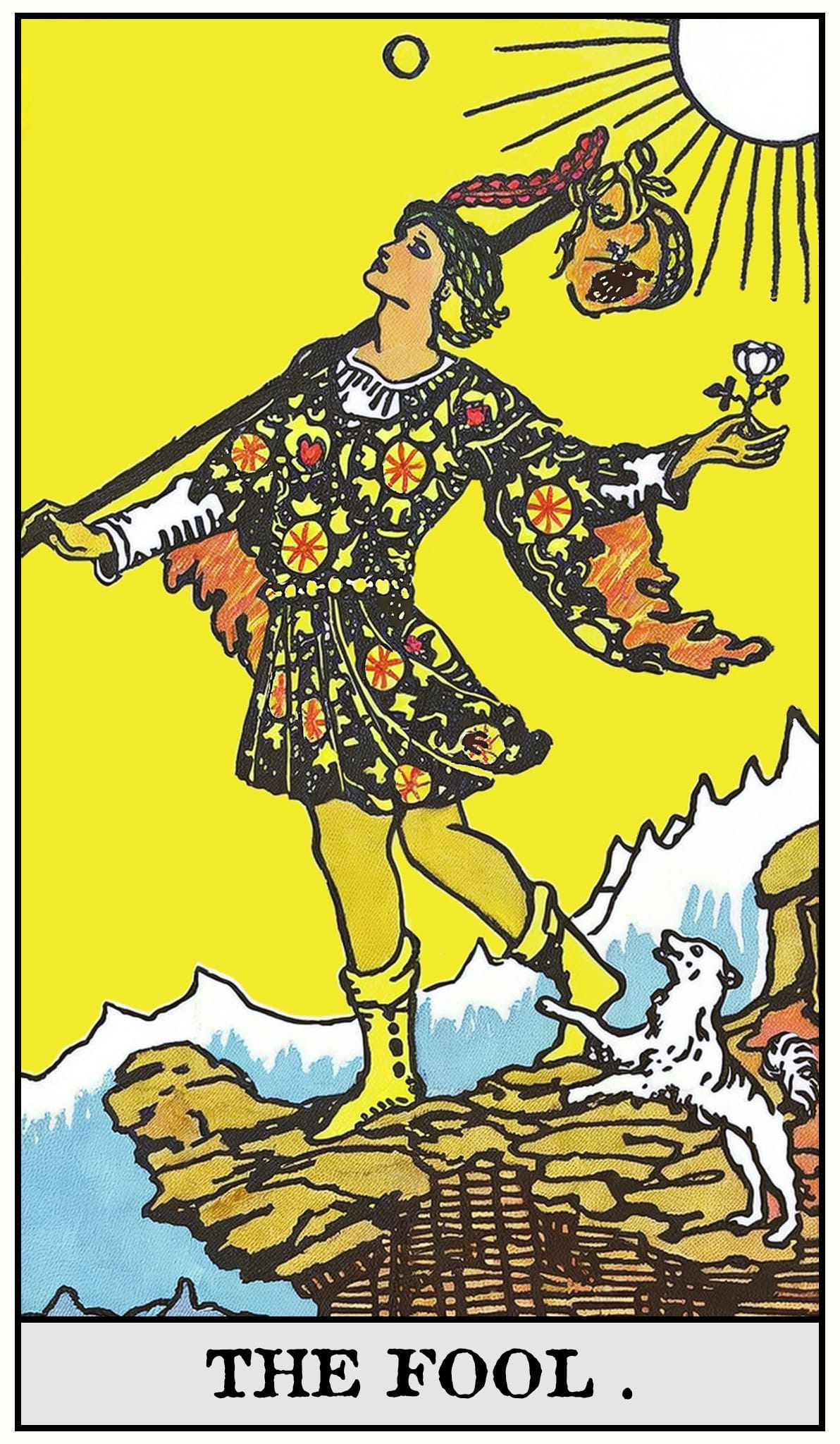
The Fool
0 · Major ArcanaHe carries everything he owns in a single bag and calls it enough — then steps toward the edge, not because he cannot see it, but because the edge is the only place a journey has ever begun.
Every card read three ways — the reading on its surface, the mechanism beneath it, and the shadow it holds. Not a keyword list. A way of thinking, applied seventy-eight times.
He carries everything he owns in a single bag and calls it enough — then steps toward the edge, not because he cannot see it, but because the edge is the only place a journey has ever begun.
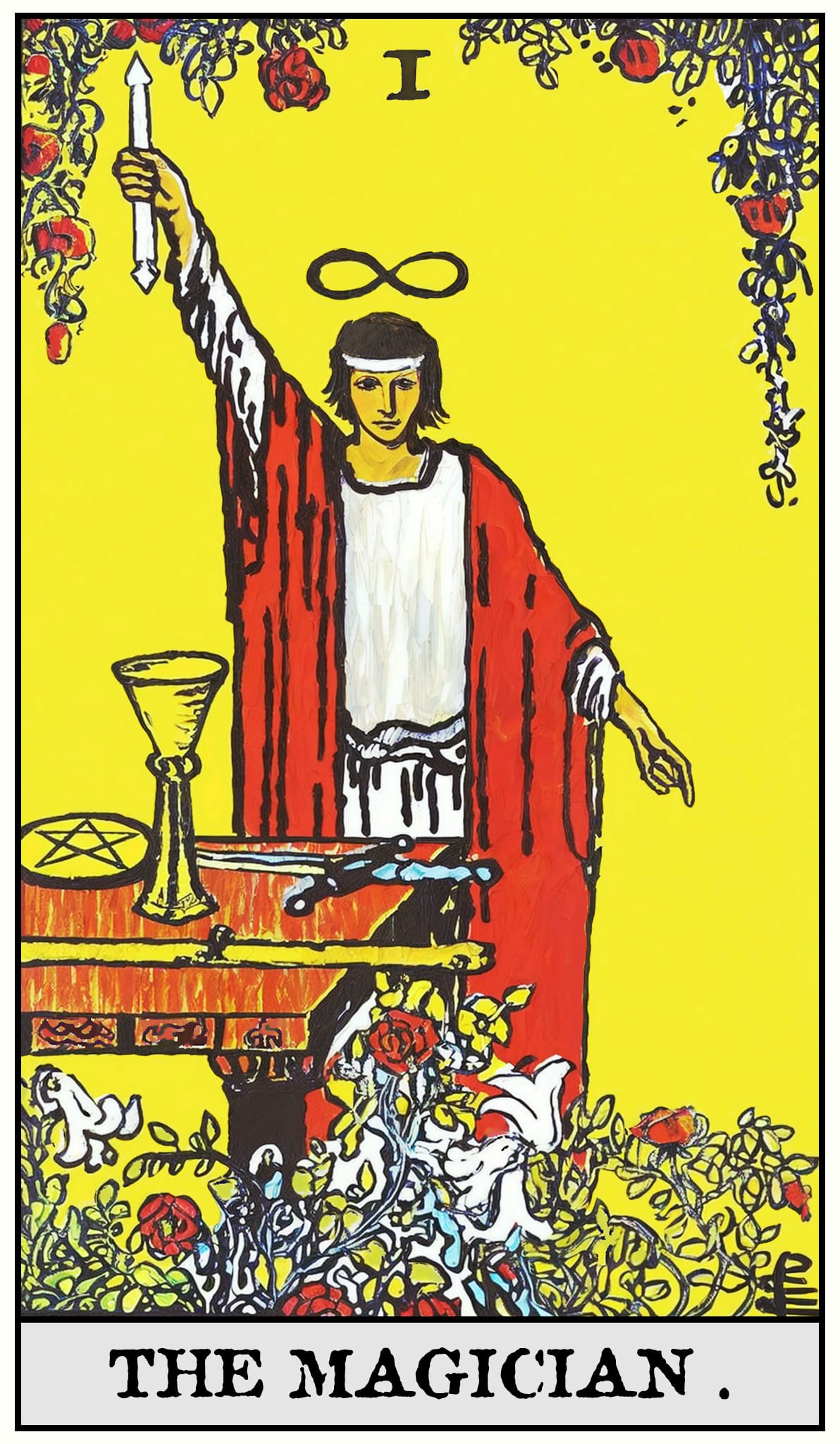
He stands at a table where all four elements are arranged before him, one hand raised to the sky, one pointing to the earth — the whole circuit of creation passing through a single body.
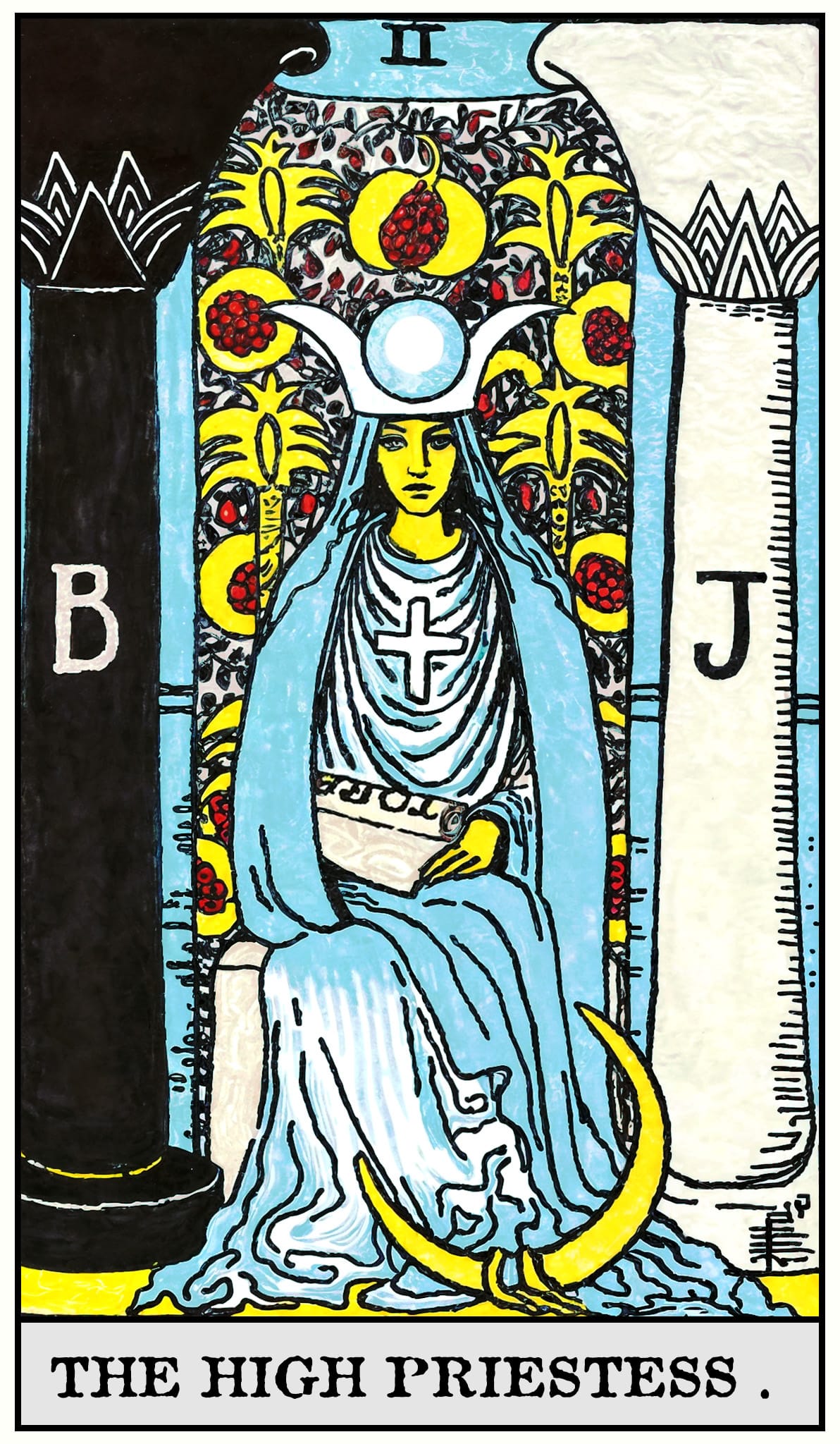
She sits between two pillars with a veil behind her, holding a scroll she has not opened — patient with what the impatient cannot wait long enough to receive.
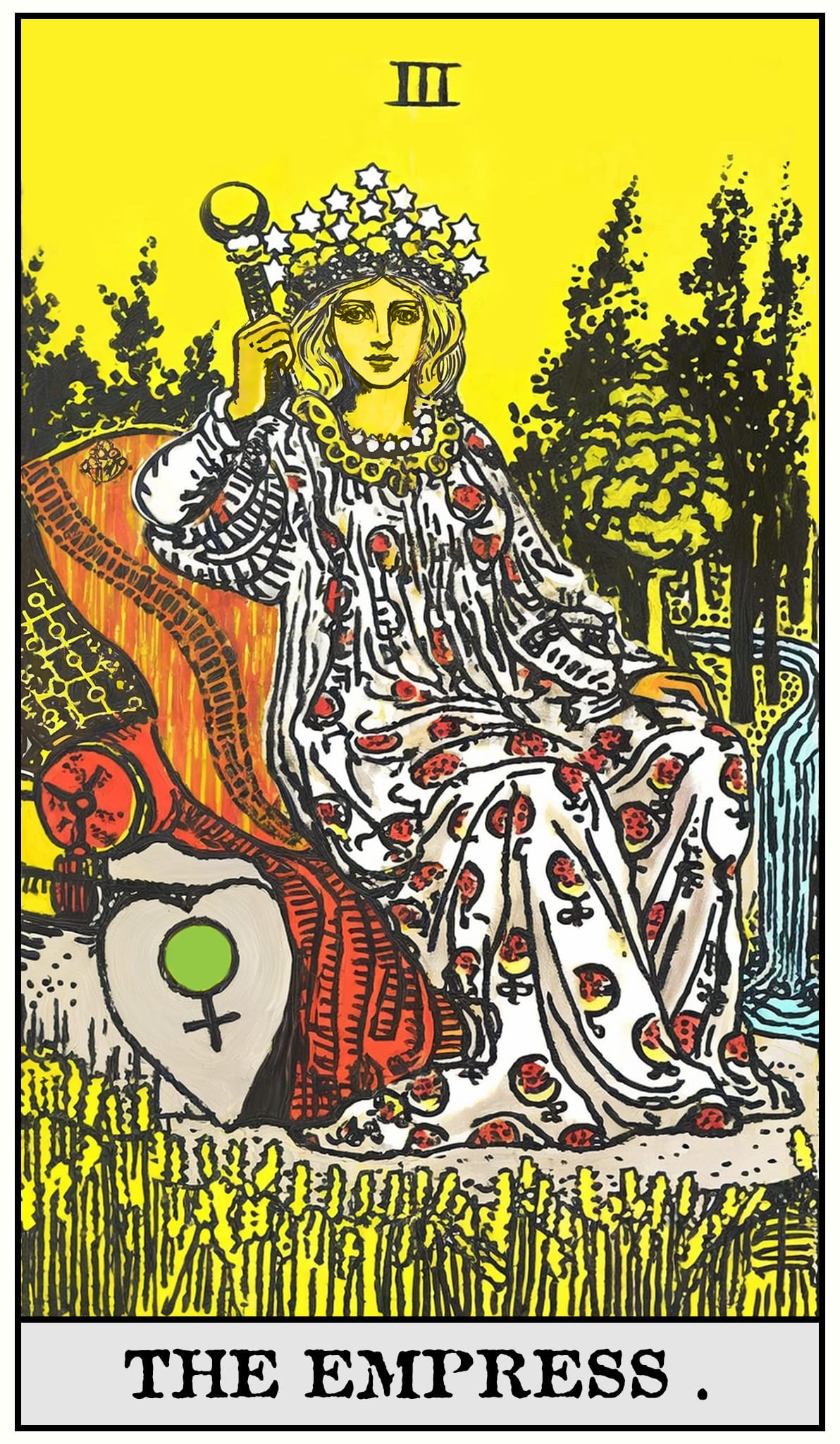
She reclines among growing things, wheat at her feet and a river behind her, the entire image giving off the heat of a late-summer field that has not yet been cut.
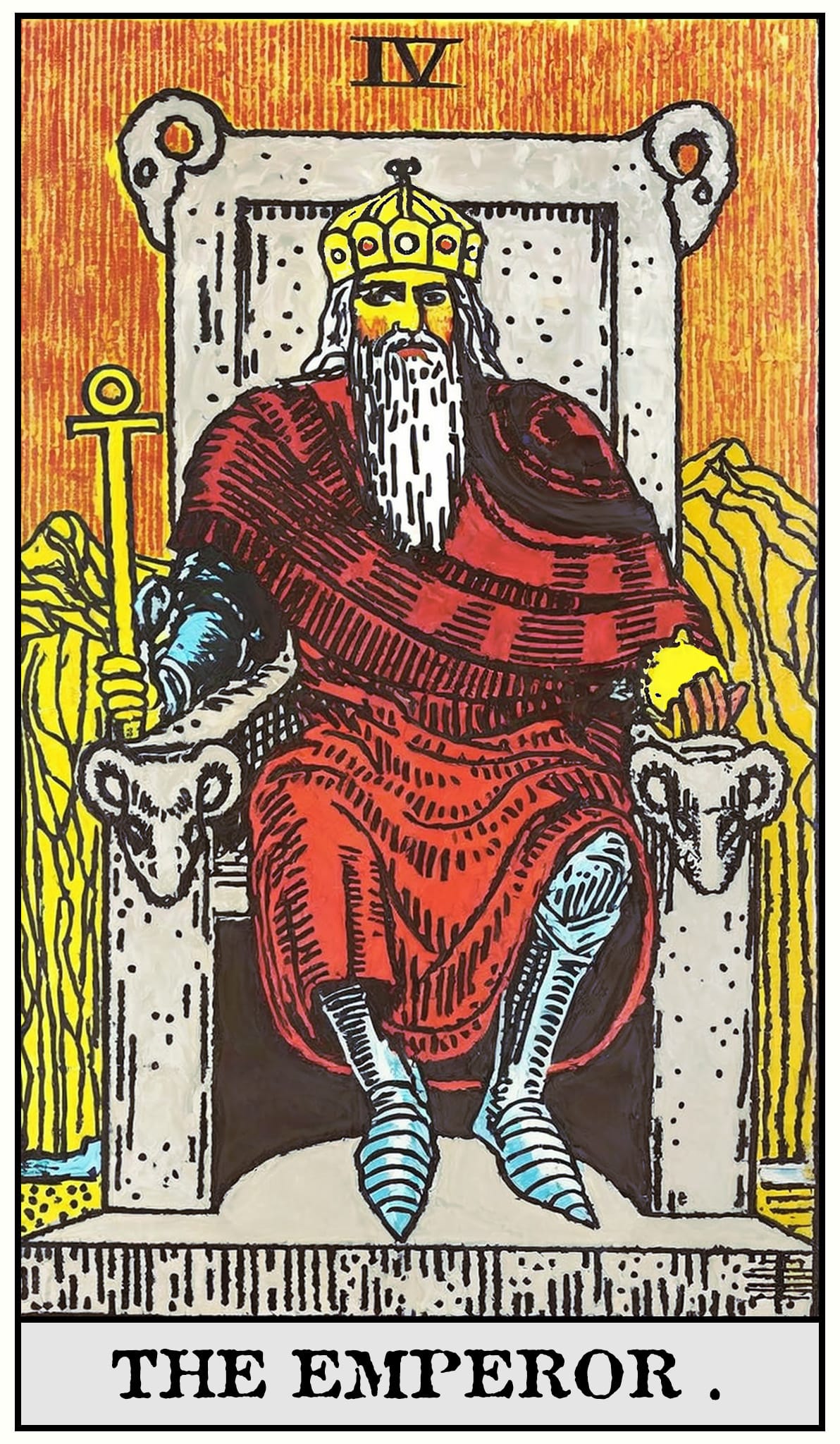
He sits on a stone throne in a bare landscape, wearing armour beneath his robes — the man who built the structure has not stopped being the man who once had to defend it.
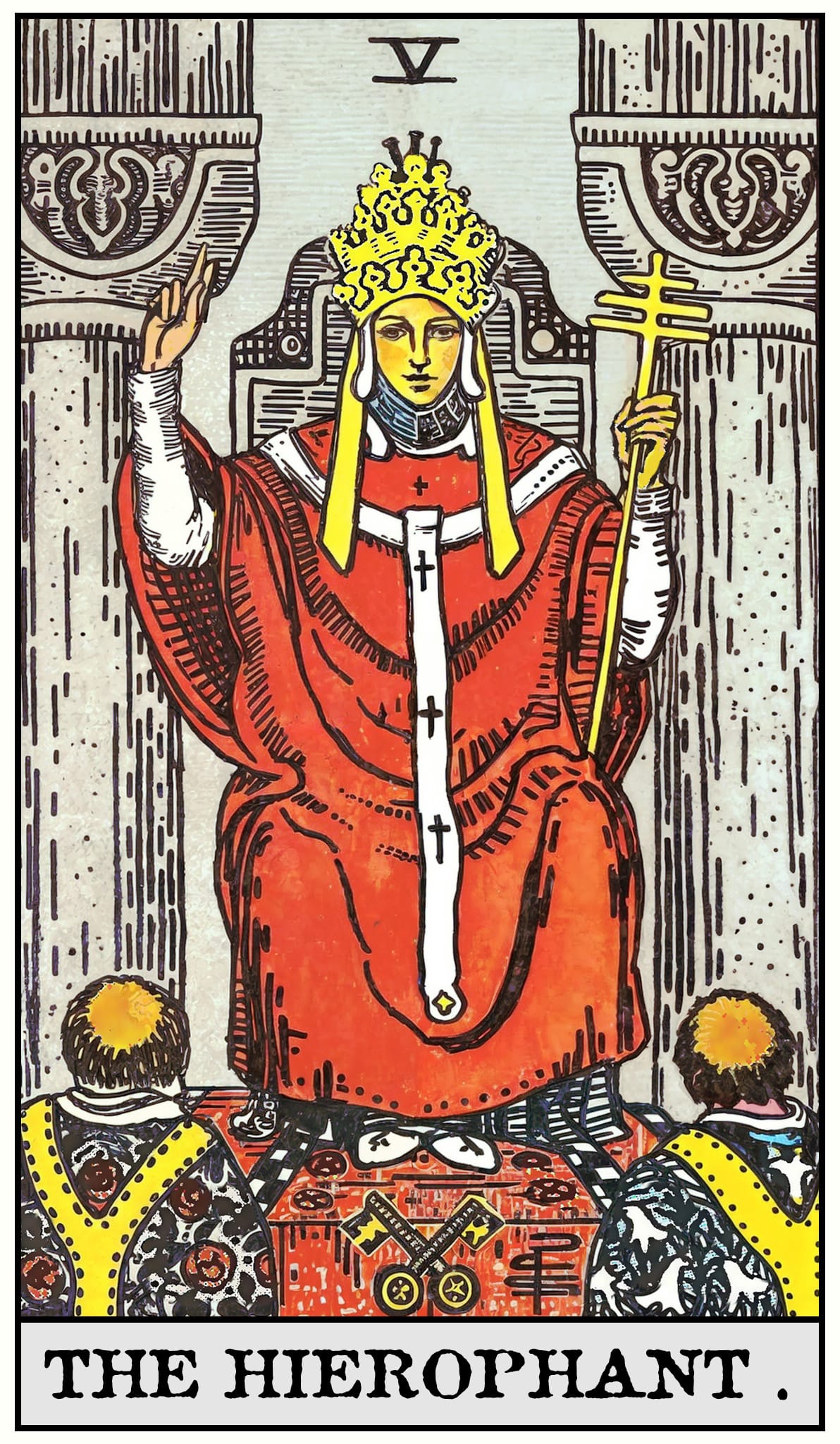
He sits between two carved pillars with two monks kneeling below him, holding the staff of a triple office — the wilderness has been replaced, entirely, by worked stone.
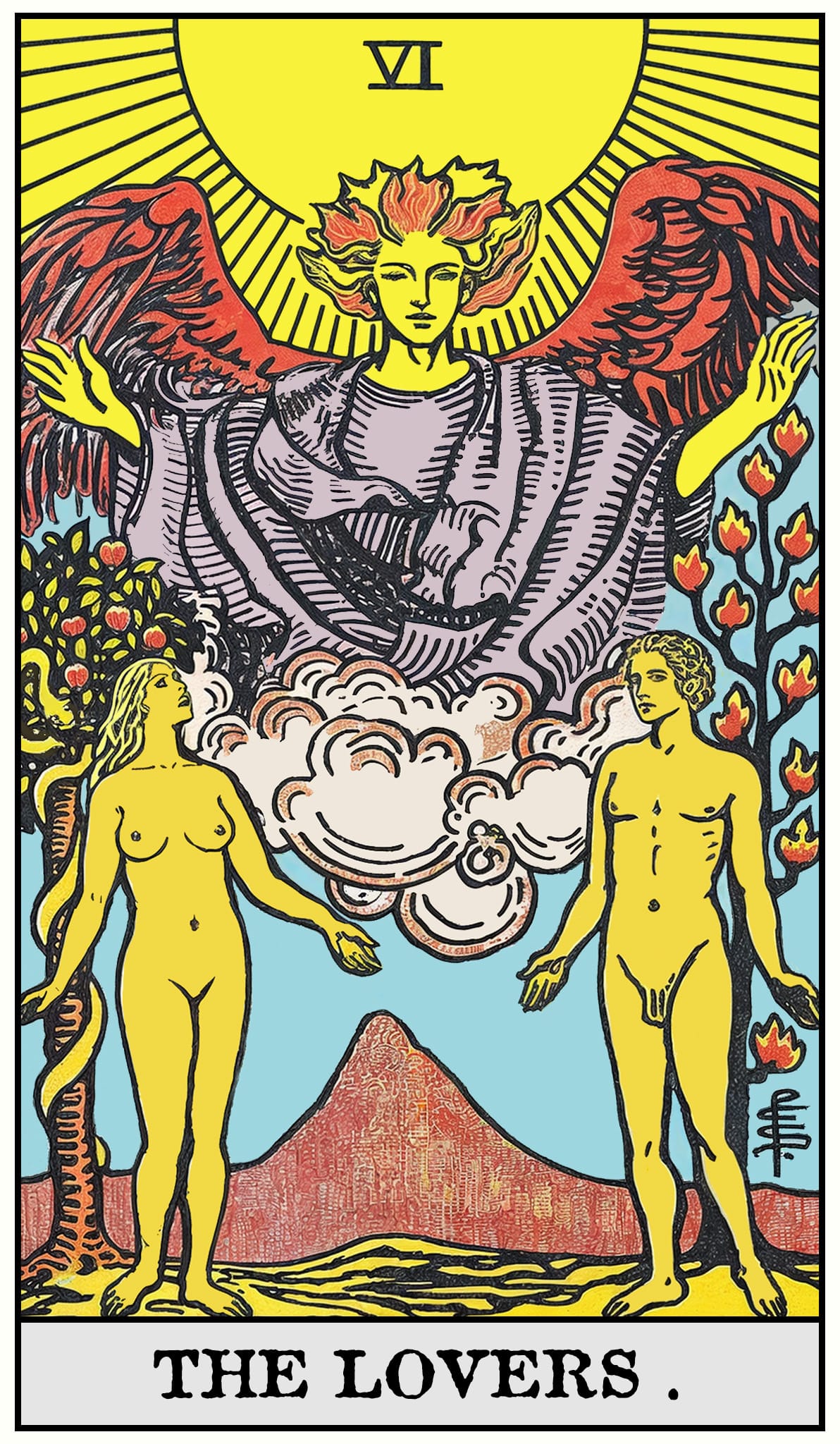
A man and a woman stand in a garden beneath a noon sun, an angel above them and a serpent in the branches behind her — the last moment before the knowledge enters, the choice is made, and the consequences begin.
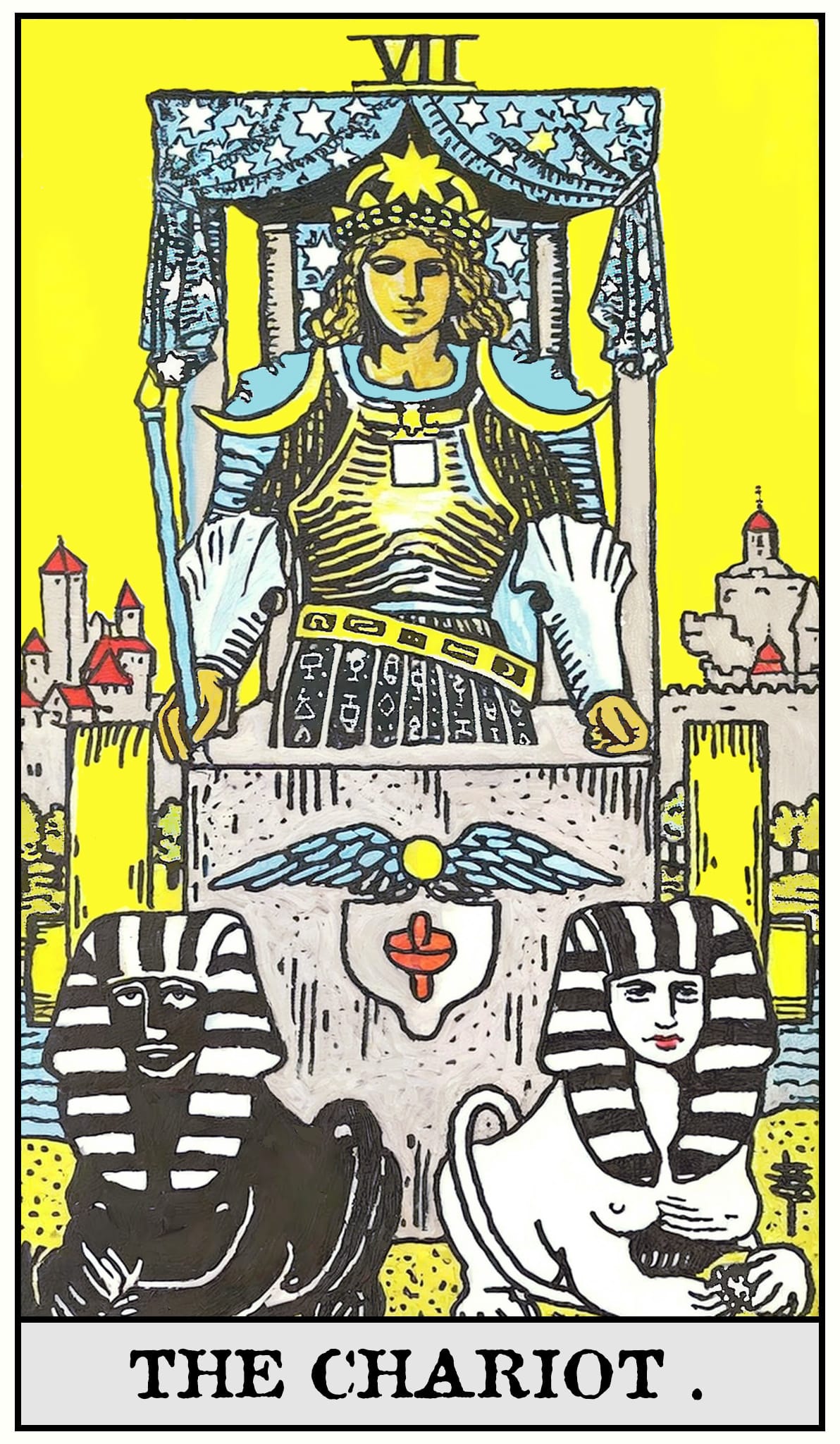
A young man stands in a stone chariot, sphinxes before him and a city behind him, moving forward by will alone — the completed self at its most powerful, which is also the moment its limits begin.
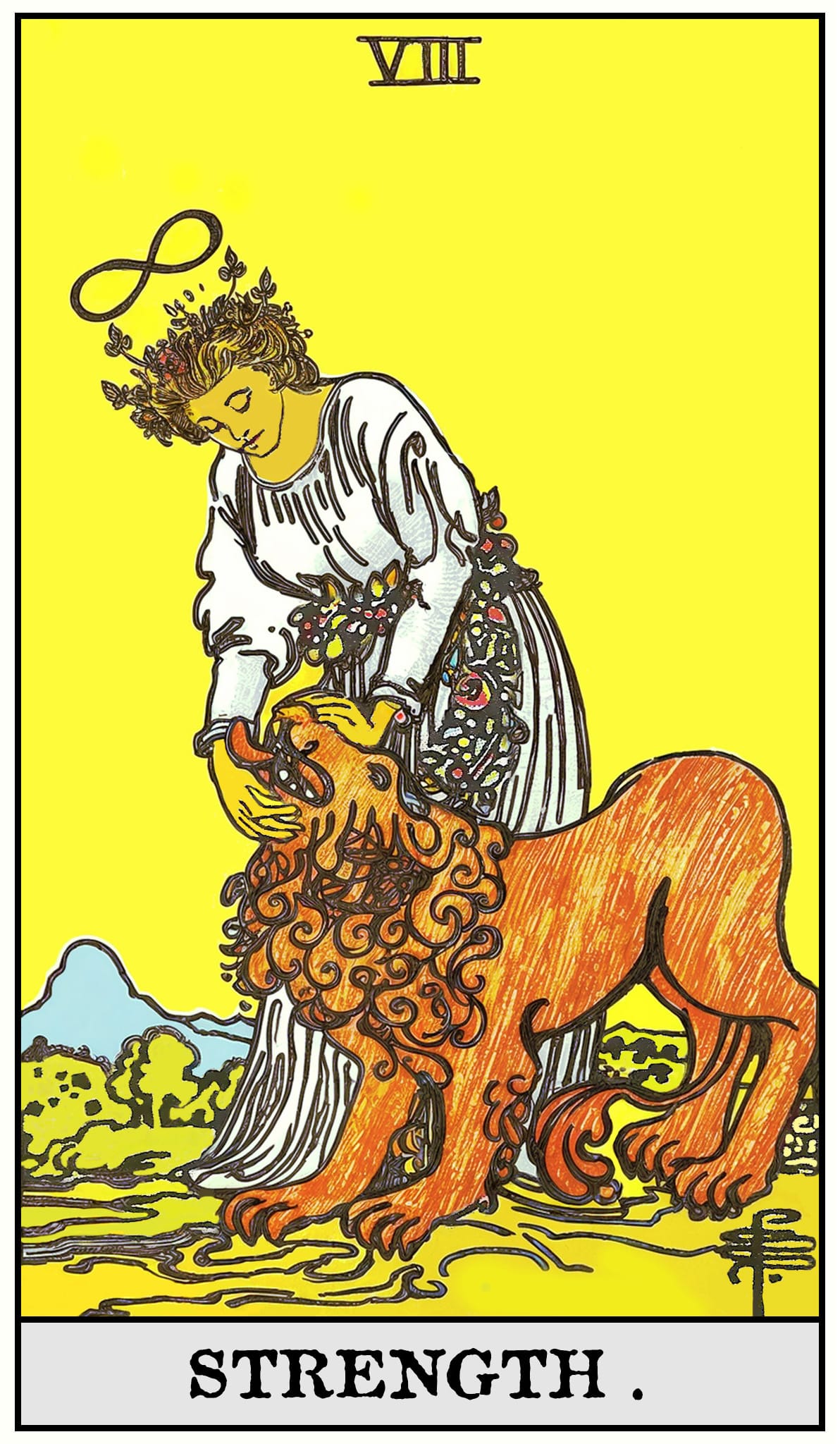
A woman in white bends toward a lion with her hands on his jaw — not forcing it shut, not forcing it open, simply present with what would frighten most people into distance.
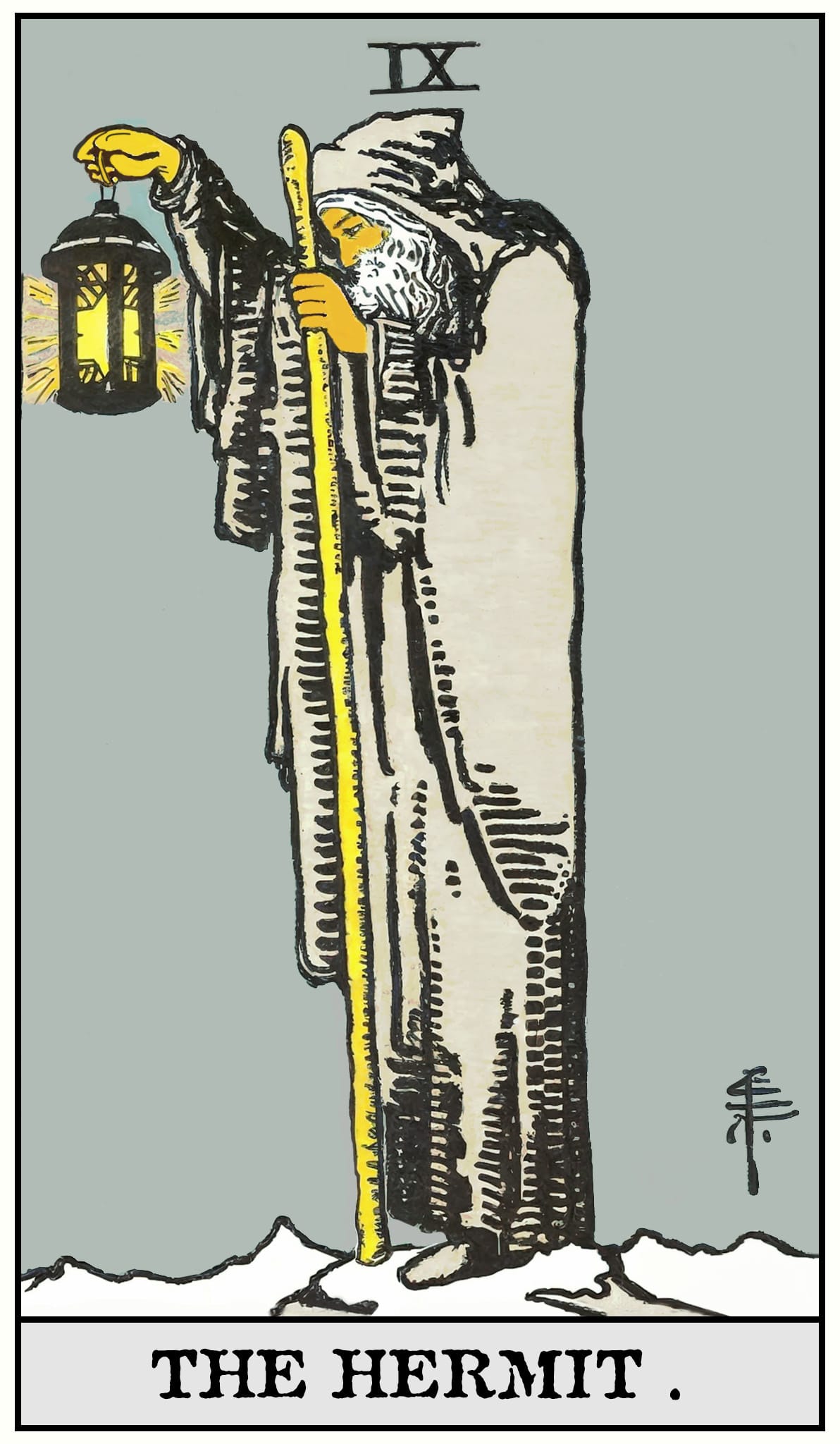
An old man stands at a mountain summit in empty landscape, holding a lantern inward, his head bowed toward the path he has already climbed — the figure that completes what the High Priestess began.
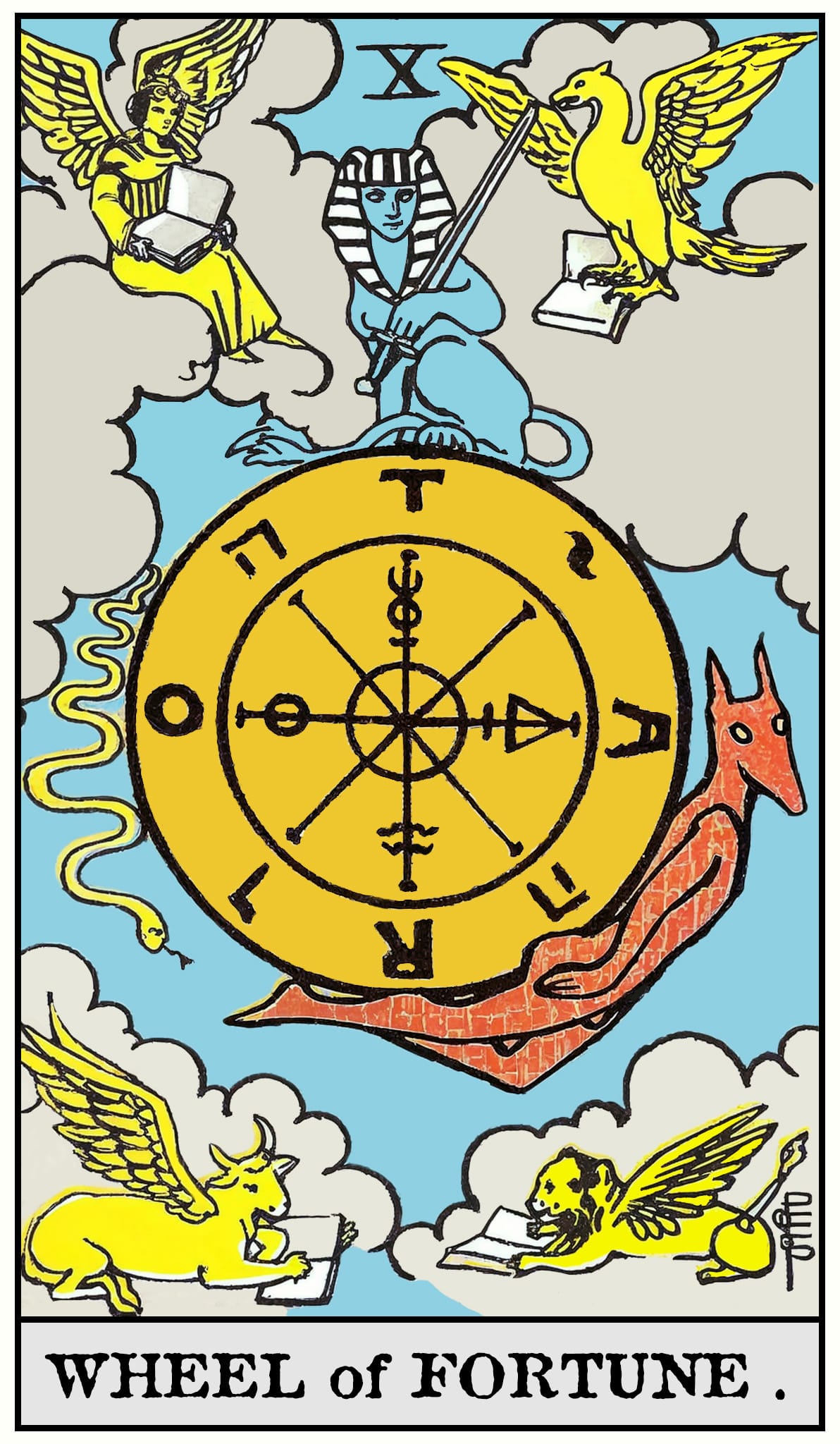
A great wheel turns at the centre of the image with figures rising and falling on its rim, four winged creatures reading in the corners of the sky — change as a structure, not an event.
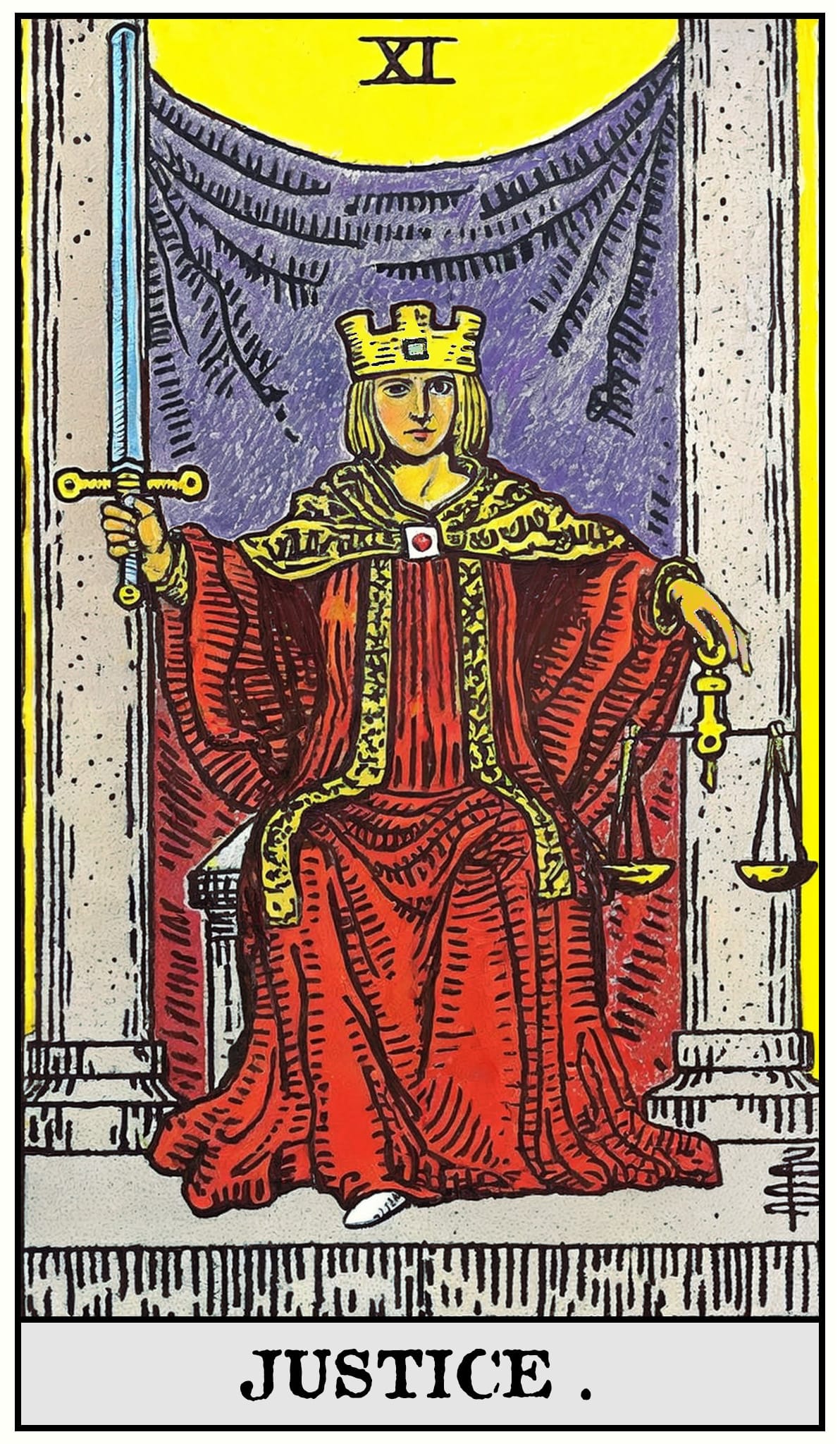
A robed figure sits between two pillars with a scale still in motion and a sword held at the exact vertical — not the moment of sentence, but the moment before it, when the weighing is still happening.
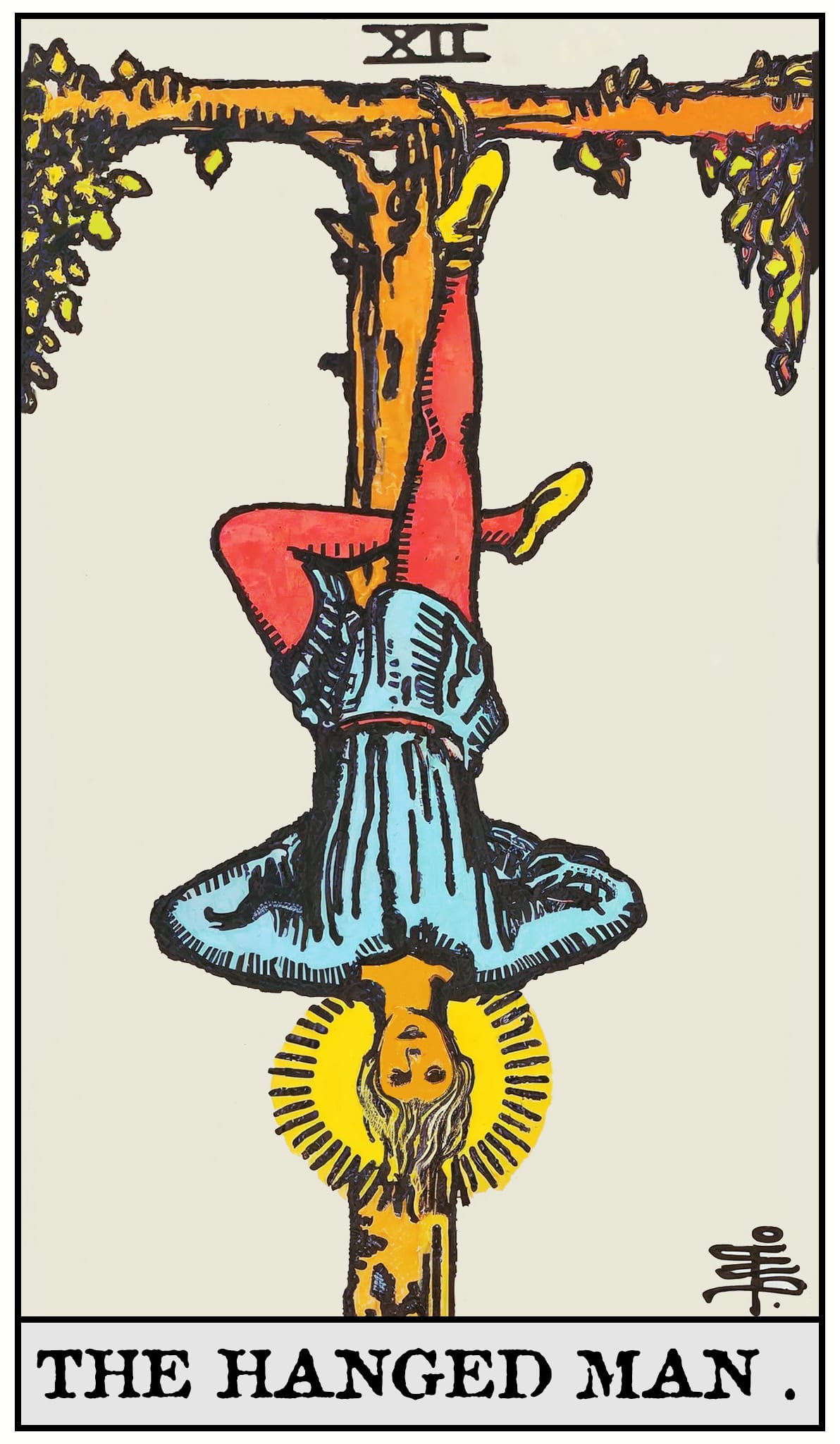
A young man hangs from a tree by one ankle, face peaceful, hands behind his back — he chose this, and he could come down, and he has not finished.
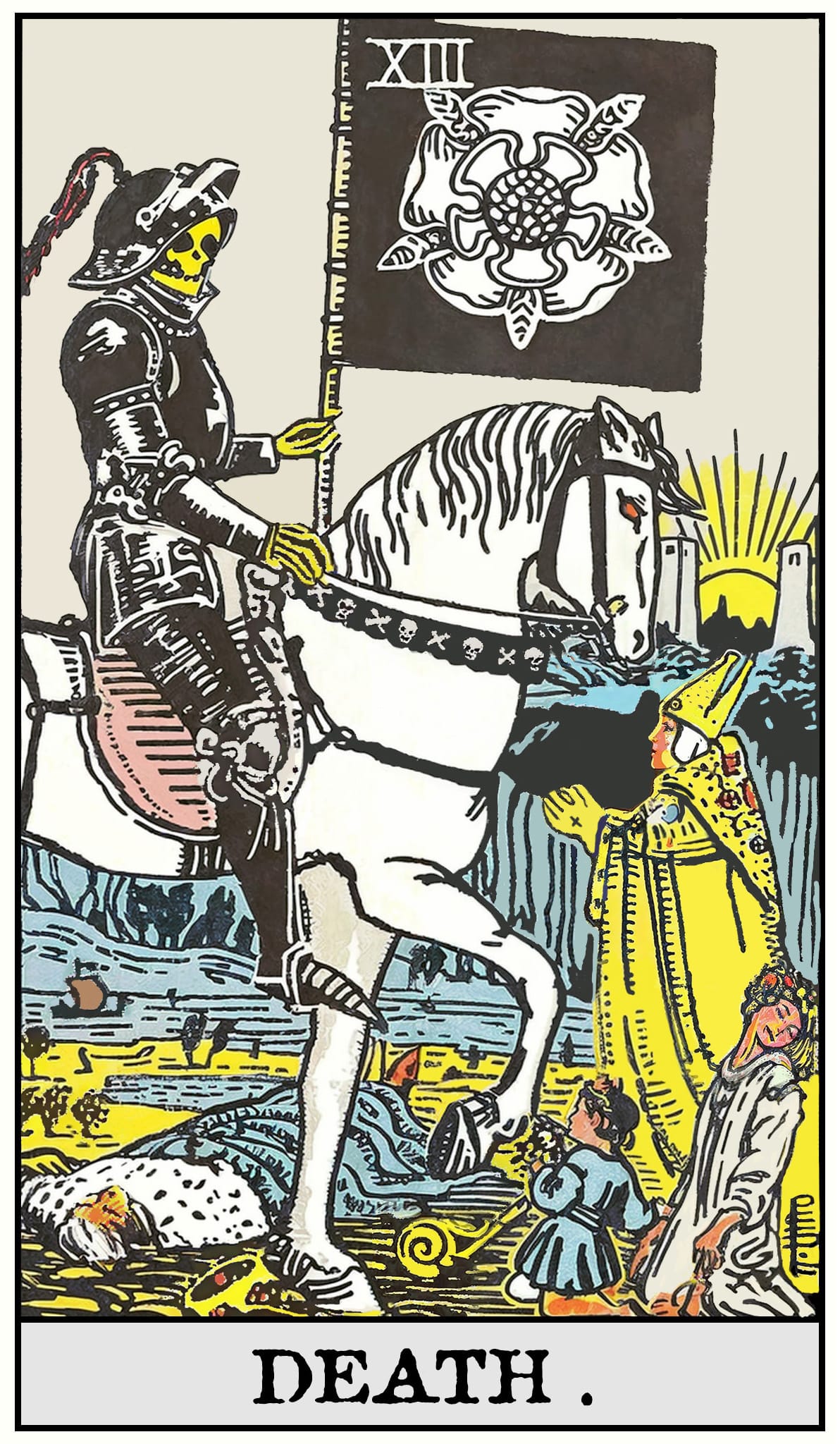
A skeletal rider crosses a low field on a pale horse, carrying a black banner with a white rose — the sun neither rising nor setting behind the two towers, the river running in both directions, the card refusing to specify an end.
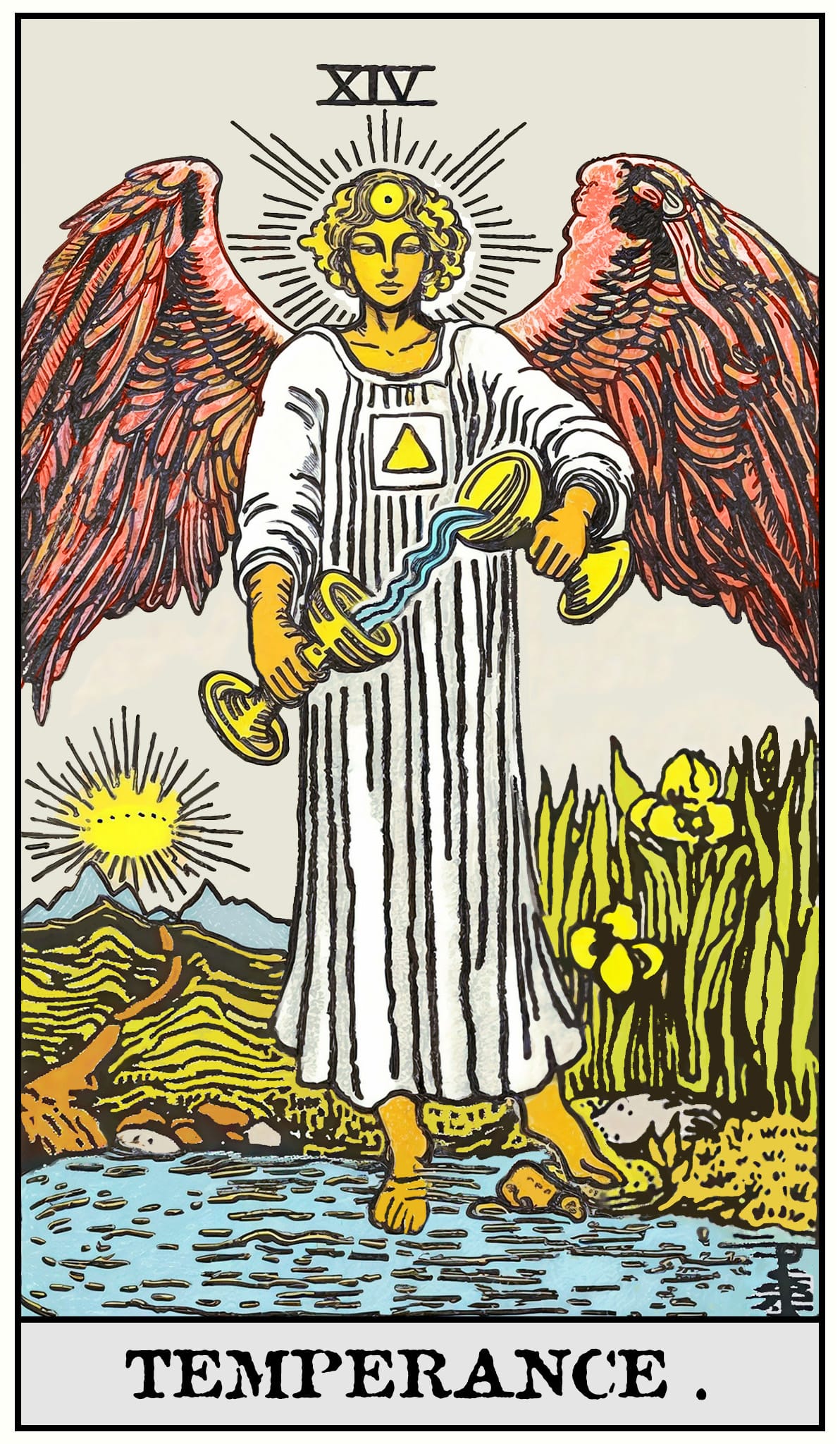
An angel stands at the water's edge with one foot on the bank and one in the stream, pouring between two cups in a flow that moves against gravity — patient, attentive, not hurrying what the chemistry requires.
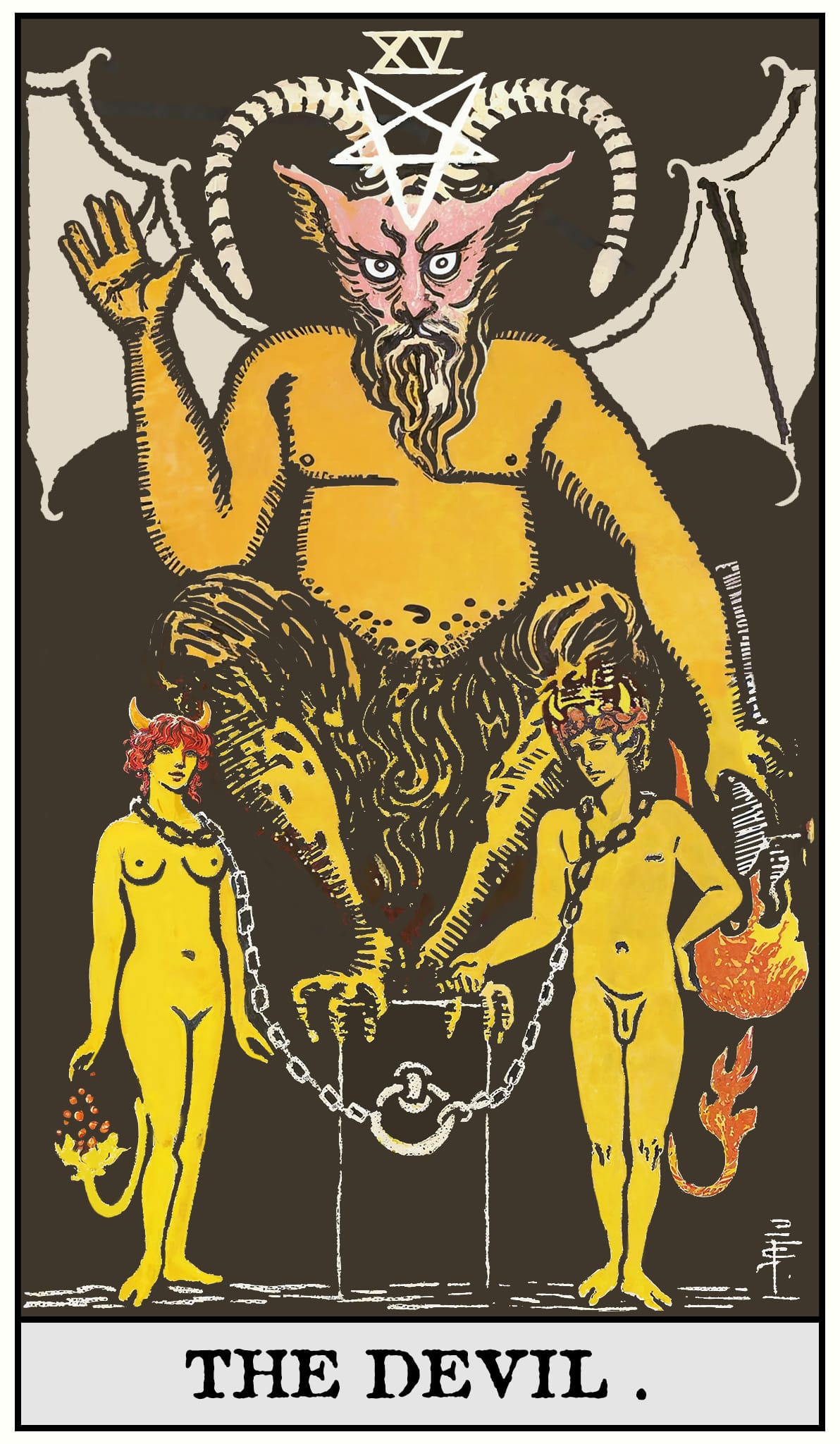
Two figures stand loosely chained at the foot of a black pedestal, the chain at their necks slack enough to lift over their heads. They do not lift it. The horned figure above them holds a torch pointing at the ground.
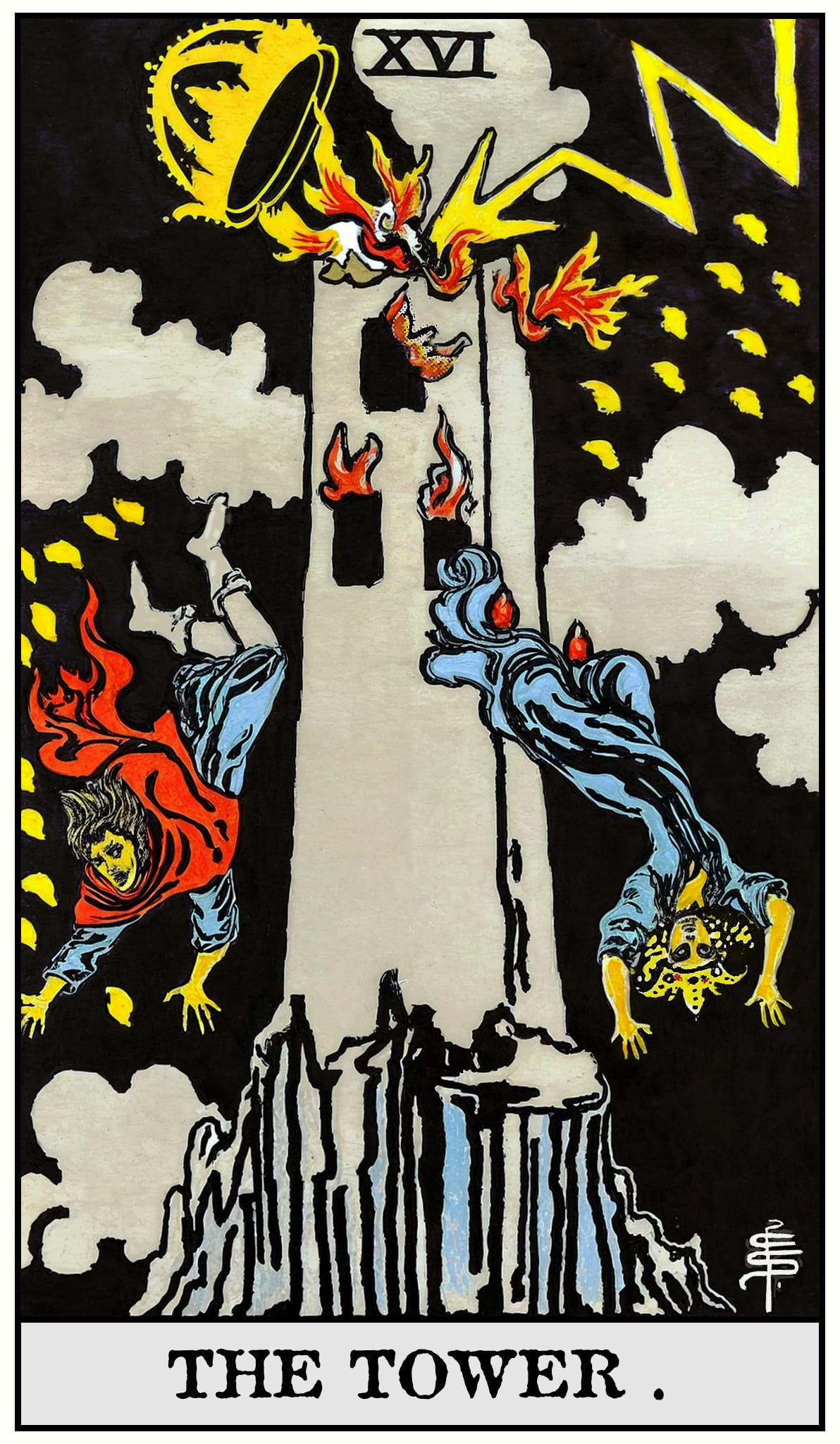
Lightning strikes a stone tower at its crown, two figures falling from the height into air that has not yet become ground — the moment when what was built to keep the truth out is breached from a direction no one was watching.
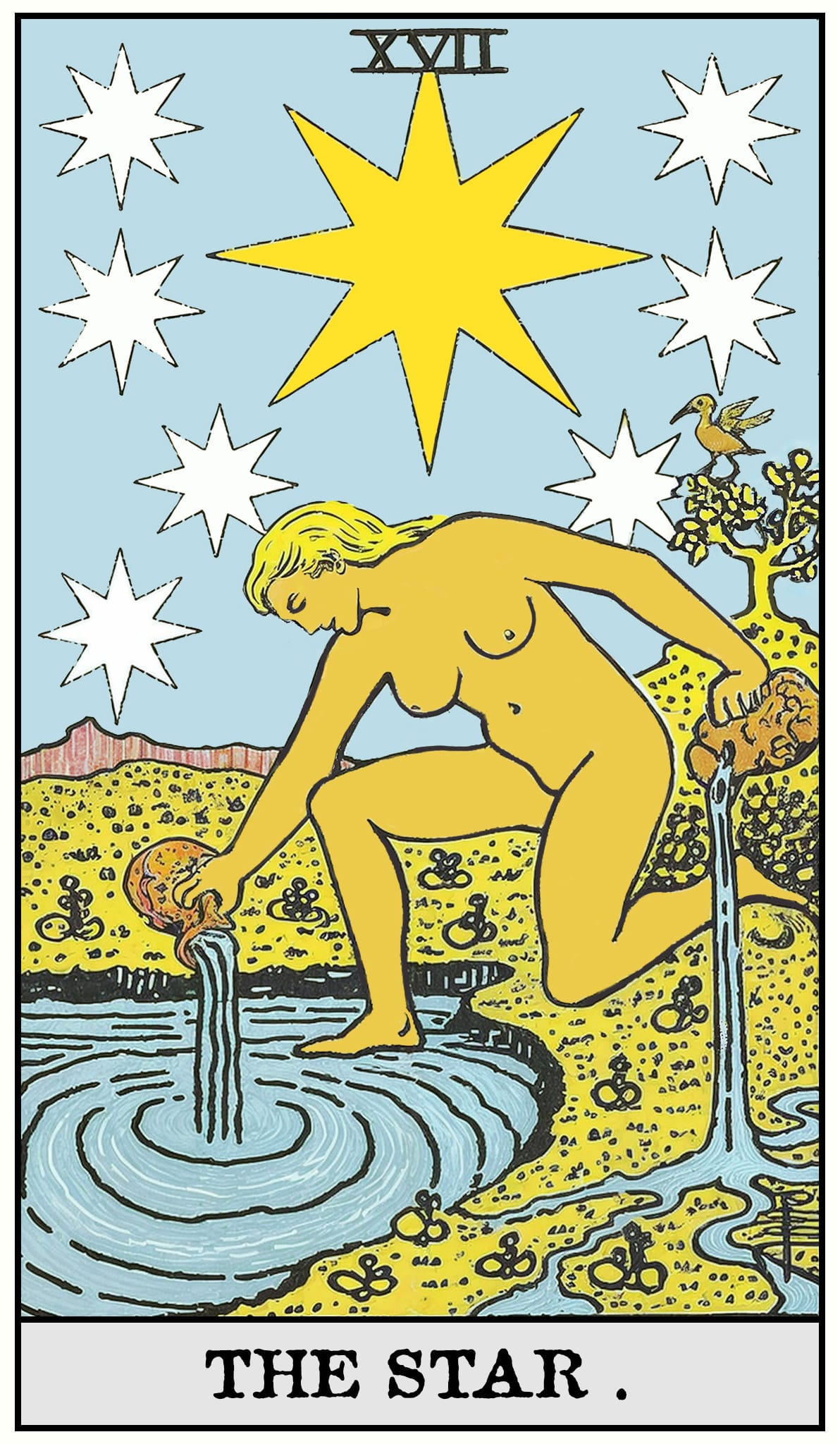
She kneels at the water's edge after the storm has taken everything, and pours — not to refill the world, but because she still can.
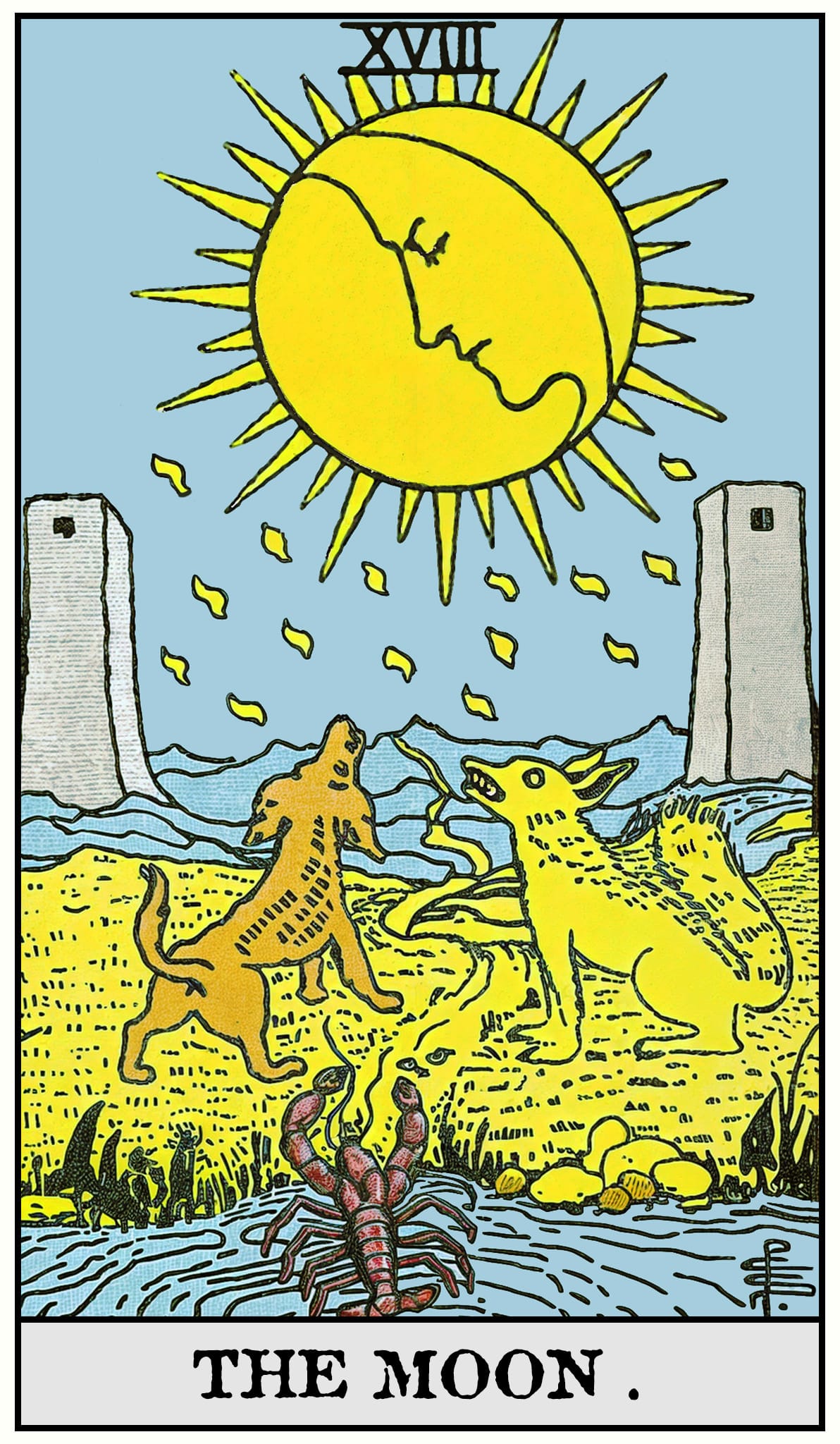
Between two grey towers a path winds forward into mountains that may or may not be reached. The path is real. The destination is not visible. These are not the same problem.
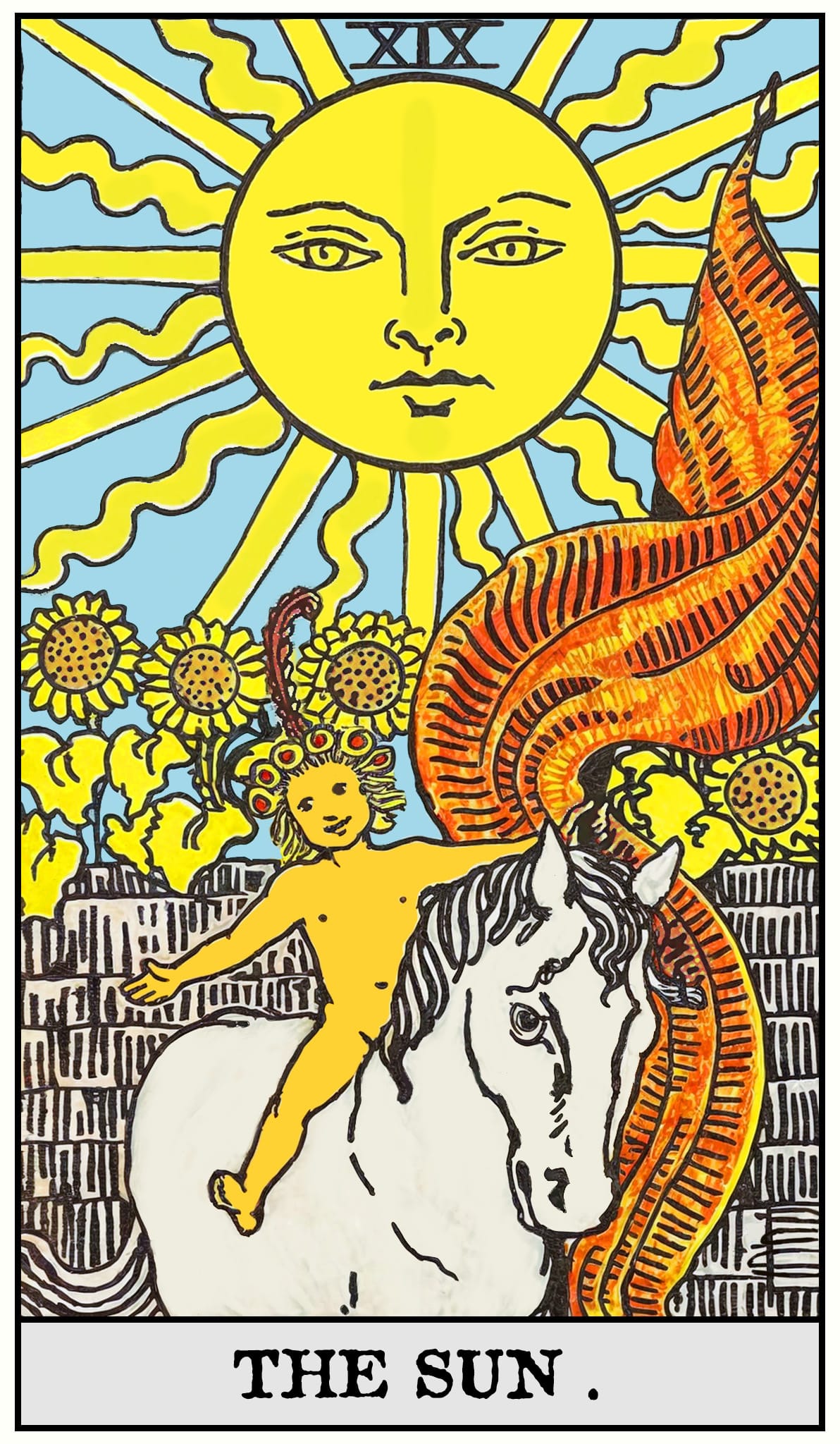
A naked child rides a white horse through open light, holding a red banner light enough for a small hand, while four sunflowers behind a low wall turn their heads — not toward the sun above, but toward the child.
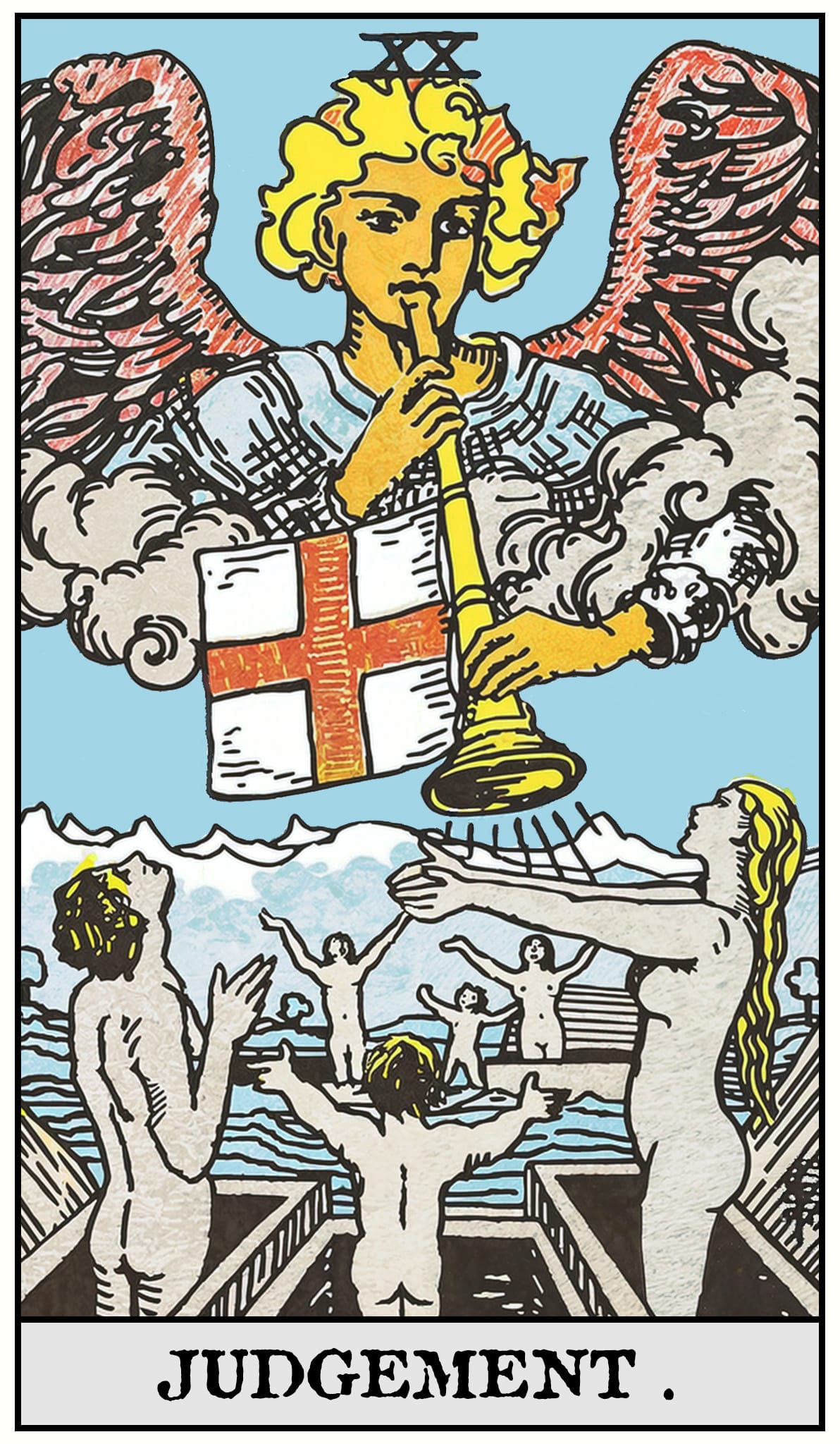
An angel leans from the clouds with a trumpet at its lips; below, three figures rise from open coffins on a grey sea with arms raised not in supplication but in answering — the moment when what has been quietly accumulating finally announces itself.
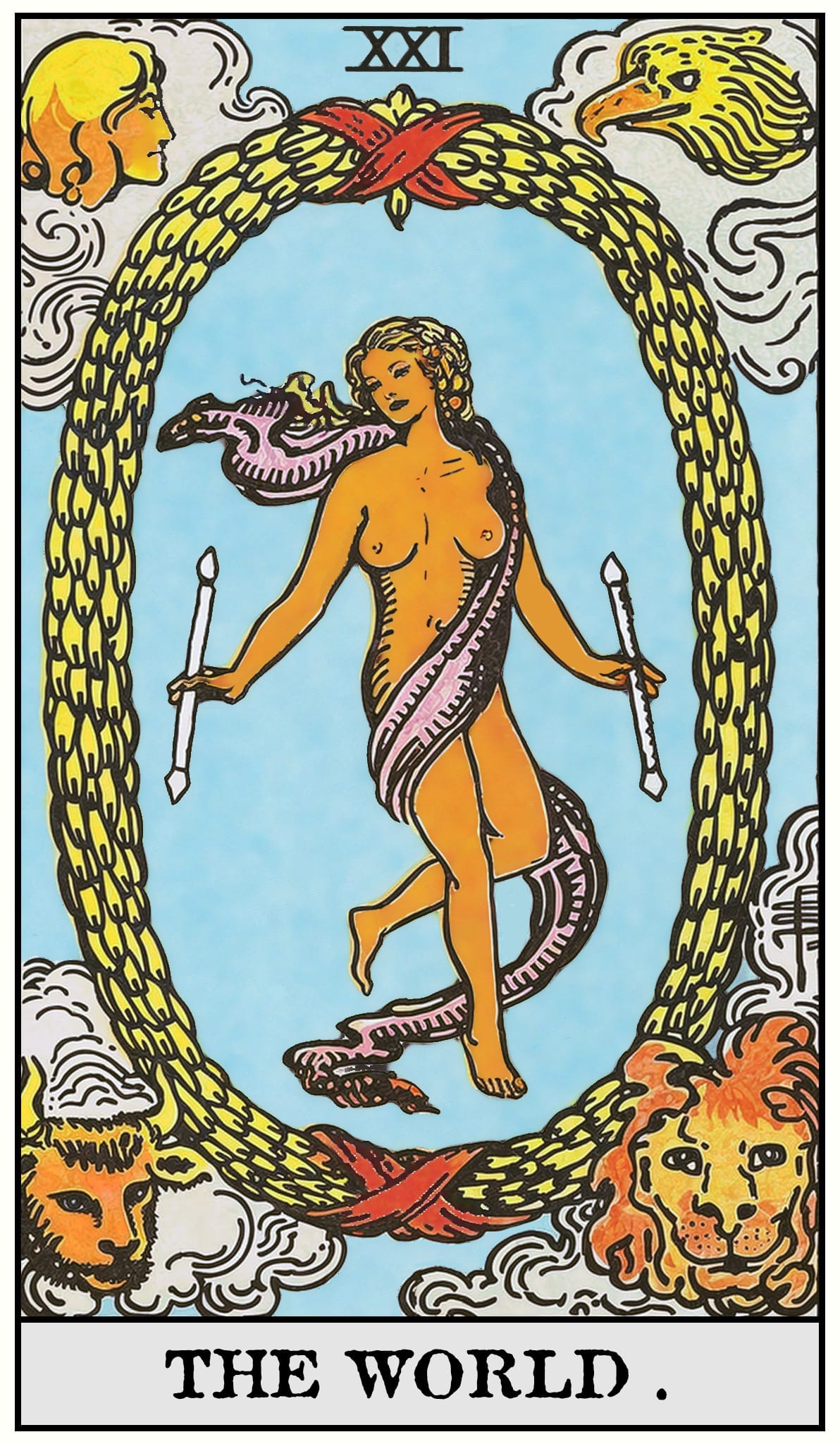
Inside an oval wreath, a figure dances draped in a violet sash, holding two wands — one leg crossed in the same figure-four the Hanged Man made, but here it is motion, not suspension, and the four creatures in the corners watch without intervening.
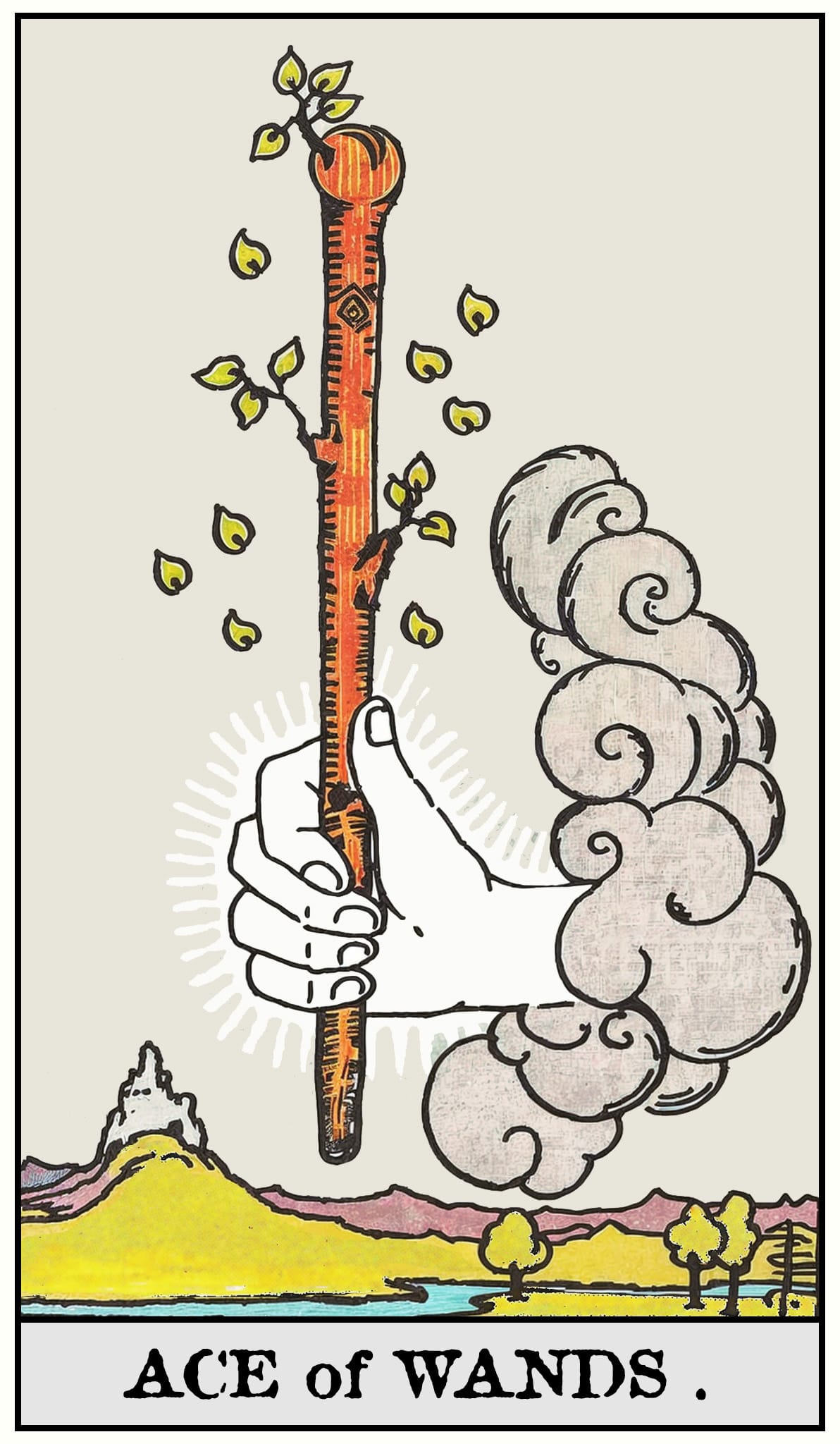
A hand emerges from a cloud, gripping a wand with fresh green leaves still sprouting from it — the wand not yet planted, held mid-gesture between offer and grasp, the landscape below wide and patient.
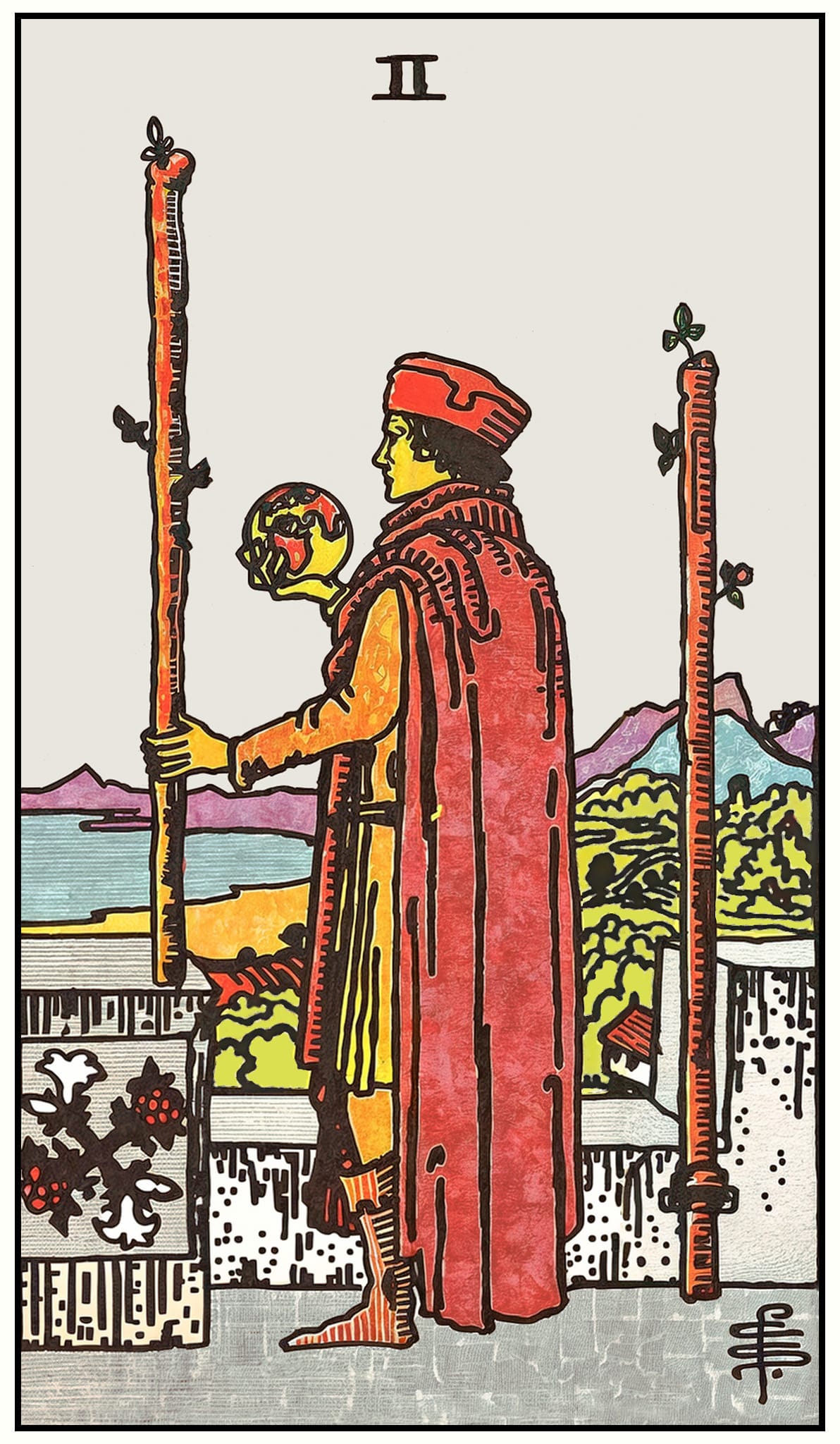
A figure stands on a battlement, a small globe in one hand and a wand fixed to the wall in the other — the world held in the palm, the horizon enormous, the ships still in the harbour.
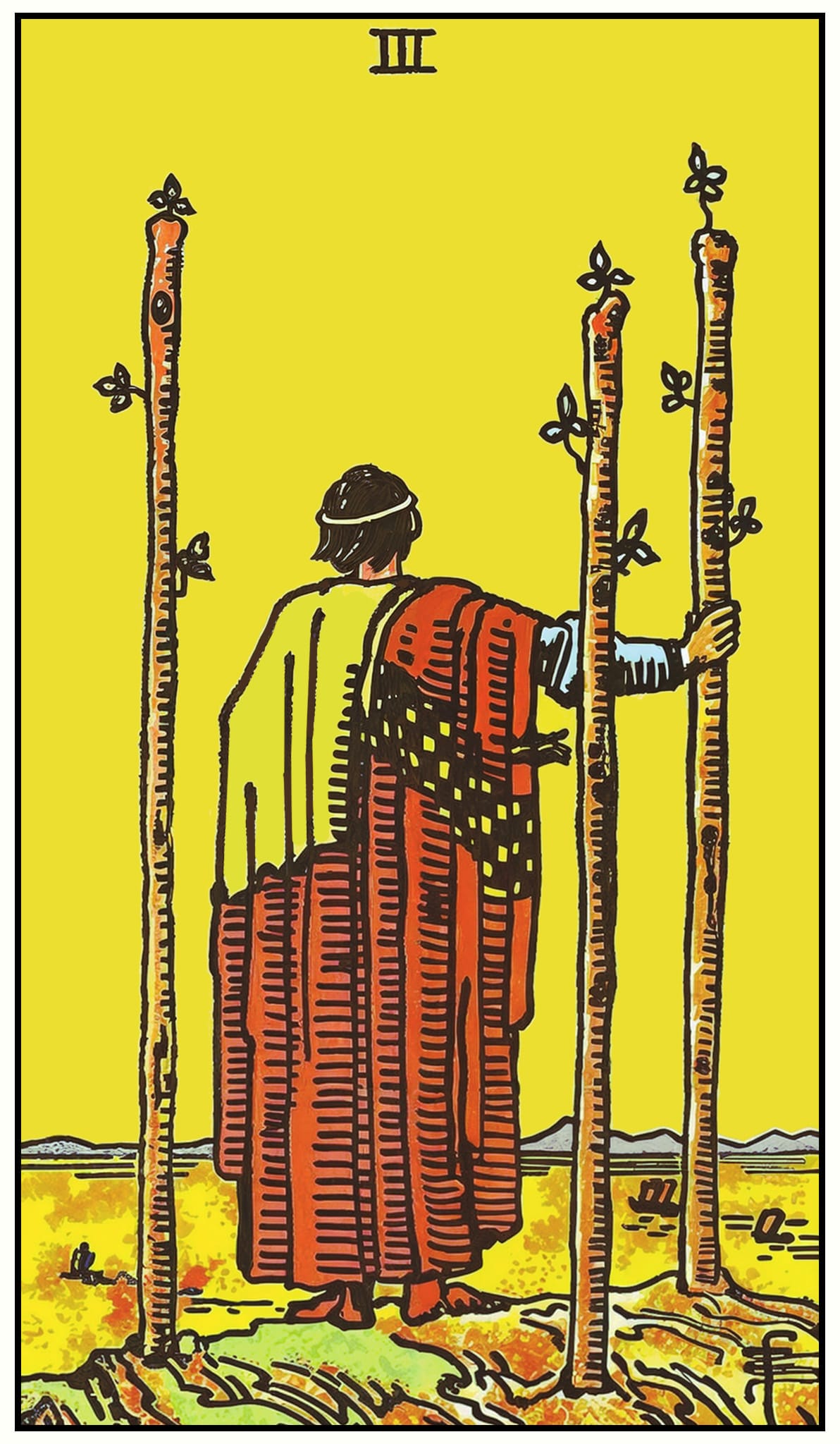
A figure stands on a cliff with his back to us, three wands planted around him, watching ships move on the water below — the decision made, the investment sent out, the horizon now doing the next work.
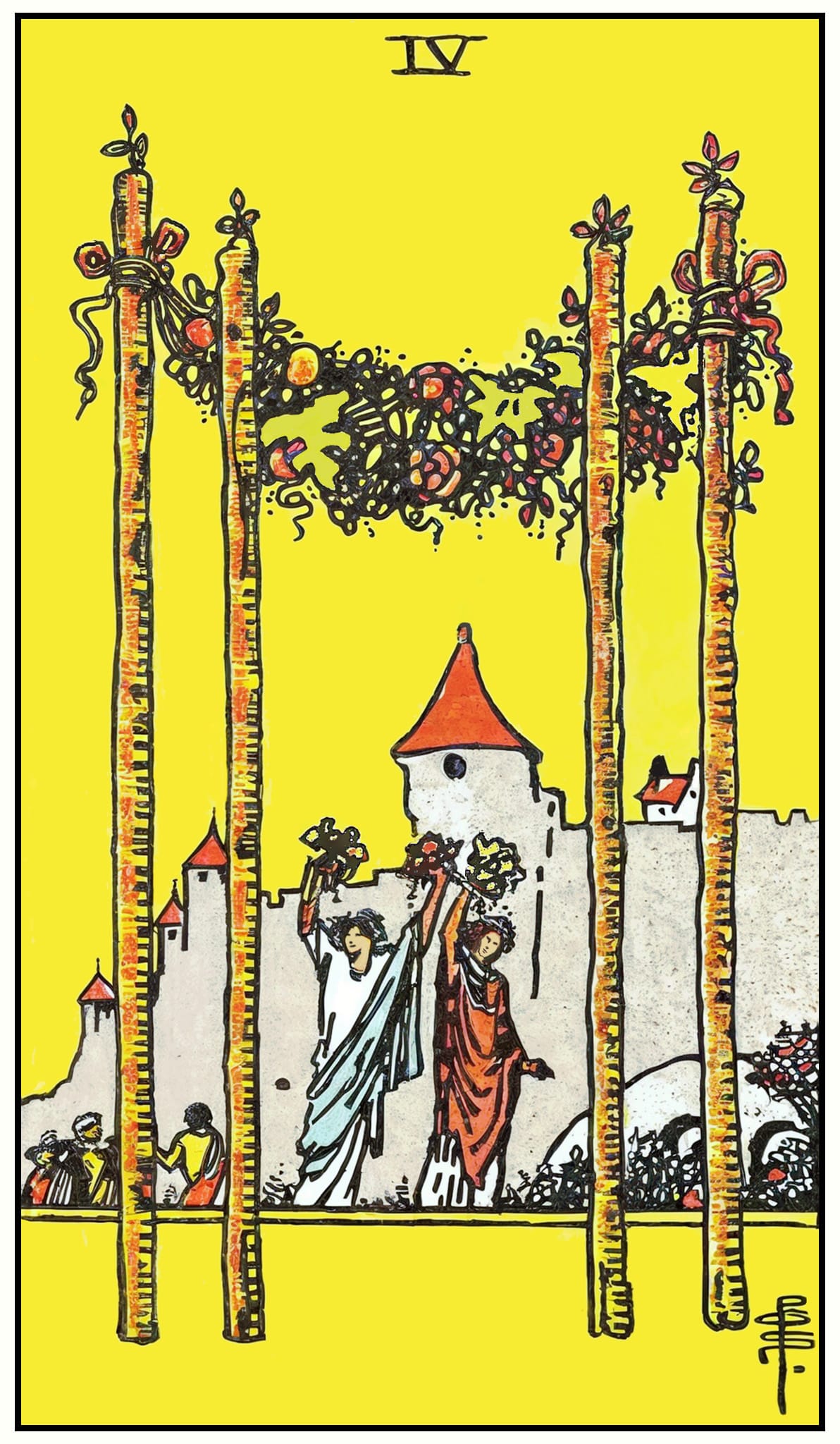
Four wands stand garlanded with flowers and fruit, forming the bones of a canopy; behind them, figures dance with raised bouquets, and further still, a castle — the first roof, open on all sides, fire earning a hearth.
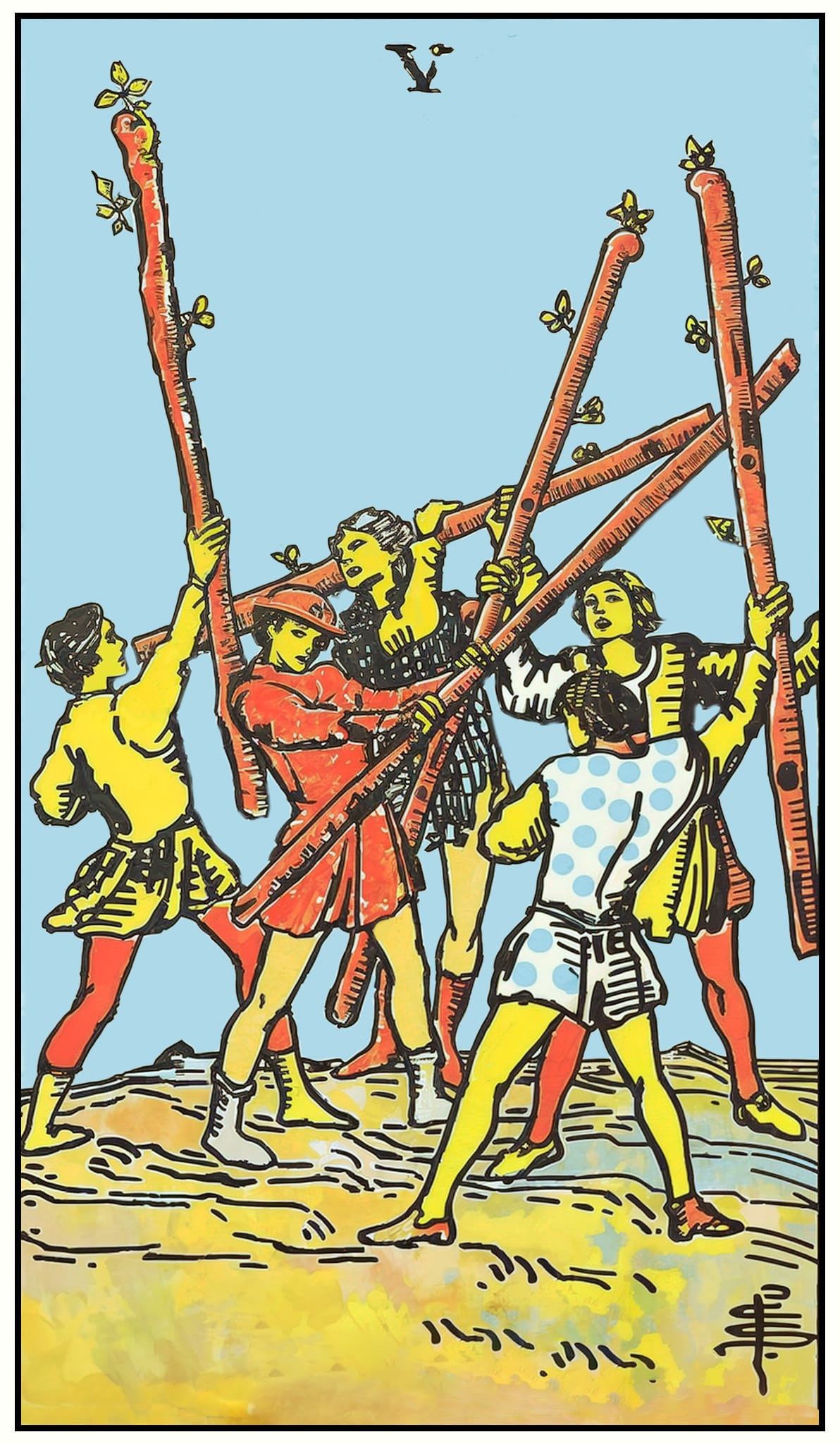
Five figures clash in a tangle of raised wands — the choreography ambiguous between fight, game, and rehearsal; no one bleeding, no one winning, the wands crossing at angles that do not resolve.
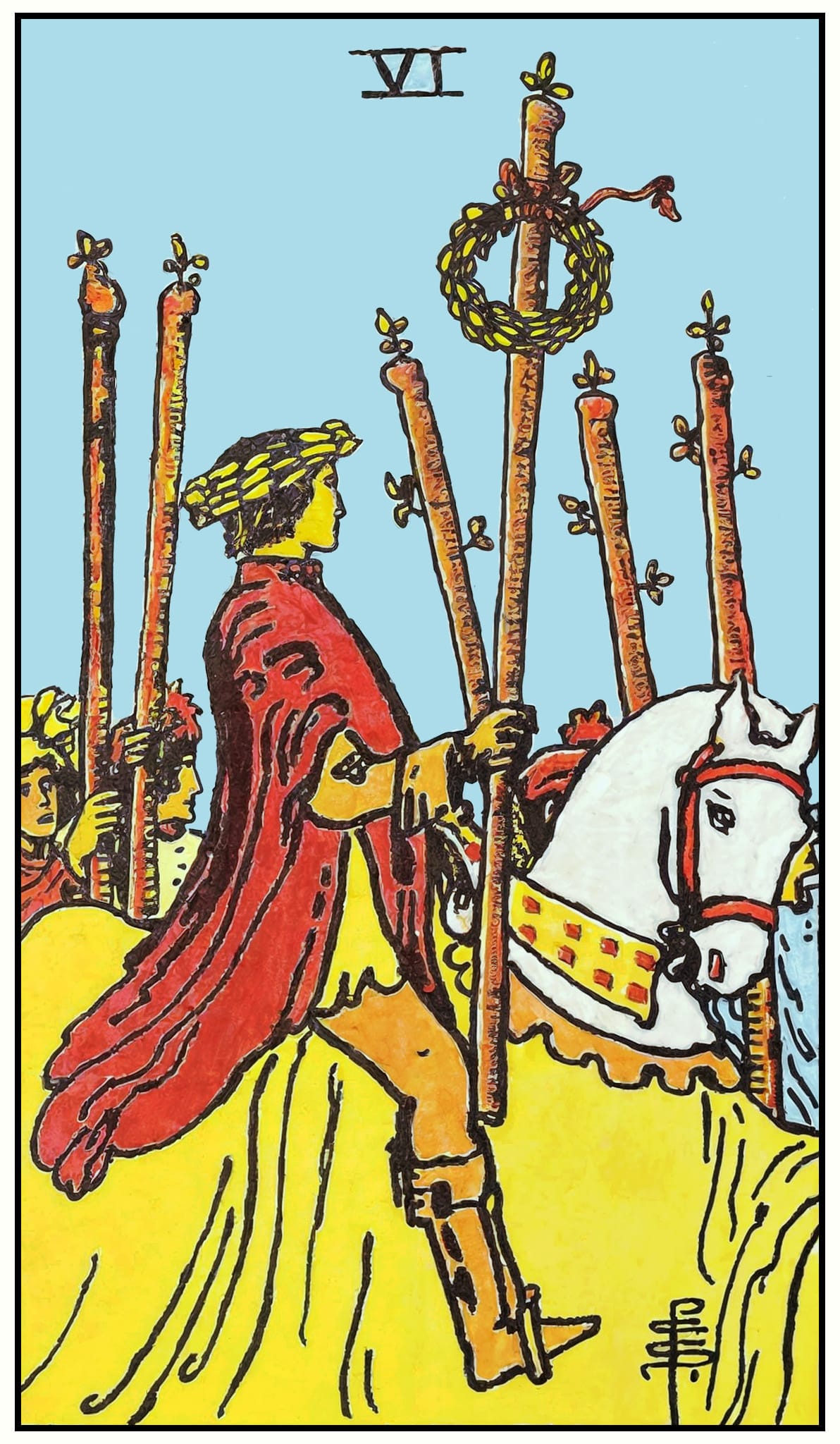
A rider crowned with laurel passes through raised wands and upturned faces — the first public yes, received clean, already beginning to recede.
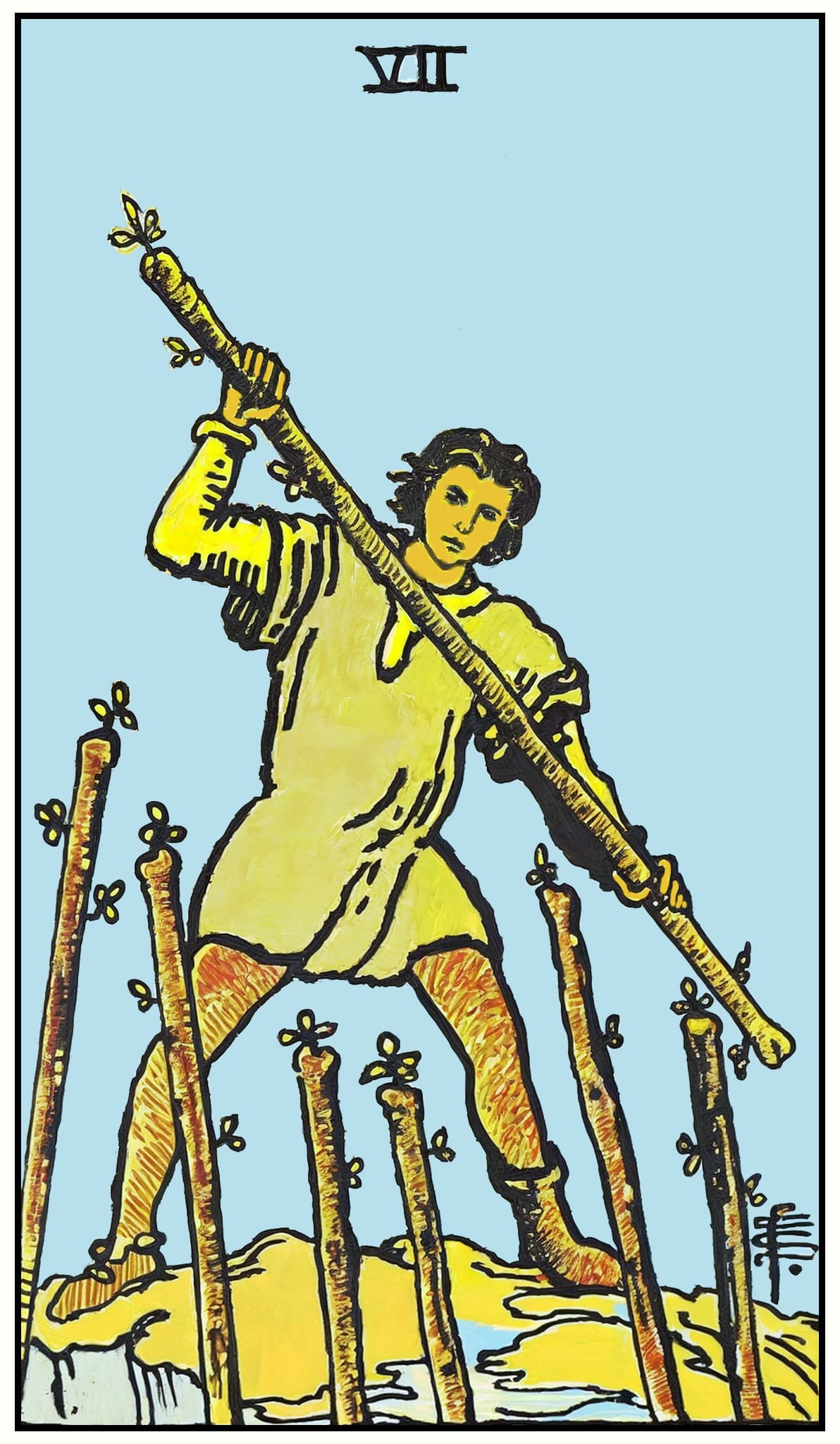
A figure holds his ground on a higher slope, one wand raised, six pressing upward from below — the footing uneven, the odds visible, the position held anyway.
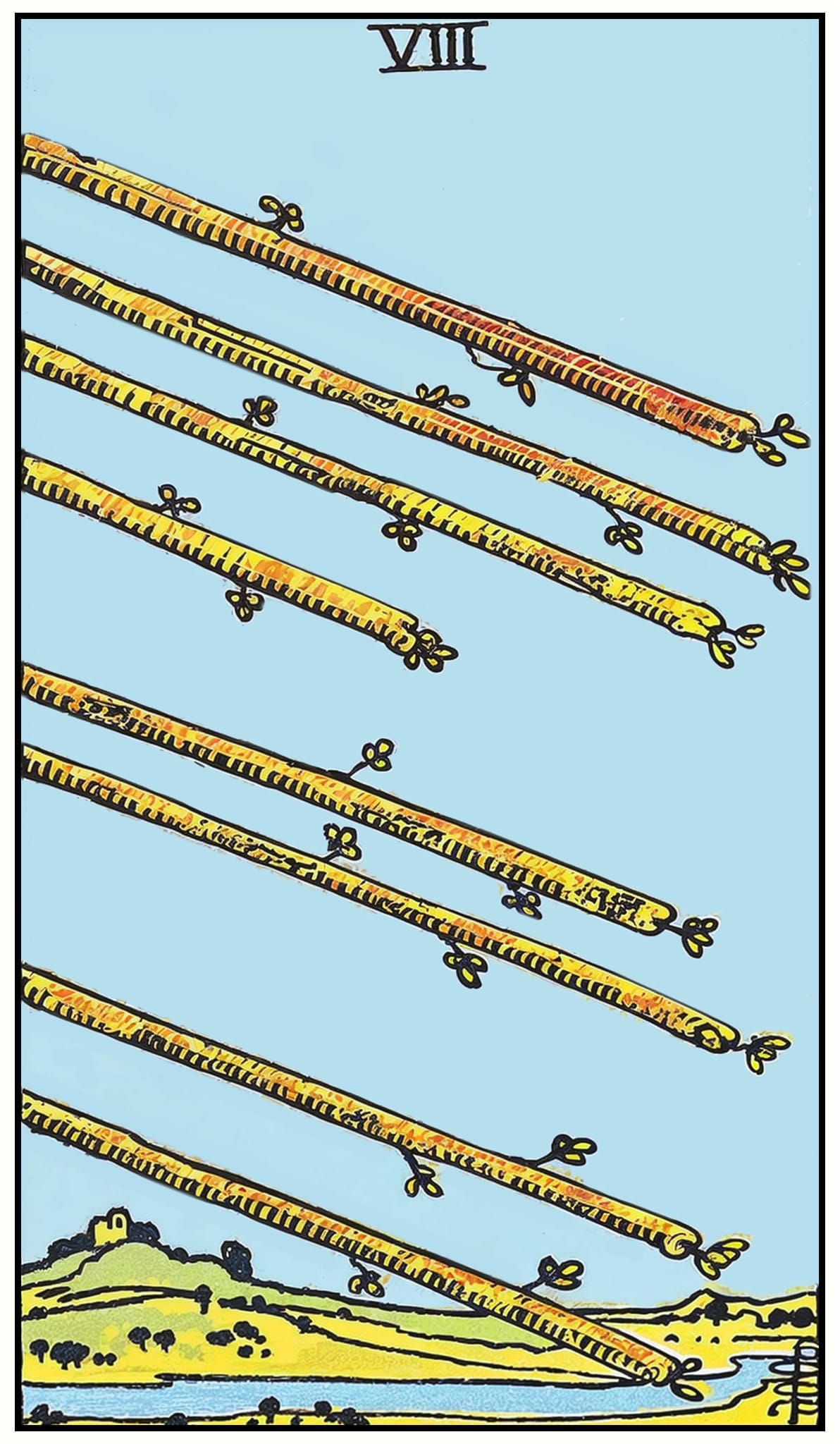
Eight wands arc through open sky in clean parallel formation, no hand holding them, the landscape below empty — the work released and finding its own line.
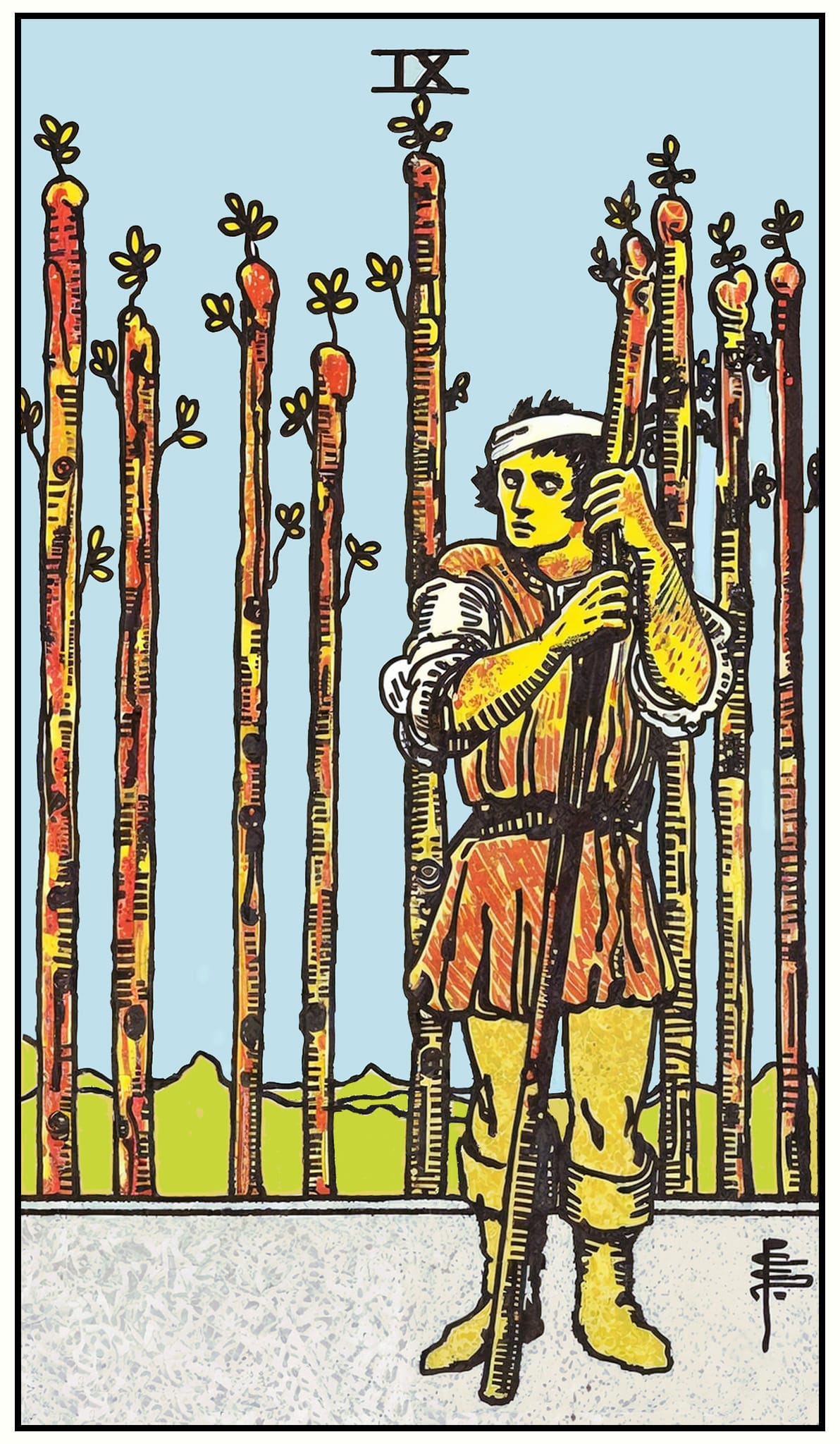
A bandaged figure leans on a wand, eight more standing close behind — watchful, tired, still at his post, the landscape open in every direction.
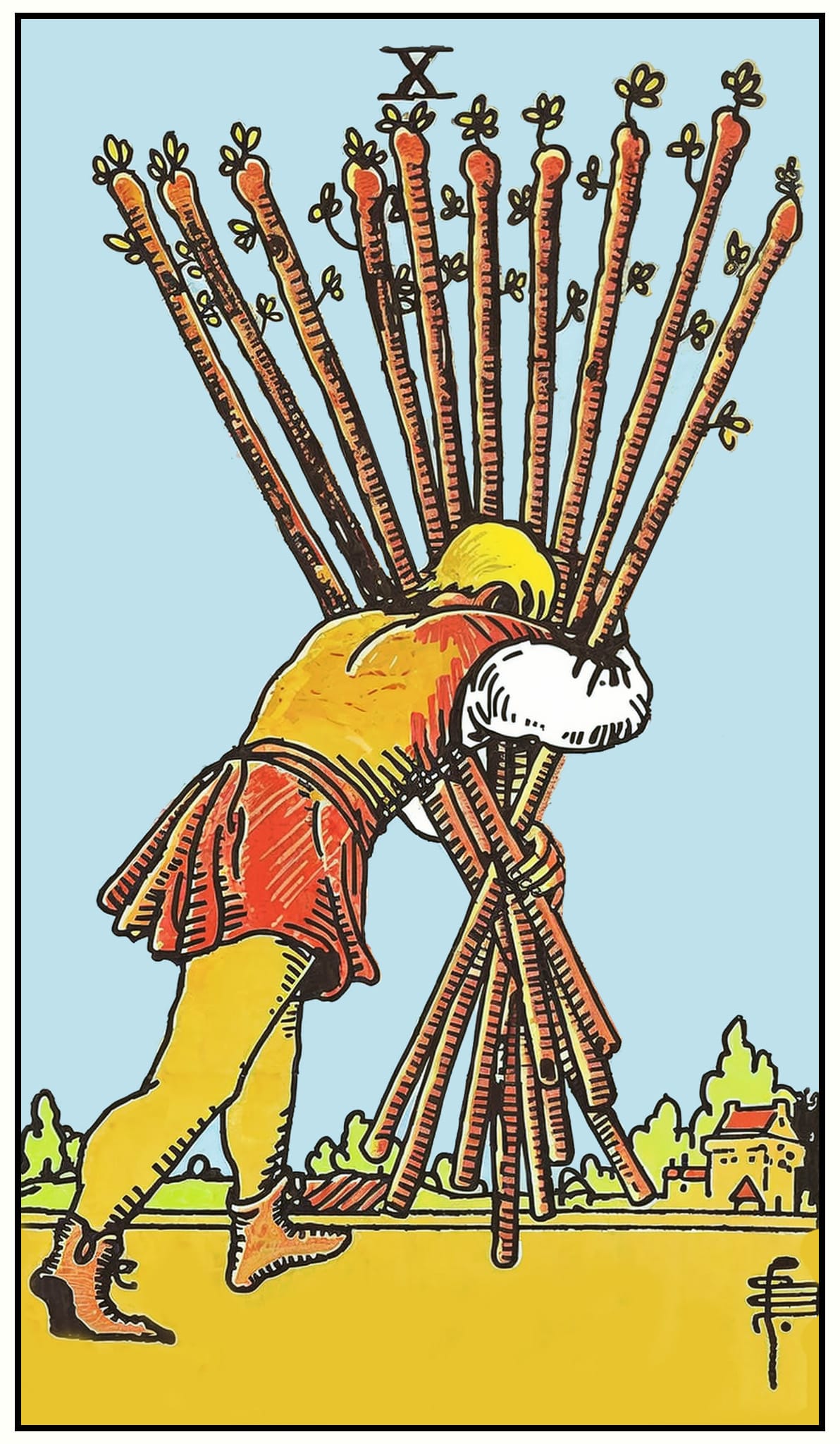
A figure walks bent under ten wands pressed against his body, a town visible in the near distance — the destination in sight, the last steps the heaviest, the face hidden by the load.
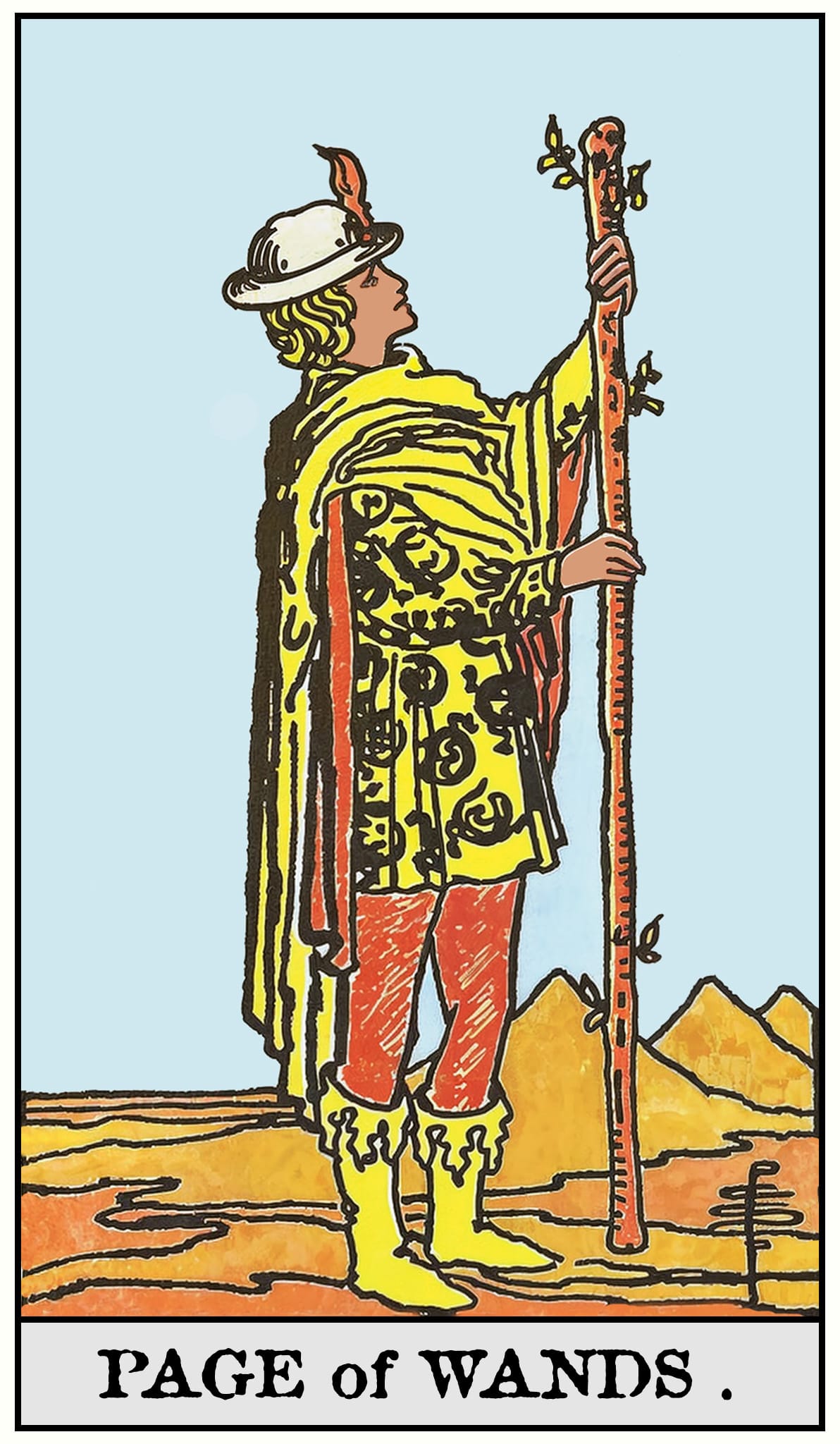
A young figure in a salamander-patterned tunic holds a tall wand upright and studies its budding tip — standing in open desert, weight on one foot, as if mid-decision.
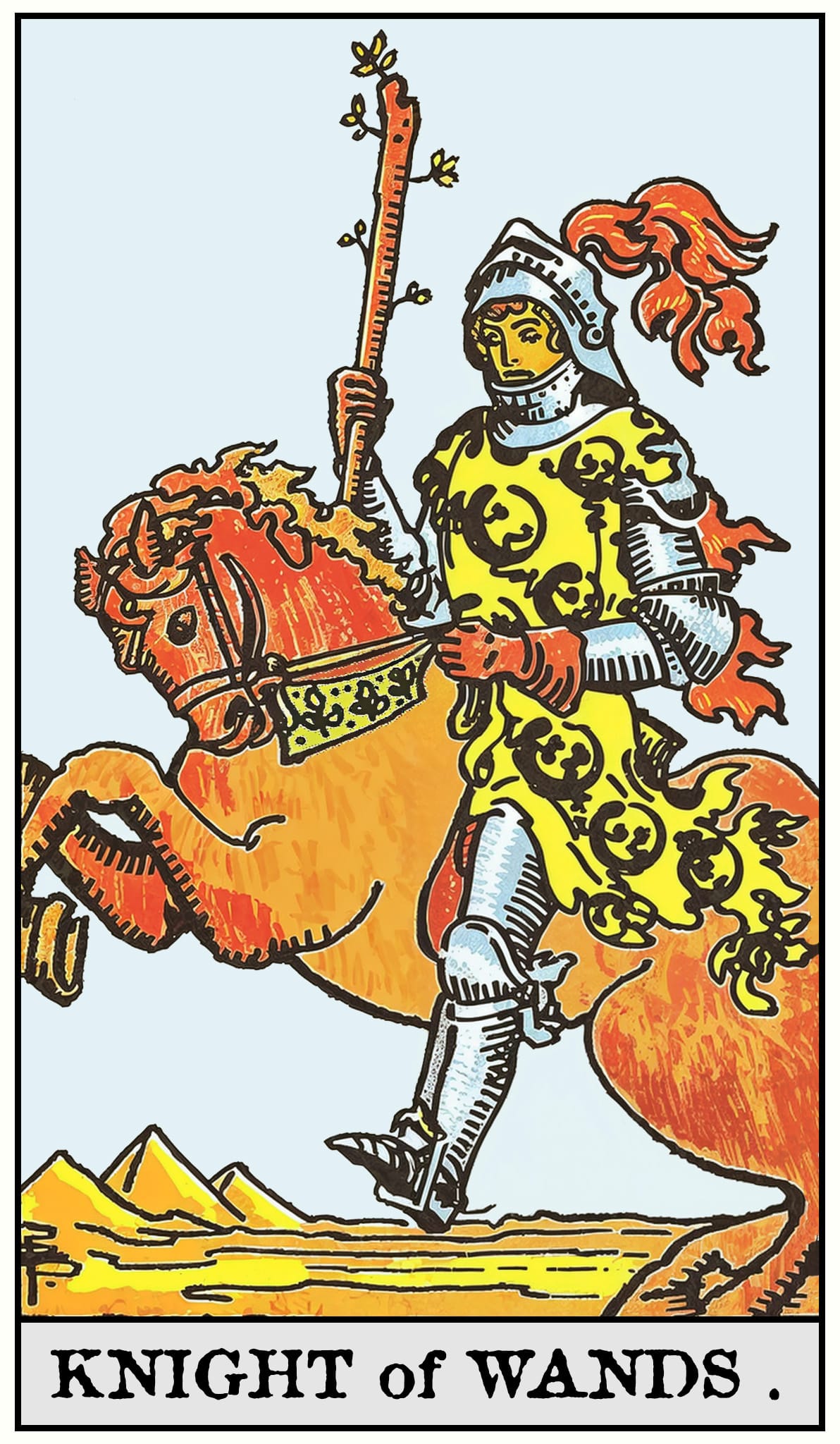
A knight in plumed armour rides a horse mid-leap through open desert, wand raised like a lance — everything in motion, all four hooves off the ground, the horizon already claimed before it is reached.
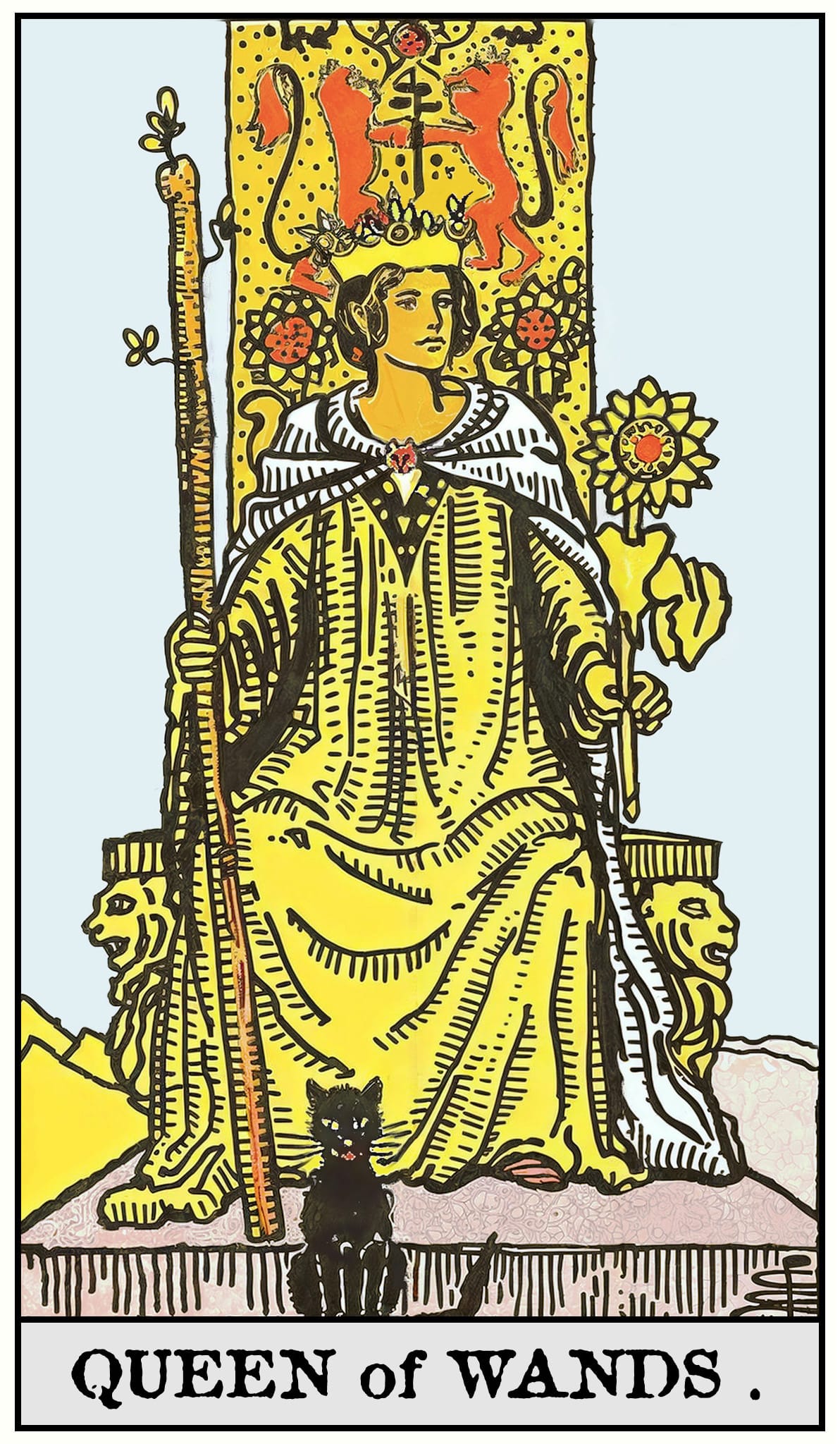
A woman on a stone throne carved with lions holds a sunflower in one hand and a flowering wand in the other — a black cat at her feet, yellow sky behind her, her gaze angled slightly away from us.
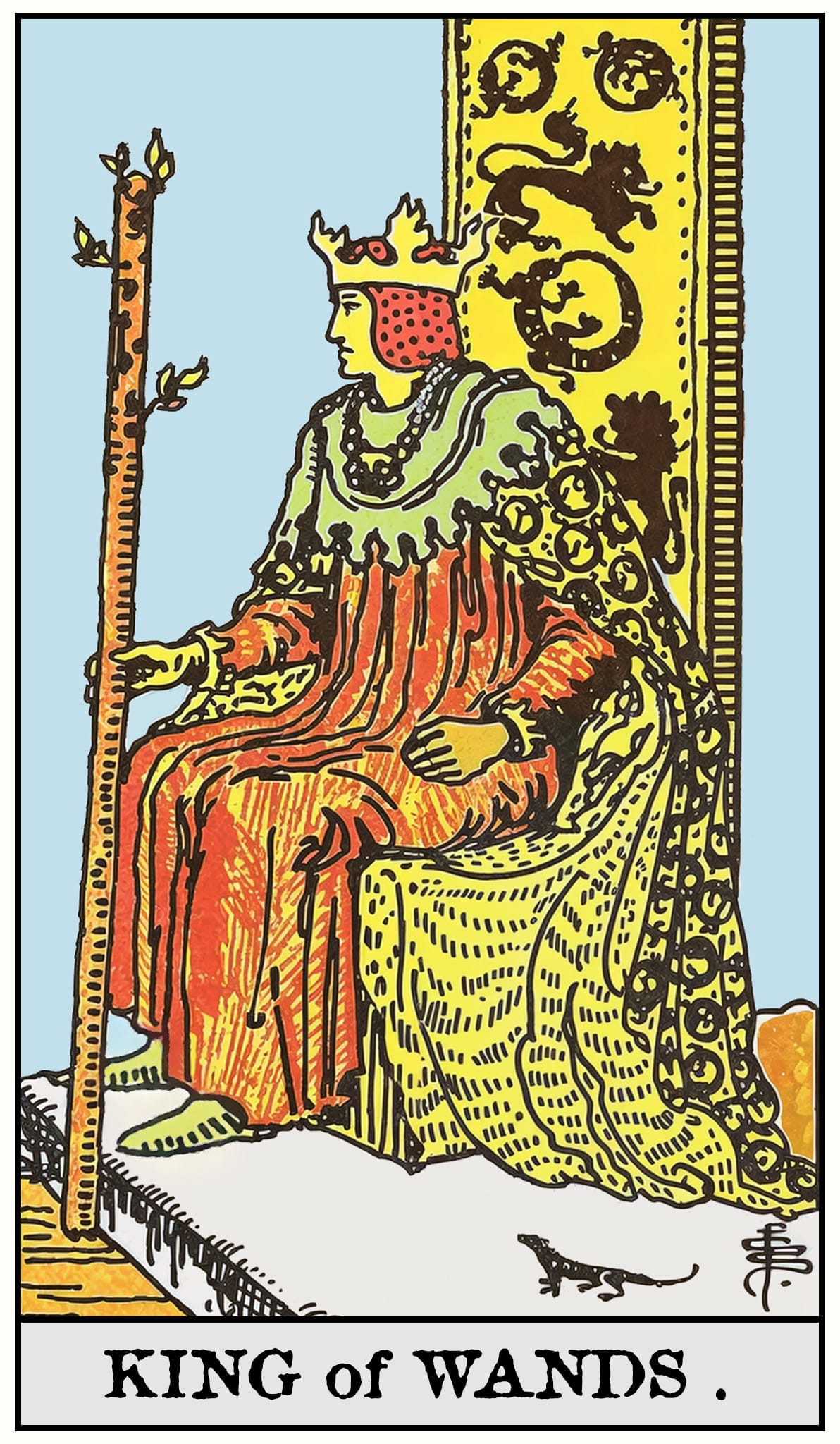
A king on an animate throne — salamanders and lions carved into the stone — holds a flowering wand like a tool rather than a weapon, looking to one side as if listening to something just begun.
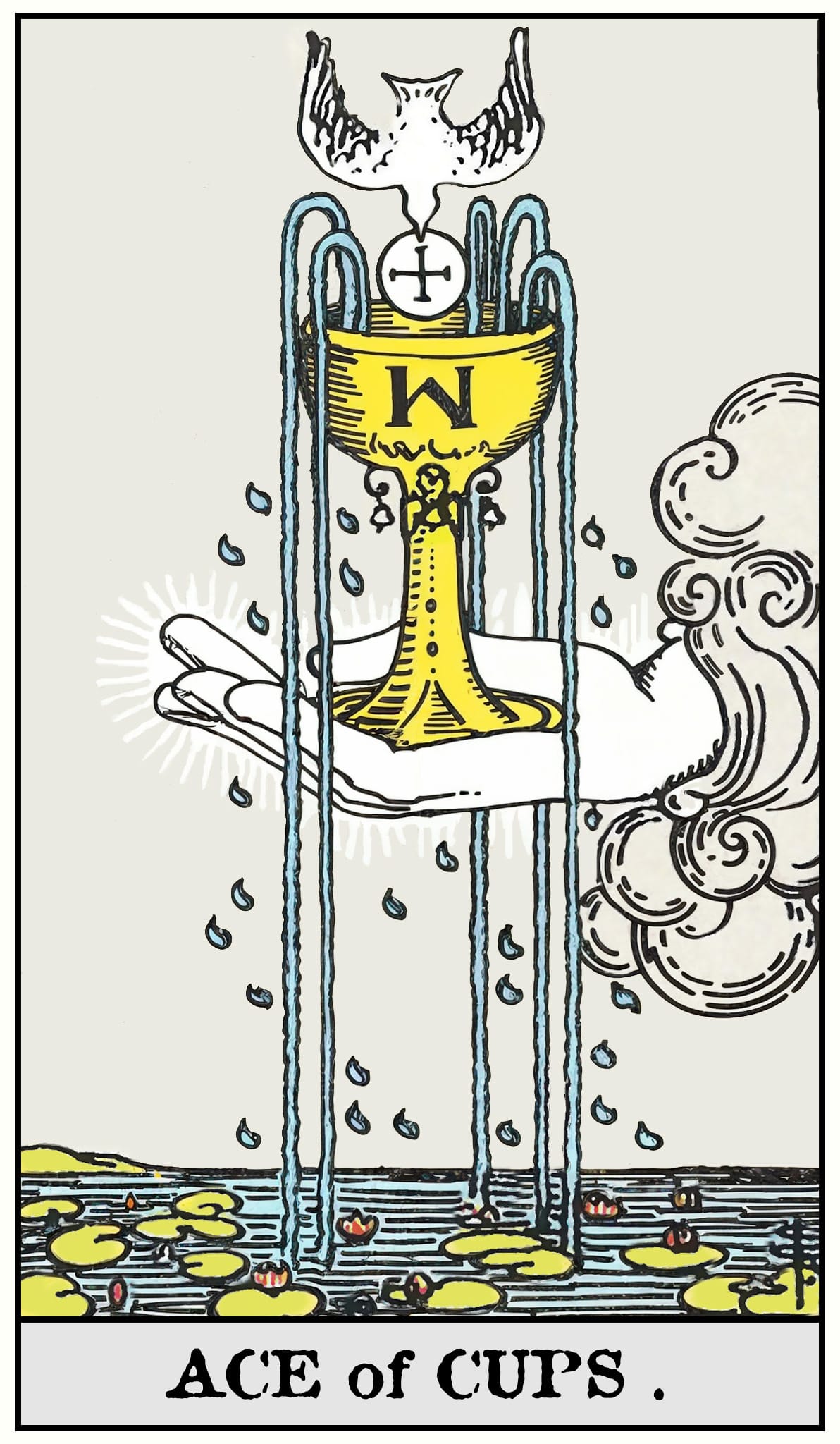
A hand emerges from a cloud, holding a chalice in full overflow — five streams descending, a dove arriving at the rim, a still pool below scattered with lotuses.
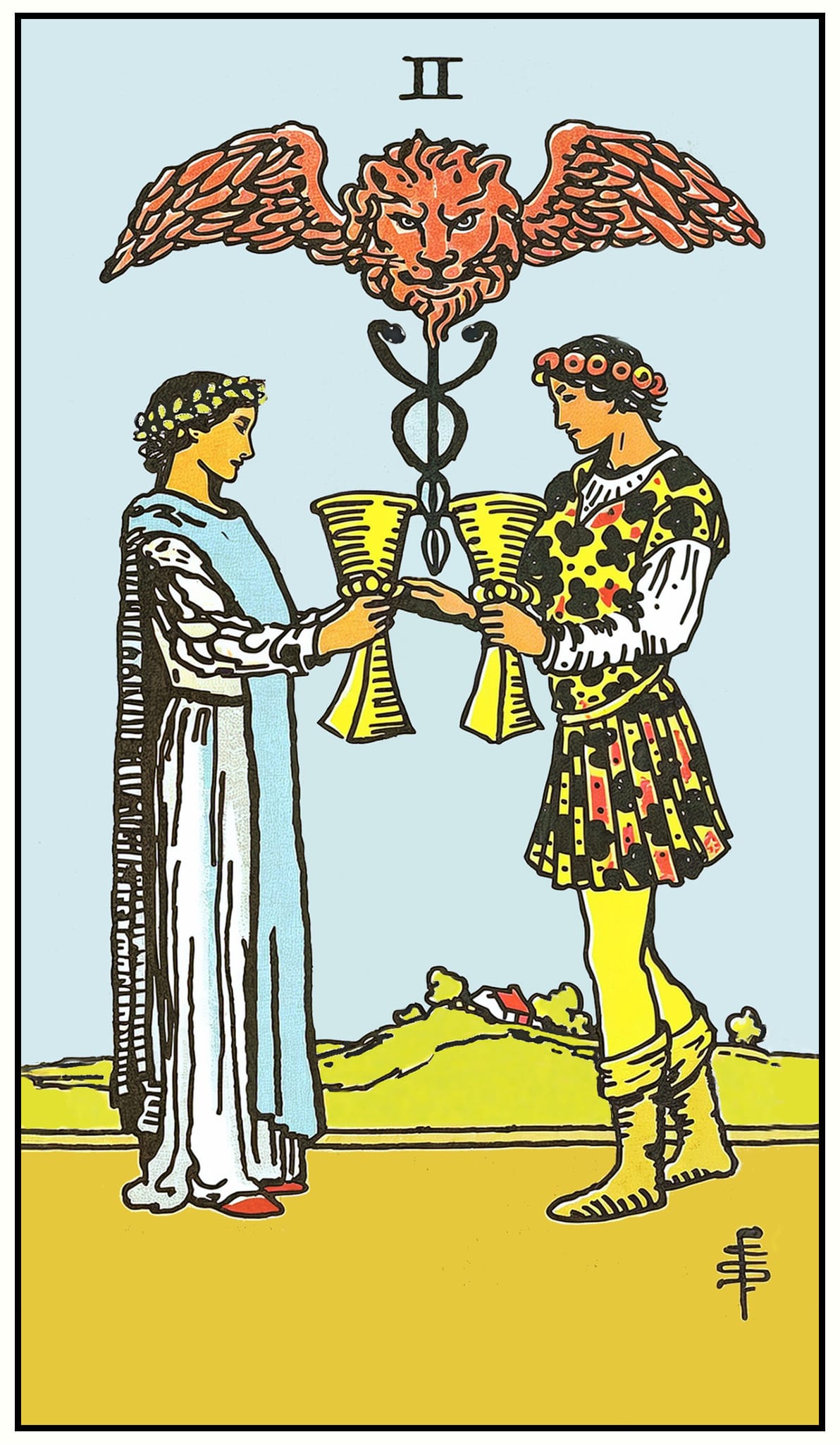
A man and a woman face each other with cups raised in exchange, the caduceus of Hermes rising between them — the meeting poised at the exact moment before the cups change hands.
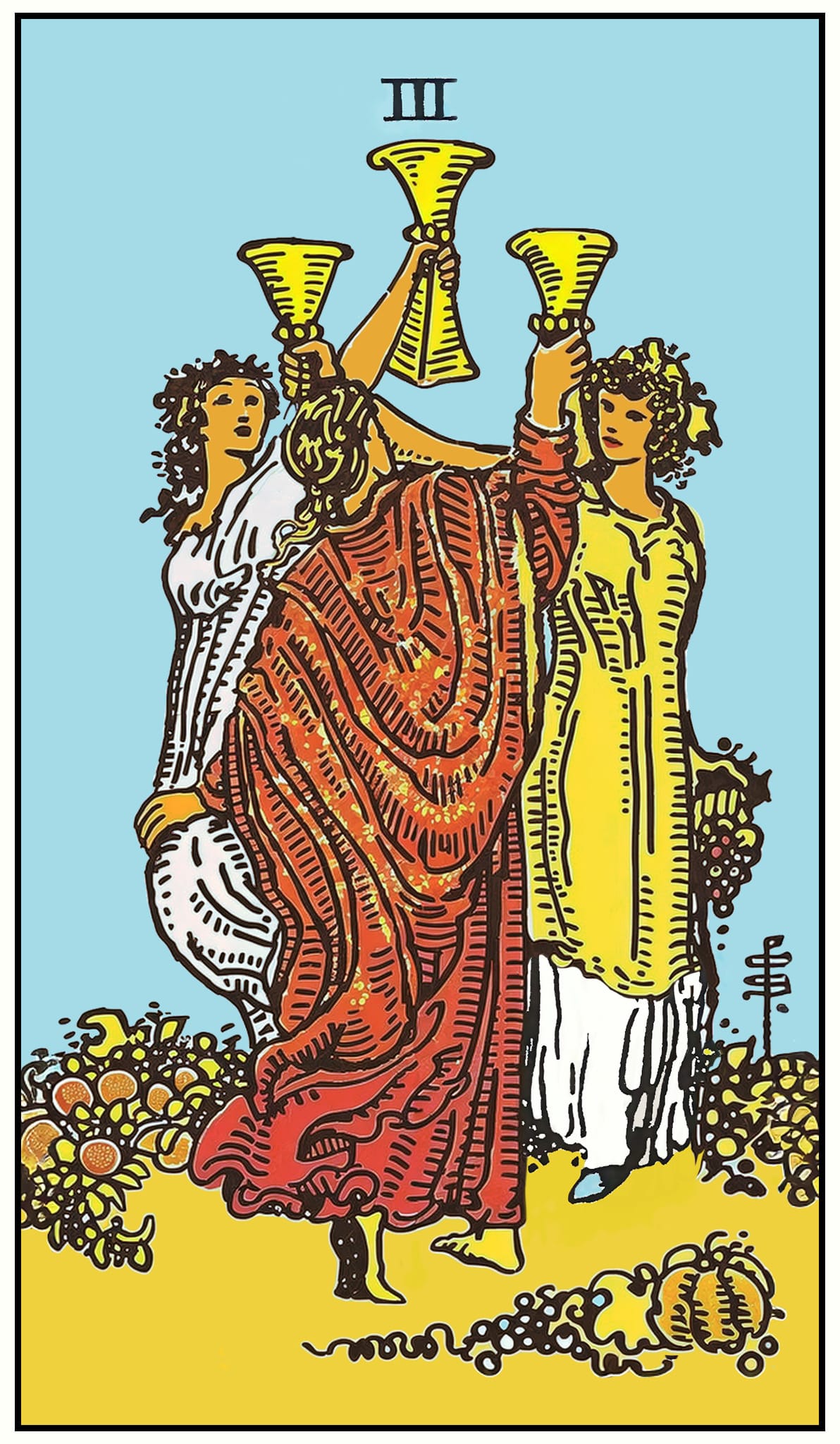
Three women dance in a circle with cups raised — fruit and vines at their feet, faces angled toward each other and not toward us, a late-harvest light over the whole scene.
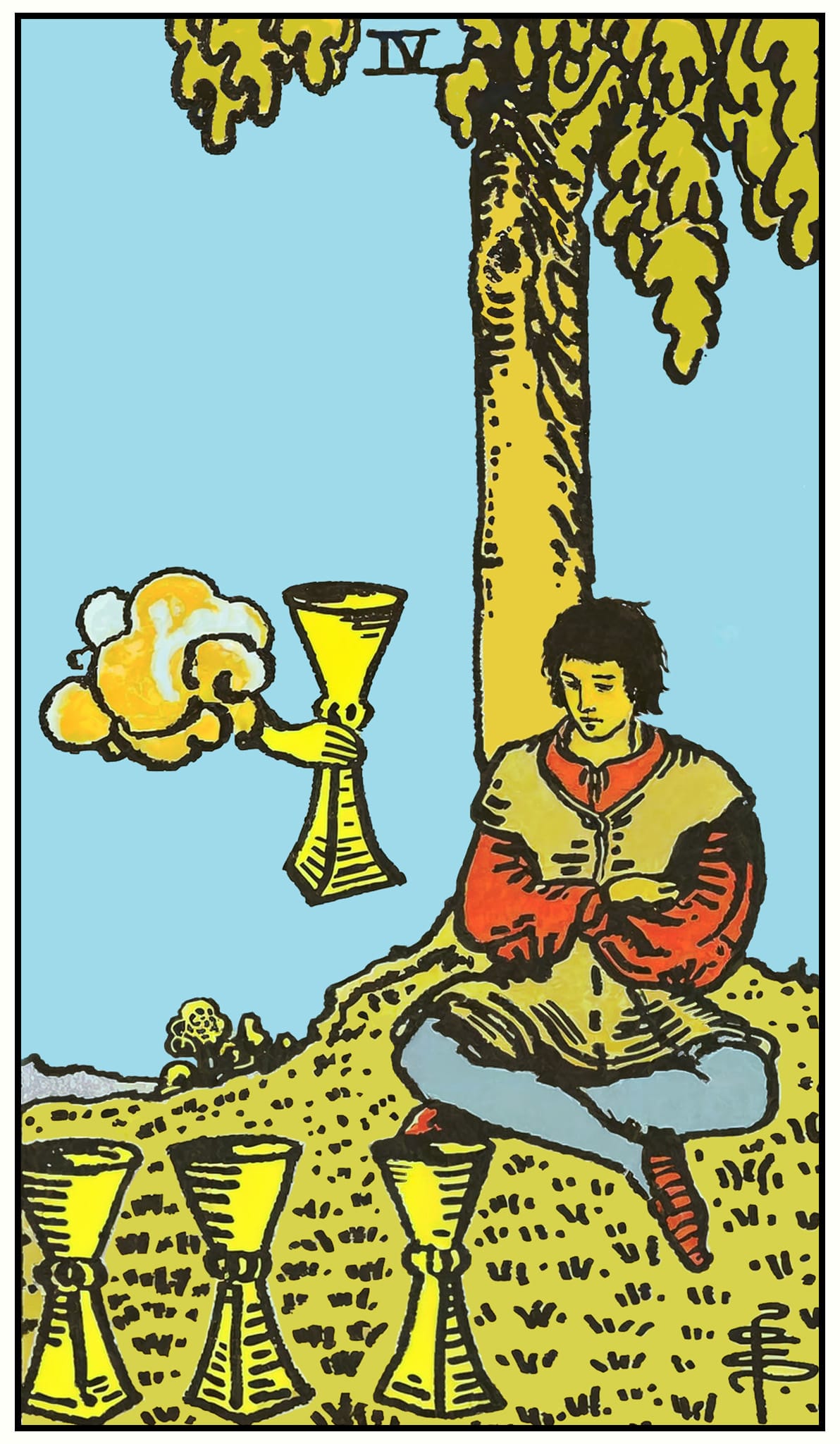
A young man sits beneath a tree, arms folded, eyes downcast toward three cups in front of him — a fourth cup extended from a cloud at his side, unnoticed or not yet chosen to be noticed.
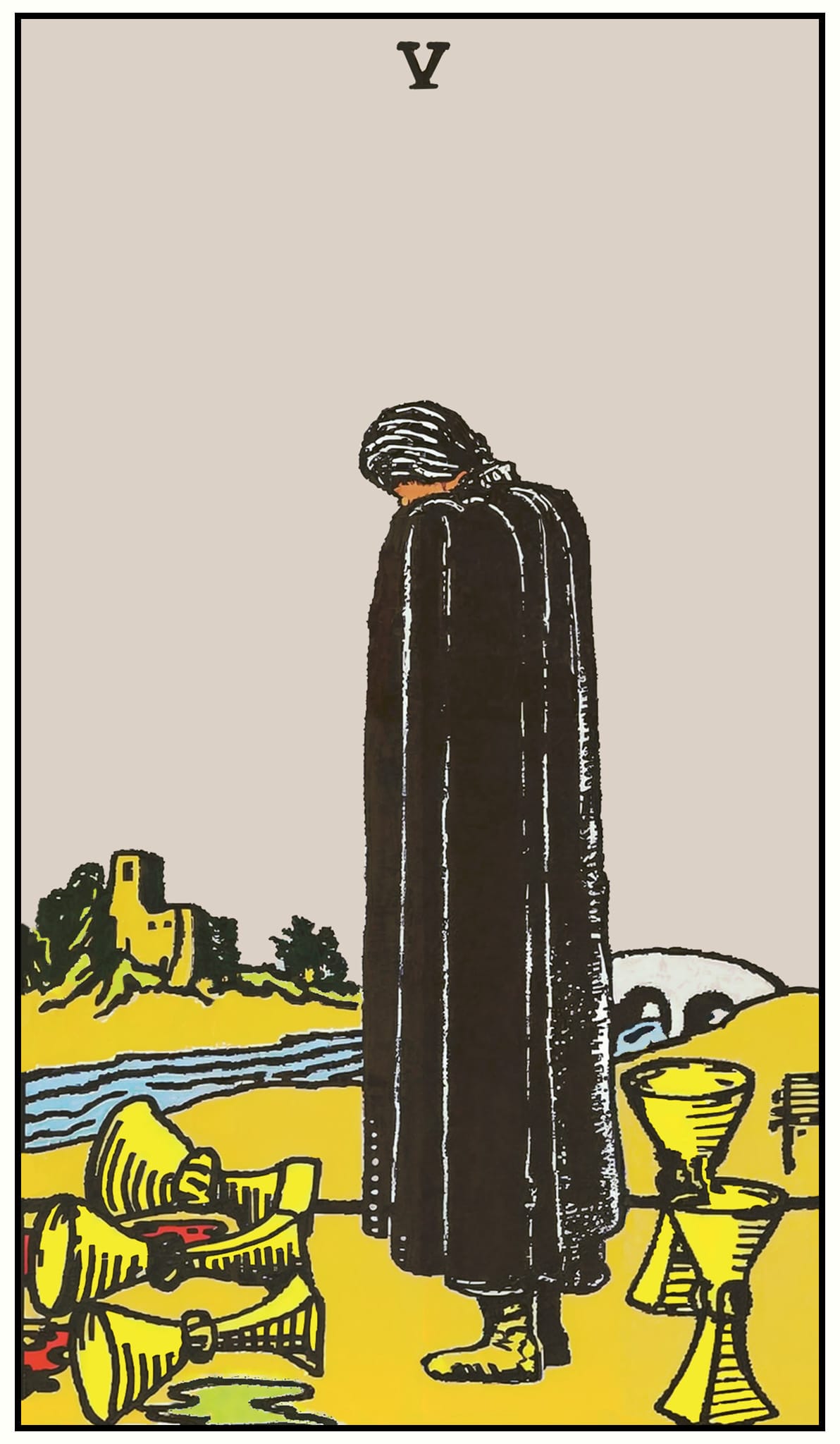
A cloaked figure stands before three spilled cups, head bowed — two cups upright behind him, a river beside him, a bridge visible in the distance leading to a house on the far bank.
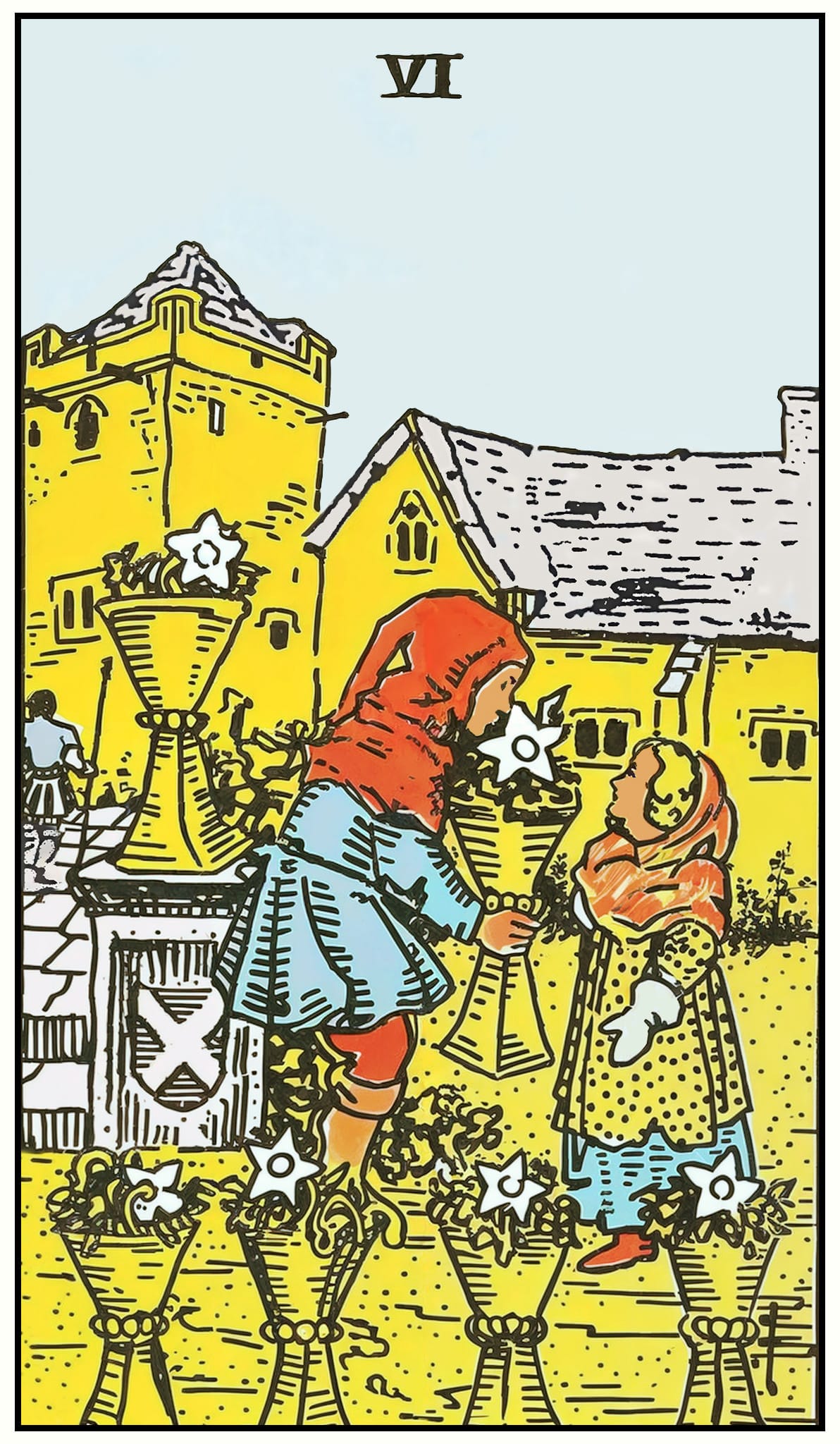
Two children in an old courtyard — the elder offering a cup of white flowers, five other flowered cups around the scene, a guard walking away in the background, golden light over all of it.
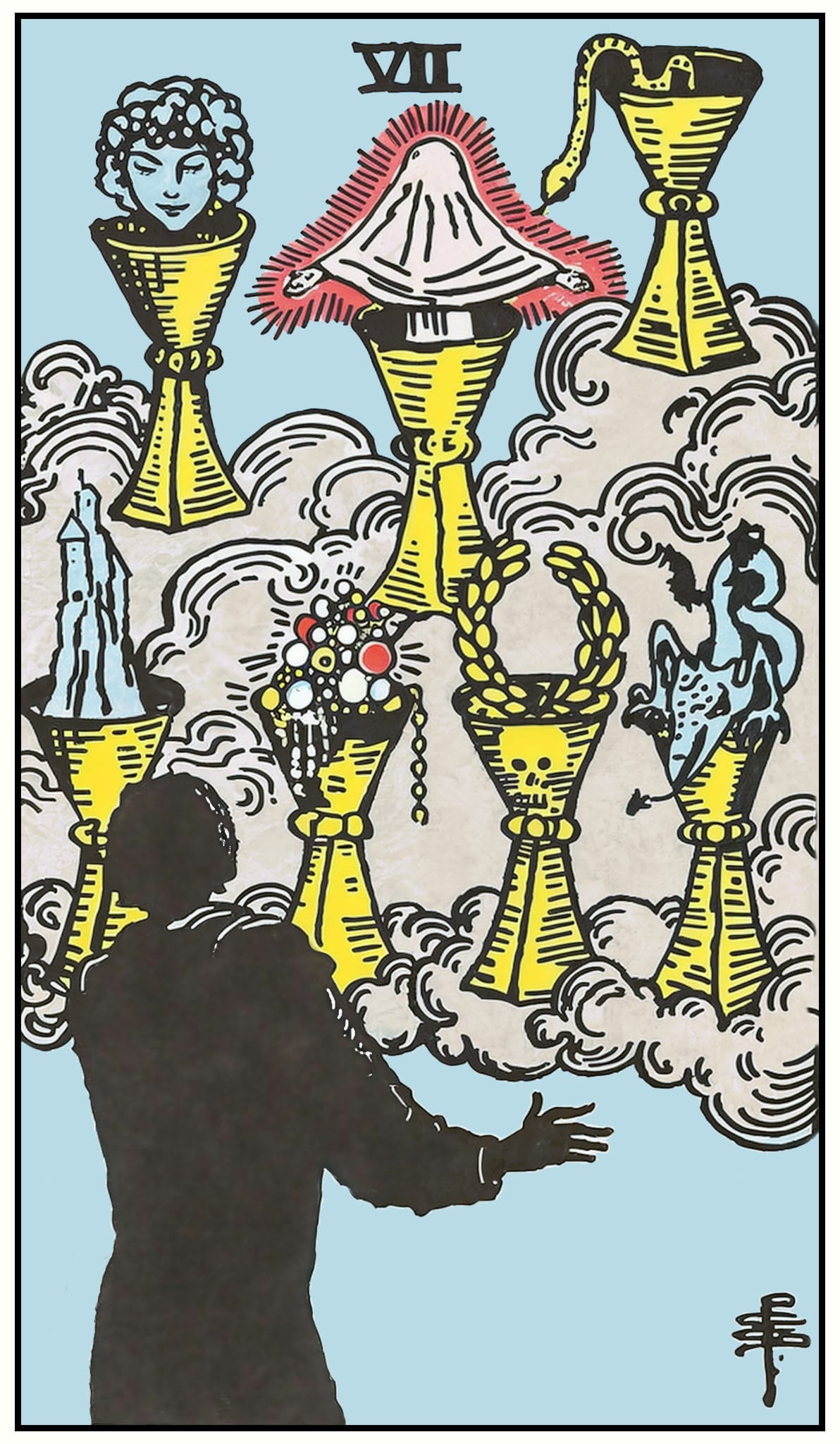
A dark silhouette stands before seven cups floating in cloud — each containing a different vision: a crowned head, a glowing shrouded figure, a snake, a castle, jewels, a wreath, a dragon.
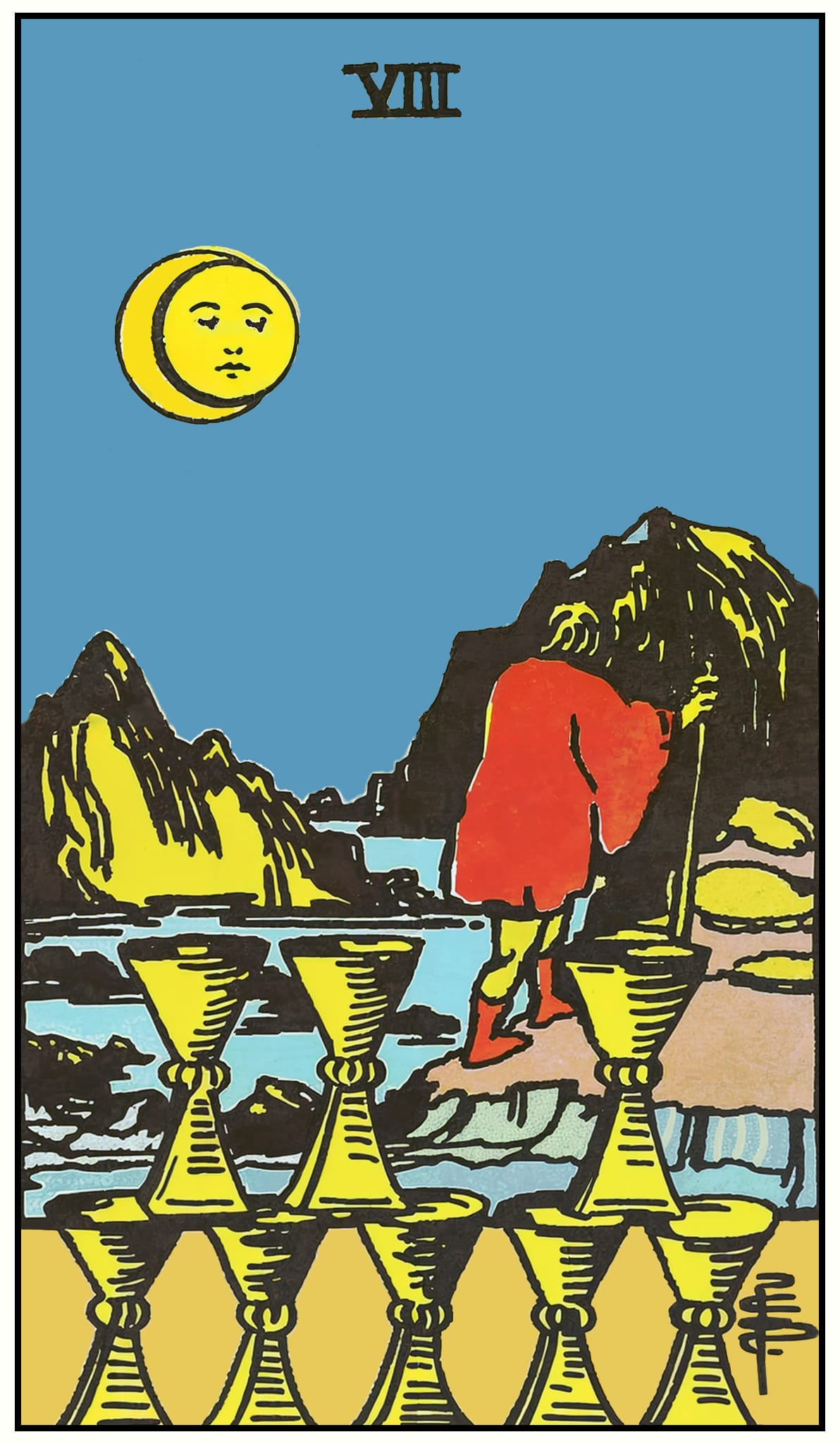
A cloaked figure walks away from eight neatly stacked cups in the foreground, moving toward rocky upland terrain — a waning moon above, a river beside him, the cups intact and arranged behind him.
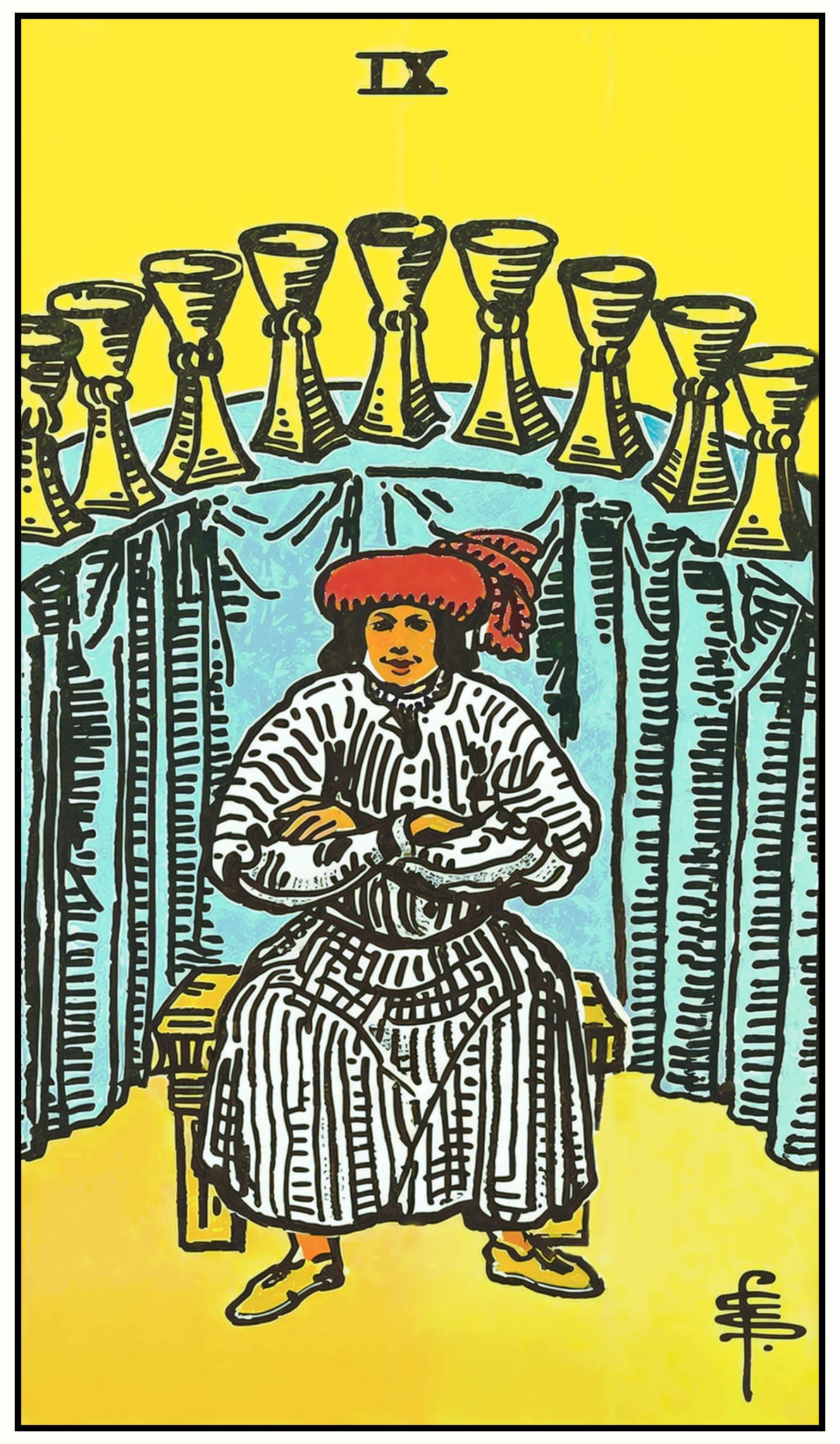
A man sits on a bench before a curved display of nine cups on a high shelf behind him — arms folded, legs planted, hat at a jaunty angle, facing us with an expression of evident satisfaction. No one else is in the card.
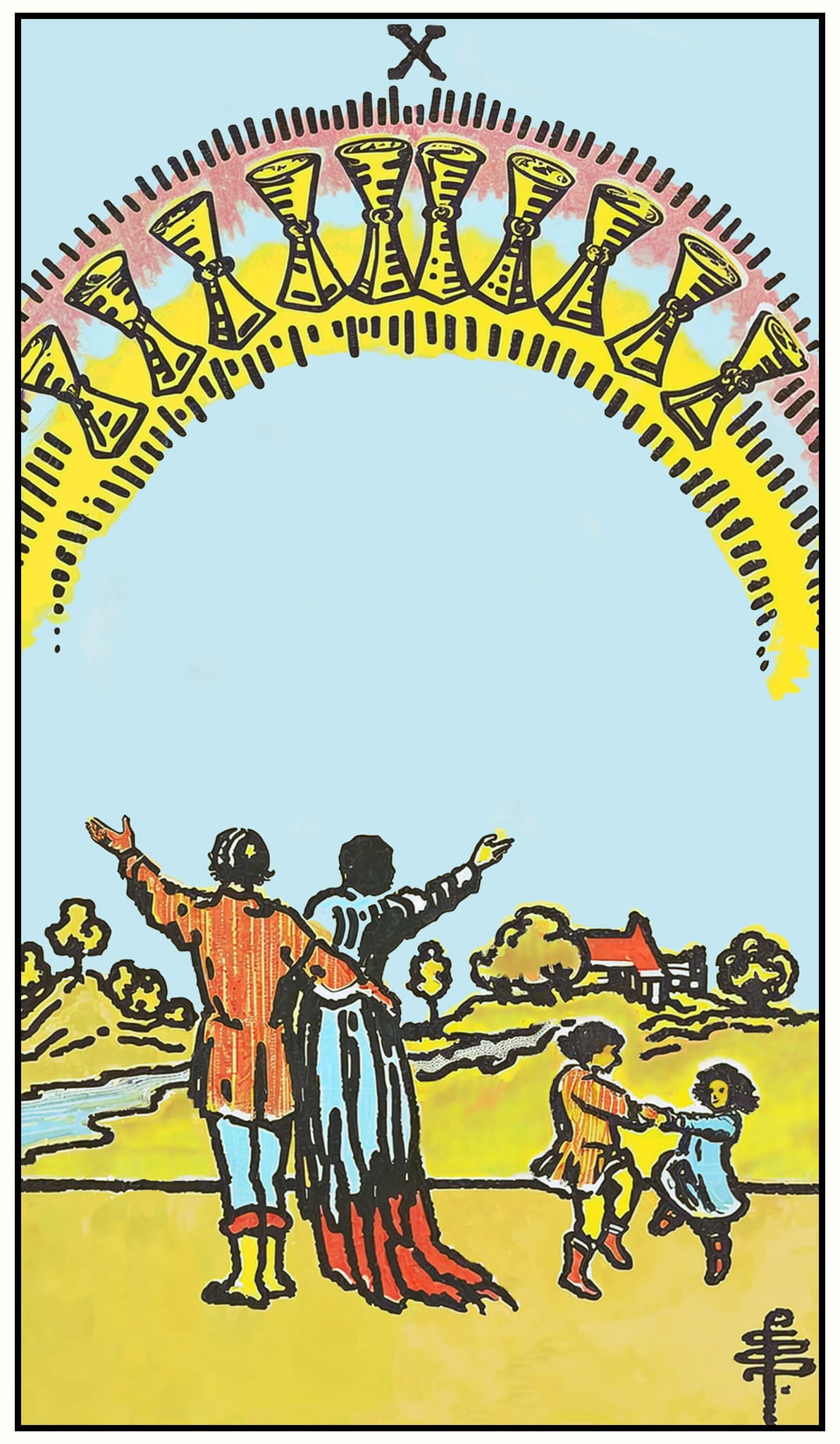
A couple stands with arms extended toward a rainbow arc of ten cups in the sky above them — two children dancing beside them, a house by a river in the distance, the whole scene holding its fullness in one moment.
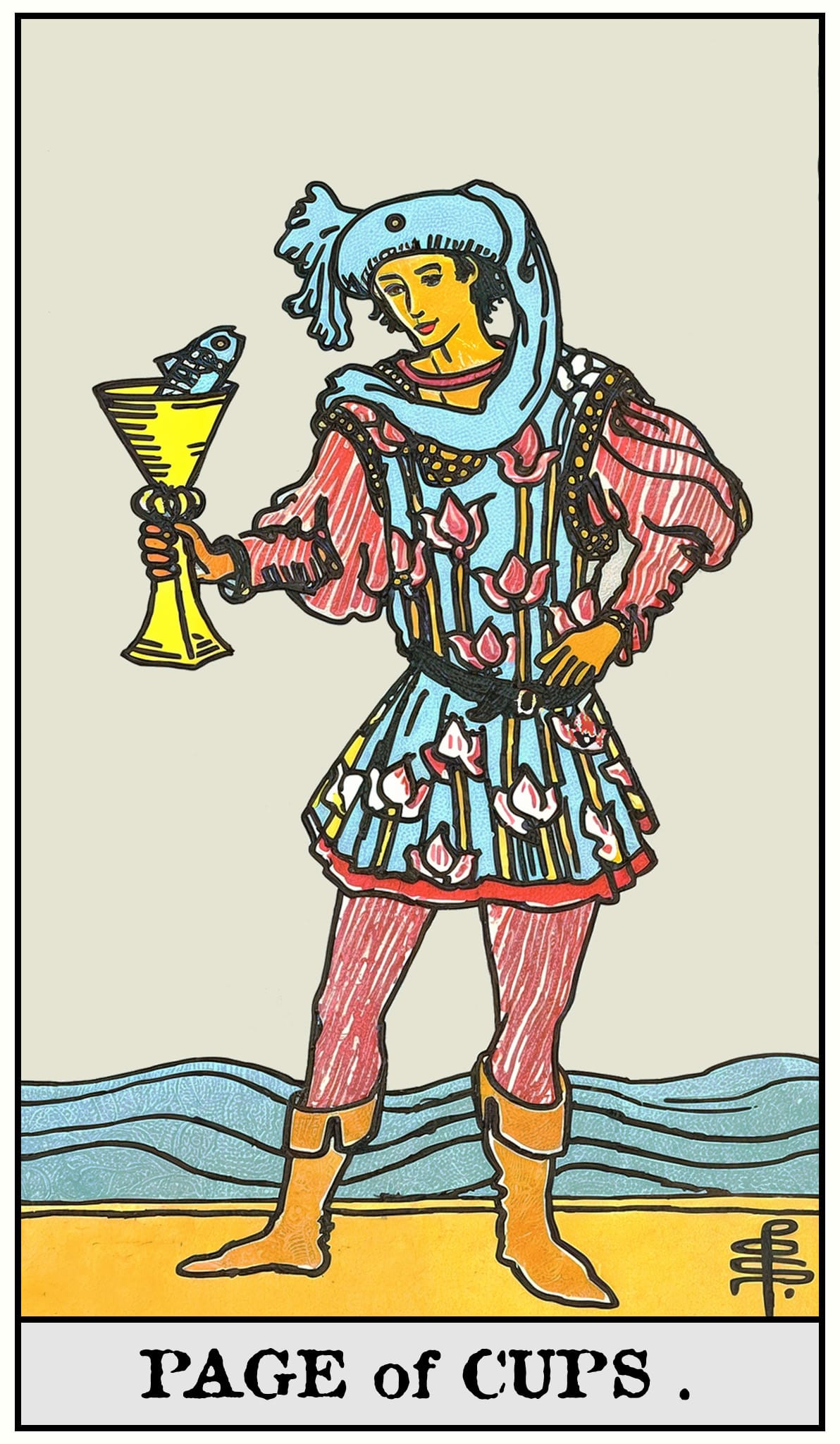
A young figure in a flower-patterned tunic stands at the water's edge, holding a cup from which a fish has unexpectedly surfaced — looking at it with an expression between surprise and careful attention.
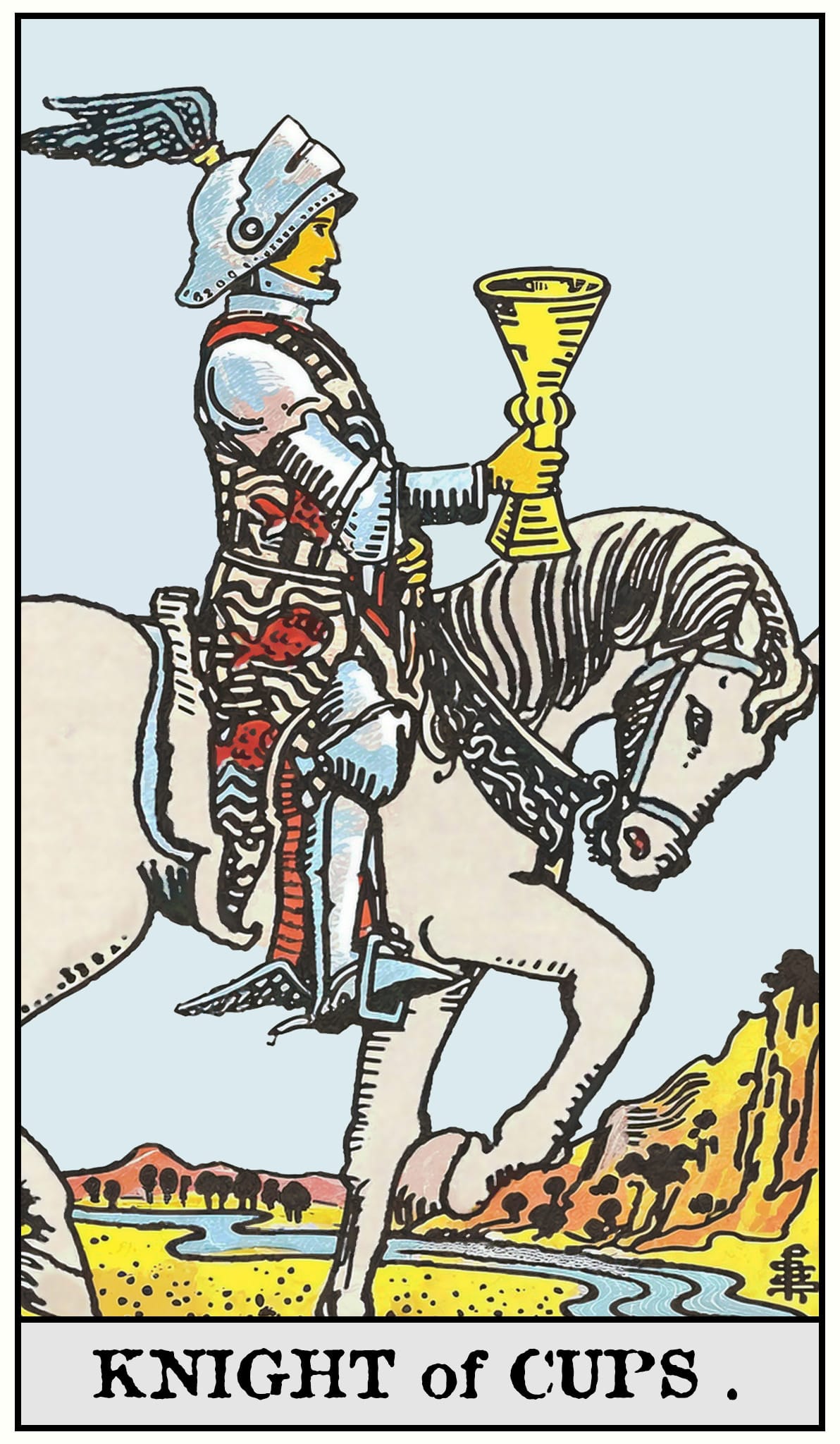
A knight on a white horse moving at a calm walk, wearing a winged helmet, his cloak decorated with fish — one cup extended forward in an offering gesture, a still river nearby.
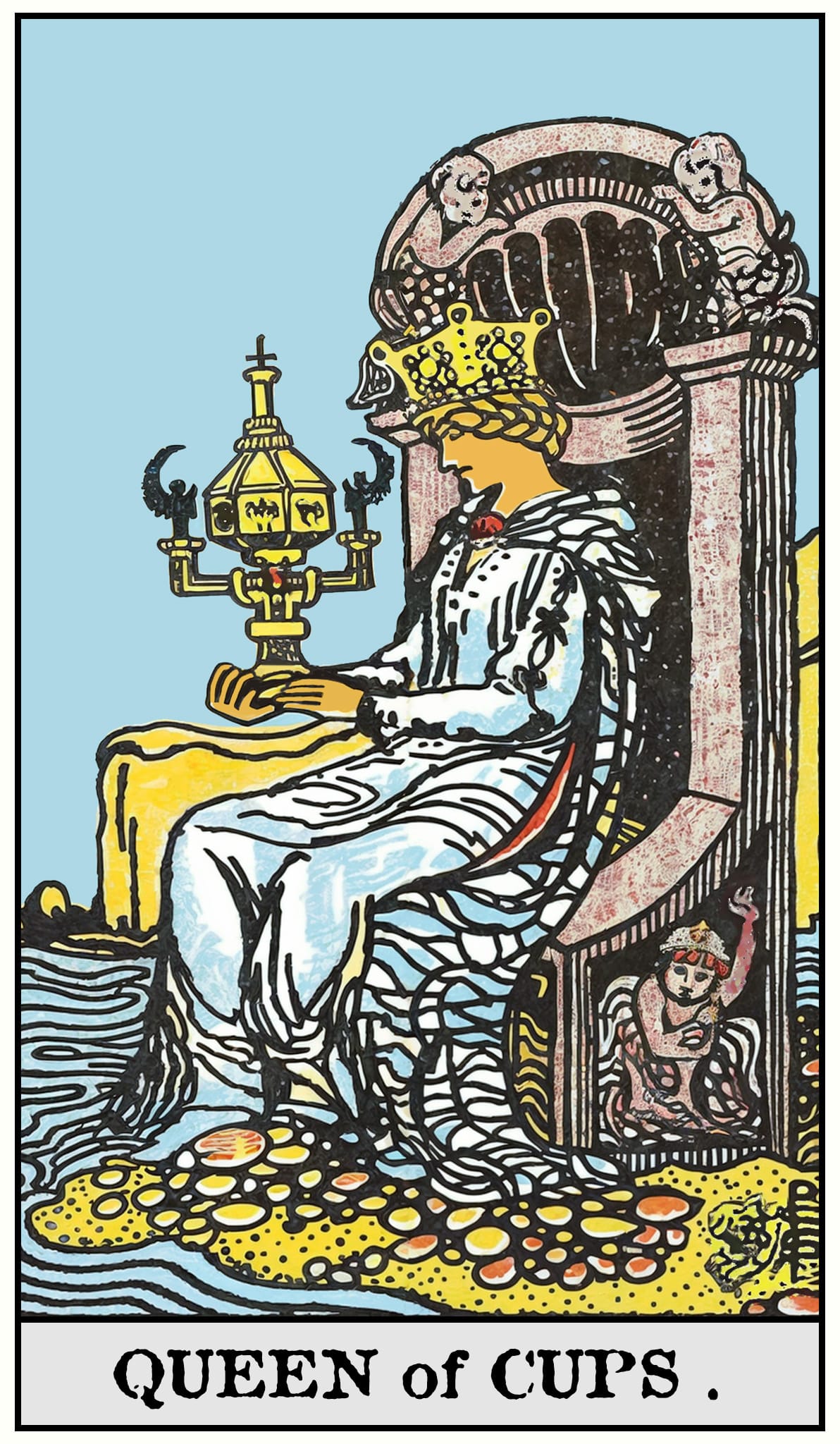
A woman on a throne at the water's edge holds a covered ornate chalice, gazing at it with focused attention — the sea moving around the base of her throne, the cup sealed, her eyes not on us.
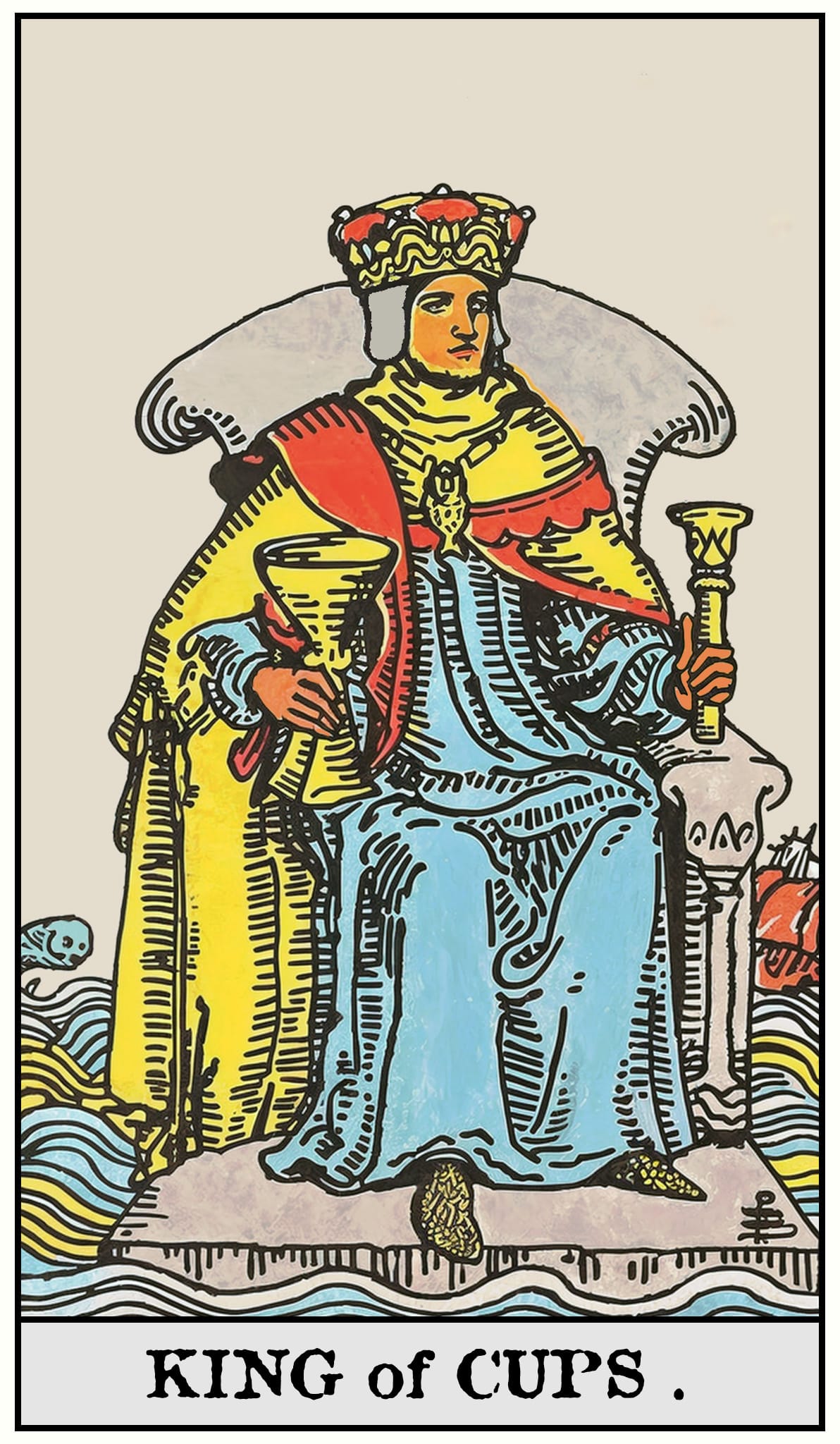
A king sits on a stone throne set directly in open water — waves moving around him, a fish amulet on his chest, a cup in one hand and a sceptre in the other, a leaping fish to his right and a ship in the distance to his left.
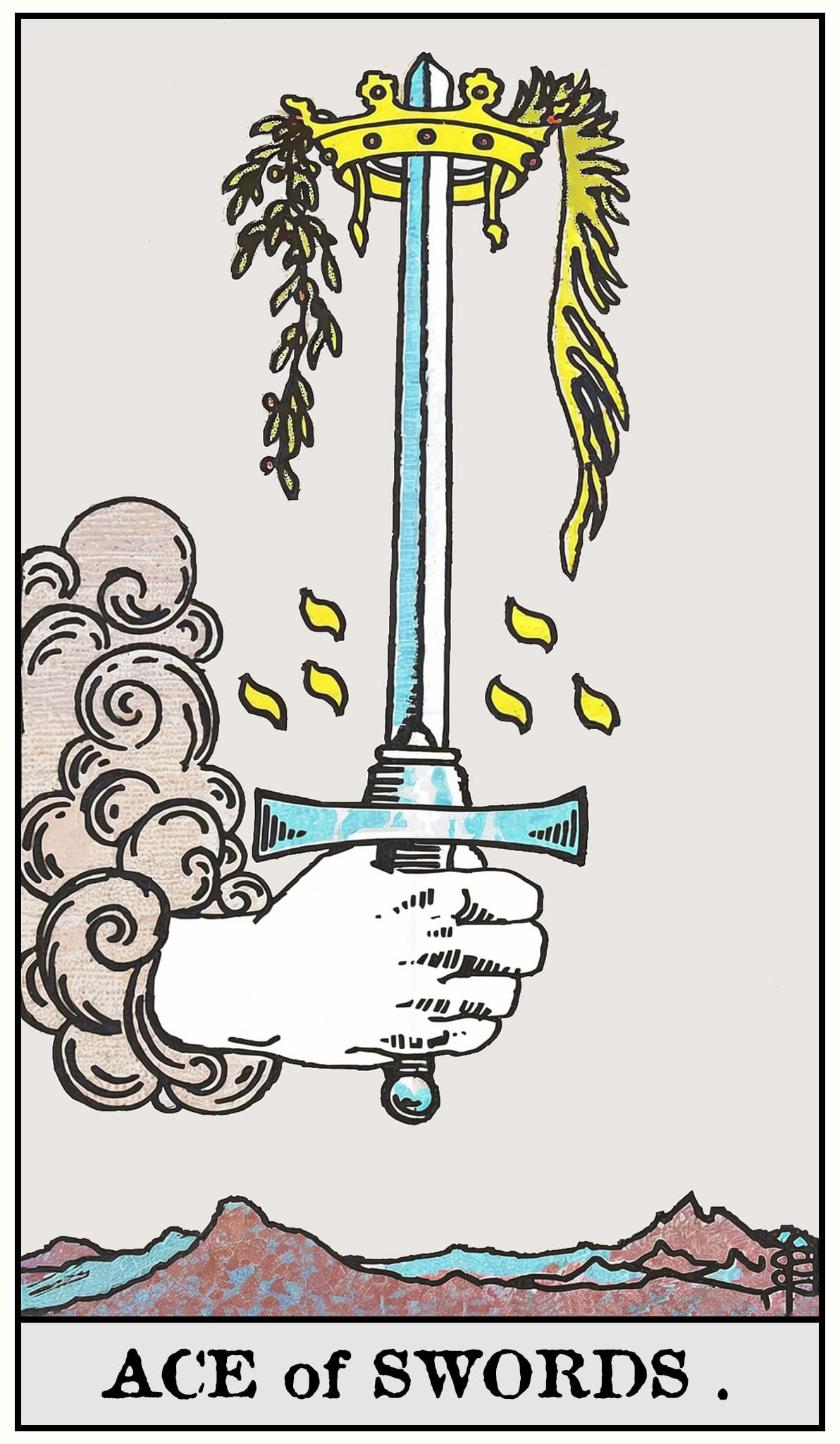
A hand emerges from a cloud gripping an upright sword, a crown floating at its tip hung with palm and olive branches — bare mountains in the distance, the blade clean, unused.
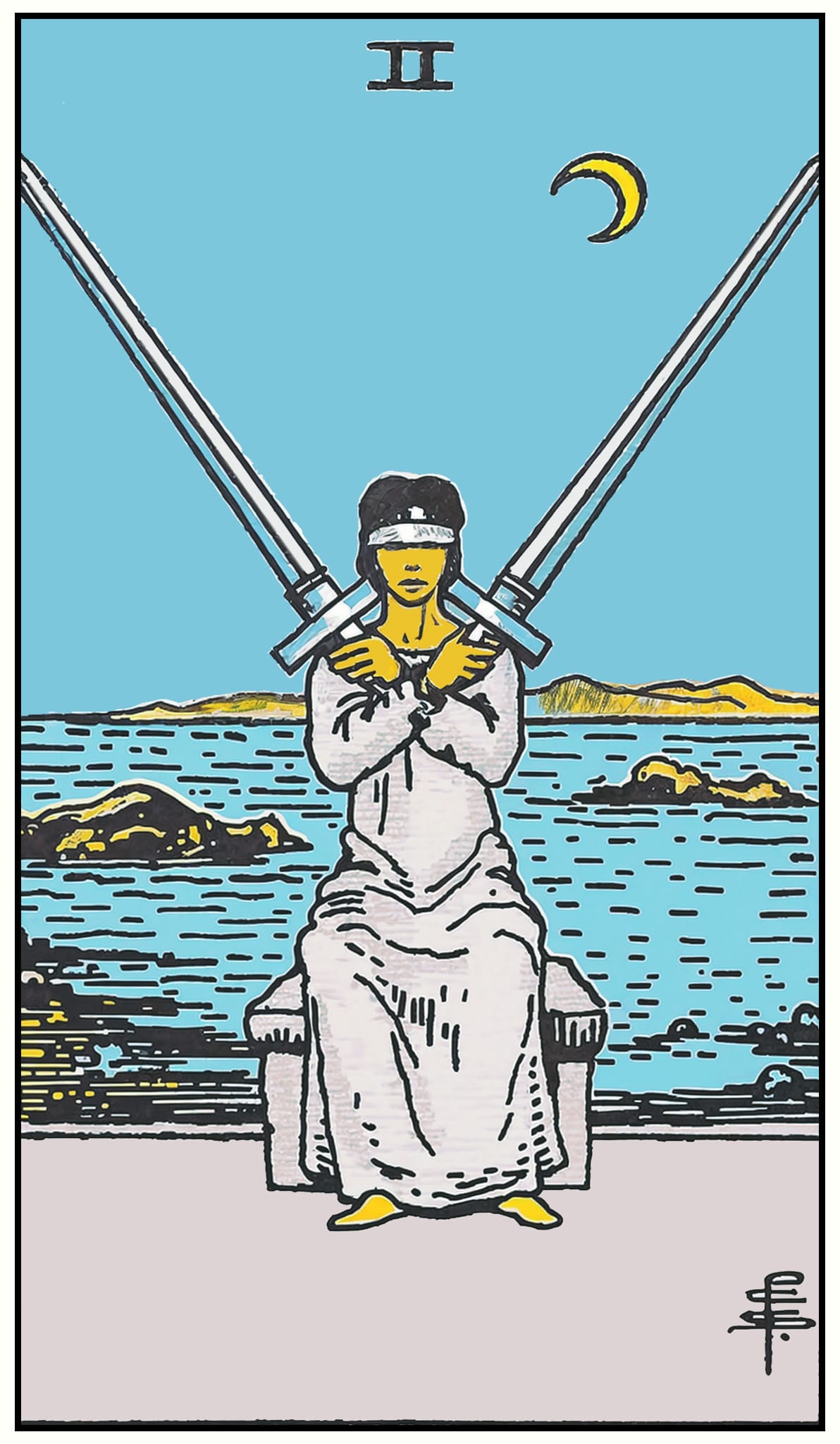
A blindfolded woman sits before a still sea with two swords crossed at her chest, arms holding both — the balance maintained but the blindfold required, the crescent moon behind her, rocky outcrops breaking the water's surface.
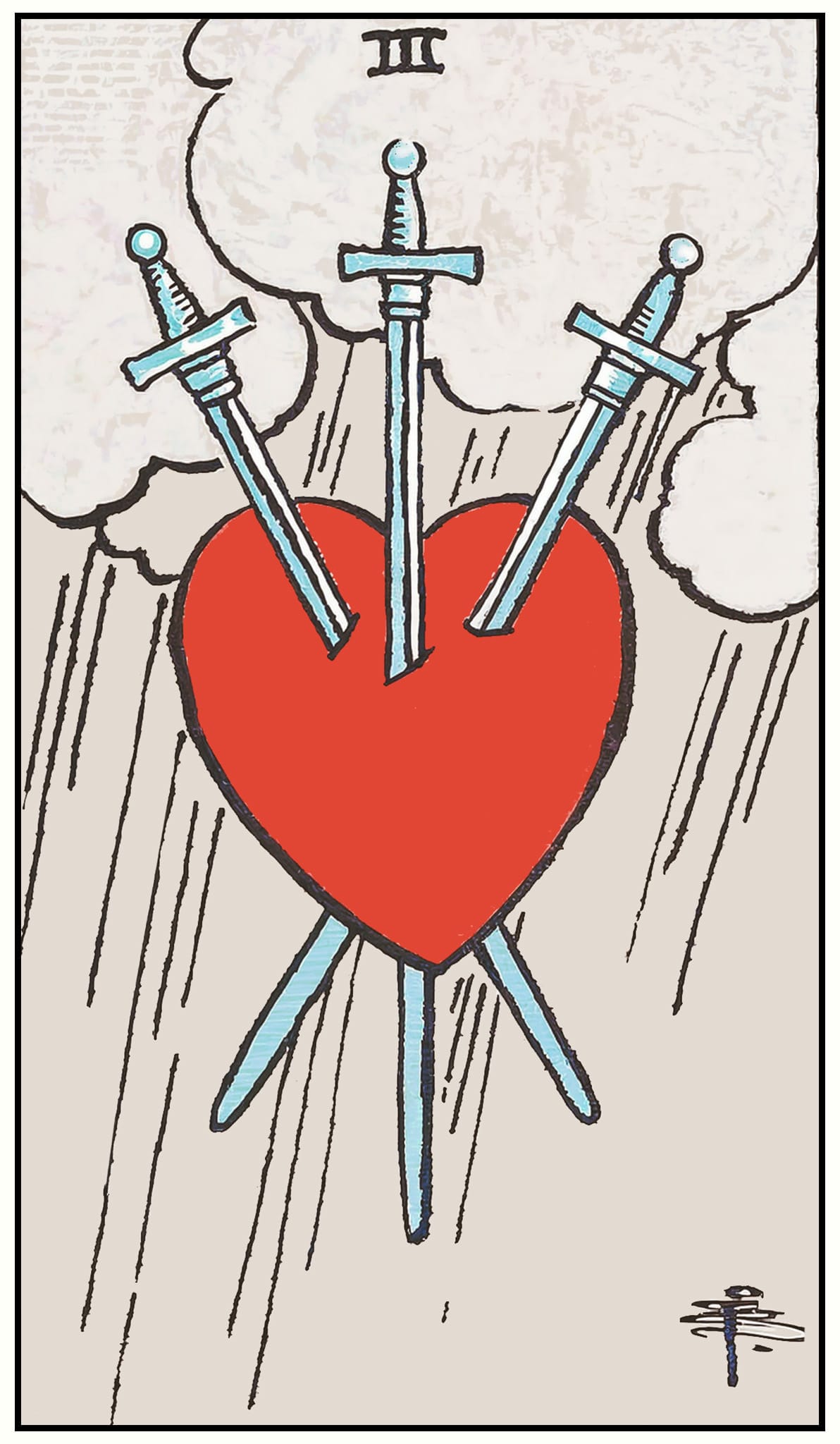
Three swords pierce a red heart against a grey sky. Rain falls. There is no figure, no narrative, no resolution. Only the heart, the swords, and the cold weather.
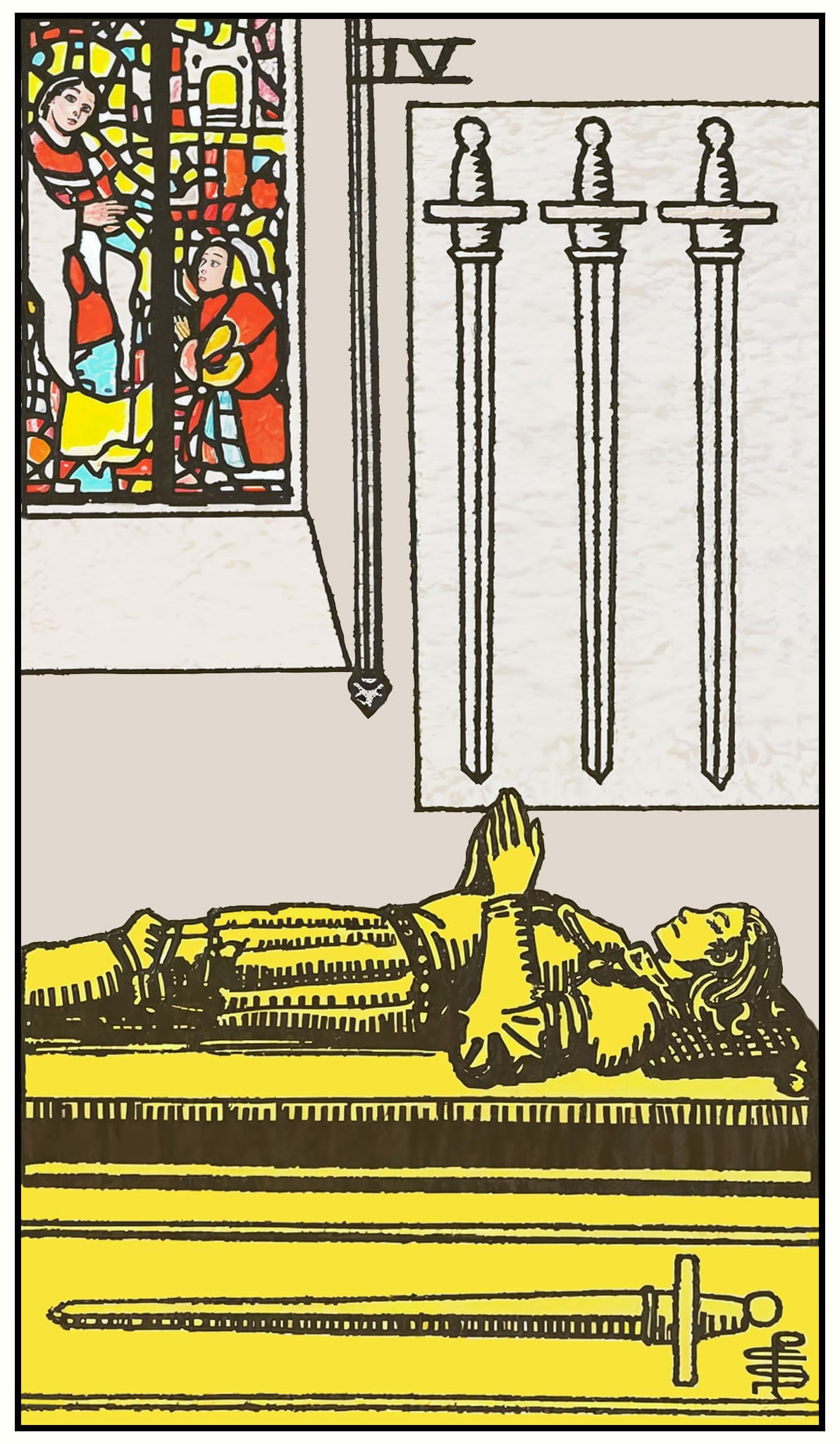
A stone effigy of a knight lies in repose on a tomb, hands joined, three swords on the wall above him, one sword aligned beneath his body — stained glass light falling across the stillness.
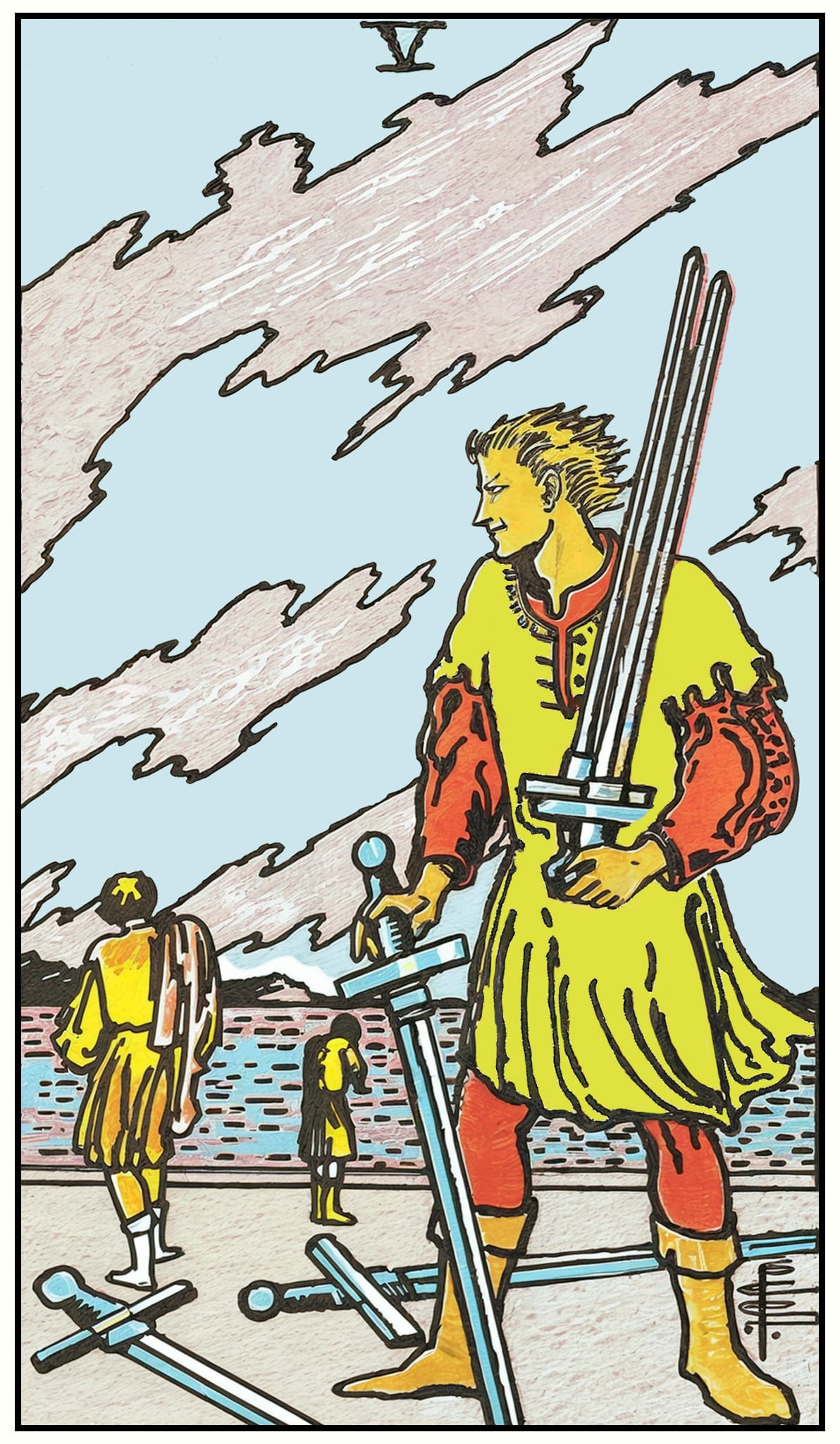
A figure bends to gather three swords from the ground, two already in hand — five total, heavy. He glances back at two retreating figures, their shoulders dropped. The sky is torn with turbulent clouds.
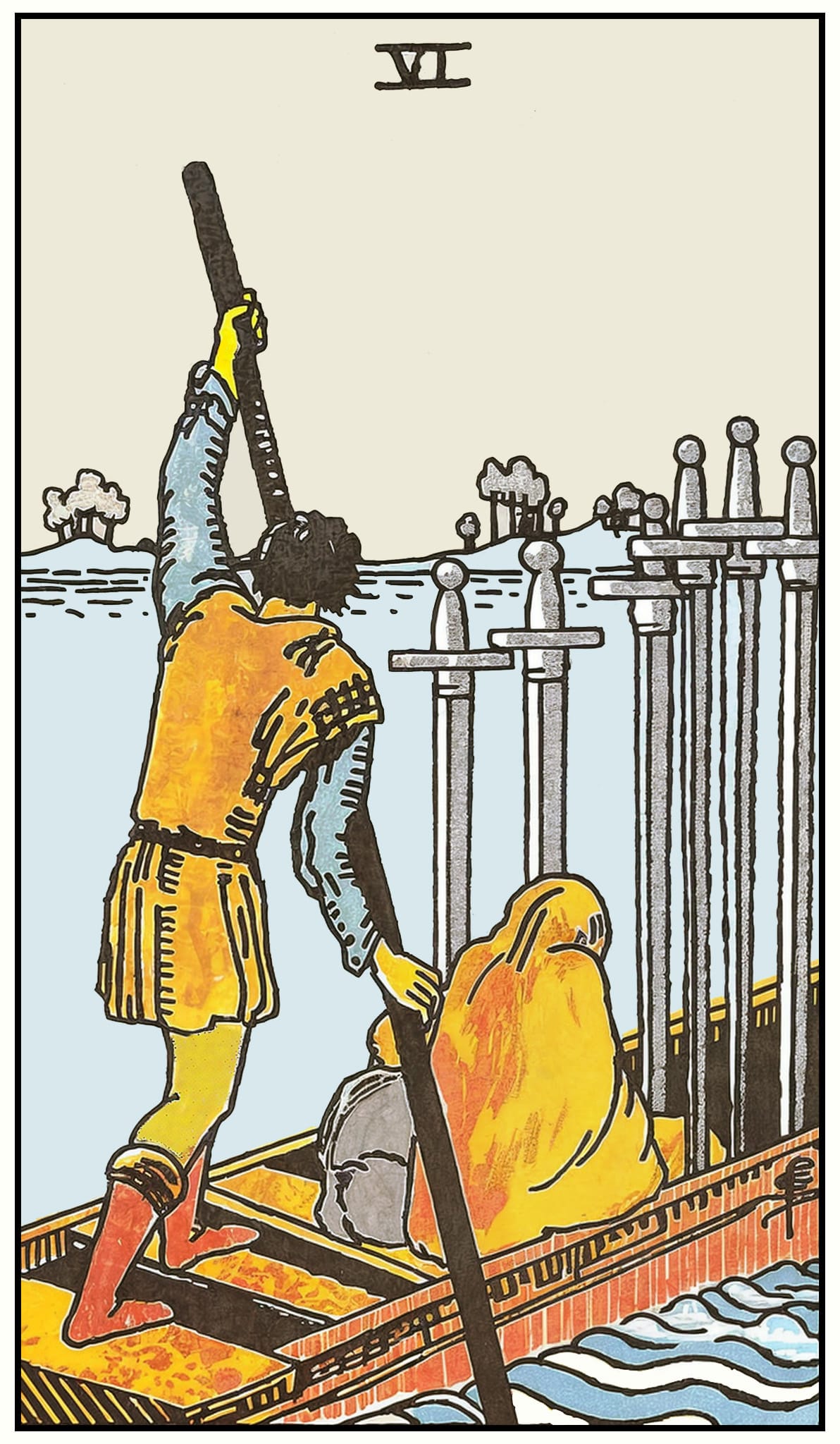
A ferryman poles a boat across still water — a woman and child sit cloaked in the prow, turned away, six swords standing upright in the bow. The water on the near side is choppy; the far side, calm.
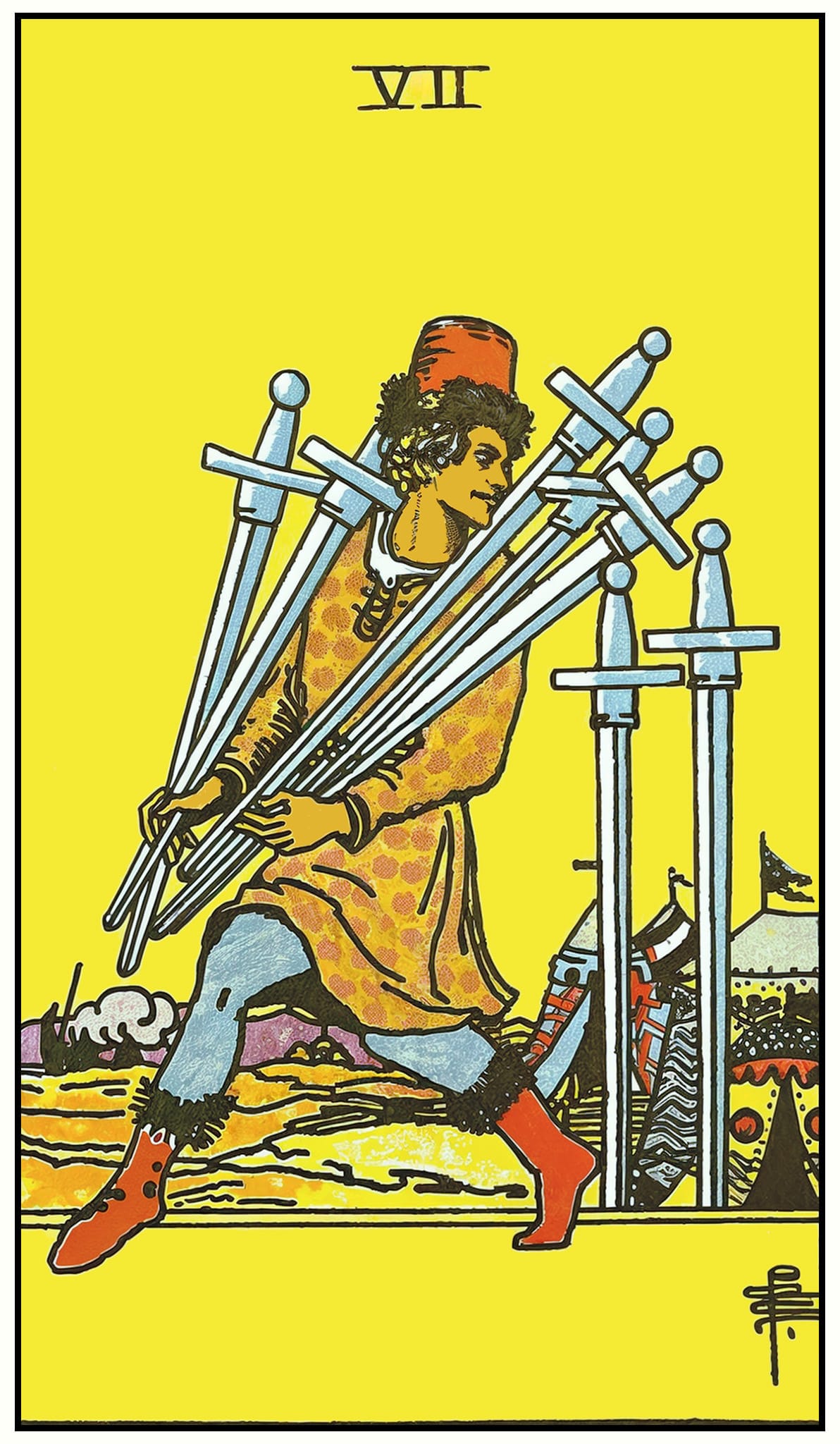
A figure in yellow shoes tiptoes away from a military encampment, five swords in his arms, glancing back over his shoulder — two swords still planted in the ground behind him.
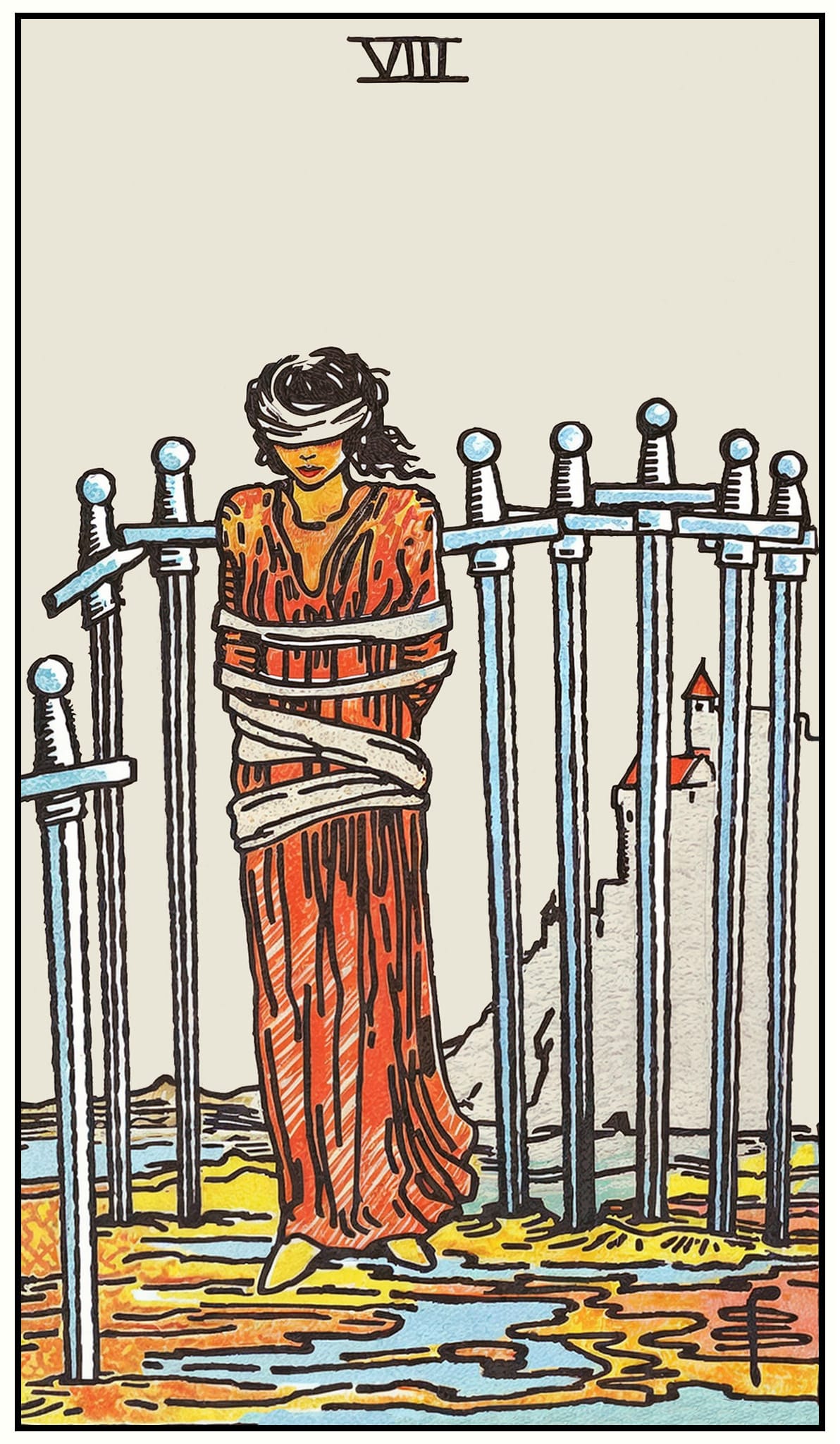
A woman stands bound and blindfolded, eight swords planted in the earth in a loose semicircle around her — the swords not touching her, the binding not tight, the exit present and unused.
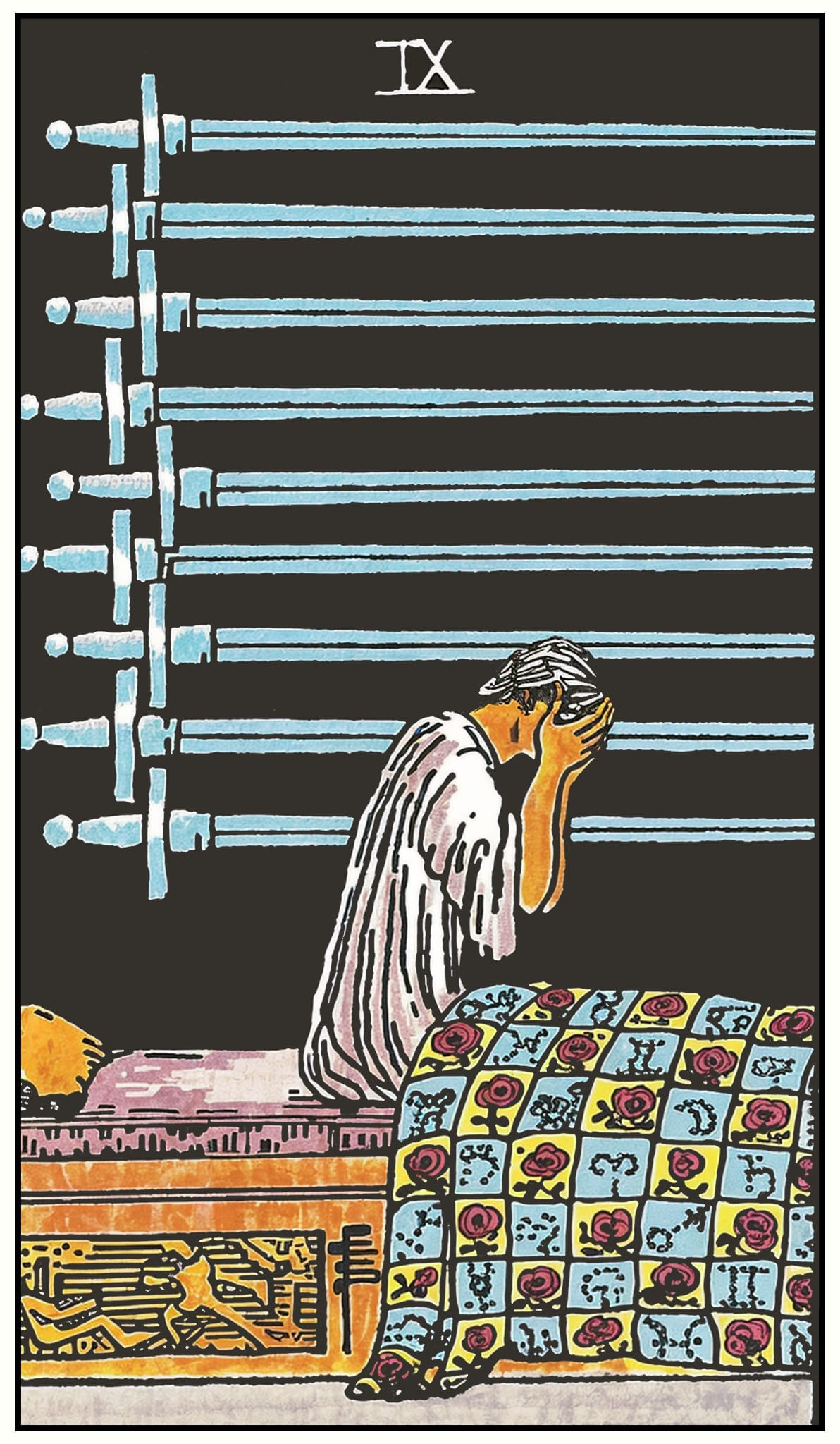
A figure sits upright in bed, hands covering their face, nine swords mounted horizontally on the wall behind them — the roses and astrological symbols of the blanket continuing undisturbed below the midnight terror above.
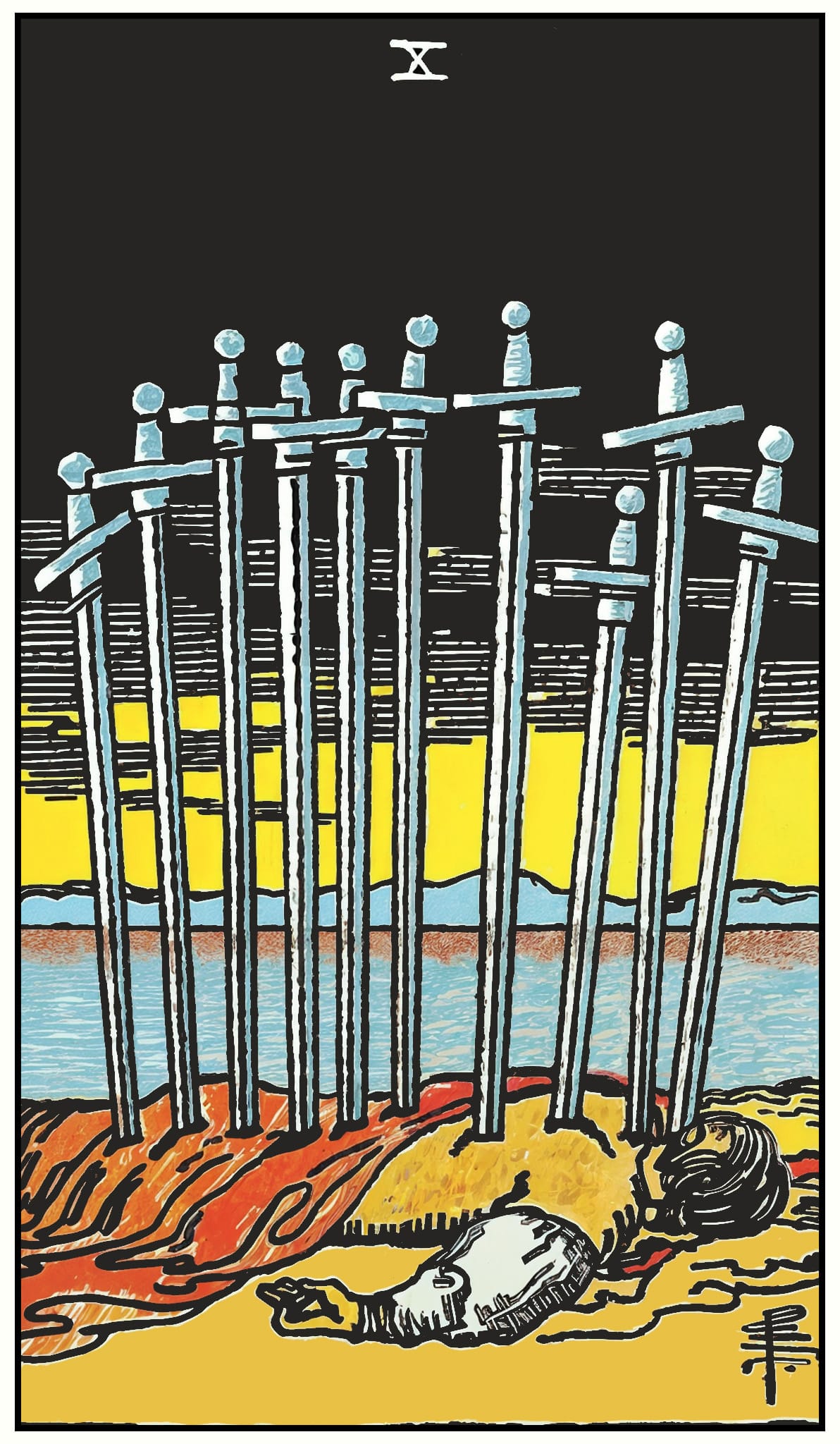
A figure lies face down on dark ground, ten swords planted in the back. In the distance, a still sea. Above it, a thin band of gold light at the horizon — the sky beginning, barely, to clear.
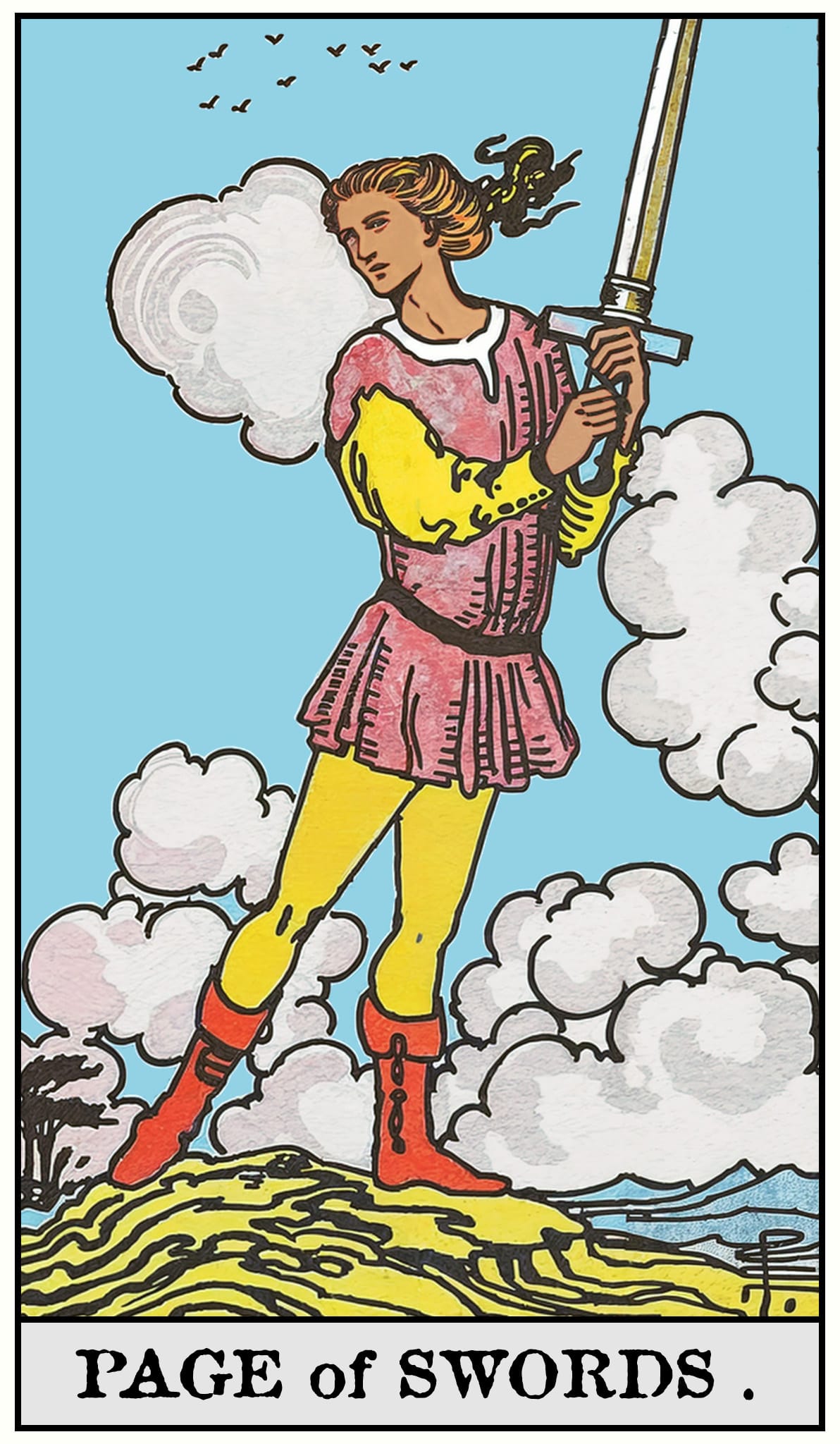
A young figure stands on a hilltop, sword raised in readiness, wind moving everything — hair, clouds, trees in the distance. The ground is uneven. The posture is alert. The expression is that of someone who has just heard something and is not yet sure what it means.
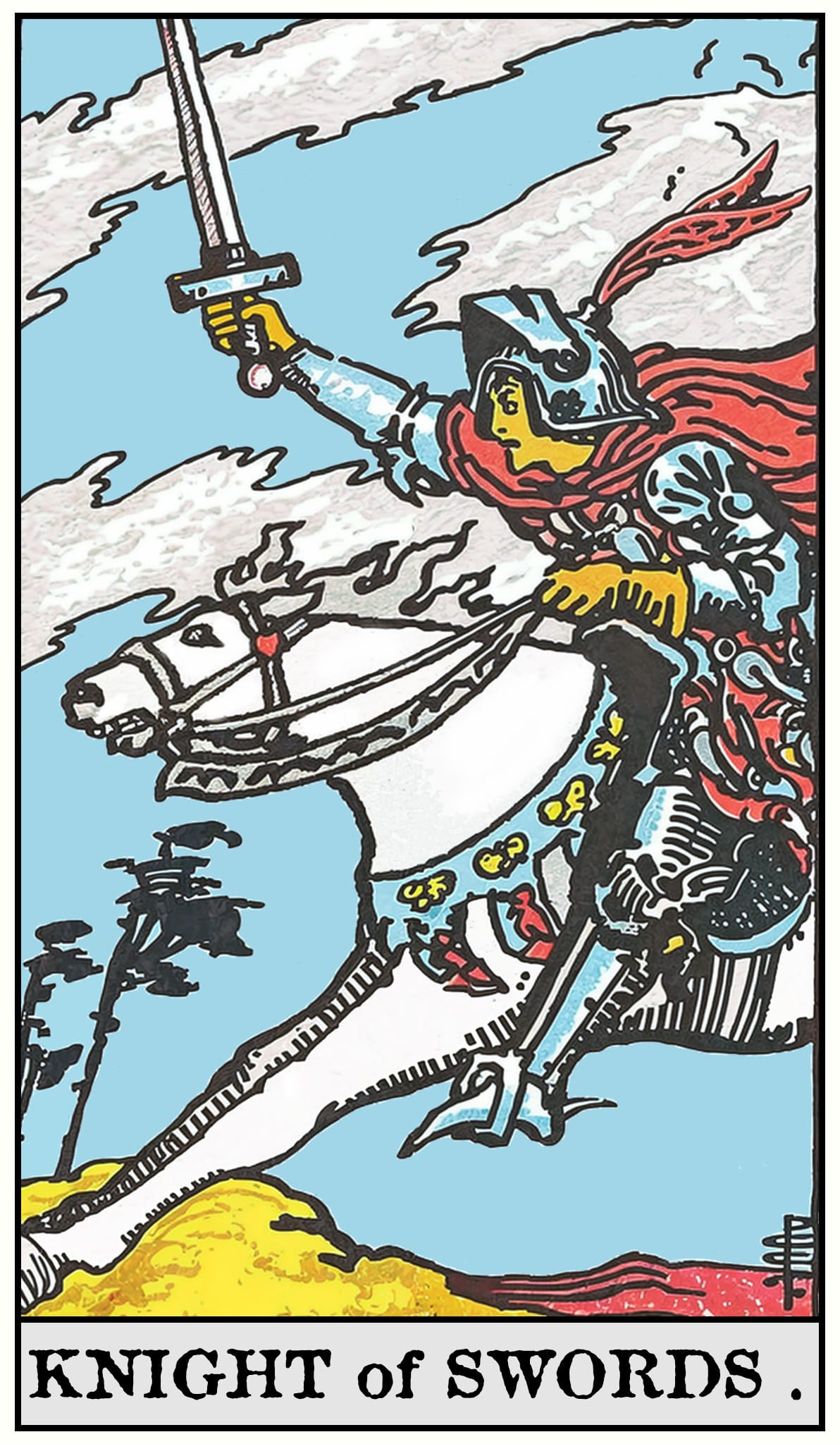
A knight charges at full gallop, sword extended forward — clouds tearing apart in the wake, trees bending, the horse's hooves barely touching the ground. He is not looking for a target. He has already decided what the target is.
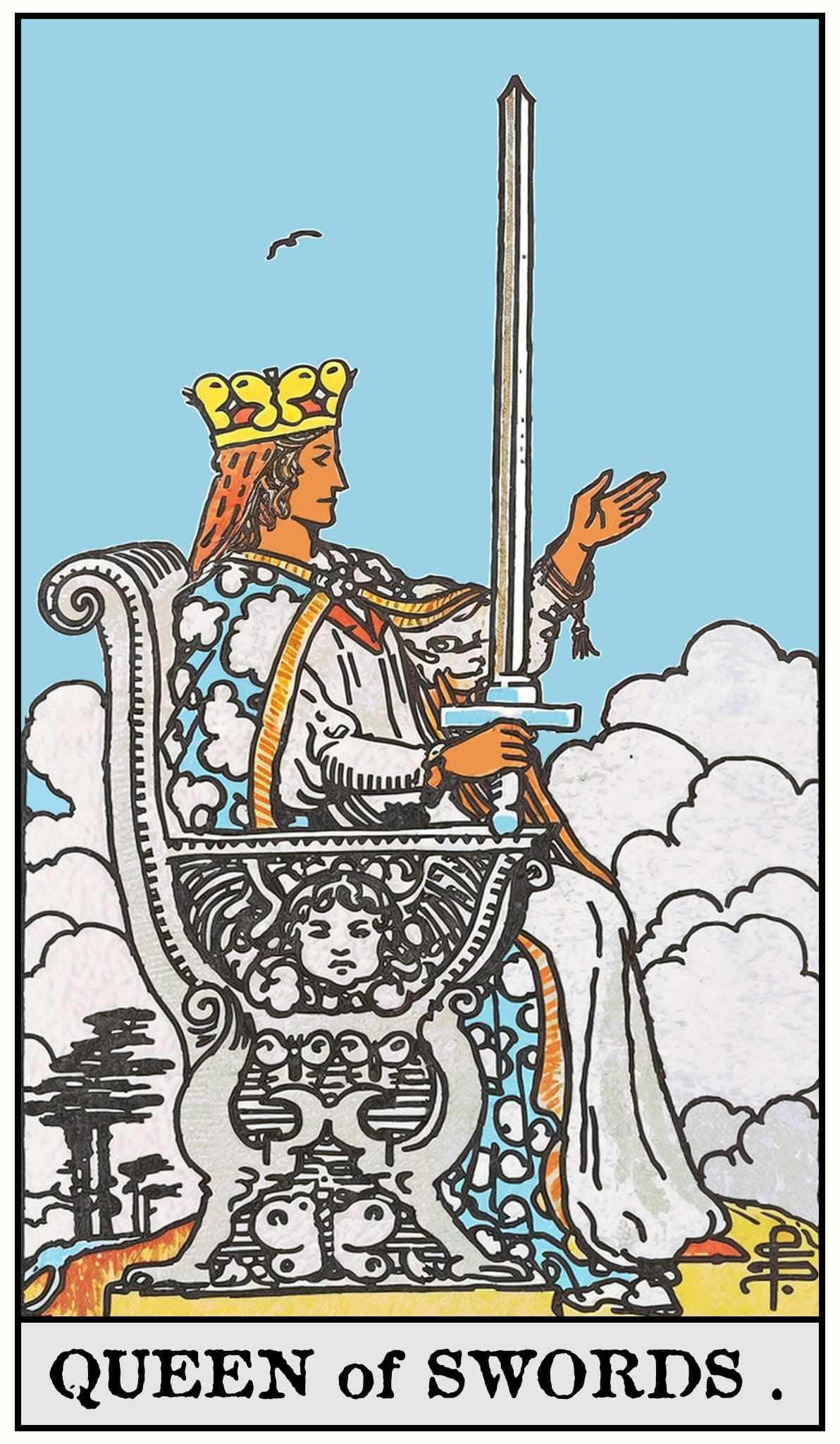
A woman sits above the clouds on a stone throne, sword raised vertically, left hand extended open — butterflies on her crown, one on her wrist, her face clear and turned slightly to the side as if listening to something just past the frame.
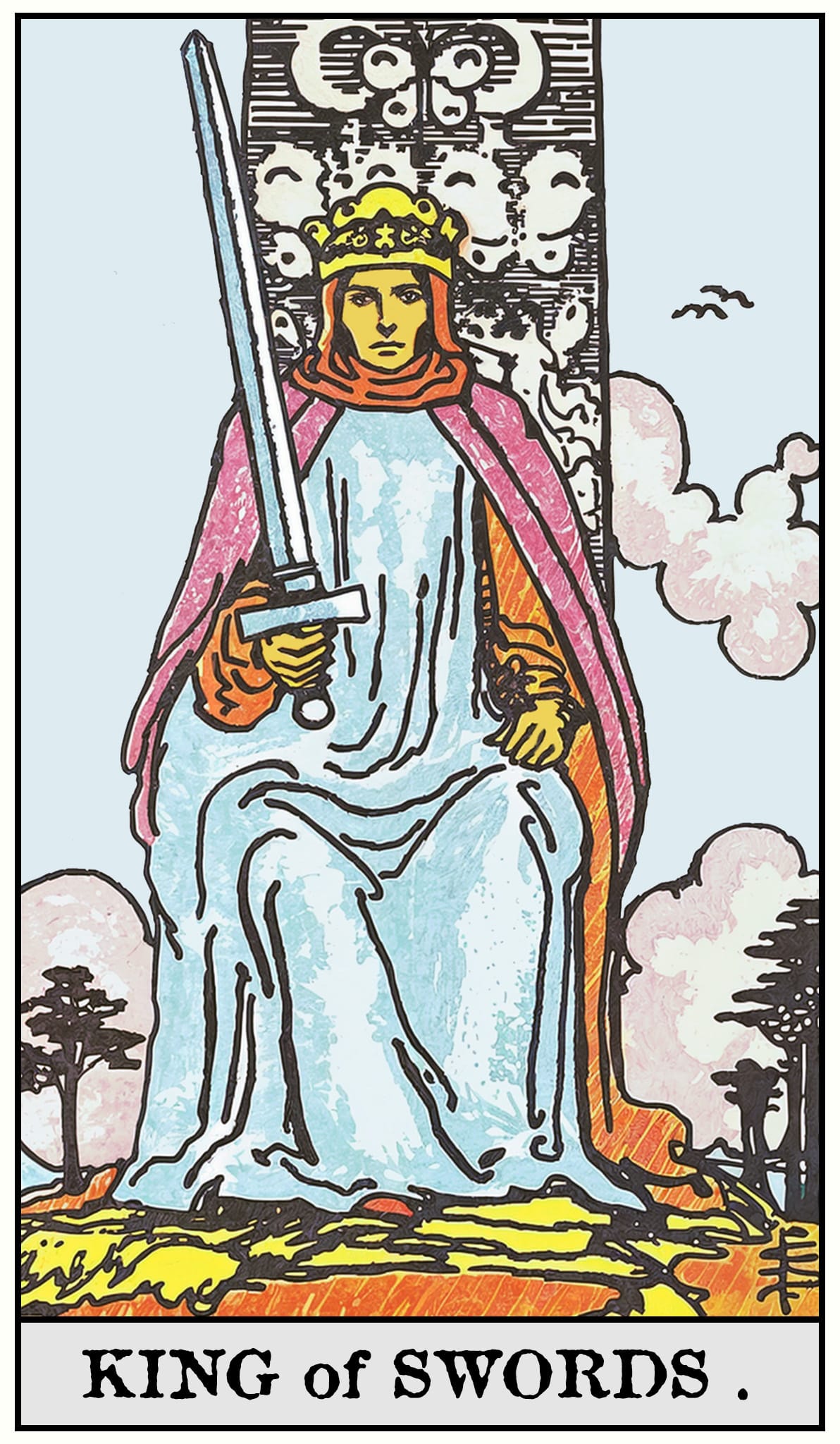
A king sits upright on a stone throne, sword raised vertically toward the sky, gaze direct and looking just past us — at the place where the actual situation is. Plain crown. Blue robe. No decoration that is not functional.
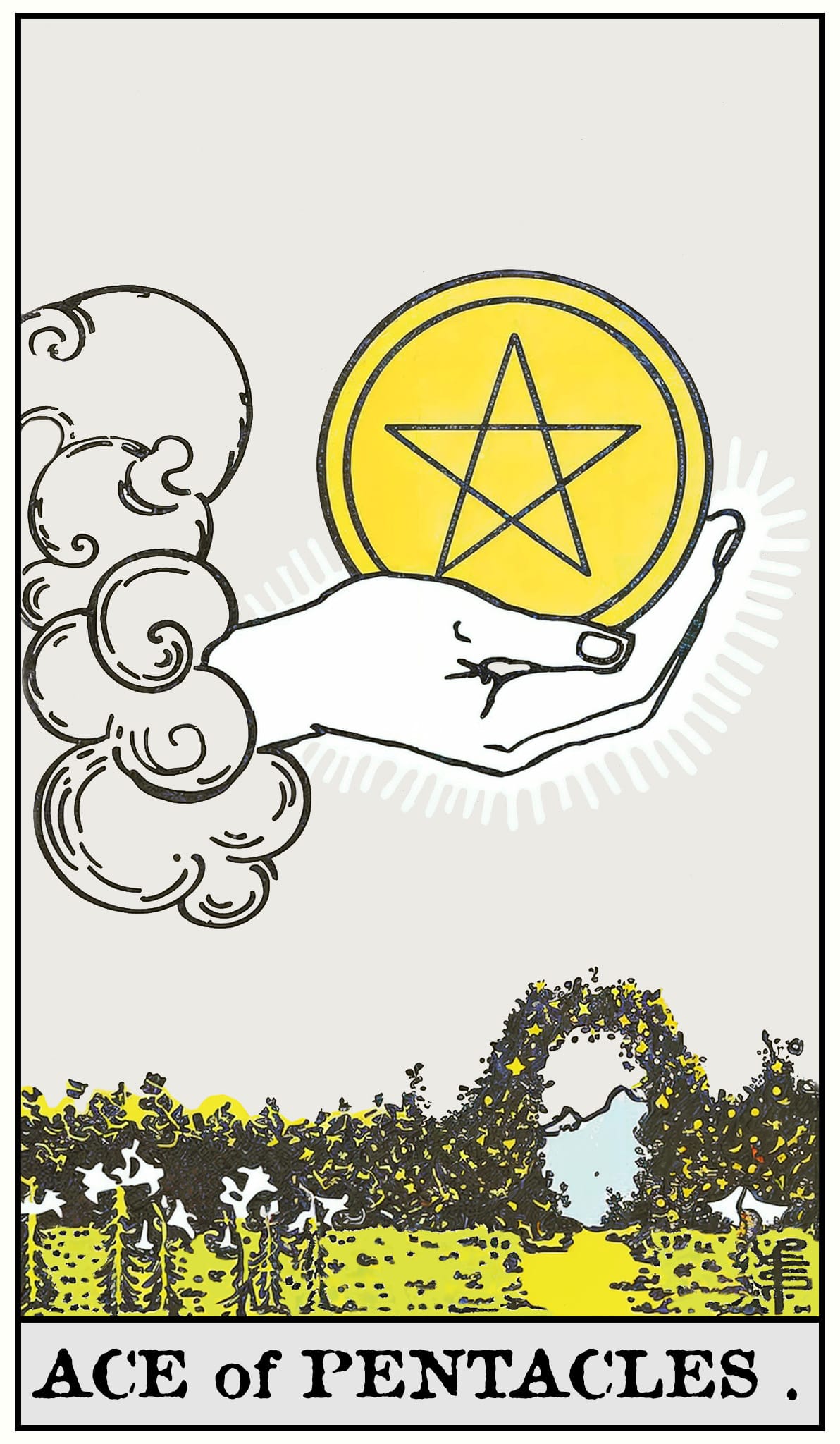
A hand emerges from a cloud holding a single golden pentacle — below, an archway of roses opening onto a garden path that winds toward distant mountains.
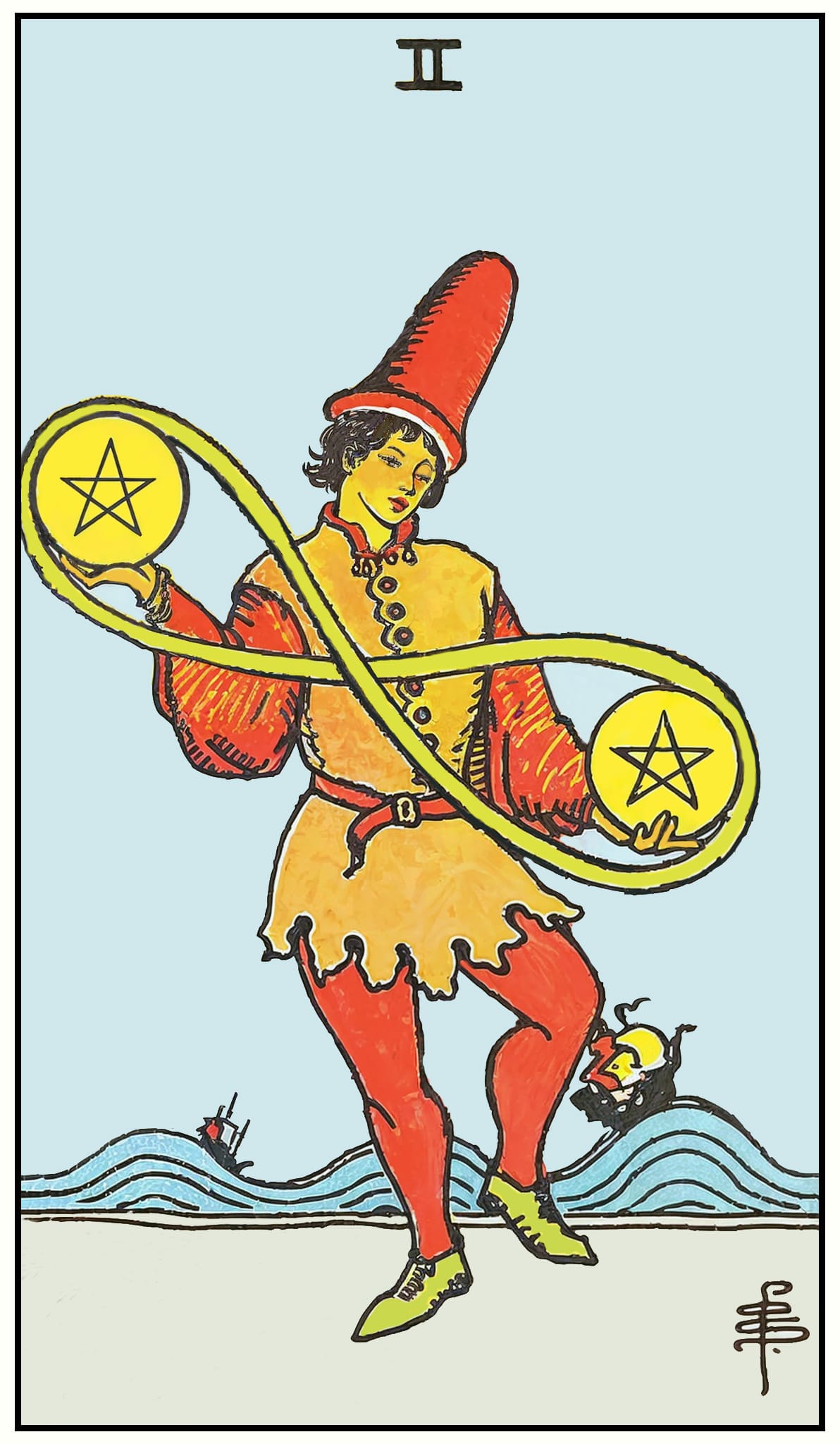
A young figure dances on a shoreline, juggling two pentacles connected by an infinity loop — two ships riding enormous waves on the sea behind him, and a smile on his face.
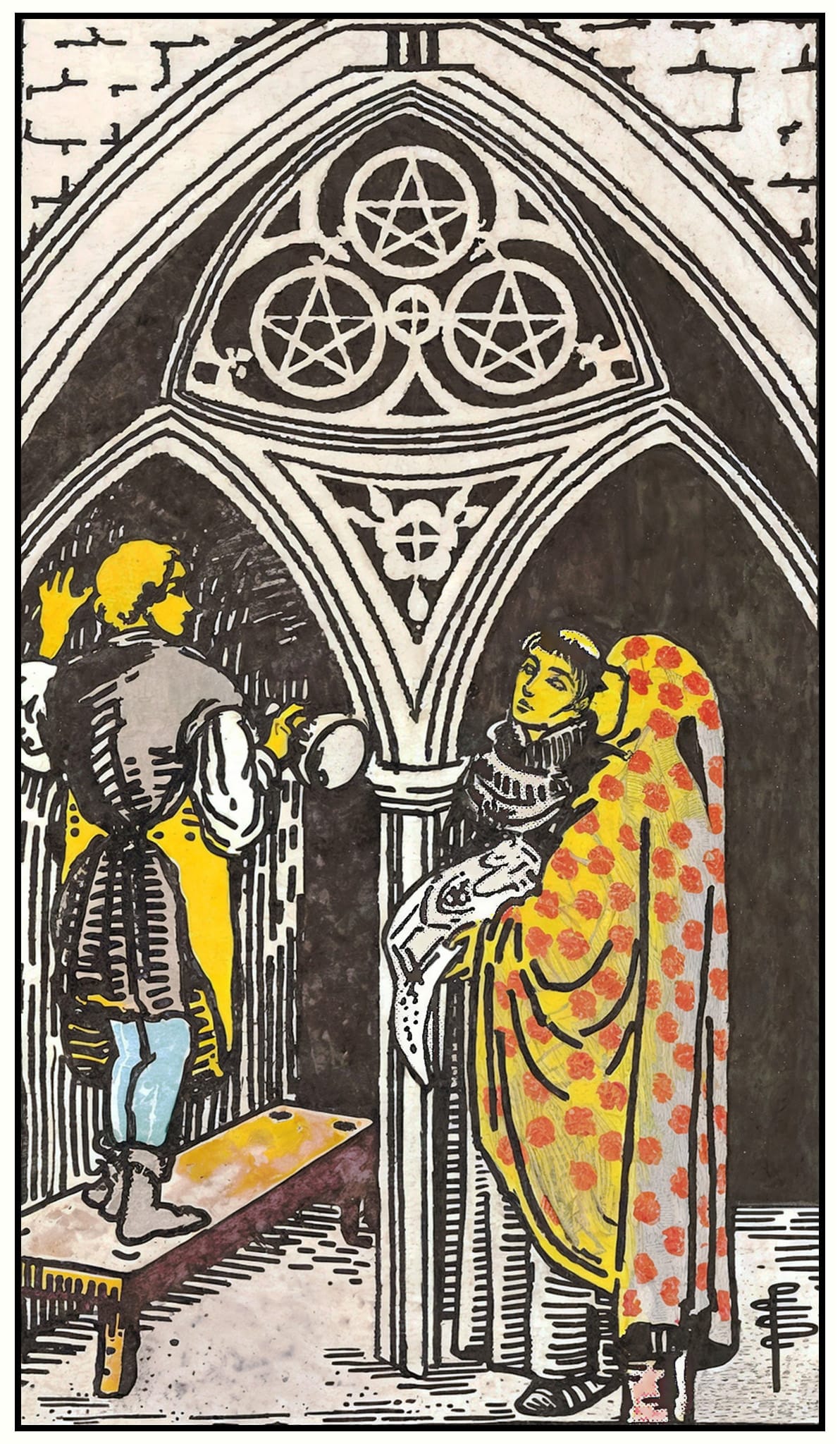
Three figures stand in a cathedral under construction — an architect with plans, a monk consulting, a craftsman working the stone on a platform above. Three pentacles carved into the arch. The work is not finished. The collaboration is deliberate.
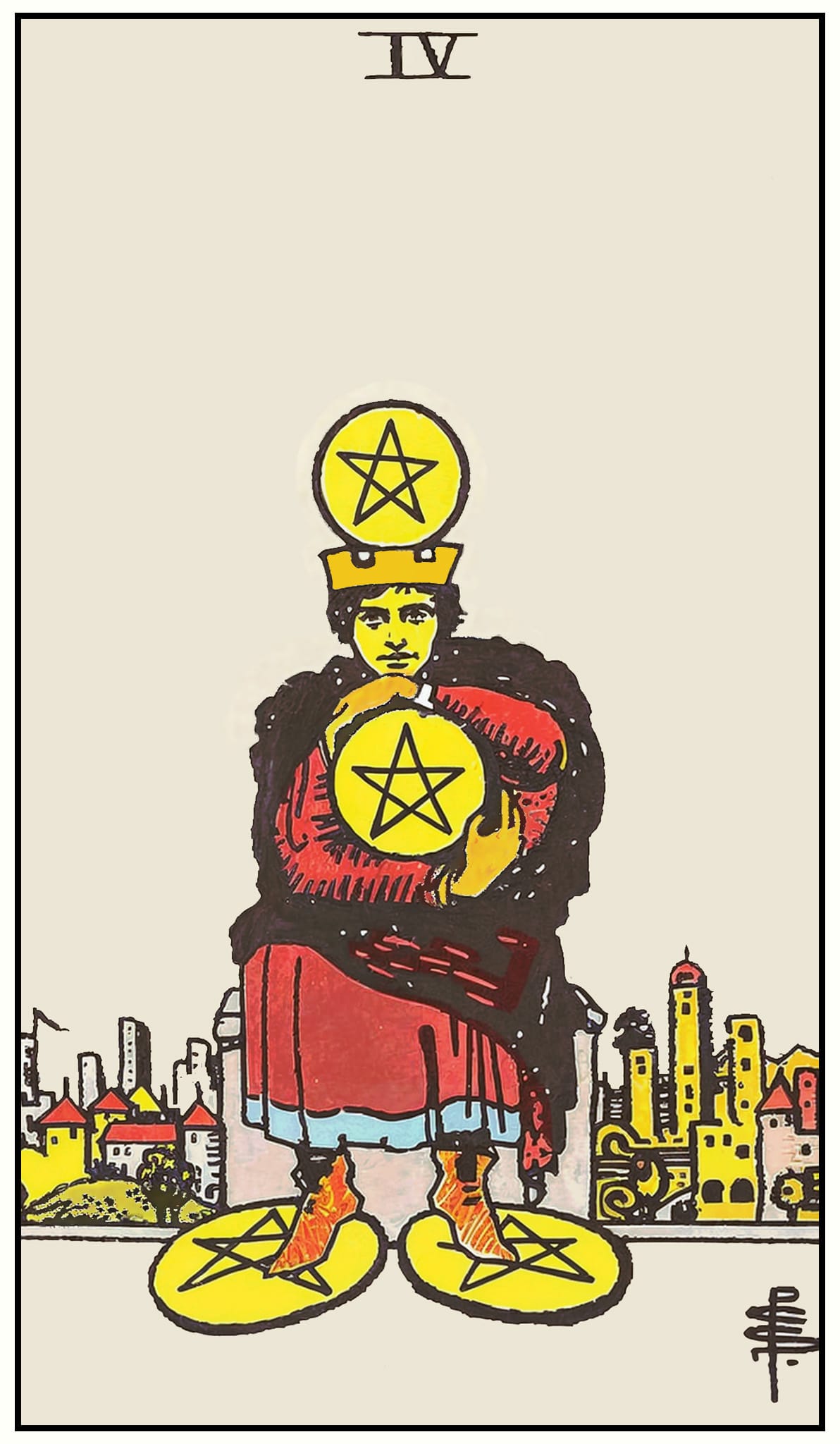
A crowned figure sits rigidly at the city's edge, one pentacle pressed to his chest, one balanced on his crown, two beneath his feet. His posture is a fortress. The city behind him is unvisited.
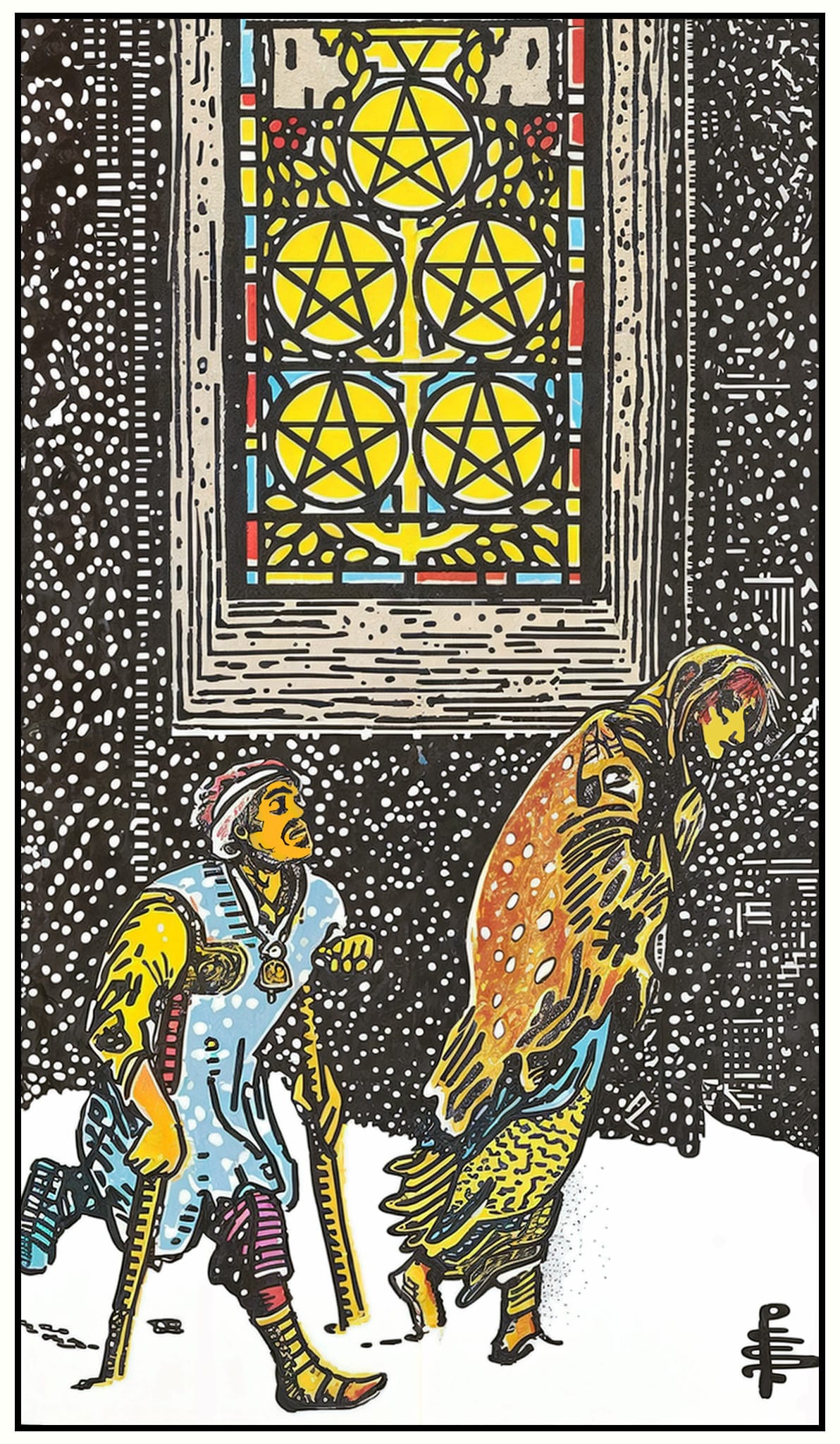
Two figures move through snow outside a lit church window — one on crutches, one hunched against the cold. The window blazes with warm light and five pentacles in the stained glass. They are not looking at it.
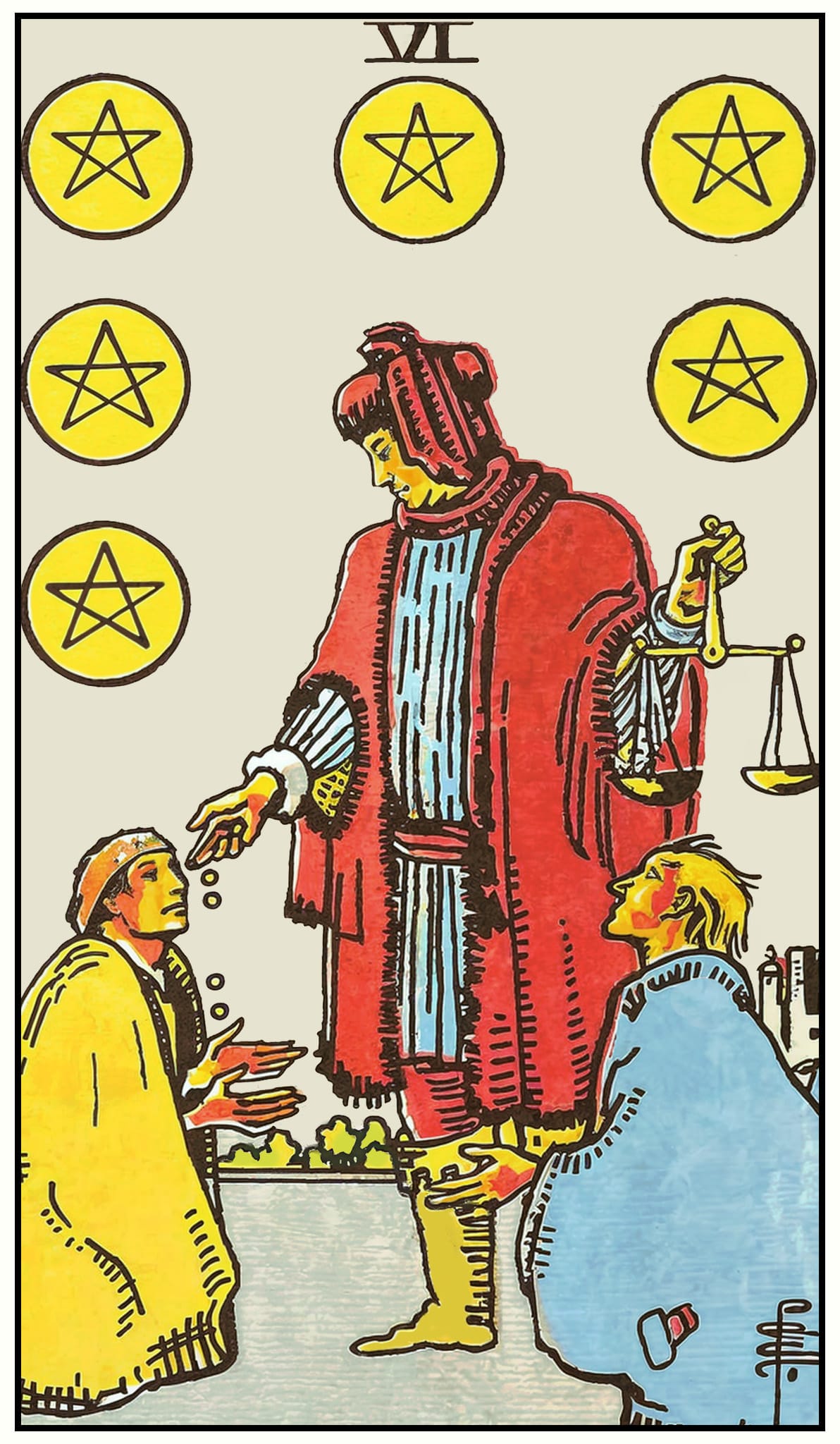
A wealthy merchant stands holding scales, distributing coins to two kneeling figures. The scales are balanced. The transaction is orderly. Whether this is generosity or the maintenance of a social order that requires the supplicants to remain supplicants is the card's deliberate ambiguity.
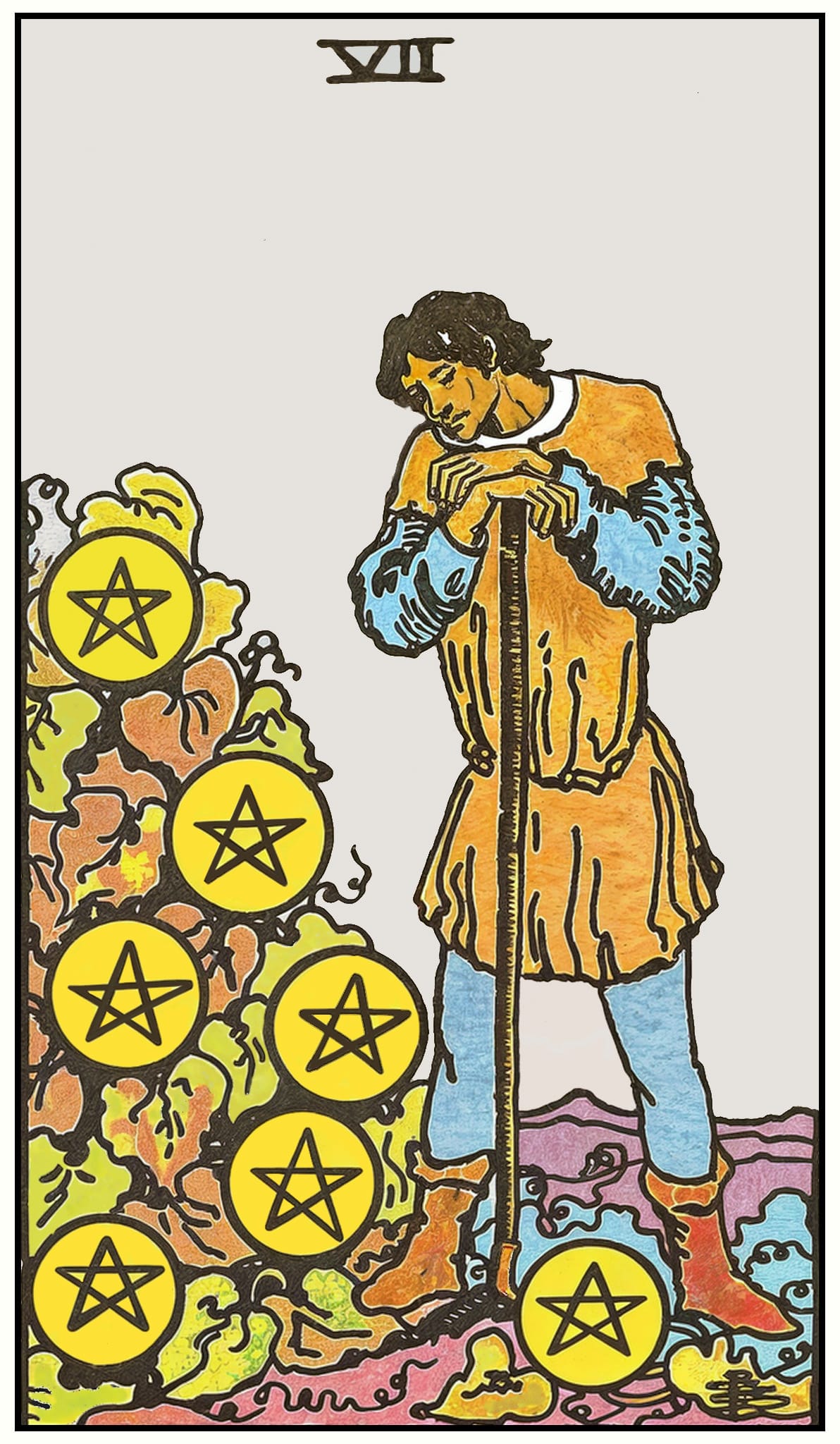
A figure leans on his hoe, looking at a vine heavy with seven pentacles — the work of the season done, the harvest not yet ready, the body at rest but the attention entirely given to what grows.
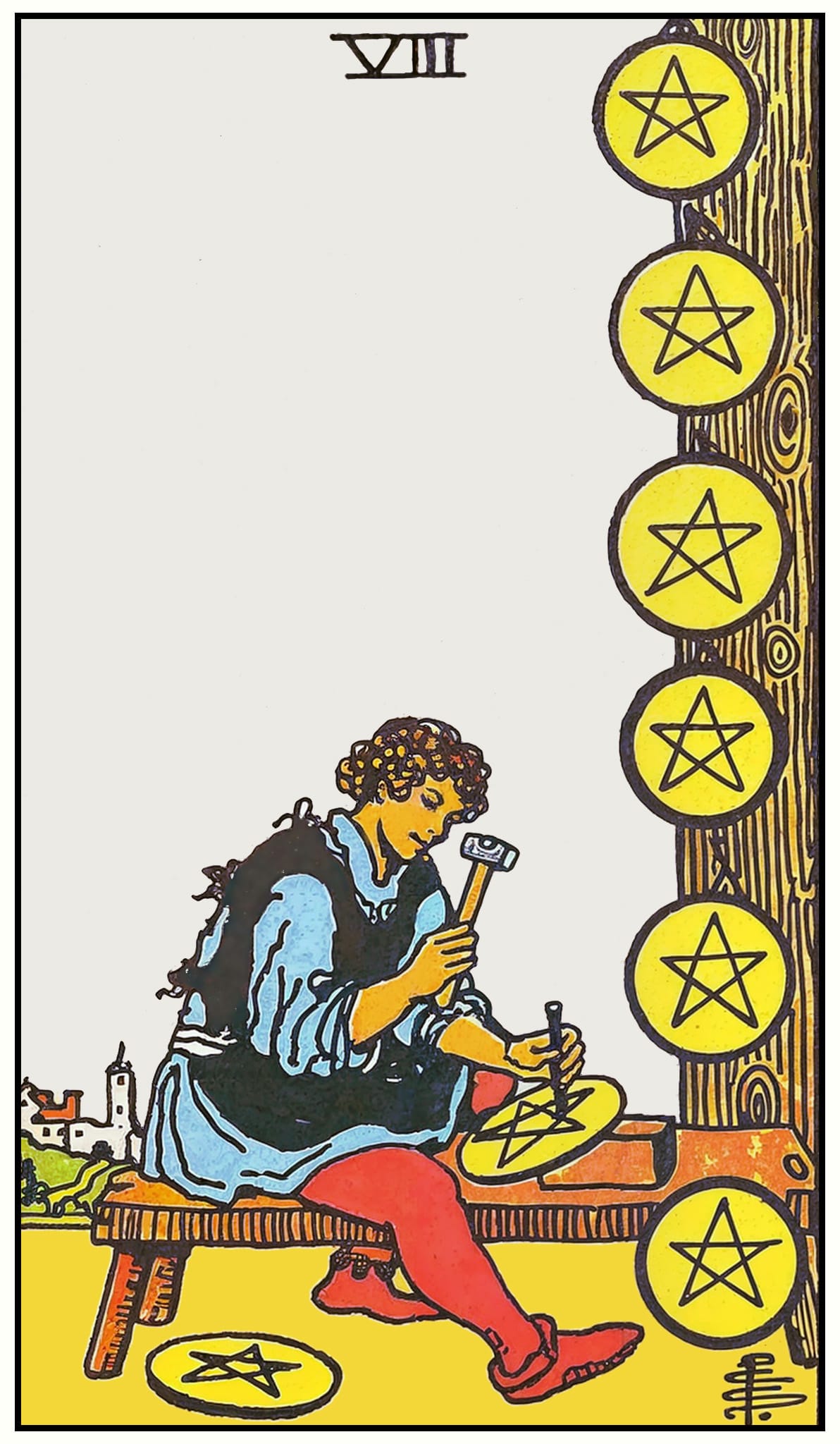
A craftsman at his workbench carves a pentacle, seven more mounted on a post beside him — his back to the distant town, the work not for the town, not yet.
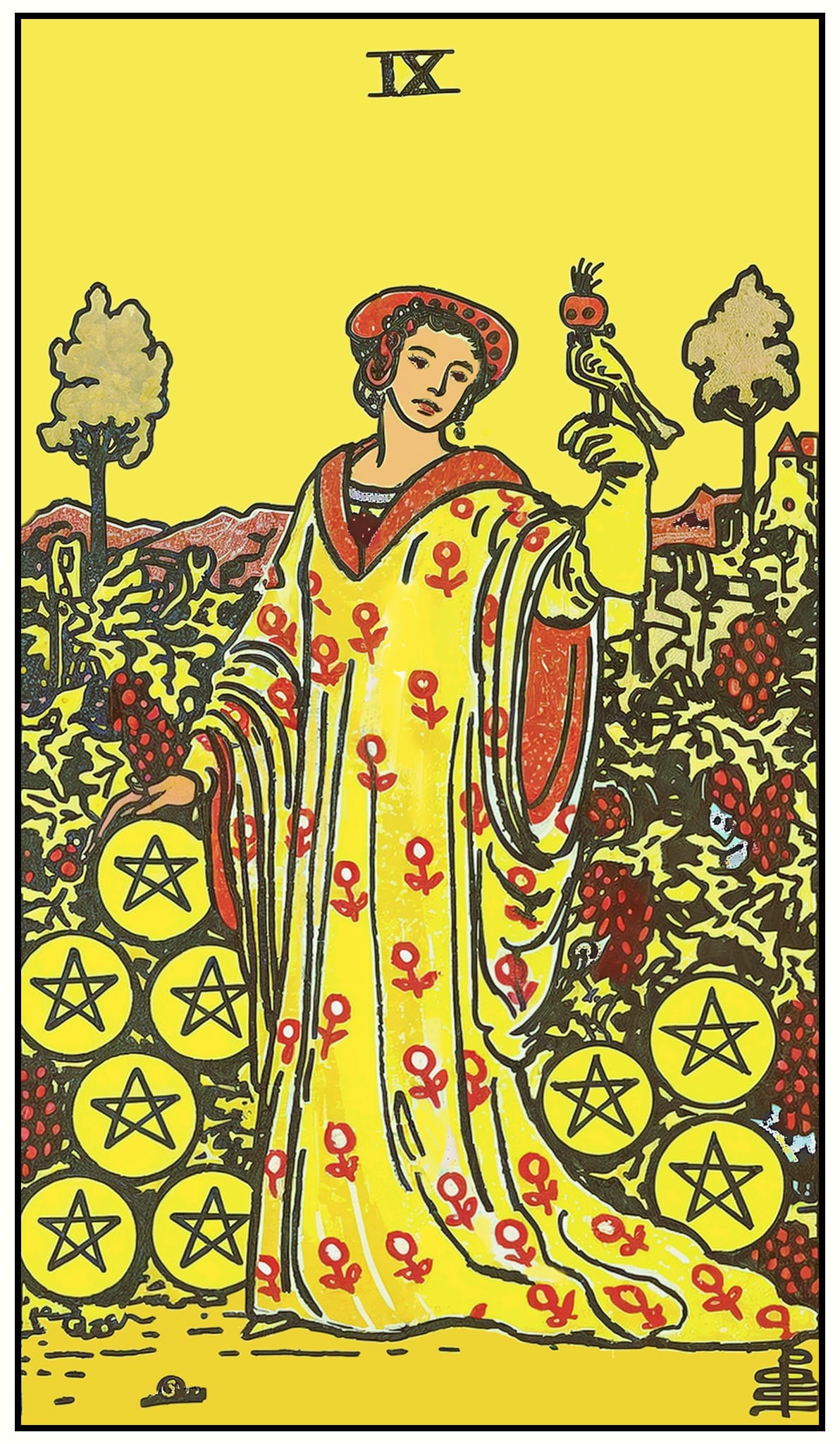
A woman stands alone in a vineyard, richly dressed, a hooded falcon on her gloved hand — nine pentacles heavy in the vines around her, a snail at her feet, her house in the distance.
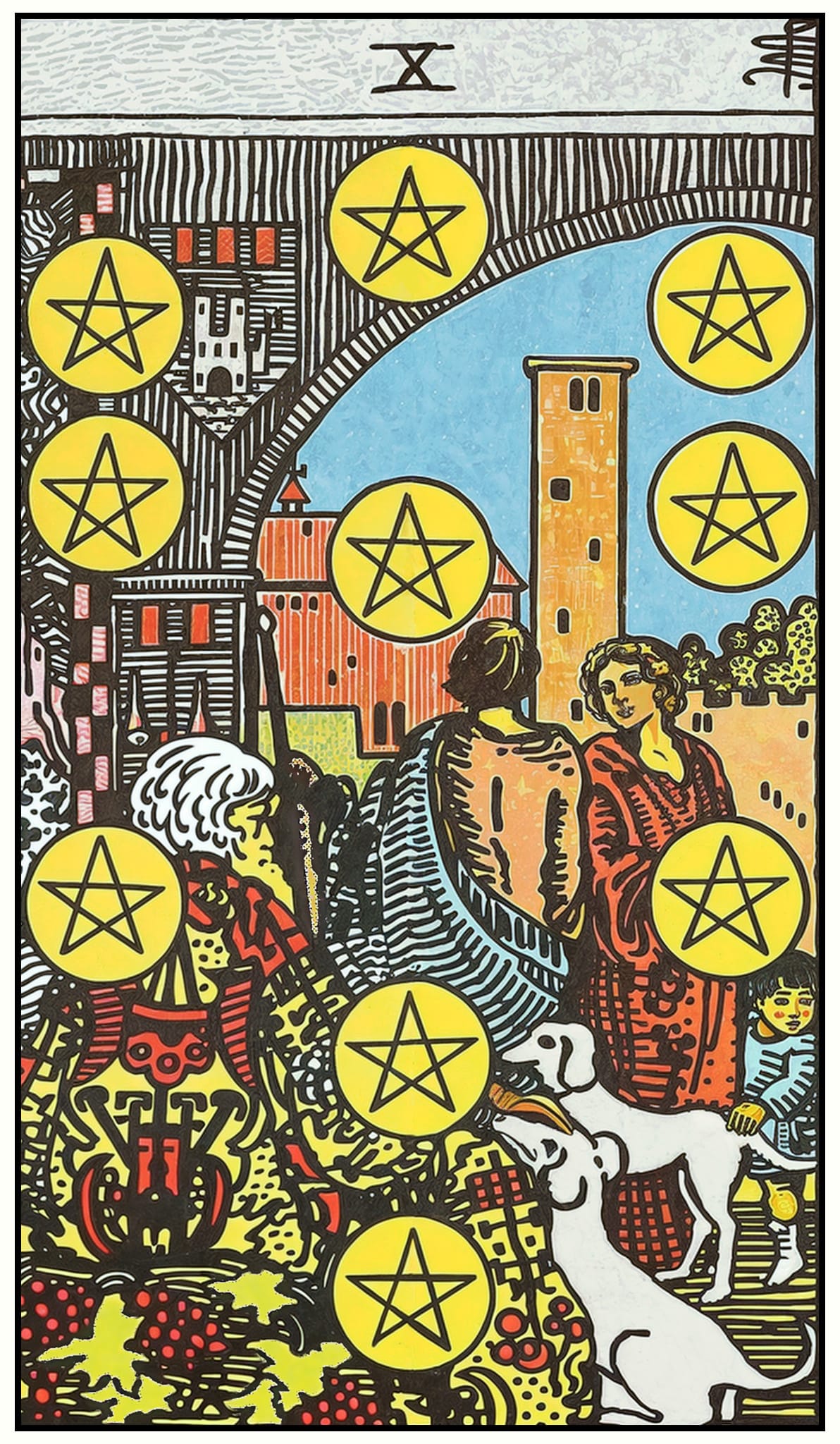
An old man sits in an archway at the scene's edge, two white dogs resting under his hands — a young couple absorbed in each other, a child reaching toward the dogs, ten pentacles in the Tree of Life pattern above. The old man watches what he built, from outside it.
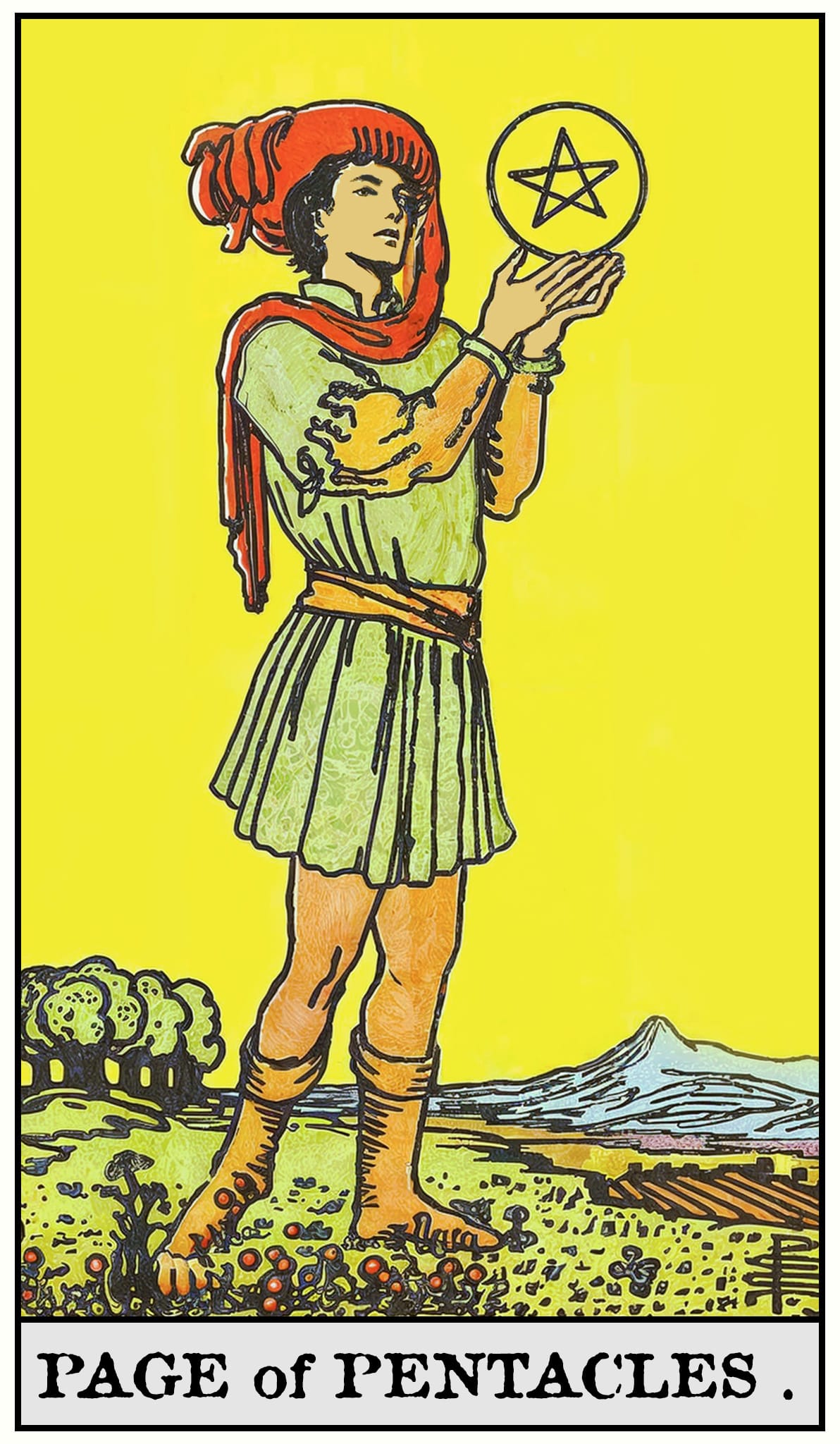
A young figure holds a pentacle up before him at eye level — not displaying it, not yet deciding what to do with it — the green field cultivated behind him, the mountains patient in the distance.
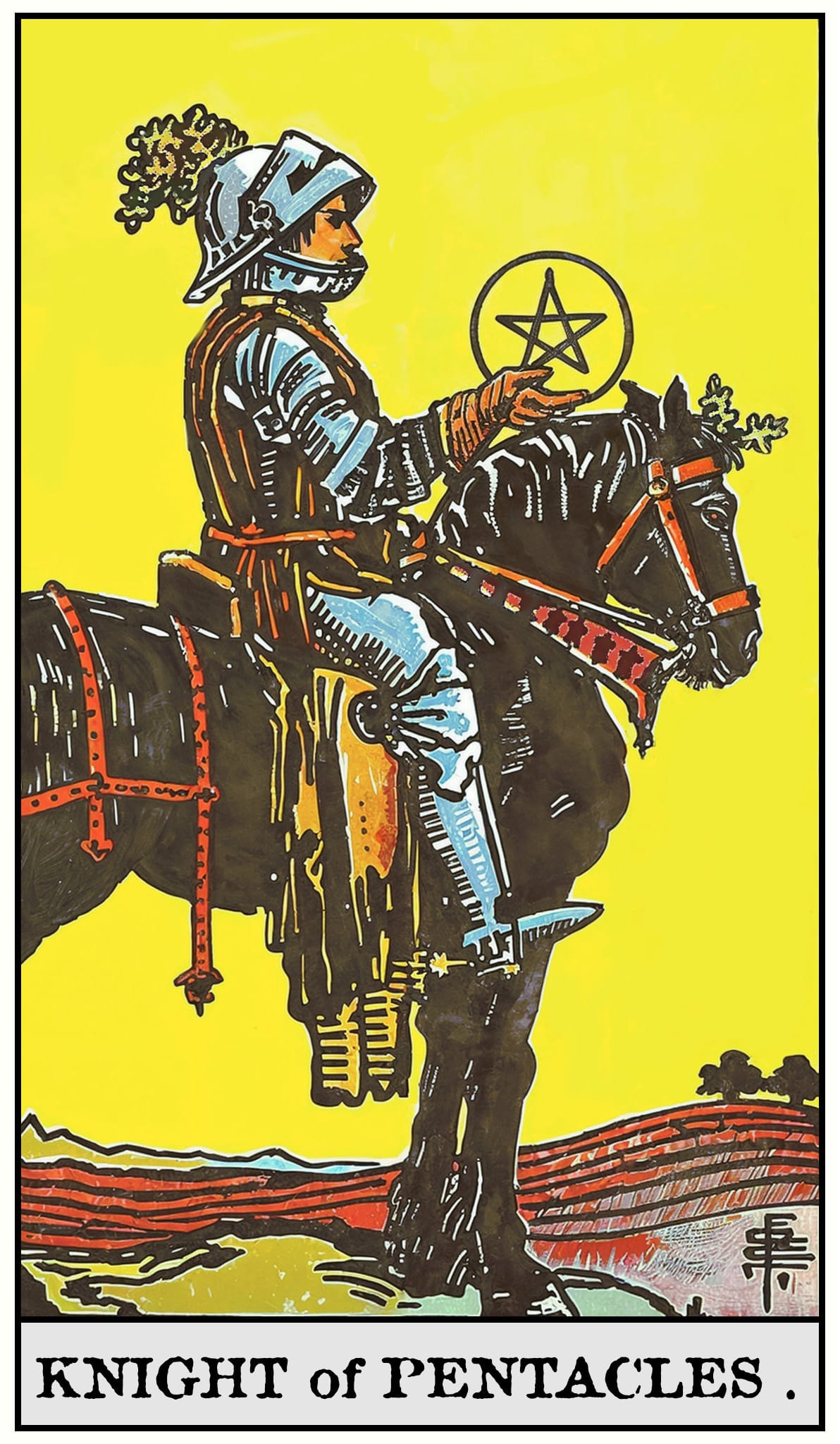
A knight sits on a heavy, unmoving horse in the middle of a ploughed field — holding the pentacle before him with both hands, looking at it with the expression of someone who has made a decision and is simply carrying it out.
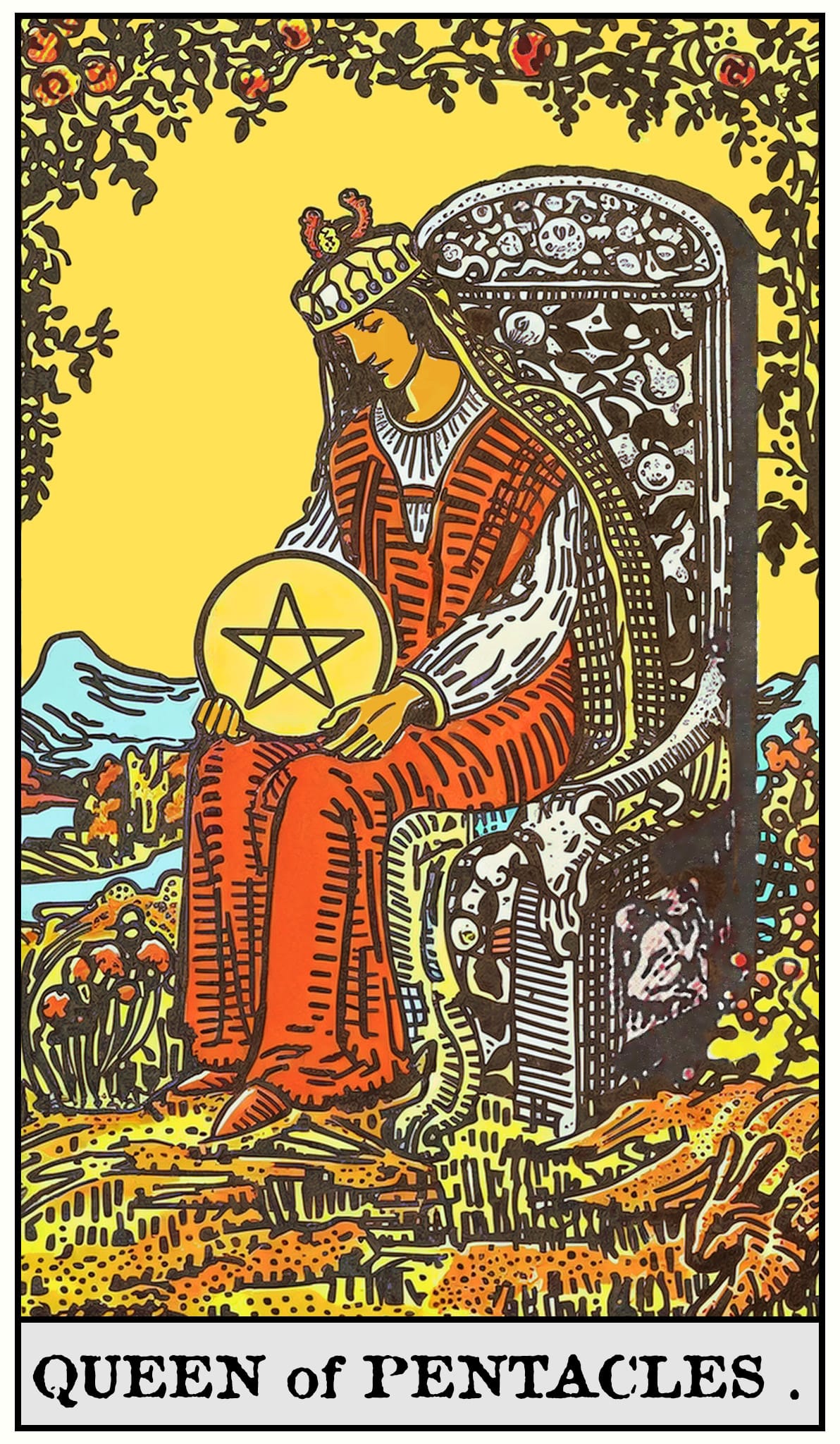
A woman on a stone throne carved with fruit and goats holds a golden pentacle in her lap, gazing at it with the attention of someone tending something alive — the garden around her abundant, the rabbit at her feet unhurried, the land and the woman looking like versions of the same thing.
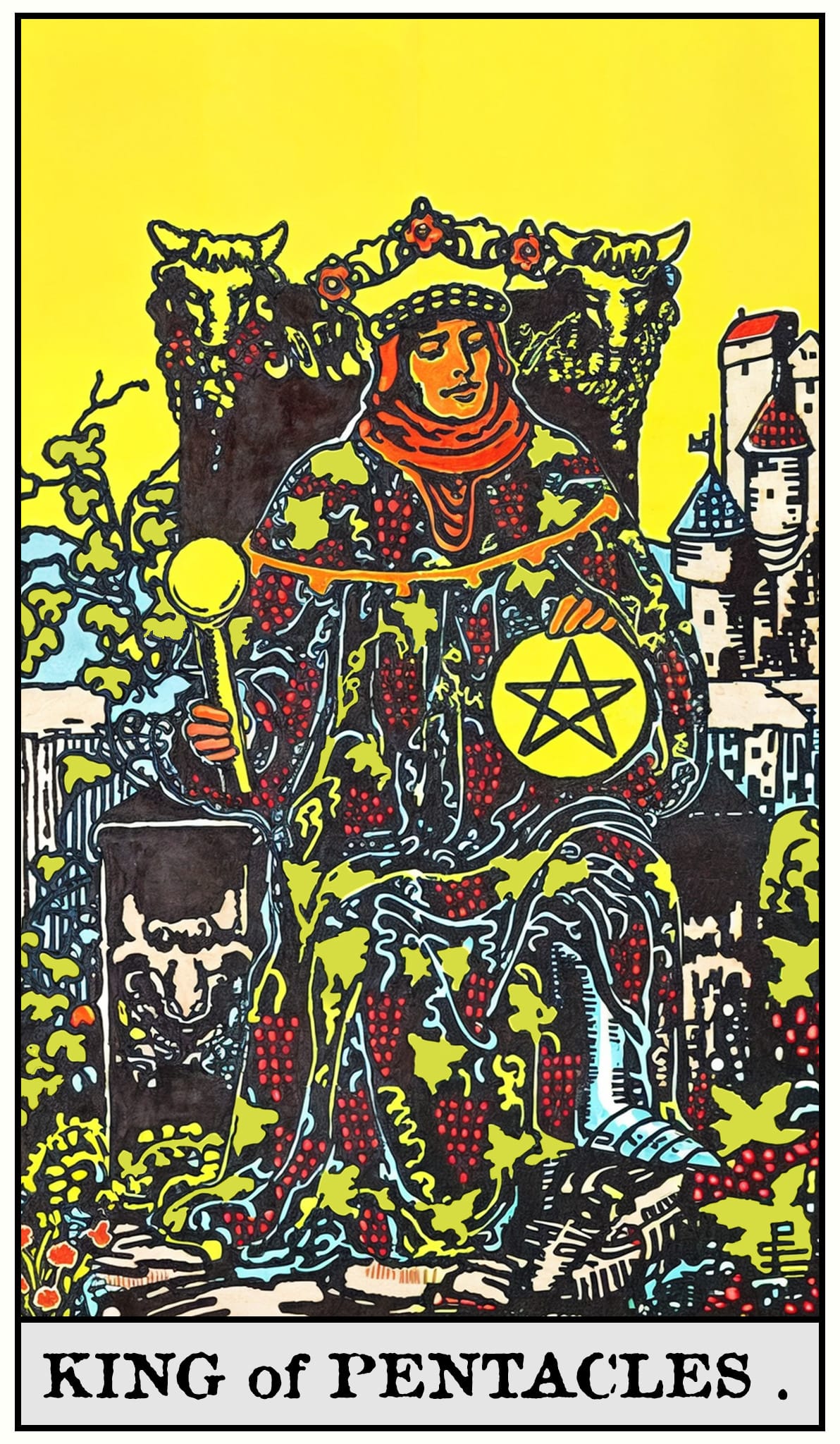
A king sits on a throne so overgrown with vines, grapes, and carved bulls that the throne itself is barely visible — robe embroidered with fruit and flowers, armour visible at the edges of the robe, golden pentacle in one hand, sceptre in the other, the castle behind him occupied and functioning.