Four of Swords
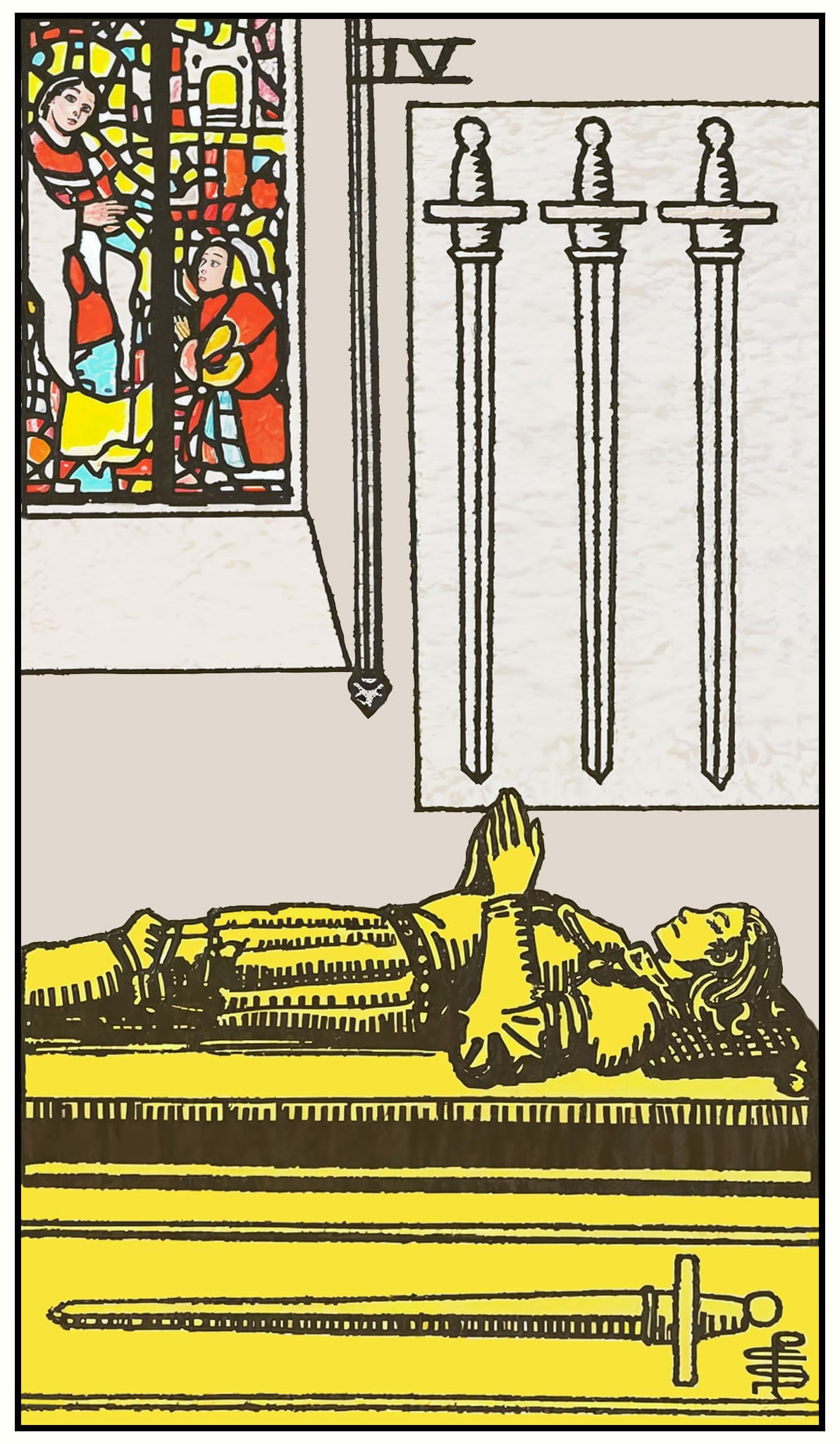
A stone effigy of a knight lies in repose on a tomb, hands joined, three swords on the wall above him, one sword aligned beneath his body — stained glass light falling across the stillness.
The Four of Swords names the necessary retreat: the deliberate suspension of the mind's forward motion long enough for the mind to recover itself. The figure has fought — the three swords on the wall are evidence. He is not defeated. He is in chosen stillness, which is the only form of rest the suit of Swords makes available, and the only form the suit actually requires.
The three swords on the wall say he has fought. The one beneath him says he is not yet finished. He is, for now, still.
The Four of Swords arrives as the card of the sabbatical honoured, the illness taken seriously, the decision to stop arguing long enough to understand what the argument has actually been about. The suit does not naturally pause. Air moves. The Four is the disciplined interruption of a trajectory that would otherwise be continuous striving. In shadow, the tomb becomes comfortable: the stone effigy position is sustainable indefinitely if the person inside it prefers the stillness to the risk of re-engagement. As a permanent posture, the Four becomes the Two of Swords with better décor — the maintained impasse wearing the garments of rest.
The mind's equivalent of metabolic winter — not death, but the slowing that precedes new growth
Pollack reads the Four as the necessary pause between the Three's grief and the conflicts that resume in the Five through Ten: the suit does not stop fighting, but it must pause before it continues or the subsequent fighting will be deterioration rather than progress. The single sword beneath the body is the self in reserve — not abandoned, not destroyed, but stilled. The three swords on the wall are the world's ongoing conflicts, which do not require attendance. The Four's structural teaching is this: the mind does not have to be present for every war to which it has been invited.
The complete three-layer reading for all 78 cards — including the full psychological and archetypal layers — is in The Pocket Guide →
Rest that becomes permanence is not rest — it is withdrawal dressed in rest's garments.
Shadow TrapThe retreat extended past its purpose — the figure who has discovered that the tomb is comfortable and has decided, without declaring the decision, not to get up, the person for whom the Four has become a permanent station rather than a temporary recovery.
Shadow GiftThe capacity to use the Four's stillness for what it was designed for — genuine metabolic rest, the kind that renews rather than avoids, with the intention of returning to the suit's remaining work when the recovery is complete.
Shadow readings for each card, by suit, are gathered in The Pocket Guide →
We do not read a reversal as an opposite; following Pollack, a turned card is the same energy blocked, withheld, or redirected — not inverted into its negation. A reversed Four of Swords often marks the rest that cannot be entered — the person who knows the retreat is needed and cannot permit themselves to take it, the mind that continues its forward motion past the point where continuation is restorative, because stopping feels indistinguishable from defeat.
Why Apocrypha Does Not Read Reversals as Opposites →Sixty-three symbols across the full deck — cross-referenced by card and meaning — are mapped in The Symbol Dictionary →
What would you discover about what you actually need if you stopped being useful long enough — not for an afternoon but for a real interval — to hear something other than the next task?
The Four of Swords is most often read as rest advised or rest incoming. The more specific reading asks what kind of rest — the distinction between recuperative stillness and avoidance dressed as stillness is the card's entire content. The card does not advise stopping. It advises the specific, temporary, deliberate stopping that the figure in the image embodies: one sword kept, three acknowledged, the effigy position assumed with full consciousness that it is temporary. The question is always whether the person receiving the card can make that distinction honestly.