Three of Swords
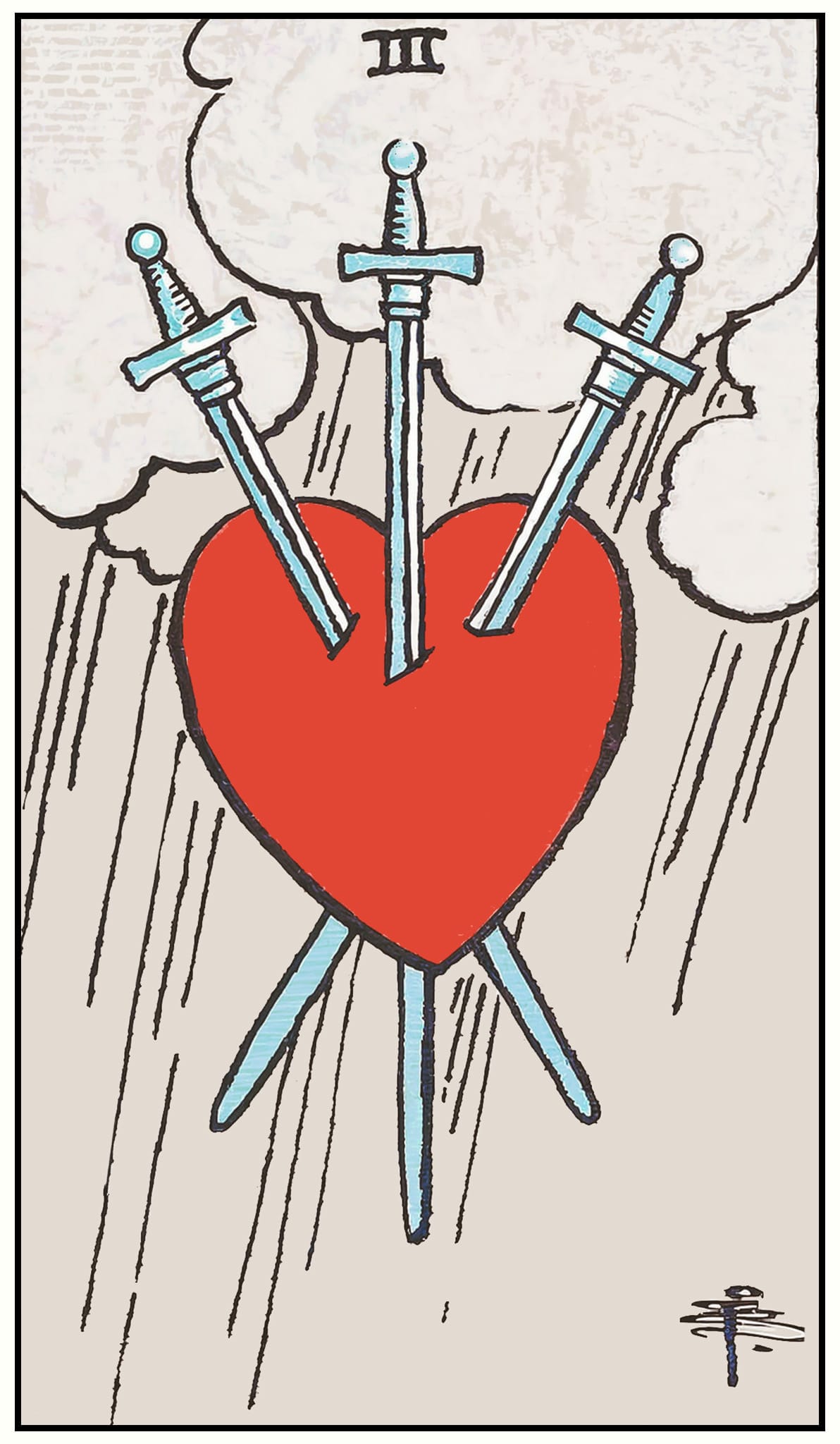
Three swords pierce a red heart against a grey sky. Rain falls. There is no figure, no narrative, no resolution. Only the heart, the swords, and the cold weather.
The card of grief faced directly. Not the prediction of heartbreak — the moment when pain is taken inside rather than pushed away.
The Golden Dawn called this card Sorrow. Apocrypha calls it the card of conscious acceptance.
The moment of integration — not the omen of heartbreak
Mainstream tarot reads the Three of Swords as a heartbreak omen — something painful is coming, brace yourself. Rachel Pollack reads it almost exactly the other way: the Three of Swords is the card that arrives after the pain. It marks the moment of integration.
Pollack's central observation is that despite the brutality of the image, the picture brings a certain calm in the symmetry of its swords. Three blades, evenly spaced, piercing the heart from the same height. This is not the chaos of injury. This is grief that has settled into shape.
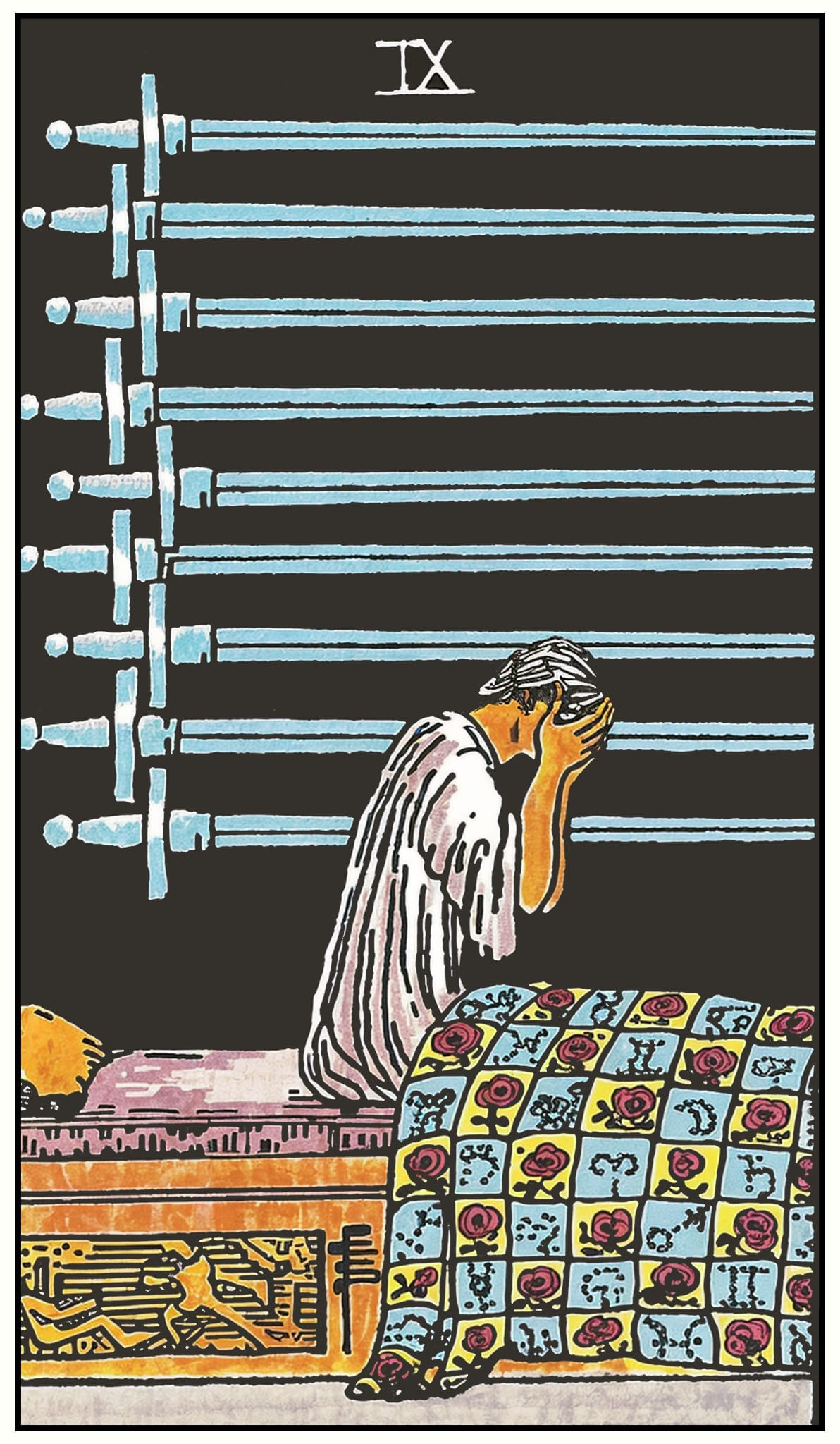
The card follows the Nine of Swords — the moment of utmost mental agony, the figure waking in the dark. The Three answers the question the Nine raises: how do you continue after great anguish? Pollack's answer is unambiguous. You do not continue by removing the swords. You continue by taking the pain into yourself — accepting it, allowing it to become part of you, until it is transformed by something the card does not depict: courage and love.
This is why the Three of Swords is, in Pollack's reading, a card of strange peace. The pain is fully present. But the running has stopped.
Pain admitted becomes finite. Pain fought becomes infinite.
Psychologically, the Three of Swords is the threshold between two coping strategies. Below the threshold lies avoidance — the attempt to handle pain by not looking at it, by staying busy, by reframing, by minimizing, by anaesthetizing. Above the threshold lies integration — the willingness to feel the thing fully, with the pain still arriving in waves, but no longer being fought.
The mechanism the card describes is counterintuitive: pain that is admitted becomes finite. Pain that is fought becomes infinite. The swords in the image cannot be removed without tearing the heart. They have to stay. What changes is the relationship to them.
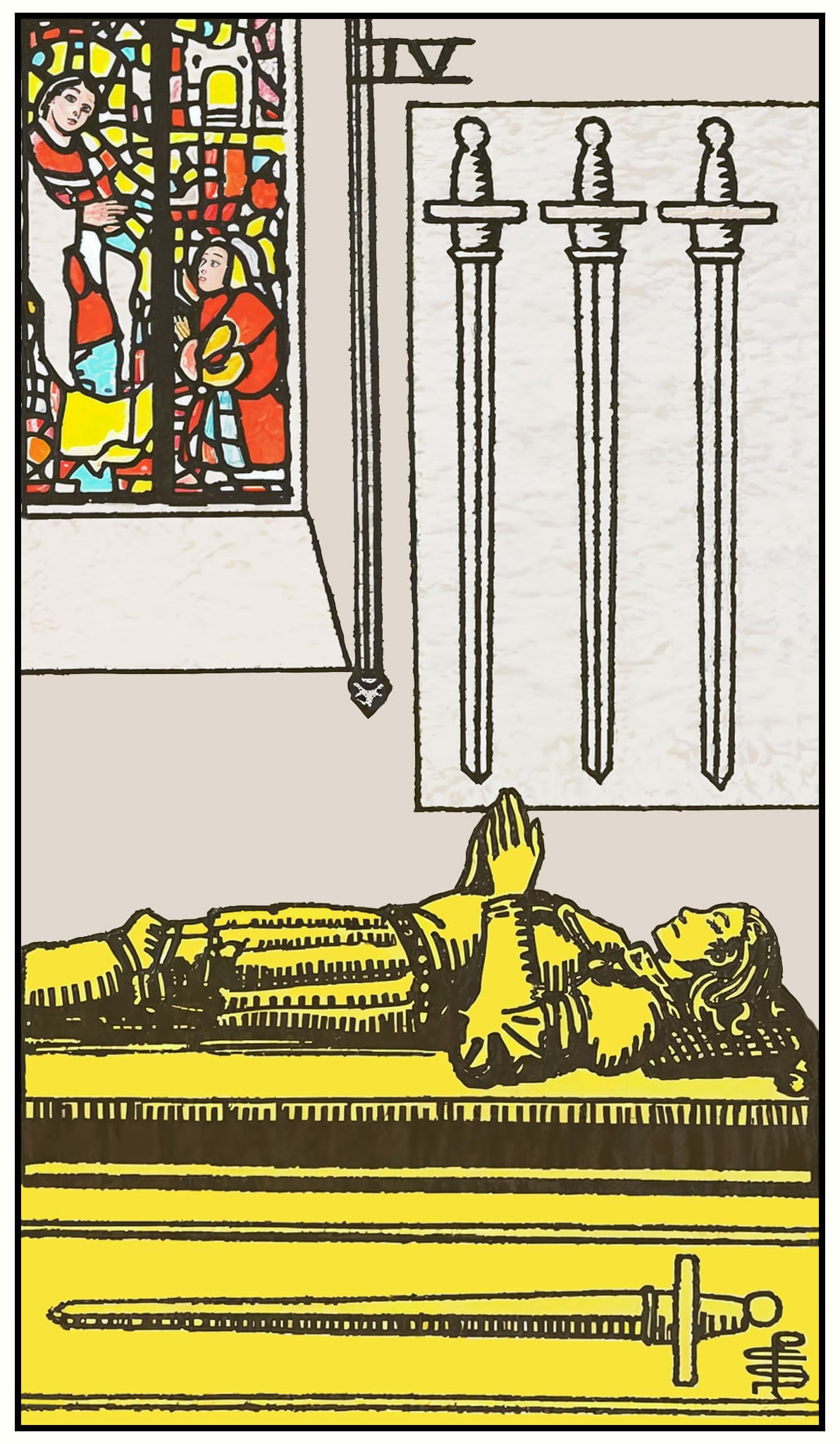
Notice the absence of a figure in this card. The Two of Swords has a blindfolded woman. The Nine has a figure sitting up in bed. The Four has a knight on a tomb. The Three has no one. Pollack does not comment on this directly, but the absence is significant: the work of this card is not performed by an actor. It is the work of a heart, alone, in weather. There is no one to watch and no one to perform for. The image is what happens when grief is finally given the room to be itself.
The shadow is not pain. It is the energy spent on not feeling pain.
The Shadow Trap
The Three of Swords has a specific and dangerous distortion: the refusal to accept the wound. This refusal can wear many faces. It can be denial ("this didn't really happen / wasn't really that bad"). It can be premature reframing ("it was meant to be / I've already learned my lesson"). It can be activity ("I'll just stay busy"). It can be cynicism ("nothing ever lasts anyway, why care"). All of these keep the swords from doing their actual work. Pollack writes that pushing pain away keeps it forever with us, and in fact increases its hold.
The Shadow Gift
The Three of Swords also offers what most cards cannot: the dignity of unmasked grief. To sit with a wound that has been fully named, without performing recovery, without rushing toward redemption, without making it useful — this is rare. The gift is the capacity to grieve as a human being instead of as an optimization problem. From here, slowly, transformation becomes possible. But it is only possible from here. There is no path around this card.
Following Pollack, reversal blocks or distorts the card's energy rather than inverting it. The Three of Swords reversed shows the healing process refusing to begin because the grief has not been admitted.
In practical terms, this often looks like prolonged numbness, repetitive intellectualization of the loss, or a strange irritability that the person cannot trace back to any cause — because the cause has been hidden from themselves. Waite gives the formula: mental alienation, disorder, confusion. Pollack adds that this is not the result of the wound itself, but of the wound denied. The energy that should be doing the work of integration is being spent on the work of suppression. Confusion is the byproduct of that division.
A reversed Three of Swords does not mean the pain is worse. It means the pain has not yet been allowed to be the pain.
Why Apocrypha Does Not Read Reversals as Opposites →In Relationship
This card in a relational reading rarely means a breakup is coming. More often, it appears when a breakup, a betrayal, or a loss has already happened — and the person reading the card is somewhere in the process of not yet feeling it fully. The question this card asks of a relationship is not who hurt whom. It is: what part of this loss have you not yet allowed yourself to grieve? Sometimes the unprocessed wound is from the current relationship. Sometimes the current relationship is a stage on which an older grief is finally arriving. The Three of Swords can also mark relationships in which both people are now grieving the same thing — the version of the connection that no longer exists — but are still living together as if it does. The card asks whether the silence between them is peace or postponement.
In Work and Vocation
In a vocational reading, this card almost never points to professional failure. It points to a vocational grief that has not been admitted — most often, the recognition that a path one committed to is no longer the right path, and that something has to be mourned before something else can begin. This grief is the precondition of authentic vocational change. James Hillman's question — what does your daimon want? — cannot be answered while the previous answer is still being defended. The Three of Swords appears when the previous answer is dying but has not yet been buried.
In Body
Somatically, the Three of Swords lives in the chest. Tightness across the sternum. A heaviness behind the breastbone that no breath quite reaches. Sometimes a sudden, surprising urge to cry that the person cannot trace to any specific cause. When this card is present and the body is honored, the response is often a long exhale — a release of held breath. When the card is present and the body is overridden, the chest stays tight for weeks. Months. Years. The body knows the swords are there even when the mind is denying them.
Sixty-three symbols across the full deck — cross-referenced by card and meaning — are mapped in The Symbol Dictionary →
Name one loss you have not yet allowed yourself to grieve fully. Do not justify why you have not grieved it. Do not explain why the loss was minor or major. Simply write what the loss was, in plain language, in one paragraph. Then close the journal. Do not read it back.
The point of this prompt is not insight. It is permission.
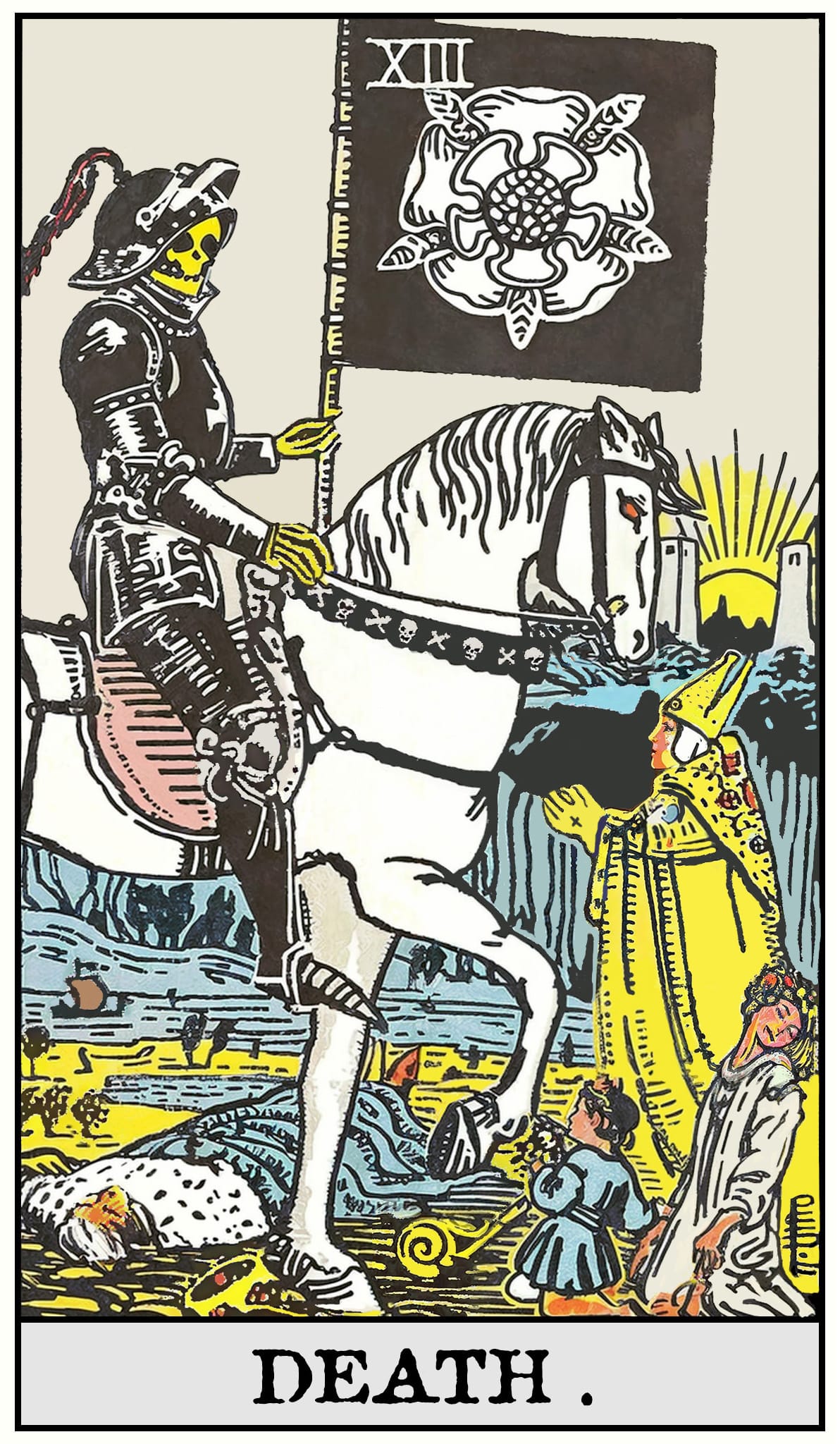
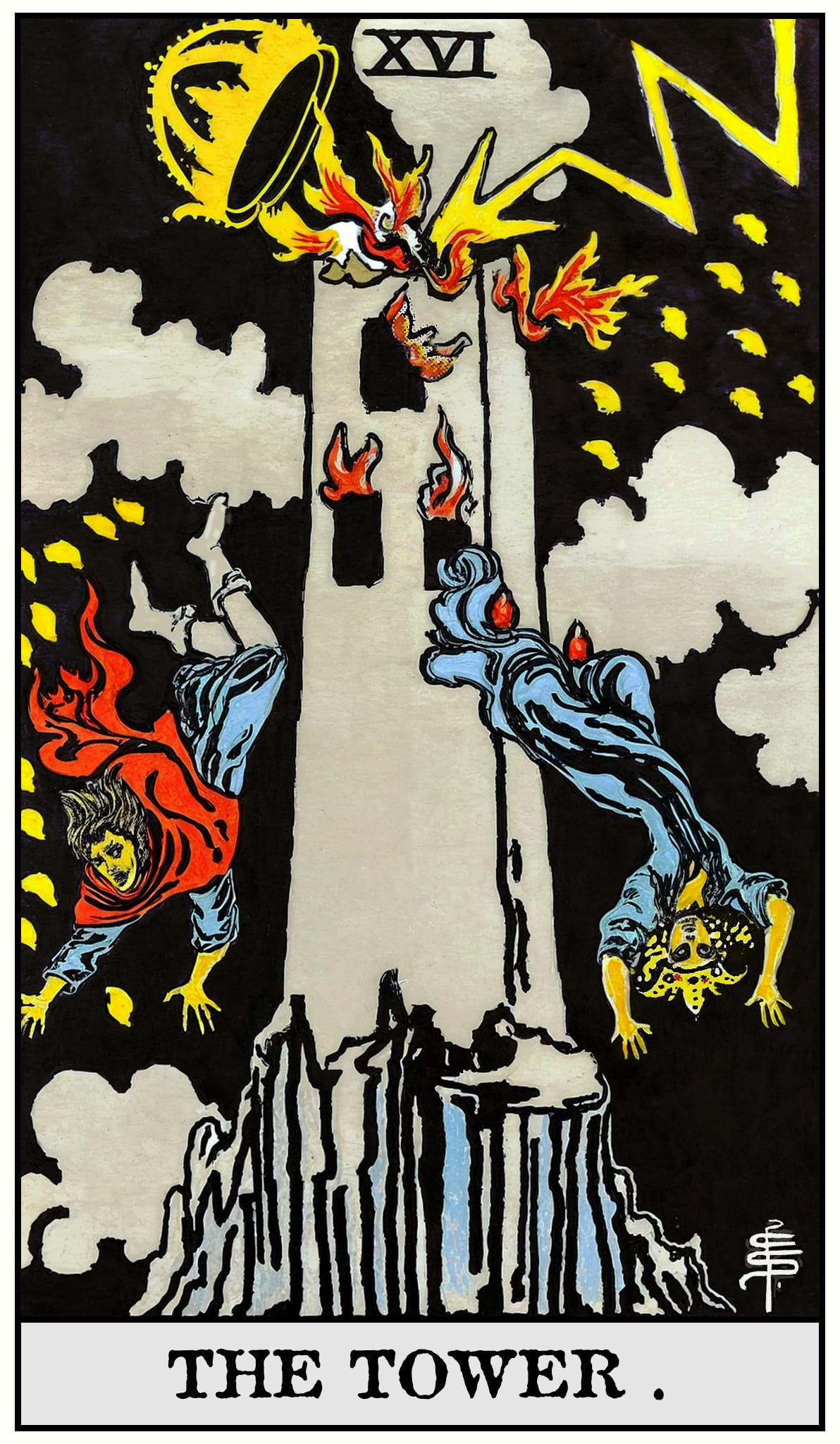
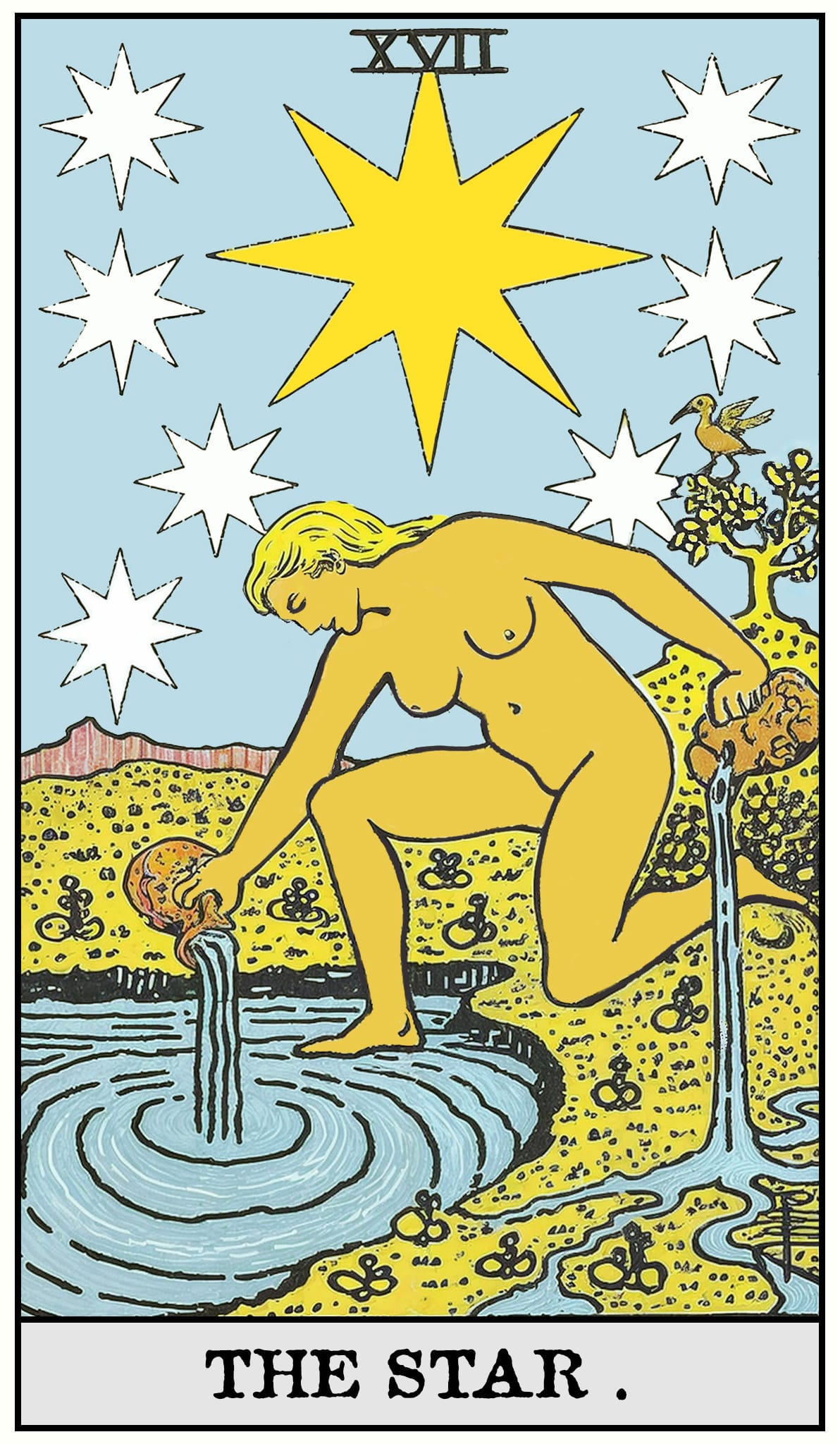
The Three of Swords is one of the cards Apocrypha most often sees misread, in both directions.
It is misread as a warning of coming heartbreak — predictive, fear-inducing, asking the reader to brace for damage. This reading is wrong. The card almost never arrives before the wound. It arrives during, or after.
It is also misread as just a sad card — something to push past, to balance with a more hopeful card, to ask: what's next? This reading is also wrong, because it repeats the very avoidance the card is asking the reader to release.
When this card appears in a spread, the correct first response is not interpretation. It is to stop. To notice what arrived in the body when the image was turned over. The work of the Three of Swords begins there.