Nine of Swords
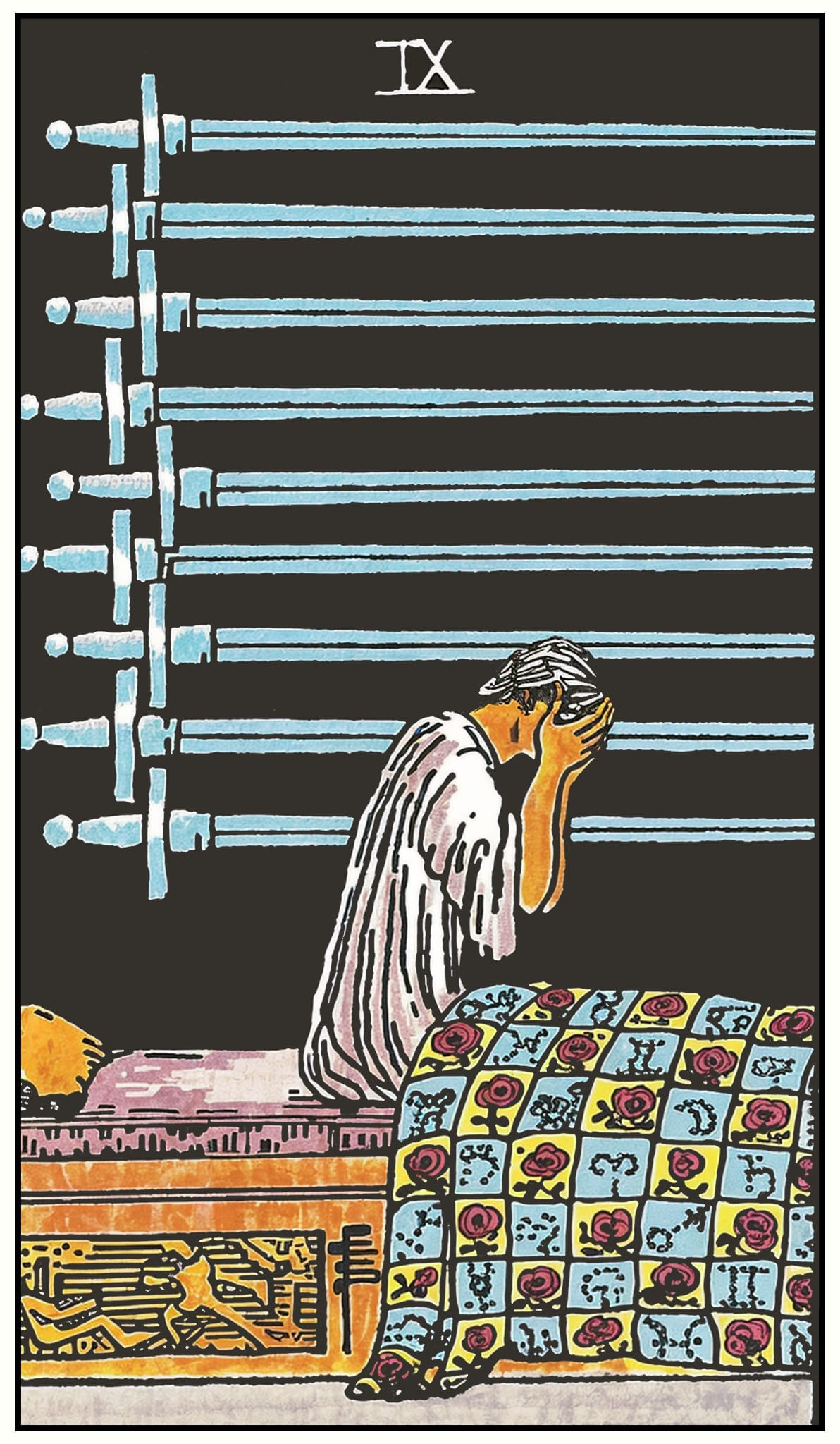
A figure sits upright in bed, hands covering their face, nine swords mounted horizontally on the wall behind them — the roses and astrological symbols of the blanket continuing undisturbed below the midnight terror above.
The Nine of Swords names the three a.m. inventory: the waking in darkness and the immediate, architectural deployment of every fear. The swords are on the wall — not in the chest, not falling. They are mounted. The mind has organized them, given them a permanent address. The suffering of this card is not random. It is curated, which is the card's most important and least comfortable observation.
The figure is not in danger. The figure feels in danger. The mind, at three in the morning, cannot tell the difference.
The Nine of Swords is the anatomy of dread: the construction of the worst version of a situation in enough detail that the nervous system responds to the construction as though it were the event. The swords are mounted on the wall, not in the chest. But in the architecture of the sleepless hour, displayed blades and wounds feel identical. The roses on the blanket are not ironic — they are the life that continues comfortable and vivid while the mind catalogs its disasters above them. In the Nine, the fears are not necessarily irrational. What is wrong is the room, the hour, and the absence of the daylight that would allow them to be accurately sized.
The suffering of the Nine is not random — it is organized, which is the night-mind's most revealing characteristic
The nine swords are horizontal, mounted, displayed. The mind has arranged them — given each blade a permanent address, which means the mind knows exactly where each one is. Pollack identifies this as the suit's private peak, a peak of suffering rather than achievement. Jung's shadow concept is partially visible here: the night-mind presenting to the waking self what the daylight hours have been refusing to meet directly. The Nine does not mean the fears are groundless. It means they are being processed at the wrong hour, without the structure that daylight and proportion would provide.
The complete three-layer reading for all 78 cards — including the full psychological and archetypal layers — is in The Pocket Guide →
The dark night that is also, precisely, the soul's dark night — the suffering that is trying to force something to be faced.
Shadow TrapThe midnight inventory that has become a nightly practice — the curated suffering installed as routine, the fears given their permanent address on the wall because there is a part of the person that prefers the known shape of the dread to the unknown cost of meeting what the dread is about in daylight.
Shadow GiftThe recognition that the mind generated this inventory for a reason — that the nine swords did not mount themselves — and that what the night-fear is circling has a daytime version that can be approached with adequate light, adequate rest, and the capacity to size what is actually there.
Shadow readings for each card, by suit, are gathered in The Pocket Guide →
We do not read a reversal as an opposite; following Pollack, a turned card is the same energy blocked, withheld, or redirected — not inverted into its negation. A reversed Nine of Swords often marks the fear suppressed rather than faced — the midnight inventory that is not happening because the person has organized their days so completely that the swords never get to the wall, which means they are somewhere else, ungiven any address at all, present but unlocated.
Why Apocrypha Does Not Read Reversals as Opposites →Sixty-three symbols across the full deck — cross-referenced by card and meaning — are mapped in The Symbol Dictionary →
What is the thought that wakes you at three in the morning — and what would happen if you met it deliberately, in the afternoon, with your full capacity rather than in the dark with only the architecture of dread?
The Nine of Swords is most often read as anxiety and its remedies. The more precise reading asks what the anxiety is about — specifically, what the nine swords are addressing that the daytime hours have been refusing to address. The card is not pathologizing sleeplessness. It is observing that the mind has generated this inventory for a reason, and that the reason has a daytime version that could be approached directly, and that the relief of the Nine is not better sleep techniques but the willingness to bring the swords down from the wall and look at what they actually are in a light that allows accurate measurement.