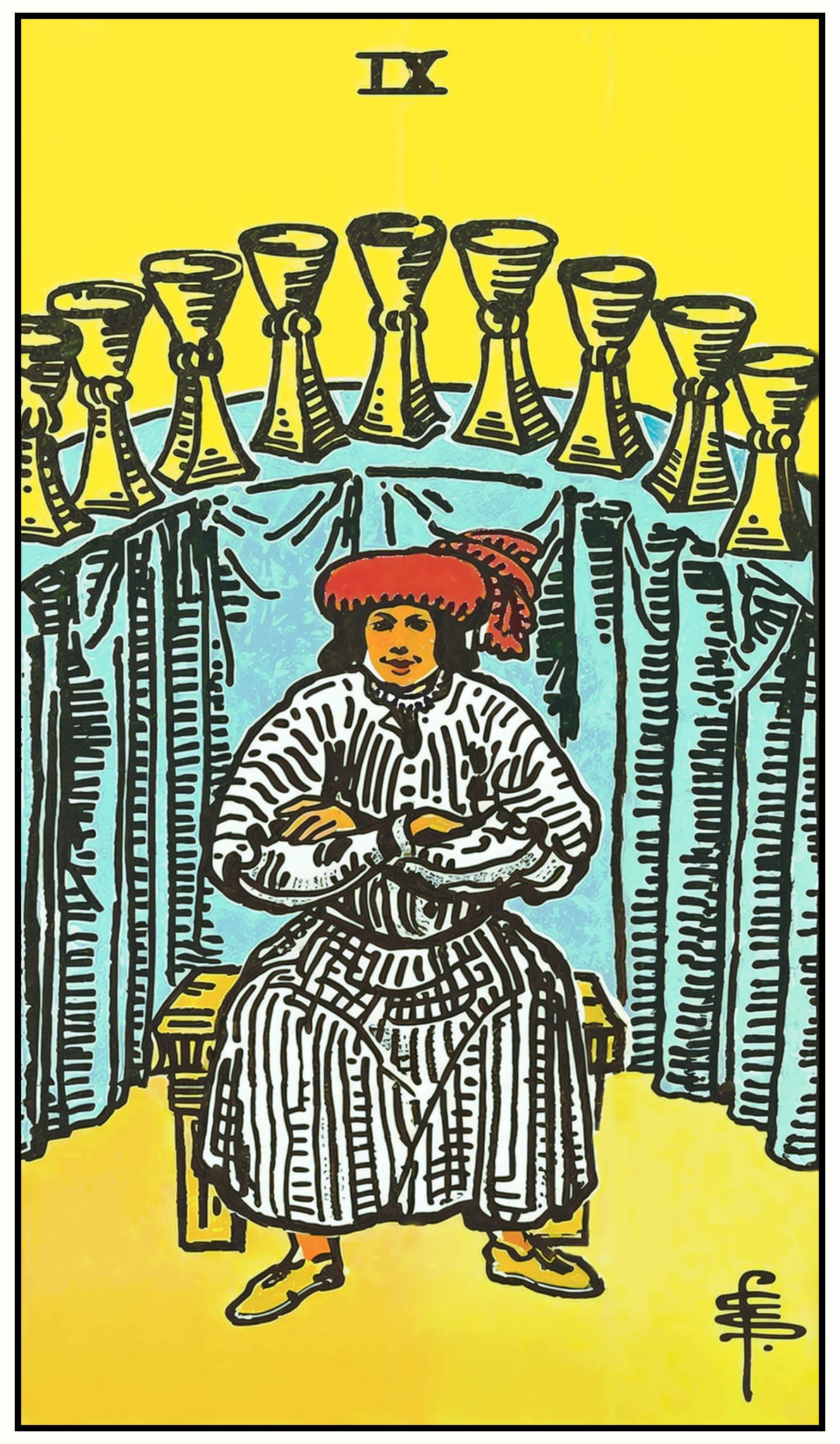
Nine of Cups
A man sits on a bench before a curved display of nine cups on a high shelf behind him — arms folded, legs planted, hat at a jaunty angle, facing us with an expression of evident satisfaction. No one else is in the card.
The Nine of Cups is not the wish card popular tarot made it — or rather, it is, and that is exactly the complication. The wishes have been granted. The satisfaction is real. The cups are arranged like trophies. The man sits alone with his achievement and faces us with contentment that is genuine and somehow, simultaneously, slightly airless.
The man has gotten what he asked for — and the card is precise about what that looks like from the outside
The Nine of Cups shows wish-fulfilment at full expression: the achievement is real, the satisfaction is genuine, and something in the image is slightly airless — the cups displayed like trophies rather than in use, the figure exhibiting abundance to a room with no one else in it. The Nine shows what the wanting looks like once it has been satisfied, and the view is more ambivalent than the wanting. In shadow, the card describes the life organized around acquisition rather than experience — nine cups collected on a shelf rather than nine feelings lived, the form of a full life without the interior that would animate it.
The suit's individual peak — and the distinction between ego-satisfaction and the deeper movement the suit has been describing
Pollack reads the Nine as the figure whose contentment is genuine but somehow prior to whatever comes next — a satisfaction that does not yet know itself as contentment because it has nothing to compare itself to. Jung's distinction between ego-satisfaction and individuation is precisely what this card holds: the ego can be decorated, fed, and acknowledged while the deeper self remains simultaneously hungry. The trophy shelf is real evidence of real effort. The question the card asks is whether the person behind the shelf knows the difference between the shelf and the life.
The complete three-layer reading for all 78 cards — including the full psychological and archetypal layers — is in The Pocket Guide →
The wish granted reveals the topology of desire — the wished-for object generates, upon receipt, a new absence.
Shadow TrapThe life organized around the acquisition of what was wanted, which produces the Nine's configuration: real achievement, real satisfaction, and a growing suspicion that satisfaction and the fullness the wanting promised are not identical.
Shadow GiftThe capacity to sit with the granted wish and ask the honest question — not "am I grateful?" (gratitude and contentment are different) but "is this what I was actually hungry for, and if not, what is the nature of what remains?"
Shadow readings for each card, by suit, are gathered in The Pocket Guide →
We do not read a reversal as an opposite; following Pollack, a turned card is the same energy blocked, withheld, or redirected — not inverted into its negation. A reversed Nine of Cups often marks the blocked satisfaction — the person who has achieved the wished-for configuration and cannot receive it, who experiences the arrival of what they wanted with numbness or anxiety rather than the contentment the achievement was supposed to deliver.
Why Apocrypha Does Not Read Reversals as Opposites →Sixty-three symbols across the full deck — cross-referenced by card and meaning — are mapped in The Symbol Dictionary →
You have received something you wanted — or are close to receiving it. What did you expect to feel when it arrived, and what do you actually feel? And what does the gap between those two answers tell you?
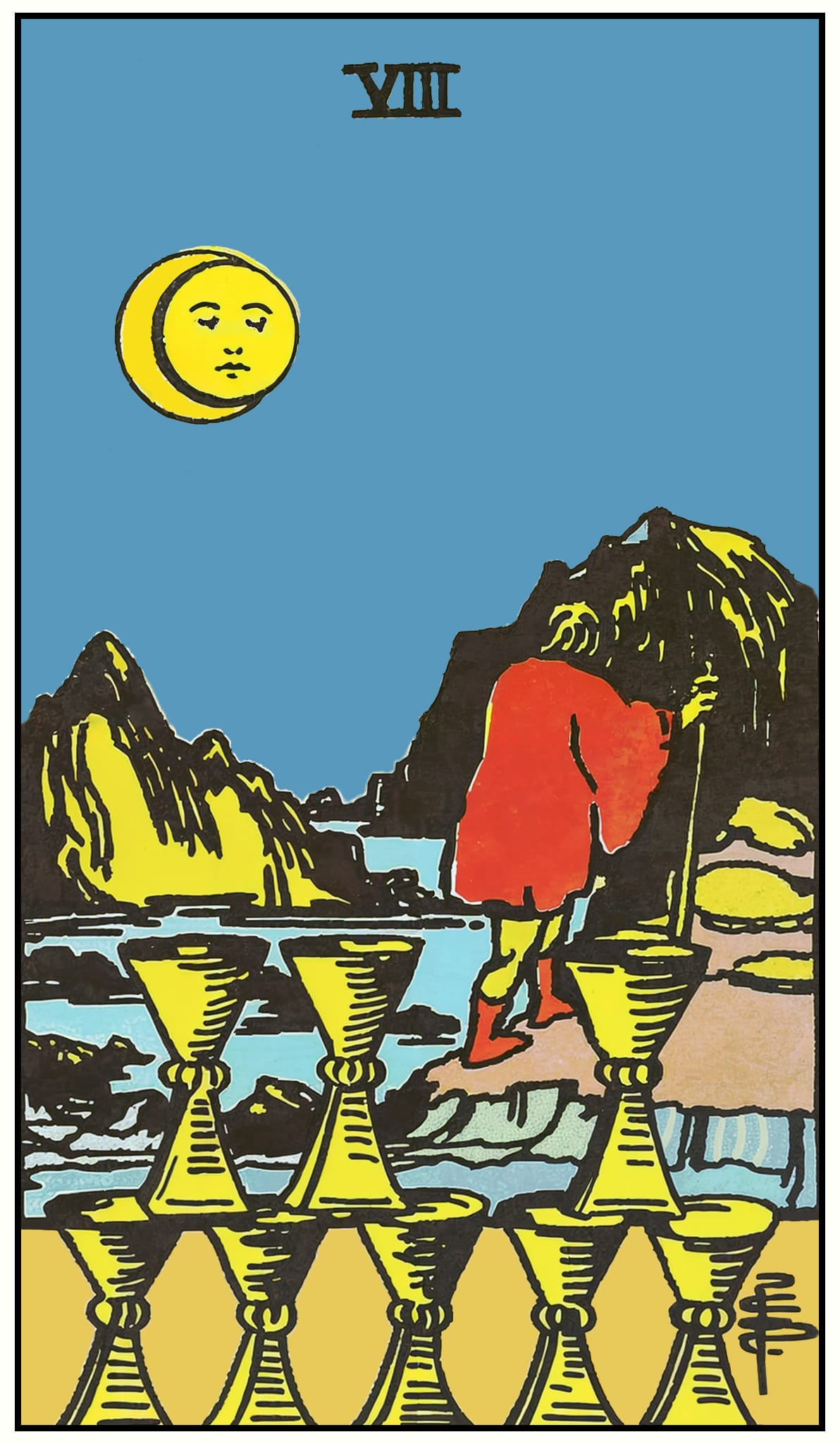
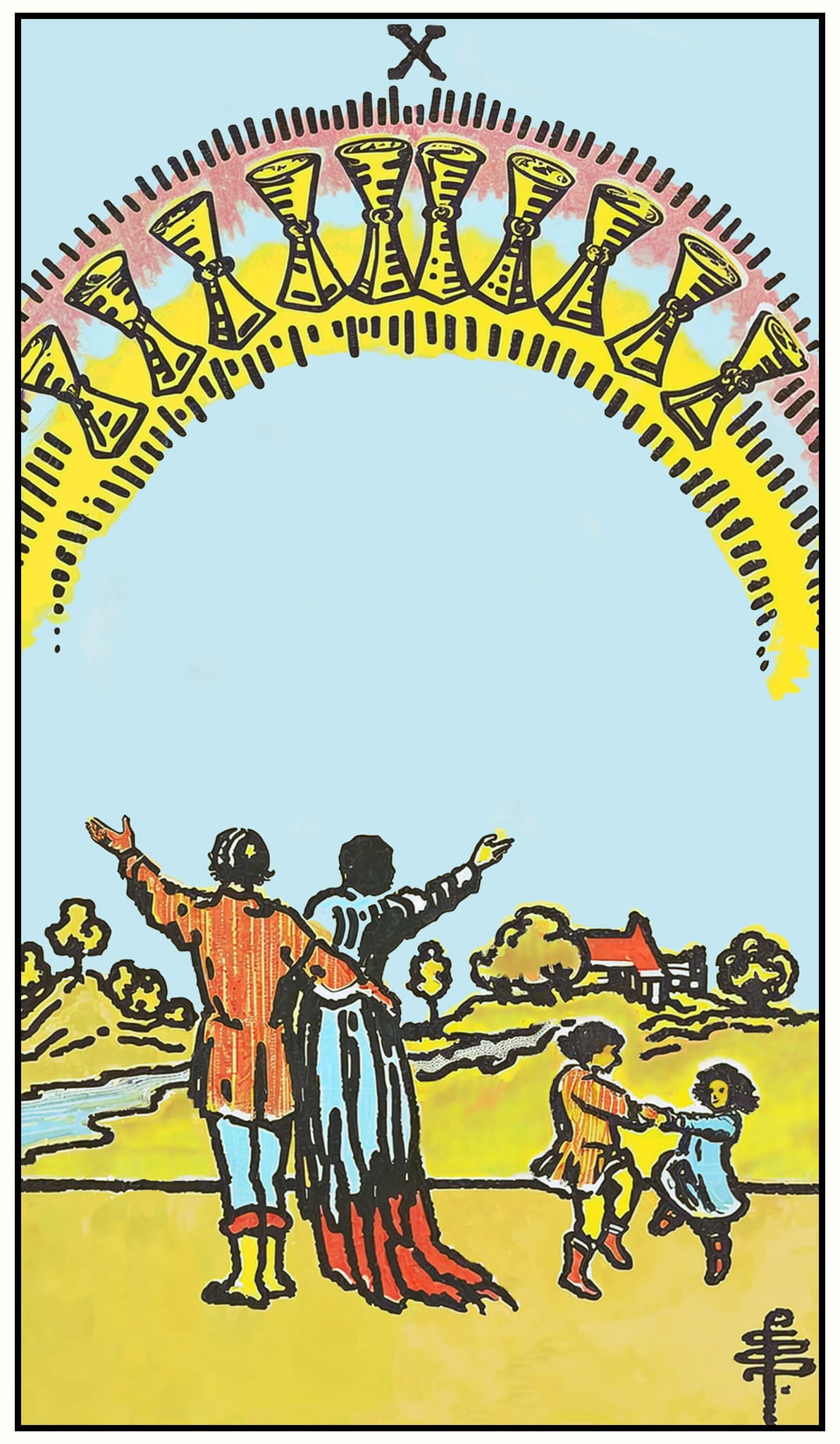


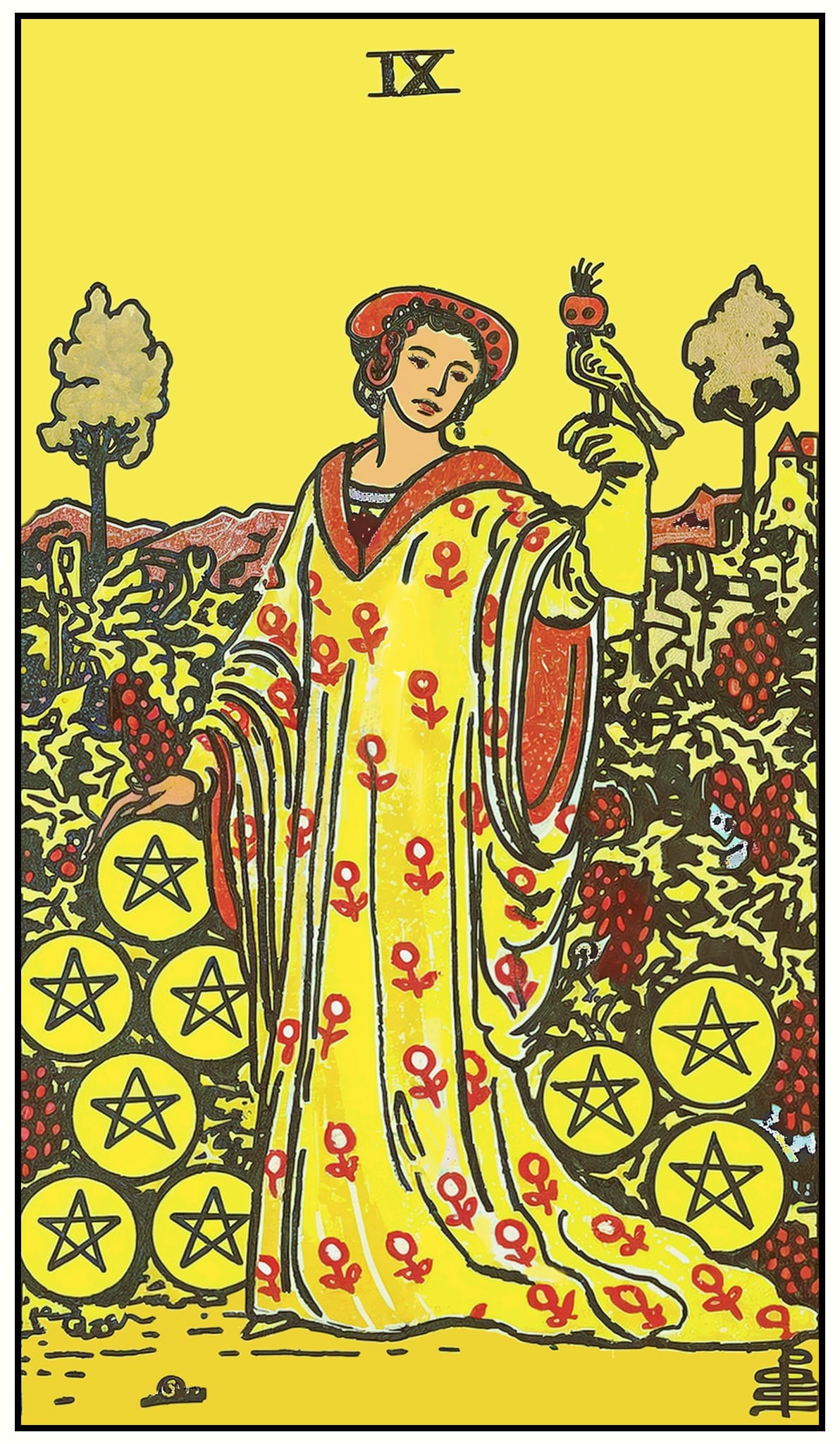
The Nine of Cups is most often given as a positive omen — wishes granted, satisfaction coming. The card does not contradict this. It complicates it. The relevant question is not whether the wish will be granted but what the granting will reveal about the wish. The card is most useful not as prediction but as preparation: it asks the reader, before the satisfaction arrives, to notice what they are expecting to feel, so that when the feeling arrives — real, genuine, and slightly other than anticipated — the gap has been made legible in advance.