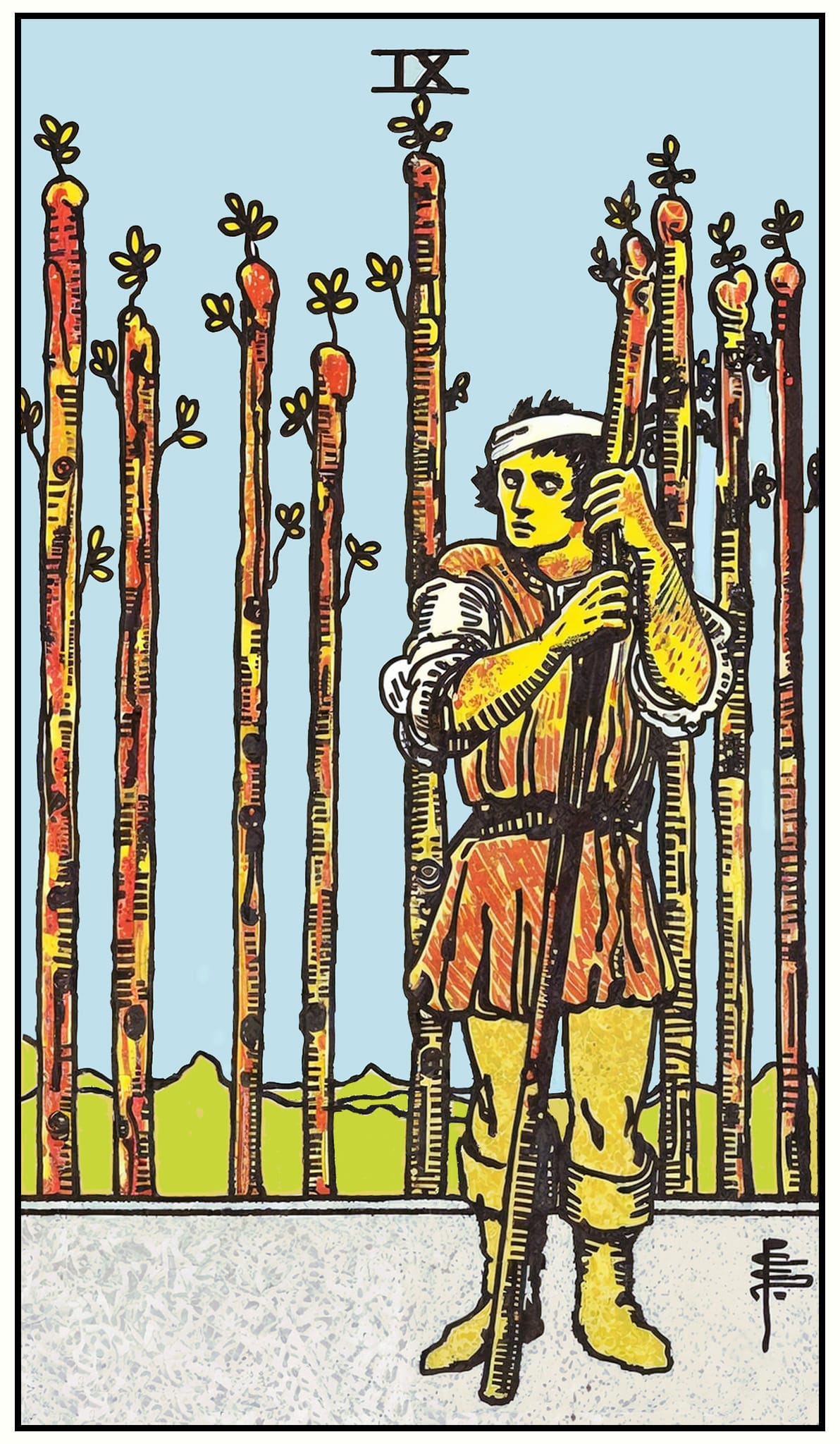
Nine of Wands
A bandaged figure leans on a wand, eight more standing close behind — watchful, tired, still at his post, the landscape open in every direction.
The Nine of Wands names durability: not triumph, not arrival, but the specific virtue of continuing when continuation is itself the whole of what is being asked. The suit's accumulated trials are written in the figure's posture and the bandage on his head. He is not celebrating. He is still here, which is the only thing the card requires of him.
The figure who has come through the whole suit and is still, exhausted, holding the line
The Nine is the card of the long-distance carrier: the founder in year seven, the person two years into recovery, the caregiver in the decade-long middle of a situation that has no clean ending. Continuation has become a form of victory because the alternative was giving up and giving up was considered and refused. In shadow, the Nine becomes the wound-as-identity — the person who has been through enough that the having-been-through-it begins to define them, the watchfulness that cannot relax even when the field has been quiet for years, the palisade that started as protection and became a position the person can no longer leave.
Wands' accumulated record — every lesson of the suit, worn in the body rather than remembered in the mind
The Nine is not a peak in the conventional sense. In the Minor Arcana, Pollack reads the nines as points of maximum accumulation before the suit's culmination — everything the fire has encountered since the Ace is now in this figure's posture. He has the Ace's spark, the Three's commitment, the Five's competition, the Seven's defence — all of it metabolized into a particular kind of weariness that is indistinguishable from competence. The card asks a precise question: is the vigilance still proportionate to the actual threat, or has it become the habit of someone who has been threatened long enough that readiness is now structural?
The complete three-layer reading for all 78 cards — including the full psychological and archetypal layers — is in The Pocket Guide →
Durability is a virtue. The shadow is durability mistaken for the only available mode.
Shadow TrapThe watchfulness that cannot be set down — the posture of readiness maintained past the emergency it was built for, the figure who holds the wand not because the threat is present but because putting it down would require admitting the threat has passed.
Shadow GiftThe capacity to distinguish between the vigilance that is still serving the situation and the vigilance that is now serving only the habit of vigilance — and to lower the wand when the lowering is accurate rather than naive.
Shadow readings for each card, by suit, are gathered in The Pocket Guide →
We do not read a reversal as an opposite; following Pollack, a turned card is the same energy blocked, withheld, or redirected — not inverted into its negation. A reversed Nine of Wands often marks the collapse of the held position — not by external defeat but by the depletion of the resource that was maintaining it, the figure who has held the line past the point where holding was possible and is now, finally, down.
Why Apocrypha Does Not Read Reversals as Opposites →Sixty-three symbols across the full deck — cross-referenced by card and meaning — are mapped in The Symbol Dictionary →
What injury have you been carrying as a watchtower — converting a wound into the justification for a vigilance that may no longer be proportionate to what is actually out there? And what would it mean to receive care for the wound rather than continue deploying it as armour?
The Nine of Wands is most often read as encouragement to keep going, and in some contexts that is accurate. The more specific and less comfortable reading asks whether the continuation is chosen or compelled — whether the figure is still at his post because the post matters or because he has been there long enough that the post and the self have become indistinguishable. The card respects endurance. It also asks whether the endurance is still in service of something or has become its own captivity.