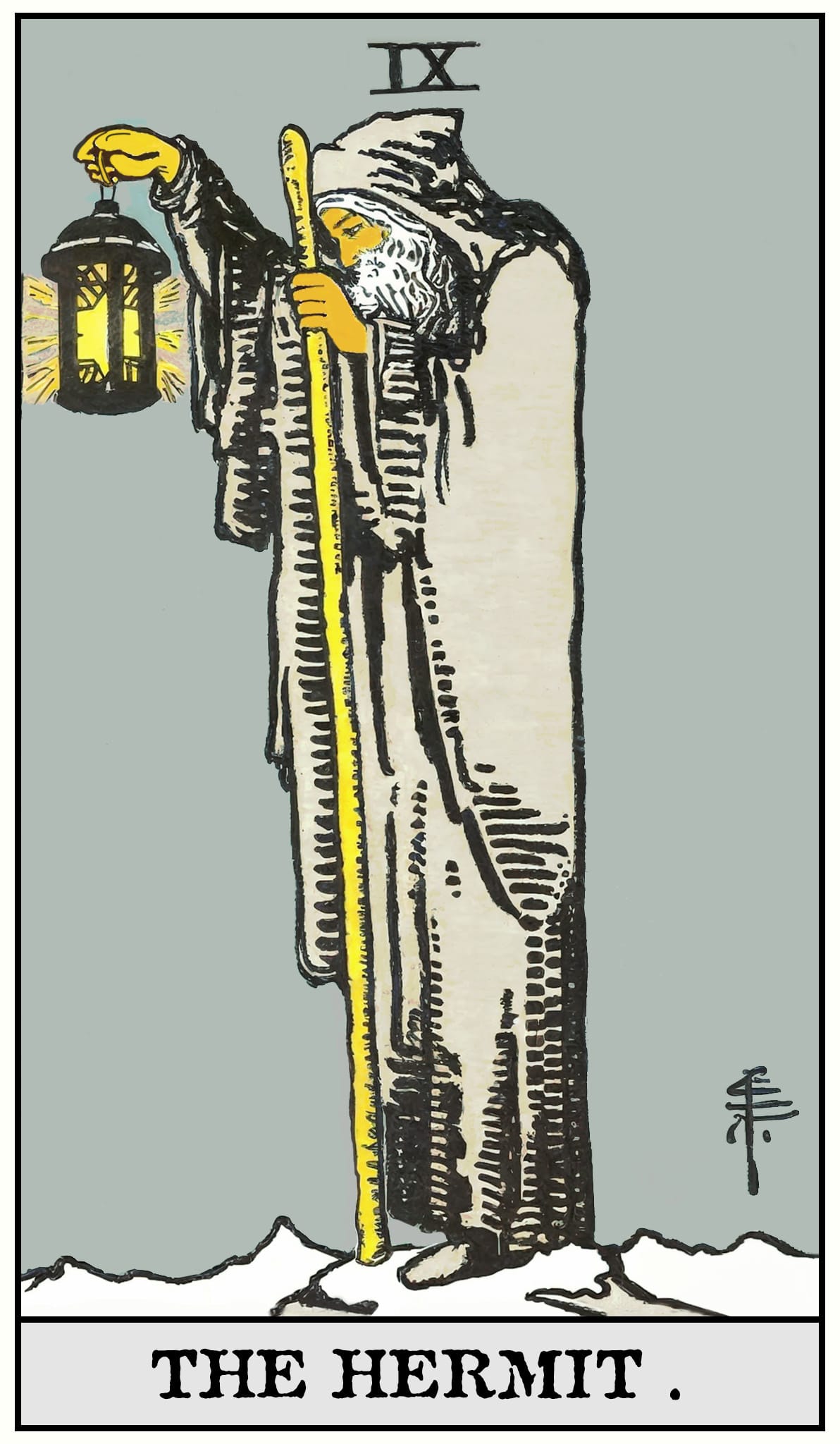
The Hermit
An old man stands at a mountain summit in empty landscape, holding a lantern inward, his head bowed toward the path he has already climbed — the figure that completes what the High Priestess began.
The Hermit names the deliberate movement into solitude — not as escape but as chosen separation that makes a particular kind of work possible. The card describes the season of inward turning: the willingness to stop acquiring more of a life and begin, instead, to subtract, to be alone with what has been outrun, to find out what the self actually is beneath its social function.
The chosen withdrawal that makes a particular kind of knowing possible
The Hermit appears when the situation requires solitude — not the loneliness that is forced but the solitude that is chosen. A sabbatical, a period of grief, a stretch of deliberate subtraction. The card also signals the appearance of a genuine teacher: not the institutional Hierophant but the older figure who has done the work himself, whose lantern points back at the path already walked, who teaches by having gone rather than by telling. In his shadow, the Hermit becomes isolation — the withdrawal that refuses to return, the introspection that turns into rumination, the lantern held high and pointed at no one.
The height from which the constructed self looks, for the first time, like a construction
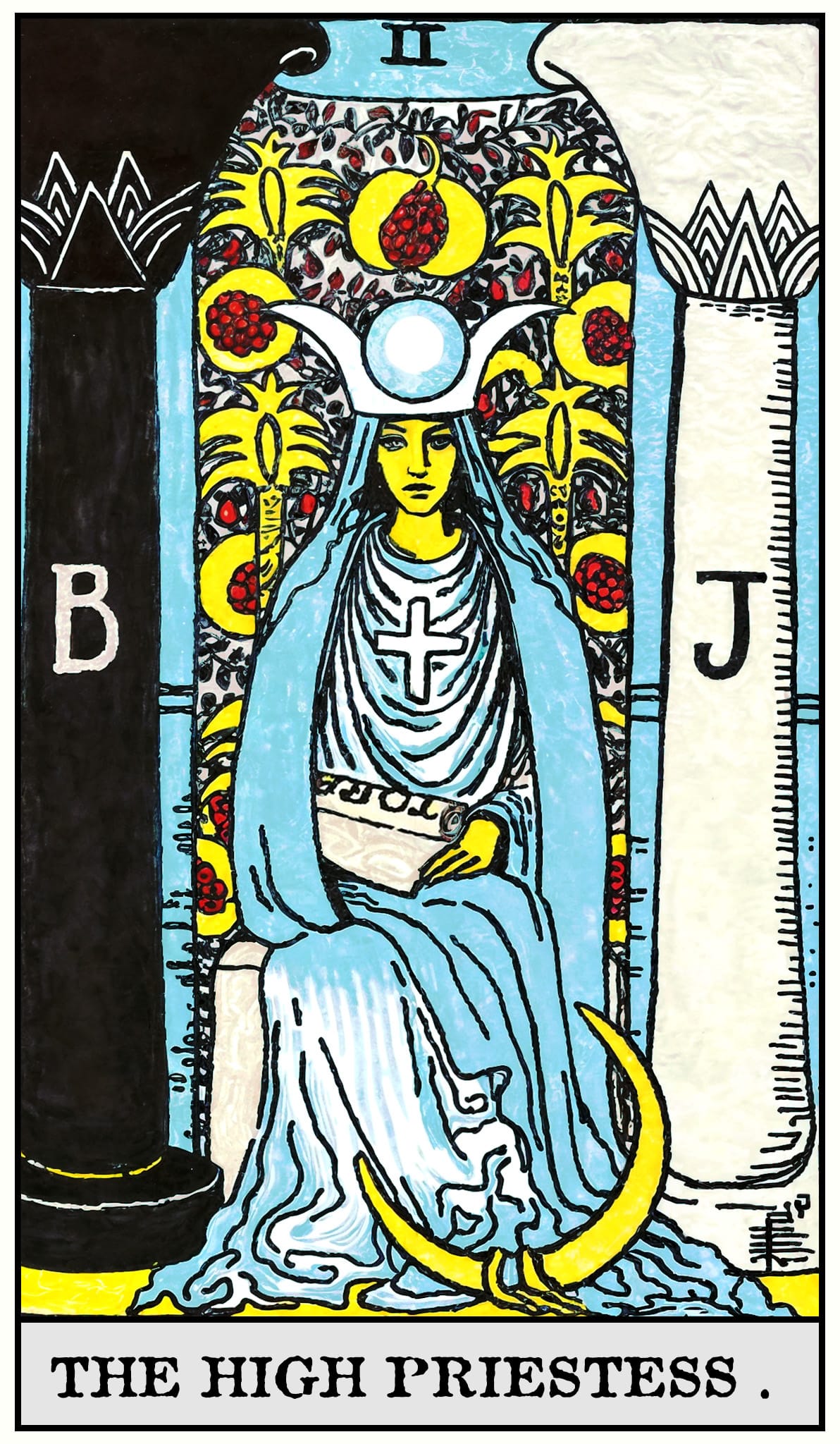
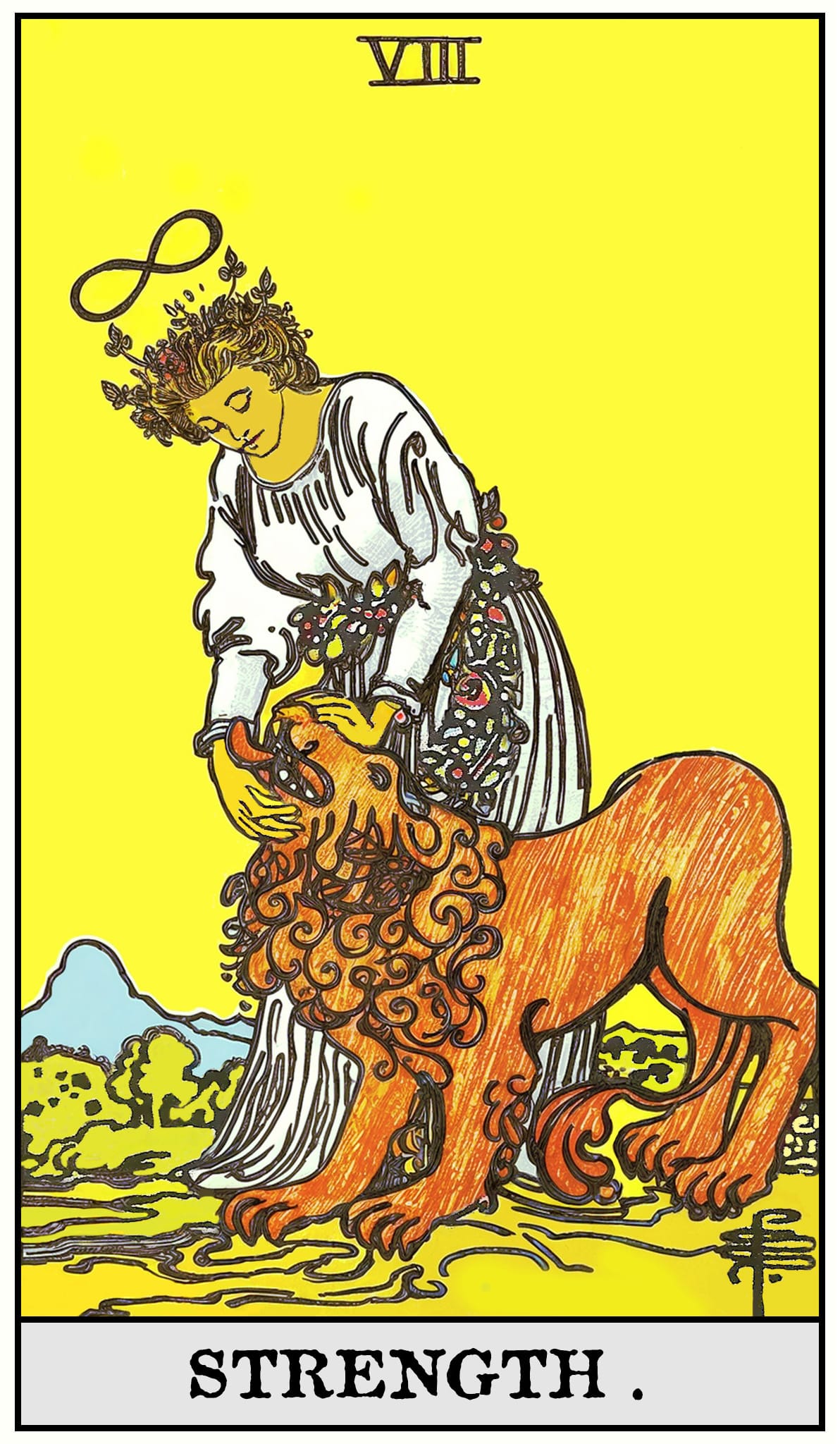
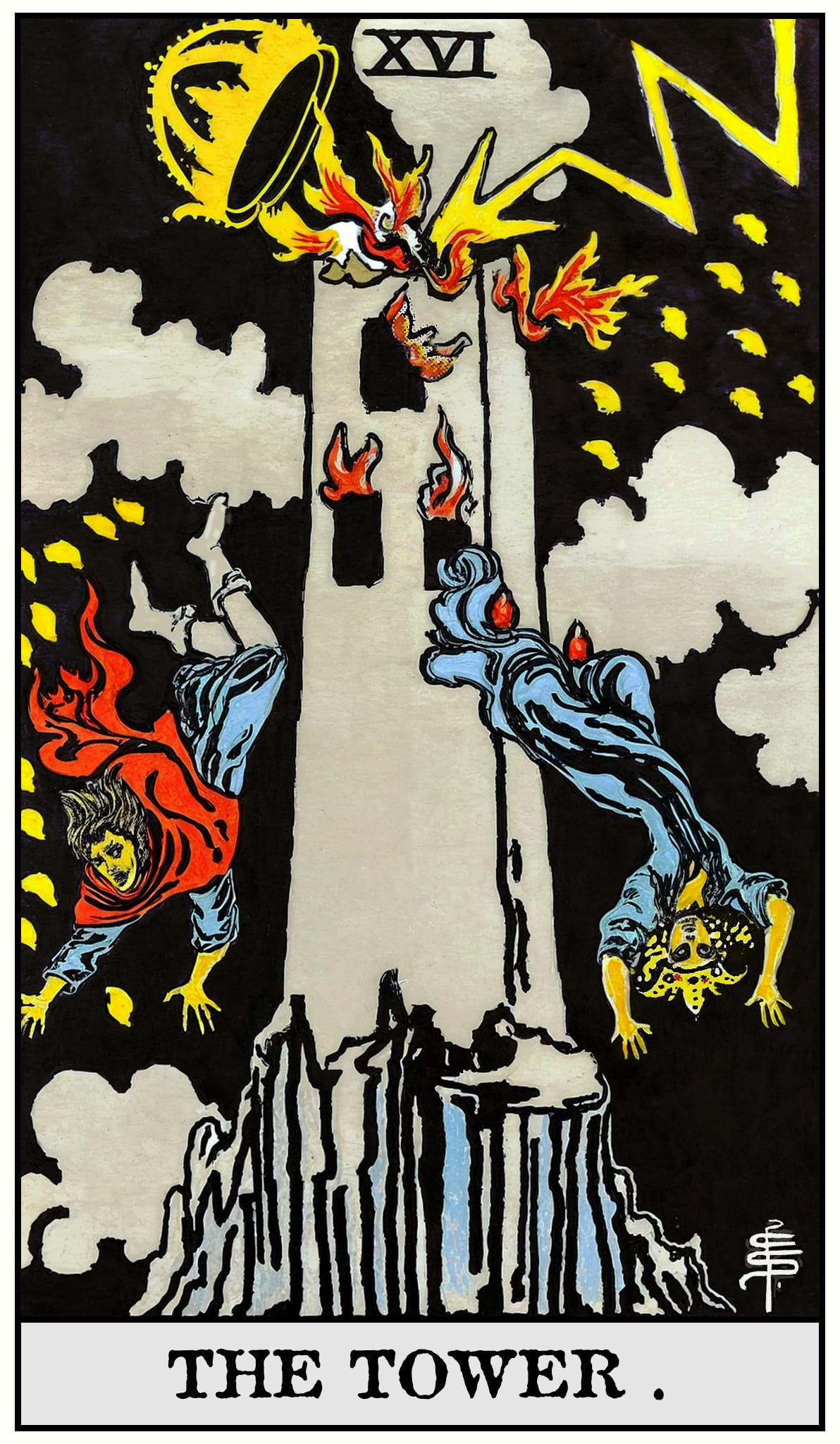
Strength established that the instinctual self could be met without conquest. The Hermit takes the next step: he asks what the self actually is beneath the integration, beneath the functioning, beneath even the achieved composure. He goes up the mountain — upward, not into a cave — to where the self can be seen in its actual proportions: small, brief, contingent, but also lit by its own lantern. The Seal of Solomon in the lantern names what he has found: not the rejection of the lower world but the recognition that spirit and body are one thing looked at from different altitudes. His vertical line — High Priestess at II, Hermit at IX, Tower at XVI — teaches a single principle: go inward by choice, or be sent inward by force.
The complete three-layer reading for all 78 cards — including the full psychological and archetypal layers — is in The Pocket Guide →
Solitude is a practice. The shadow of every practice is the practice turned into a shelter.
Shadow TrapThe inwardness that has become a permanent address — the figure who has climbed the mountain and decided not to come back down because the city was worse than the cold.
Shadow GiftThe capacity to be genuinely alone with oneself long enough to discover what was there before the noise, and to return from that discovery as someone changed by it rather than someone hiding in it.
The complete shadow reading — trap, gift, and the practice of integration — for all 22 Major Arcana is in The Shadow Archetype Reference →
We do not read a reversal as an opposite; following Pollack, a turned card is the same energy blocked, withheld, or redirected — not inverted into its negation. A reversed Hermit often marks solitude that has curdled — the withdrawal that was once deliberate and productive and has become a mechanism for not having to re-enter the world the work was meant to prepare the self for.
Why Apocrypha Does Not Read Reversals as Opposites →Sixty-three symbols across the full deck — cross-referenced by card and meaning — are mapped in The Symbol Dictionary →
What have you been refusing to be alone with? And if you stopped filling the silence — stopped reaching for the next task, the next conversation, the next distraction — what would be there, waiting, that has been waiting for some time?
The Hermit is most often read as advice to take a break. The card is asking for something considerably more specific: the willingness to be genuinely alone with the self, without the modifications the self usually applies to make solitude bearable. A retreat that is full of activity is not what this card describes. The distinction between solitude as practice and busyness with a scenic backdrop is the distinction the card requires the reader to make.