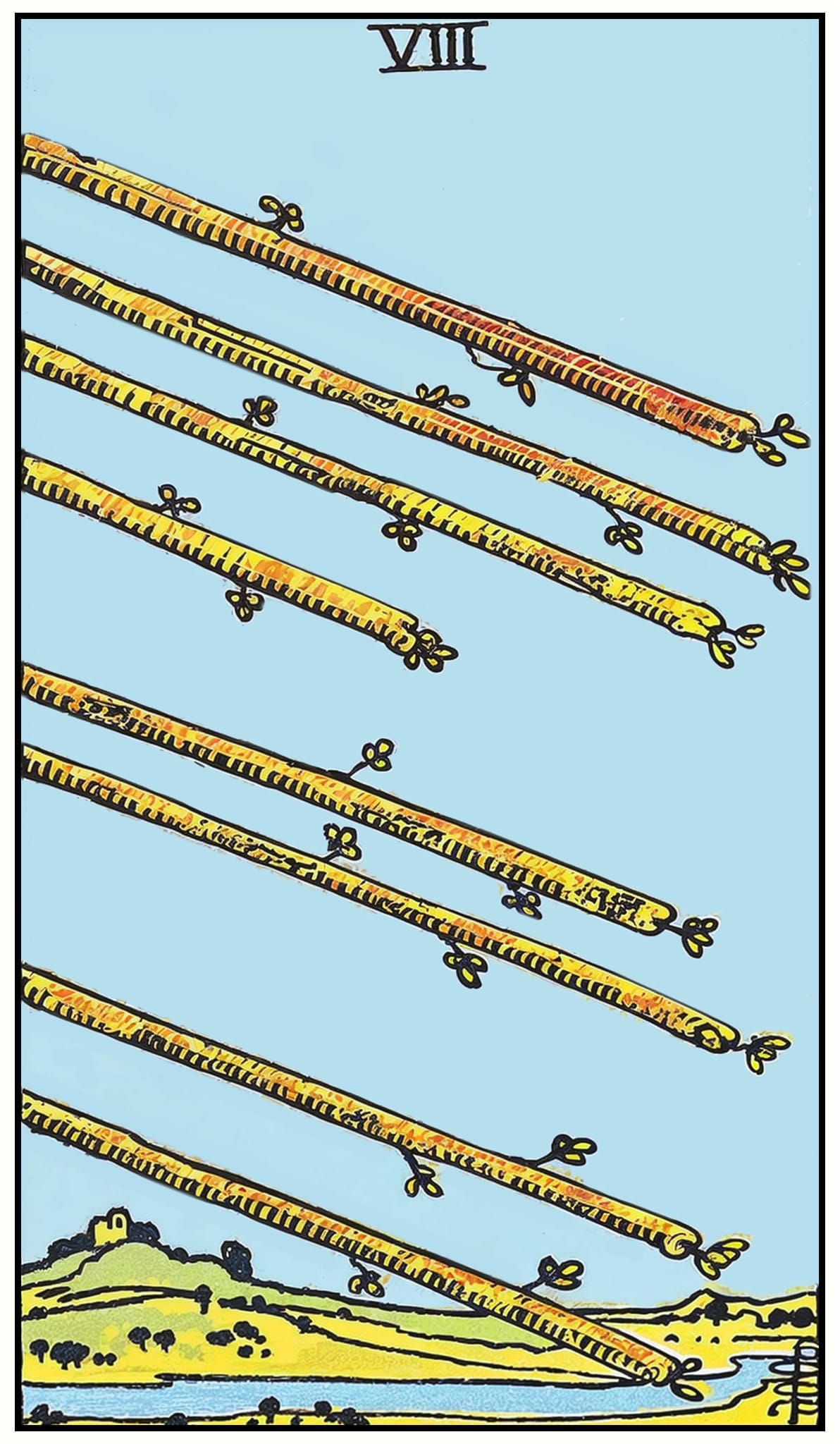
Eight of Wands
Eight wands arc through open sky in clean parallel formation, no hand holding them, the landscape below empty — the work released and finding its own line.
The Eight of Wands names the moment of clean release: the effort that has been aimed well and can now be trusted to complete its arc without being managed. The card is one of the few in the deck with no human figure — the human has, for once, stepped out of the way. The danger is confusing speed with direction. The wands are moving. The question is whether they were aimed before they left the hand.
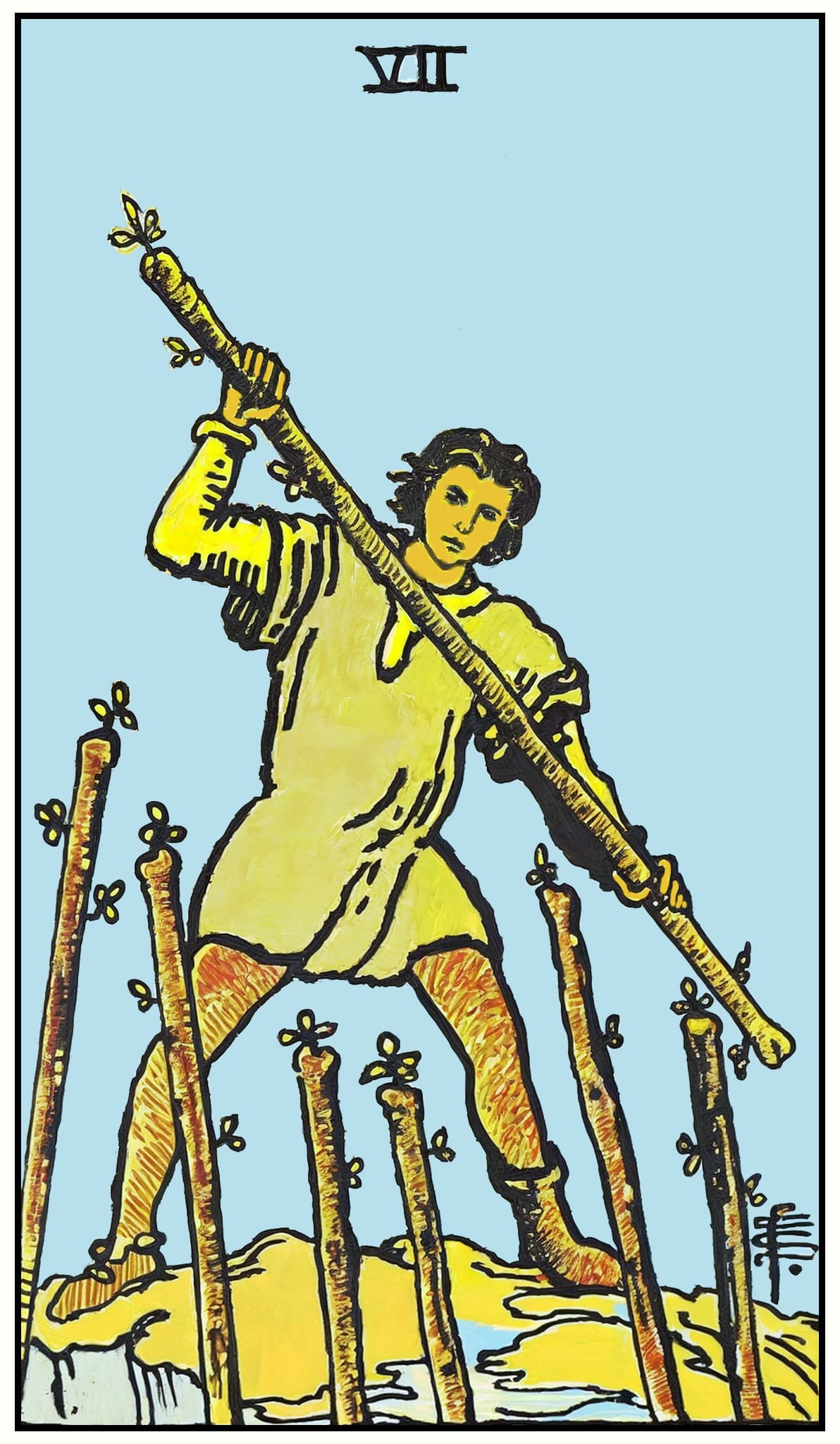
After the Seven's held defence, something releases — and the work finds its own speed
The Eight arrives as clearing: the project enters its rhythm, the correspondence breaks open after months of silence, the long-delayed thing moves. No figure appears in the image because the human element has, for this interval, become unnecessary — the wands are in flight and the flight is theirs. In shadow, the Eight becomes the cascade that feels like momentum but is only activity: the inbox cleared at midnight, the travel schedule filled beyond capacity, the forward motion that has forgotten what it is moving toward. Speed without an aimed prior is not this card. It is its counterfeit.
The point in the suit where fire learns the aerodynamics of its own form
Pollack reads the Eights across the suits as cards of structural maturity — the moment when an element has learned enough about itself to operate with efficiency rather than effort. In Wands, this means fire that no longer needs to assert itself. Earlier in the suit, intensity was the tool: more push, more will, more presence. The Eight introduces the opposite intelligence — the release that comes from having done the preparation. The pleasure specific to this card is the competence that has become, finally, second nature.
The complete three-layer reading for all 78 cards — including the full psychological and archetypal layers — is in The Pocket Guide →
The card of clean release becomes, badly used, the card of undirected velocity.
Shadow TrapThe activity that has accumulated enough momentum to feel like the Eight but is missing the prior aim — the person moving fast in several directions at once, mistaking the speed for evidence of the rightness.
Shadow GiftThe capacity to recognize when the preparation is genuinely complete, to release the work without further management, and to let the arc finish at the distance it was thrown to reach.
Shadow readings for each card, by suit, are gathered in The Pocket Guide →
We do not read a reversal as an opposite; following Pollack, a turned card is the same energy blocked, withheld, or redirected — not inverted into its negation. A reversed Eight of Wands often marks the work that cannot be released — the project held past its natural completion point, the correspondence managed rather than sent, the effort that has been aimed and should be trusted but is being retrieved and re-aimed out of anxiety about where it will land.
Why Apocrypha Does Not Read Reversals as Opposites →Sixty-three symbols across the full deck — cross-referenced by card and meaning — are mapped in The Symbol Dictionary →
What have you prepared well enough to release — and what is the difference between the revision that would genuinely improve it and the revision that is postponing the moment you have to let it reach where it's going?
The Eight of Wands is most often read as "things moving fast" and left at that. The more precise reading distinguishes between the movement that is this card and the movement that resembles it: the Eight requires prior aim, and the absence of prior aim means the figure is not in the Eight but in its shadow. The absence of a human figure in the image is not decorative — it is the card's central instruction. The question is whether the practitioner is absent because they have completed their part or because they never engaged it.