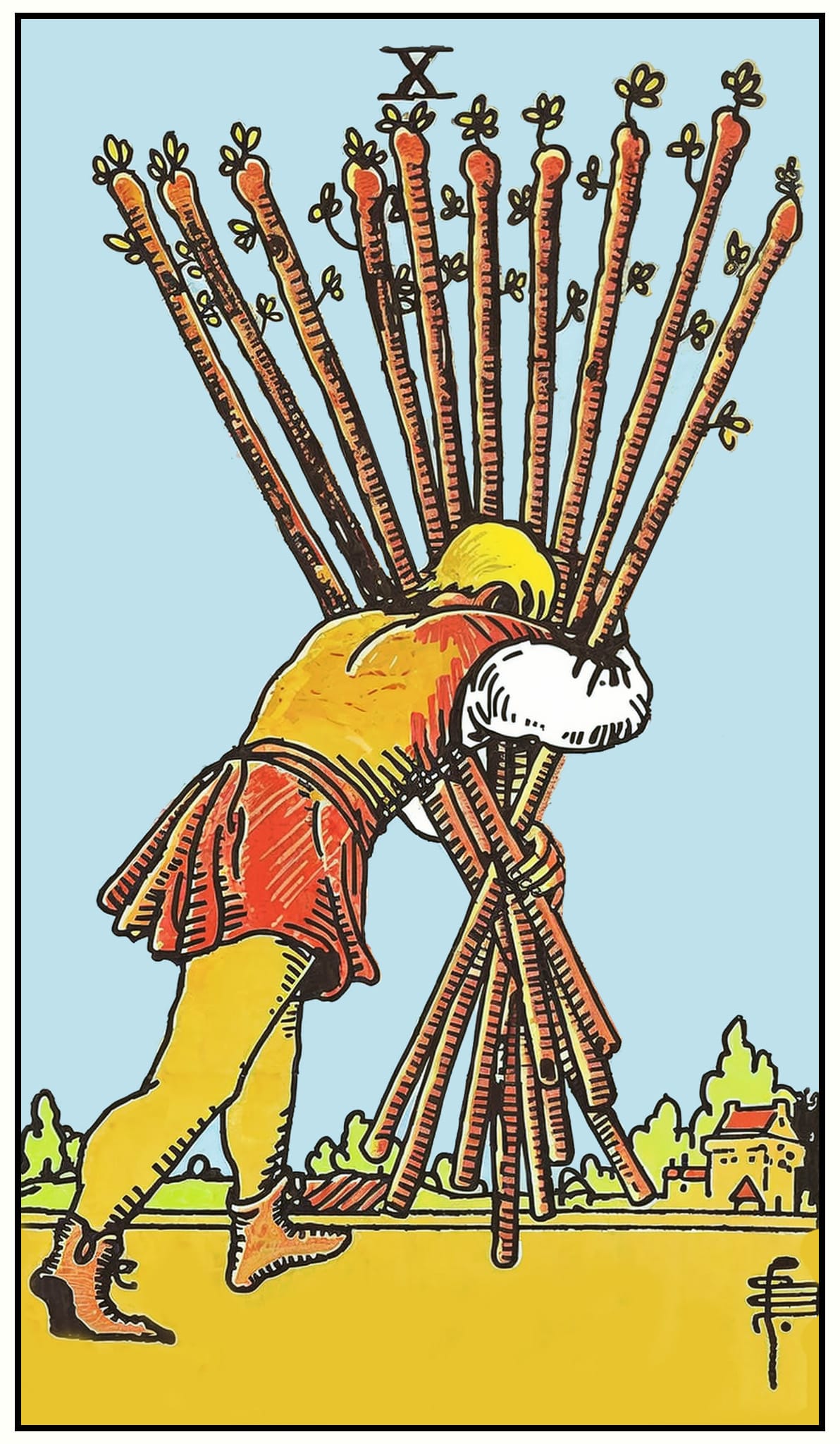
Ten of Wands
A figure walks bent under ten wands pressed against his body, a town visible in the near distance — the destination in sight, the last steps the heaviest, the face hidden by the load.
The Ten of Wands names the overload at the suit's completion: every yes accumulated across ten cards now carried in a single body toward a finish line that should be relief but has become just another weight. The card is not about failure. It is about the fire that succeeded well enough to become its own burden — the commitment that outlasted the self who originally made it.
Every yes the suit accumulated, now hauled toward an ending that cannot quite arrive
The Ten arrives as the suit's outer limit: the leader who built something and cannot now give any of it away, the artist whose success has become an obligation to reproduce, the person whose original commitments have compounded into a load that no longer fits inside a single life. The town is close enough to see. The figure's posture says the last steps are the hardest. In shadow, the Ten is the martyrdom that refuses the set-down — the bundle has become identity, and to hand any of it to someone else would mean admitting that the self is not, and perhaps never was, the only one who could carry it.
Fire at its outer limit — the suit that began as freedom of will ends, badly handled, as the inability to say no
Pollack reads the Ten of Wands as the suit's over-extension: the Ace's spark pursued through ten increments until the original impulse is now pressed flat against the body of the person carrying it. The Ace was held outward in an open hand. The Ten is hauled with both arms. This is what sustained fire produces if no renegotiation occurs along the way — not defeat but the accumulated weight of every commitment that arrived as yes and was never revisited. The suit ends asking: which of these were ever yours to carry?
The complete three-layer reading for all 78 cards — including the full psychological and archetypal layers — is in The Pocket Guide →
The fire that refused to delegate has become, at scale, the fire that cannot breathe.
Shadow TrapThe refusal to redistribute the load, not from inability but from the quiet terror of discovering — once the wands are set down — who one is without them, which the carrier suspects may be less than the bundle implies.
Shadow GiftThe recognition that the load was assembled one yes at a time and can be disassembled the same way — and that the town is close enough that setting some of the wands down before the door is not abandonment but accuracy.
Shadow readings for each card, by suit, are gathered in The Pocket Guide →
We do not read a reversal as an opposite; following Pollack, a turned card is the same energy blocked, withheld, or redirected — not inverted into its negation. A reversed Ten of Wands often marks the person just before or just after the drop — either the moment when the refusal to redistribute is reaching its physical limit, or the disorientation of someone who has set the bundle down and does not yet know what to do with the hands that carried it.
Why Apocrypha Does Not Read Reversals as Opposites →Sixty-three symbols across the full deck — cross-referenced by card and meaning — are mapped in The Symbol Dictionary →
Which of the things you are carrying arrived as a choice and have since become a fact — and what would it cost to ask, for each of them separately: was this mine to carry, and is it still?
The Ten of Wands is most often read as a warning about burnout, and the burnout is real. The more specific reading identifies the mechanism: it is not the weight but the refusal to redistribute that produces the card's characteristic suffering. The town is there. The set-down is available. The card is not asking whether the figure can make it to the door. It is asking why he hasn't put anything down before reaching it — and what that refusal is protecting him from having to know.