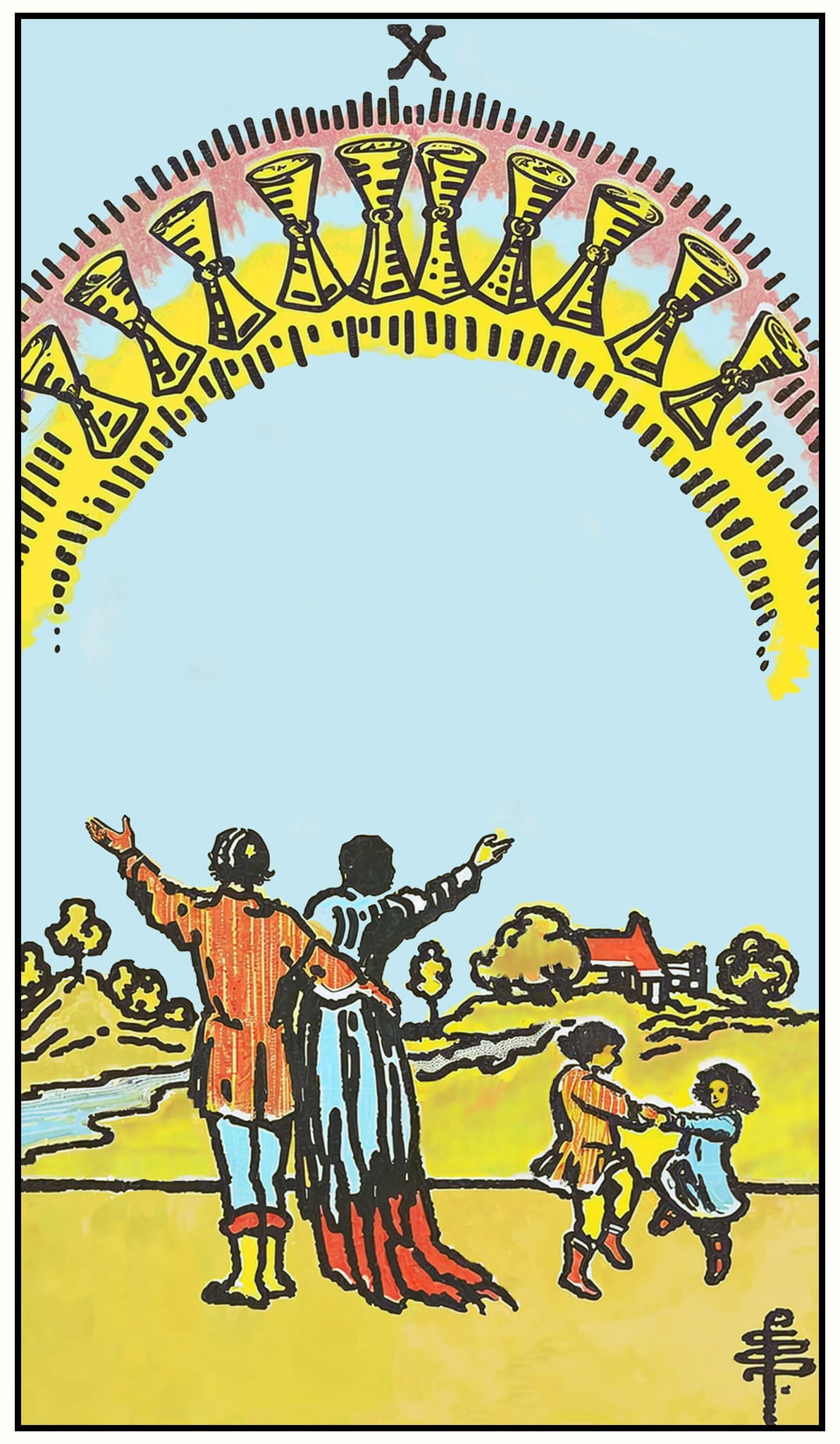
Ten of Cups
A couple stands with arms extended toward a rainbow arc of ten cups in the sky above them — two children dancing beside them, a house by a river in the distance, the whole scene holding its fullness in one moment.
The Ten of Cups names the moment in which a life recognizes itself as full. Not the perfect family — something more specific and more demanding: the developed capacity to perceive completeness from the inside, while inside it. The rainbow does not touch the ground. What the sky offers and what the earth receives are related, and the distance between them is the card's most honest detail.
The fullness is real — and so is the rainbow not touching the ground
The Ten of Cups is the configuration of the life recognized as complete: the couple, the children, the house, the river, the arc of cups in the sky. No one in the card is performing for anyone else — the couple looks upward together; the children are in their own world beside them. In shadow, the Ten is the image mistaken for the substance: the person who has assembled the visible form of a full life — relationship, children, home, apparent meaning — and experiences it as hollow, because the interior that would animate the form has not been developed. The rainbow does not touch the ground. Fullness can be present and unfelt.
Cups' final expression — the whole emotional arc from source to completion, briefly visible in one view
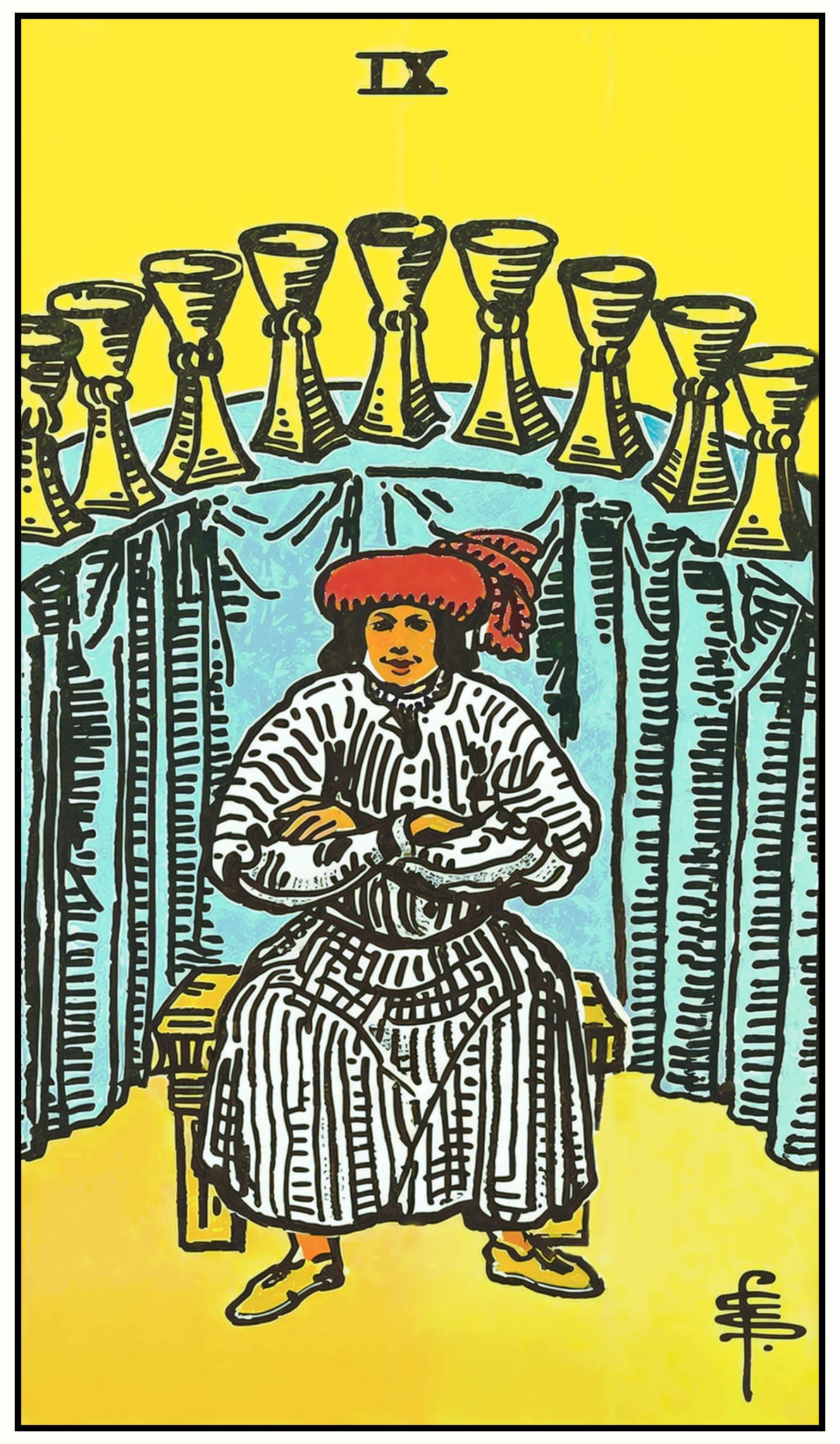
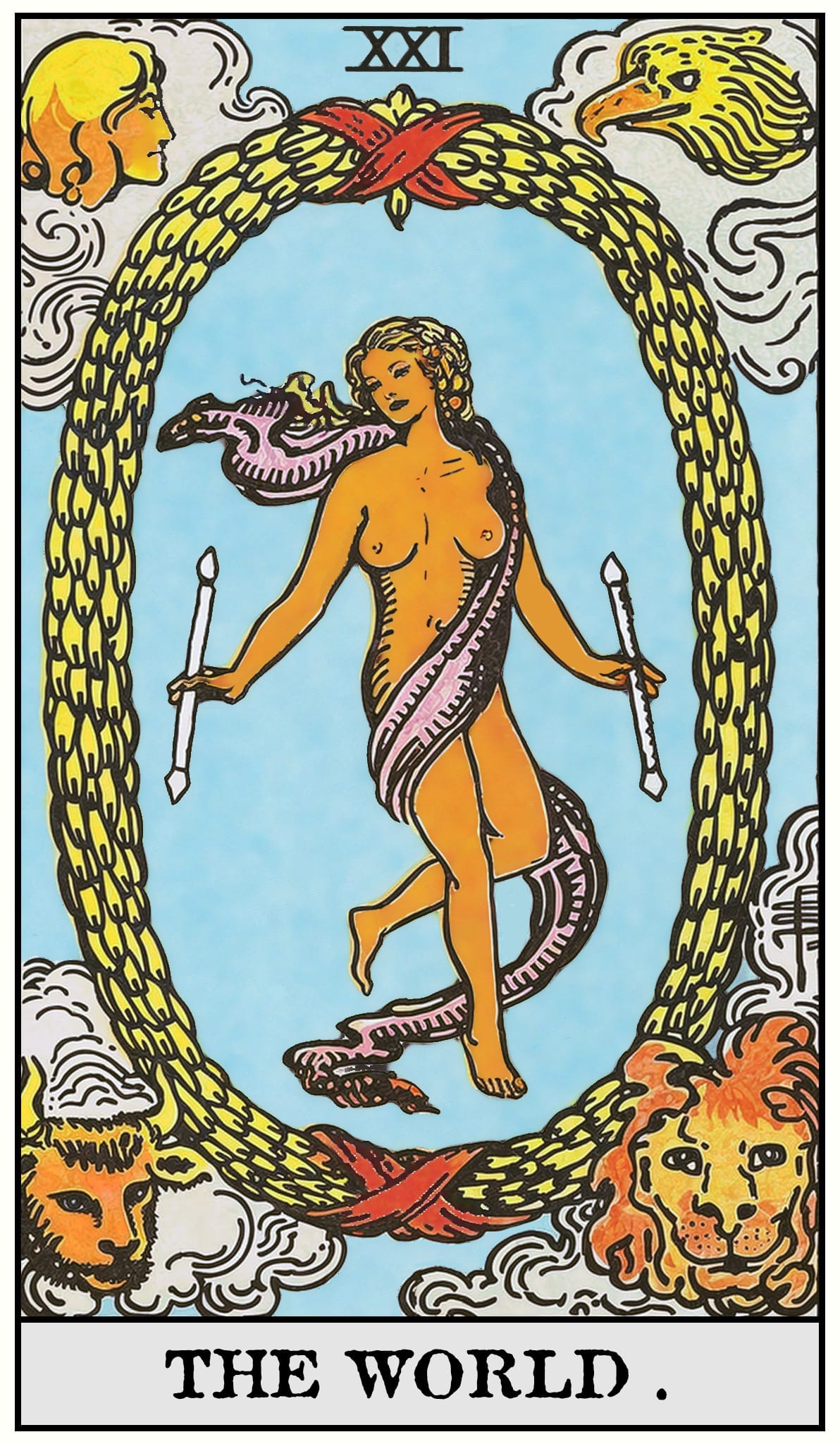
The Ten holds the suit's complete journey: from the Ace's solitary opening through meeting, celebration, withdrawal, loss, recovery, fantasy, departure, and satisfaction to this — the full emotional arc briefly visible in one frame. It is not permanent. Tens are not permanent. The World (XXI) is the Major Arcana's equivalent, but the World is cosmological closure. The Ten of Cups is the same truth at the human, domestic scale — more fragile, and for that reason more precious. The universe holds the World. A house by a river, two children, and a rainbow that does not touch the ground holds the Ten of Cups.
The complete three-layer reading for all 78 cards — including the full psychological and archetypal layers — is in The Pocket Guide →
Fullness can be present and not perceived. It can also be performed and not felt.
Shadow TrapThe full life assembled in form without the interior that would make it legible — the relationship, the children, the house, the visible arc, and the private experience of none of it landing.
Shadow GiftThe developed capacity to recognize fullness from the inside, in real time, rather than only in retrospect — which is what this card names as the rare, specific achievement of emotional maturity.
Shadow readings for each card, by suit, are gathered in The Pocket Guide →
We do not read a reversal as an opposite; following Pollack, a turned card is the same energy blocked, withheld, or redirected — not inverted into its negation. A reversed Ten of Cups often marks the fullness present but unrecognized — the person inside a configuration that would register as complete if seen from outside, who cannot yet see it from inside, either because the interior capacity to receive completeness has not been developed or because the form has been assembled before the feeling was ready.
Why Apocrypha Does Not Read Reversals as Opposites →Sixty-three symbols across the full deck — cross-referenced by card and meaning — are mapped in The Symbol Dictionary →
Are you able to recognize fullness when you are inside it — or only in retrospect, after it has passed? And if retrospect is where you do your recognizing, what is the cost of that timing?
The Ten of Cups is most often read as the highest possible positive outcome — the happy ending. The more precise reading describes not an outcome but a capacity: the ability to be inside a full life and recognize its fullness in real time. That capacity is the rarest thing the suit develops, and the card is not predicting its arrival. It is describing what it looks like when it is present — and implicitly asking whether the person receiving the card has built the interior that would allow the fullness to be felt rather than only assembled.