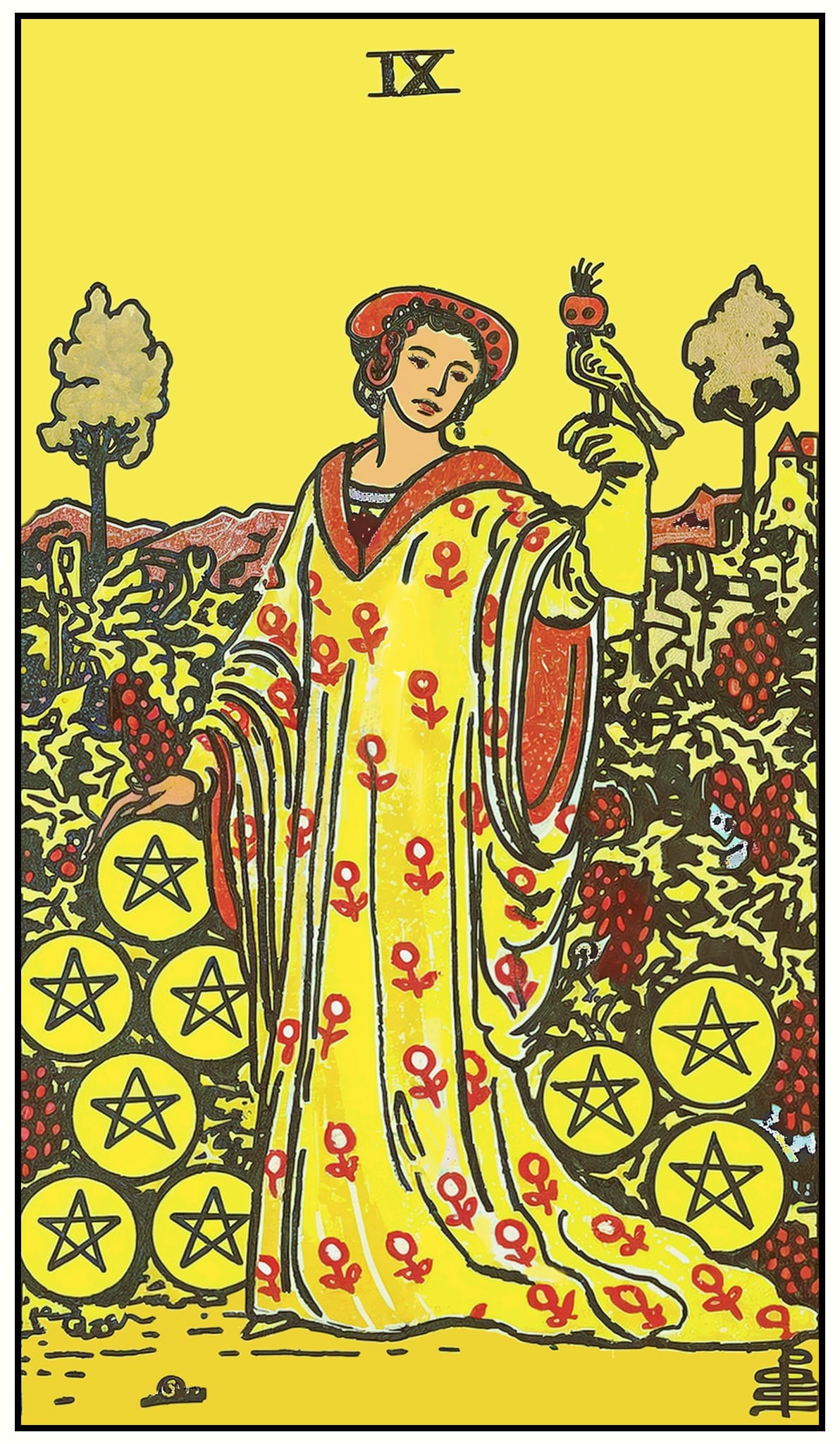
Nine of Pentacles
A woman stands alone in a vineyard, richly dressed, a hooded falcon on her gloved hand — nine pentacles heavy in the vines around her, a snail at her feet, her house in the distance.
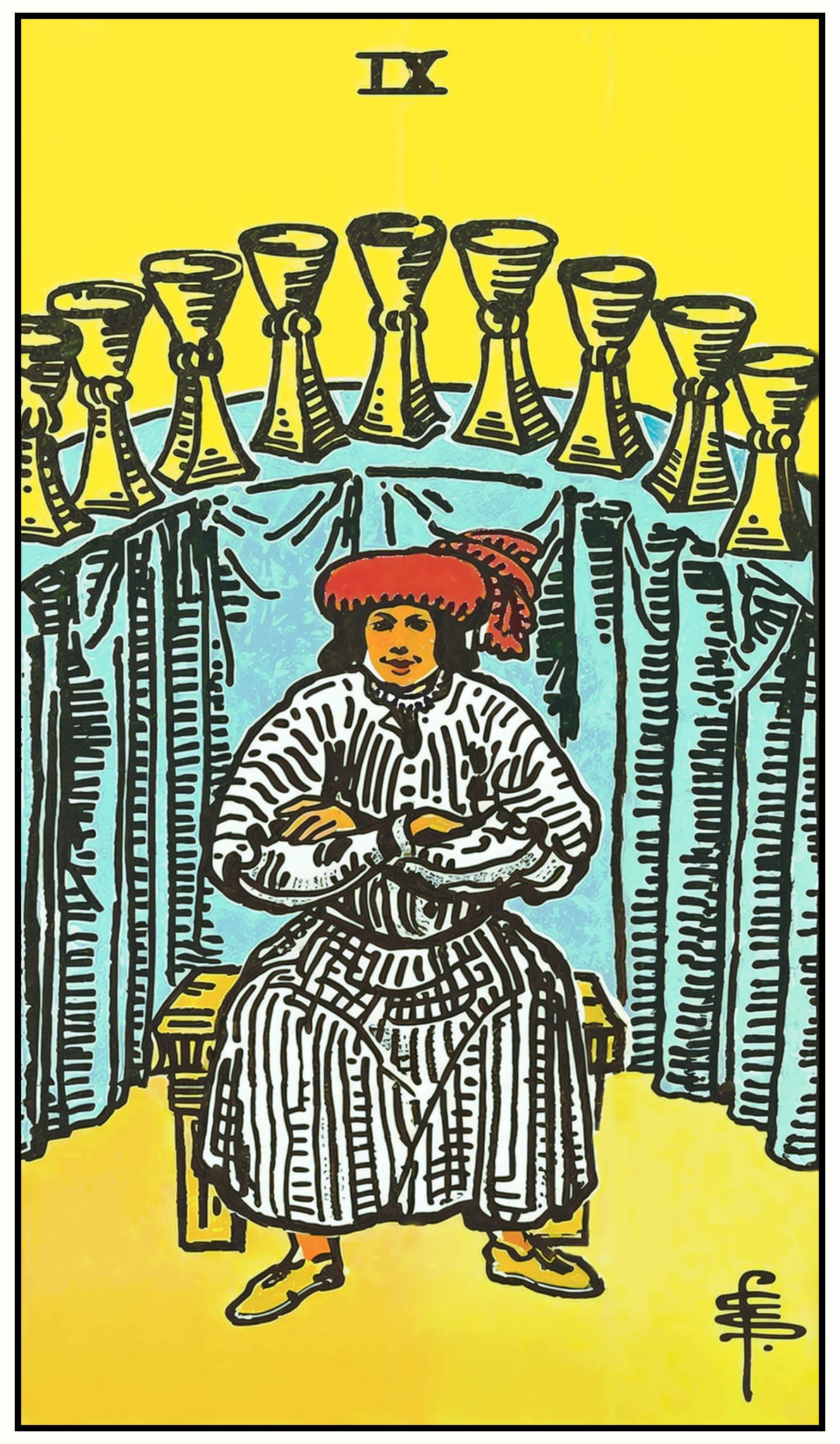
The Nine of Pentacles names the life constructed by deliberate effort and inhabited without apology: not the Nine of Cups' slightly airless satisfaction but a settled integration — the garden is the garden she built, the house is hers because she worked toward it, and the solitude is not the card's problem. It is the card's condition, and she has made her peace with it.
She built toward it. She is living inside it. These are not small things.
The Nine of Pentacles is not a promise of abundance incoming. It is a description of a specific life: self-determined, materially stable, earned rather than inherited, and genuinely solitary in a way that is neither tragedy nor performance. The falcon on her hand is trained — a wild thing brought into relationship by patient skill, available to be released, always returning. This is what the suit has been building toward: not merely having, but having arranged things according to one's own understanding of what matters. In shadow, the garden that has become so complete it no longer admits anything wild that was not invited — the self-sufficiency that has become a closed system.
The suit's promise fulfilled — spirit made external, the structure built on accurate self-knowledge
Pollack distinguishes the Nine of Pentacles from the Tower: the Tower is the structure built on false premises, which collapses when the premises are exposed. The Nine is the structure built on accurate self-knowledge, which is why it stands. Not because she was protected from difficulty — the falcon knows something about difficulty — but because what she built reflected what was actually true about her. This is the suit's anti-spiritual-bypass position in its most affirmative form: the real thing, built in the real world, by real sustained effort, over real time.
The complete three-layer reading for all 78 cards — including the full psychological and archetypal layers — is in The Pocket Guide →
The garden complete and the garden closed are different conditions that can look the same.
Shadow TrapThe self-sufficiency that has become so complete it no longer admits anything unplanned — the garden that does not allow things to grow in directions the gardener has not authorized, the life so thoroughly arranged that its own completeness becomes a form of enclosure.
Shadow GiftThe capacity to inhabit what has been built without requiring it to be defended from everything that has not been planned — to let the falcon return without guaranteeing it will, and to tend the garden without controlling every direction of its growth.
Shadow readings for each card, by suit, are gathered in The Pocket Guide →
We do not read a reversal as an opposite; following Pollack, a turned card is the same energy blocked, withheld, or redirected — not inverted into its negation. A reversed Nine of Pentacles often marks the self-sufficiency undermined — the garden that has been built and is now at risk, or the completion that cannot be inhabited because the person who built it cannot believe it is theirs to inhabit without apology.
Why Apocrypha Does Not Read Reversals as Opposites →Sixty-three symbols across the full deck — cross-referenced by card and meaning — are mapped in The Symbol Dictionary →
What have you built that is genuinely yours — and are you inhabiting it without apology, or still standing at its edge asking permission to enter?
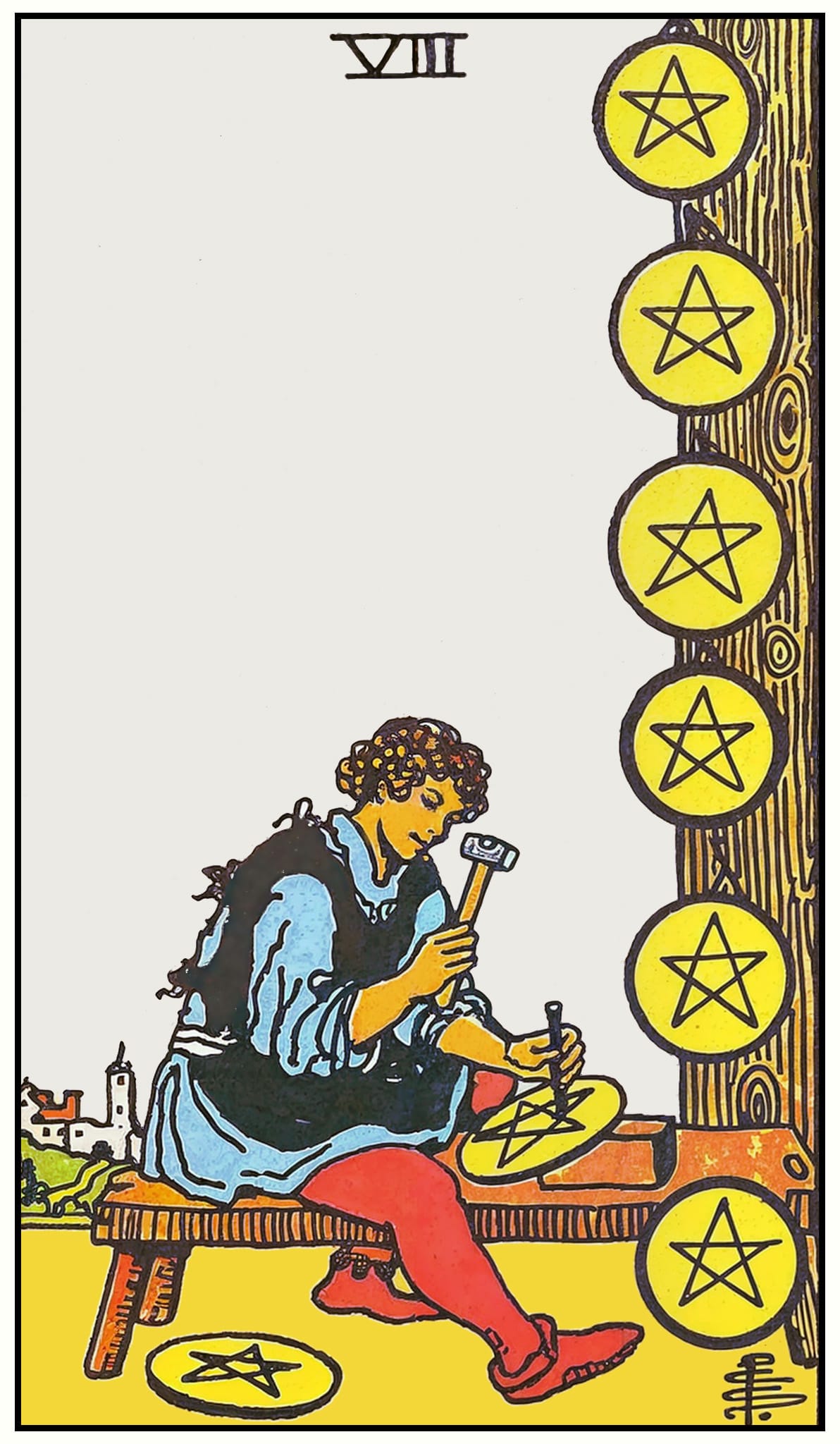
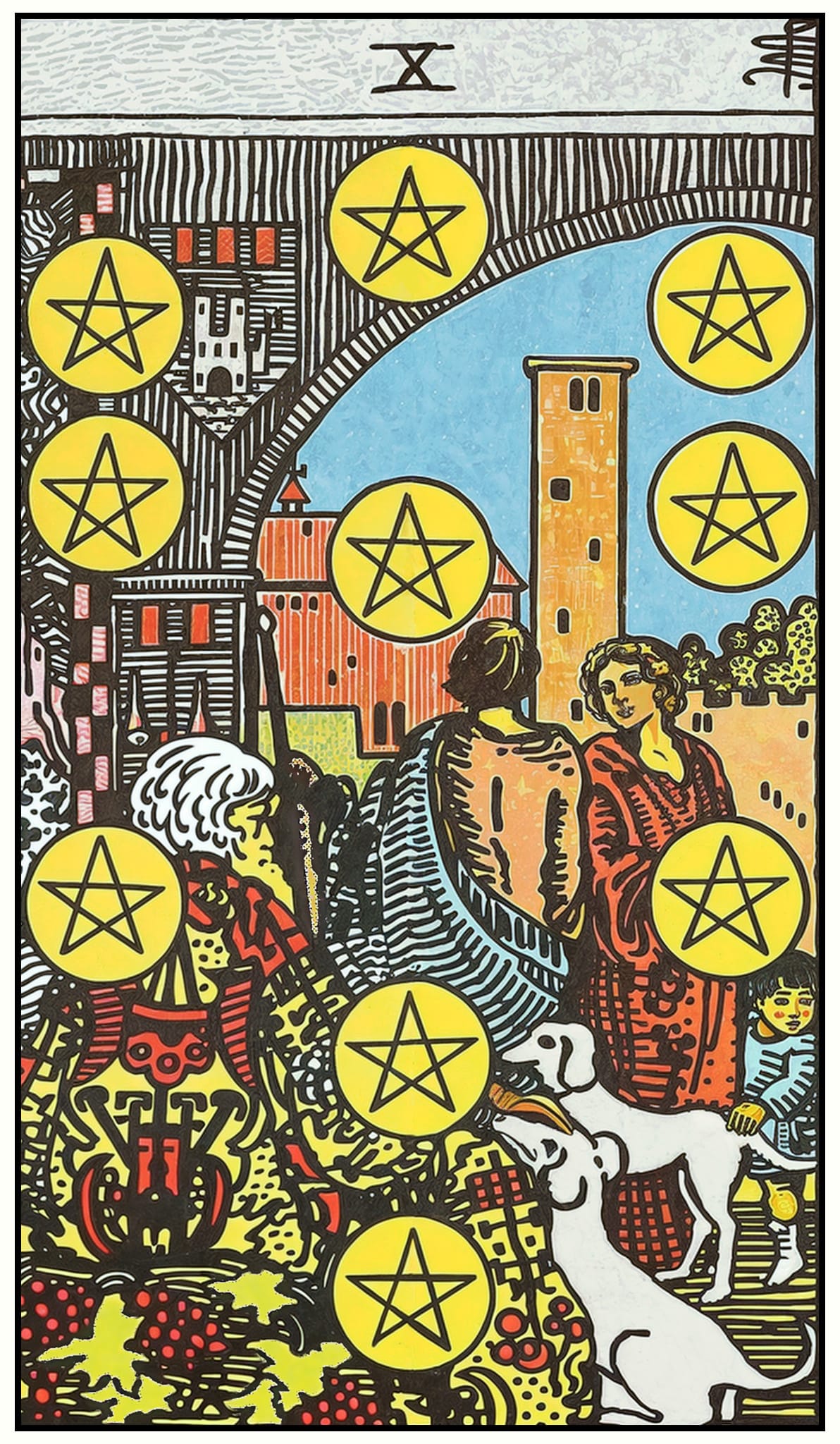
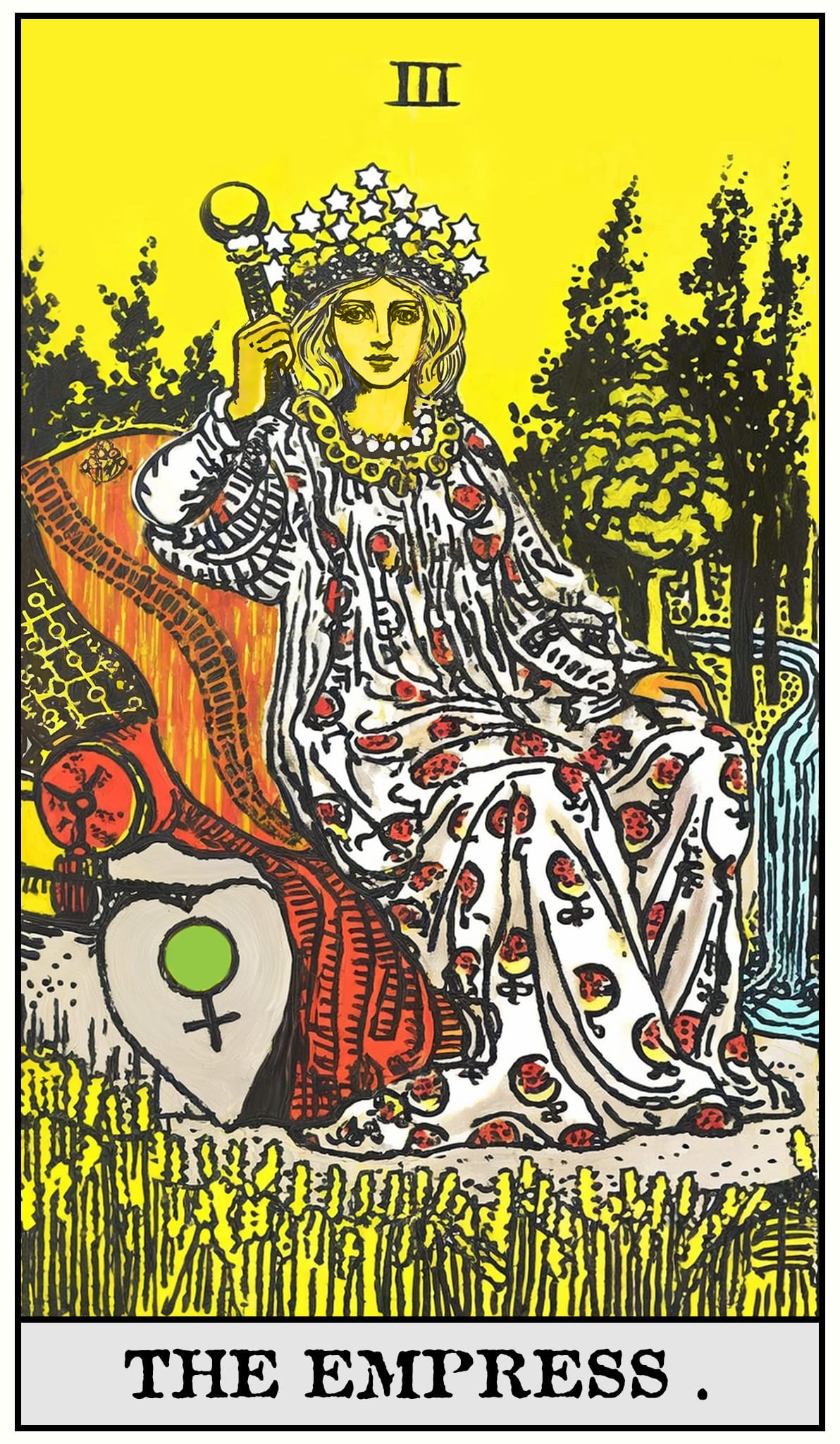
The Nine of Pentacles is most often received as abundance, luxury, financial independence incoming. The more interior reading asks not about what will arrive but about what has been built — and specifically whether the person receiving the card has done the work the card describes, and if so, whether they are allowing themselves to inhabit the result without ongoing apology. The card is not promising anything. It is describing a specific configuration of a life, and asking whether the reader can recognize it from the inside.