The Moon
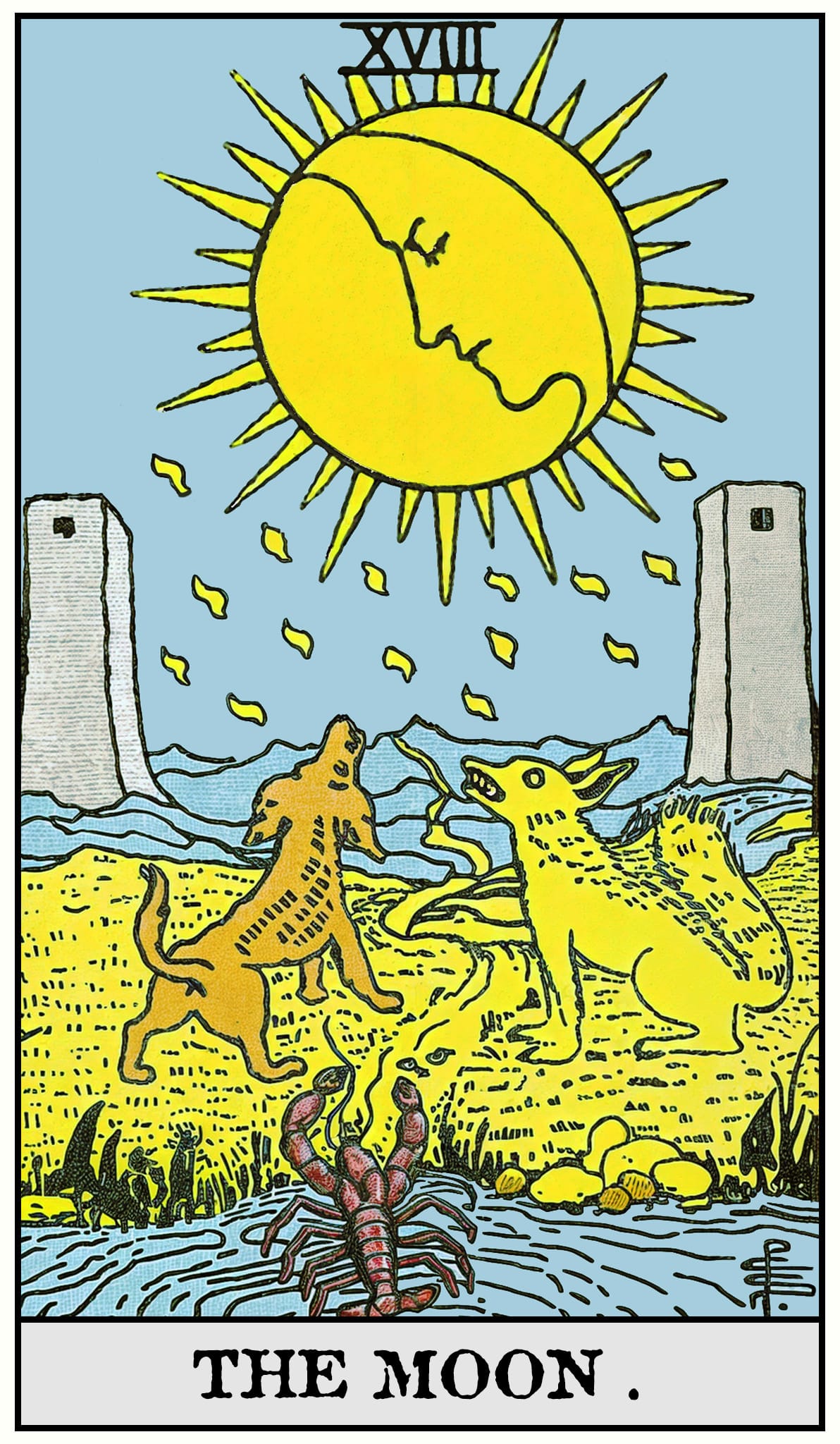
Between two grey towers a path winds forward into mountains that may or may not be reached. The path is real. The destination is not visible. These are not the same problem.
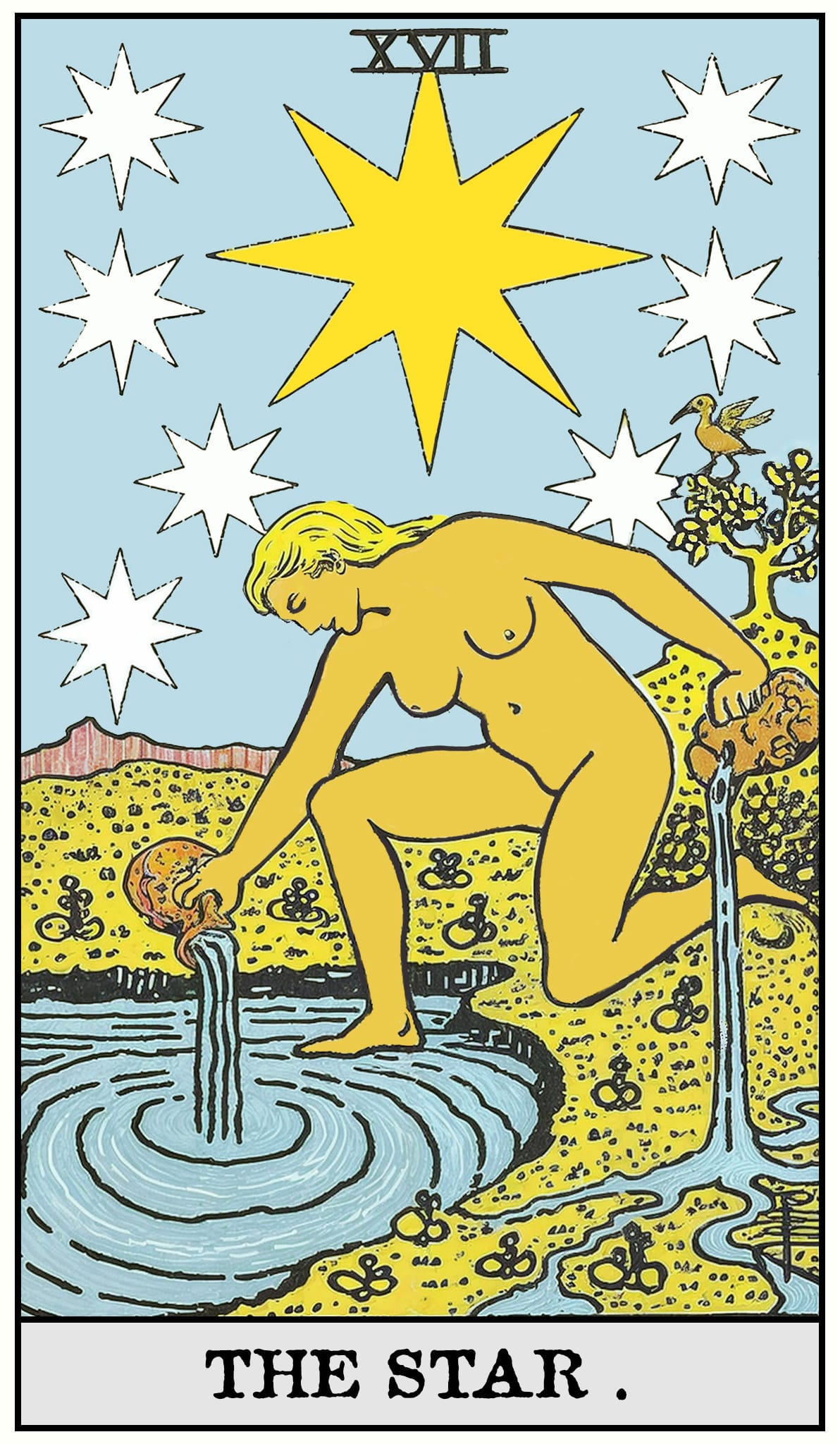
The Moon is the card that arrives after the Star and refuses to confirm that progress is linear. What the Star opened — intuitive flow, the willingness to pour without calculation — the Moon does not cancel. It takes further. The still pool of the Star now contains something climbing out of it. The rational categories that made the outer life legible have temporarily withdrawn. The card does not announce danger. It announces that the most important material is about to surface, on the unconscious's schedule rather than the conscious mind's.
This is also the card most commonly misread as a warning. It is not a warning. It is a threshold. The figures on the card — the dog, the wolf, the crayfish, the howling pair — are not threats. They are what was always present beneath the manageable surface, now visible because the light has changed.
The temporary withdrawal of the daylight categories
The Moon arrives as a period in which ordinary interpretive tools stop working. Things mean more than one thing. People say what they mean and the words don't land, or say something adjacent and the words land differently than intended. Dreams leak into the waking hours. Atmospheres move without obvious cause. The path through this territory is visible on the card — it is right there, winding between the towers — but its end is not. The depth of this card is not illusion and deception, which is how most readings frame it. That is the surface. The depth is something stranger: the temporary withdrawal of the daylight categories, and the requirement to continue walking while they are absent. The Moon's shadow form is to mistake this passage for a permanent address. To enter the fog and find it interesting enough to stay. The card insists: this is a passage. The figures on it are passing through and noting that they are passing through.
The structure being honest about its limits
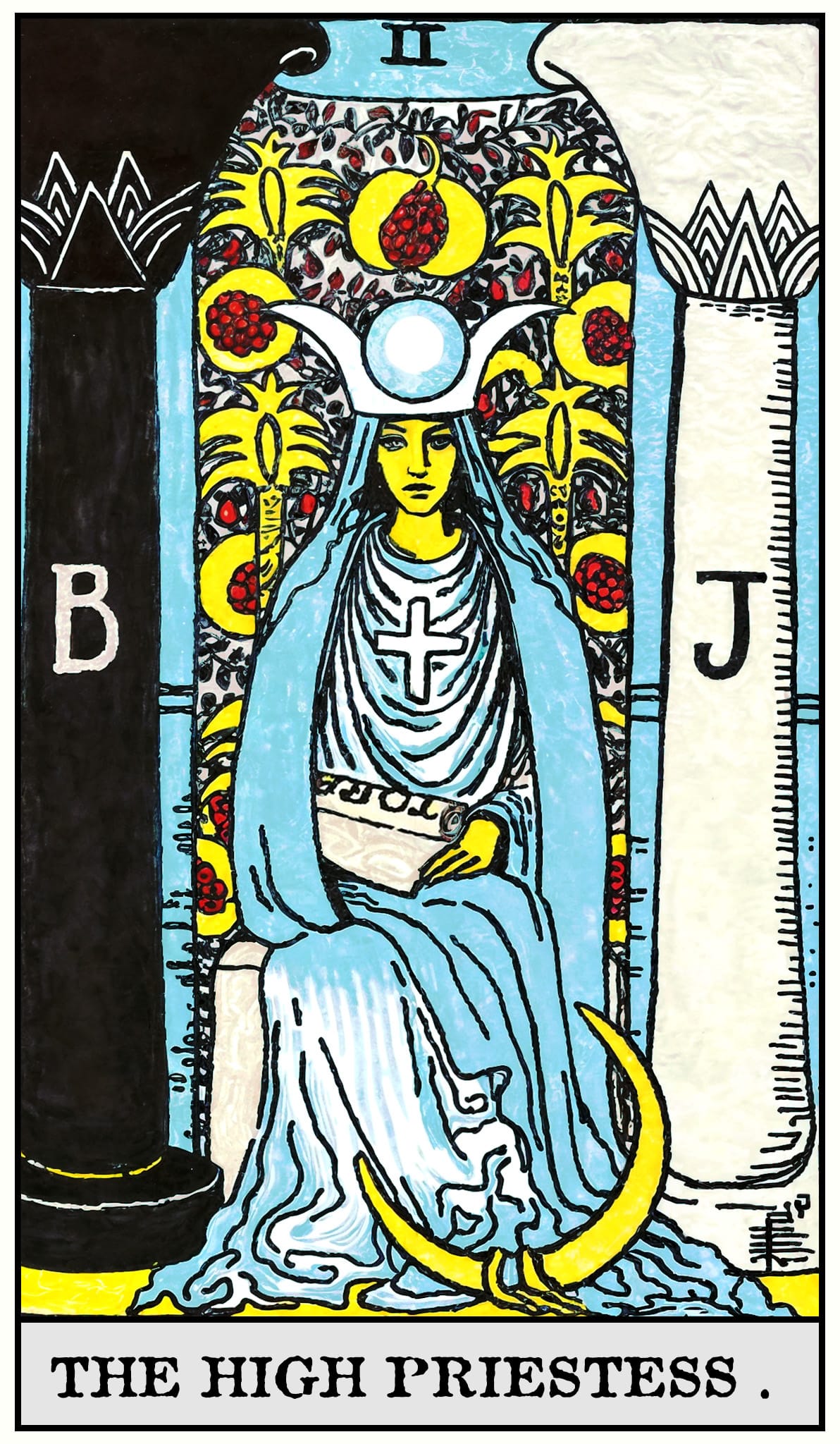
Vertically in the three-row architecture, the Moon stands in the column of structure: Emperor (IV) at the first row, Justice (XI) at the second, Moon (XVIII) at the third. The Emperor builds the form; Justice tests whether the form has been just; the Moon reveals everything the form cannot see from inside its own daylight. This is not the structure failing. This is the structure being honest about its limits. Marie-Louise von Franz observed that the unconscious cannot be reached by the same mind that built the approach to it — and the Moon is where that limit becomes undeniable.
The dog and wolf are the card's psychological precision. The dog is domesticated instinct — the portion of the instinctual life that has been brought into relationship with consciousness, that answers when called. The wolf is the same instinct before domestication, or after it breaks down. They stand on opposite sides of the path but howl at the same moon: they recognize the same call. The card does not ask the walker to choose between them. It asks for the acknowledgment that both are present, both are one's own, and both must be walked between without disowning either.
The only real error is to make the passage into a residence.
Shadow TrapThe Moon's specific danger is making the unmapped territory into an identity. The conscious self, finding the dissolution of categories more interesting than any category, begins to prefer the fog. It mistakes the confusion for depth, the dissociation for sensitivity, the inability to read the situation for some kind of superior awareness. The card becomes a residence rather than a passage. This is the only real error available here — not the darkness, but the refusal to continue through it.
Shadow GiftThe Moon also offers something available nowhere else in the deck: the capacity to move through territory that cannot be proven, systematized, or argued with, and to continue anyway. The figures that howl are not obstacles. They are companions who know this terrain from the inside. The crayfish that surfaces is not a threat. It is the oldest layer of the psyche presenting itself for recognition. The gift is the willingness to witness this material without either re-imprisoning it or being consumed by it. To see it, let it pass, and keep walking toward the mountains that may or may not be reached tonight.
Following Pollack, reversal indicates blocked or redirected energy rather than an opposite meaning. The Moon reversed marks one of two failures — and the distance between them is almost complete.
The first is the refusal of entry: the practical, daylight-only person who dismisses the dream-life entirely, who categorizes the Moon territory as irrational and therefore irrelevant, and who continues walking on the surface of a life while the crayfish accumulates unchecked in the depths below. The fog never comes because the windows are always closed. This person will eventually encounter the card's material through symptom rather than passage.
The second is the inability to exit: someone has gone into the Moon territory and cannot locate the path back toward daylight. The confusion has become structural. The howling has become the entire soundscape. What was meant to be a passage has become, in Pollack's phrase, a residence — and the person cannot quite remember what it was like before the ordinary categories were legible.
The reversal asks: which of these are you? And the question underneath: can you tell the difference between the fog that is content surfacing and the fog that has become a preference?
Why Apocrypha Does Not Read Reversals as Opposites →In Relationship
The Moon in a relational reading marks the moment when you cannot be certain whether what you are seeing is the other person or your own archaic material projected onto them. The pool contains a crayfish. Something ancient is climbing out. The question this card asks is not whether to stay or leave — it is: what are you actually seeing? And the harder question underneath: what are you bringing to this person that predates them entirely? The Moon also marks the relational territory where projection is operating at full strength — when the other person has become a screen on which the unconscious plays its oldest material. Not as accusation. As observation. The card asks the reader to notice the projection before acting from it.
In Work and Vocation
In vocational readings the Moon is the creative fog — the period when the project refuses to clarify, when the next step is not visible, when the work seems to be generating contradictory signals. Hillman would say the daimon is renegotiating. The card asks for a specific posture: continue working without demanding that the work prove itself. The destination is not visible. The path is real. These are not the same problem, and conflating them is the error that stops most creative work at its threshold. The Moon in vocation also signals the return of material that the professional self had organized away. The repressed vocation. The question about the work that was never asked aloud.
In Body
Somatically, the Moon is the night body. The 3am waking with something unnamed and unlocatable pressing on the chest. The vague dread that has no object. The dream that doesn't resolve into an image but leaves a residue in the body for hours. When the Moon is present, the body often knows before the mind does — and what it knows cannot be translated into the mind's ordinary language. The work is not to force translation. It is to let the body carry the knowledge until the knowing takes a form that can be held.
What have you been naming confusion that is actually content arriving on the unconscious's schedule, not yours? And the harder question: if you knew the daylight categories would not return when you wanted them to — that the fog has its own timing — would you continue walking the path anyway, or would you wait for a guarantee the card has never offered?
The most common error with the Moon is to read it as a warning about the external situation: things are not what they seem, watch for deception, someone is not telling the truth. These readings are not wrong, but they are the surface, and they point the reader outward when the card is pointing inward. The Moon is almost never primarily about what someone else is doing. It is about what the reader's own unconscious is doing with what they are seeing.
The second most common error is to read the card as simply uncomfortable and therefore to move past it quickly toward a more pleasant card in the spread. This is the choice to stay on land. The Moon's discomfort is the discomfort of the passage, not the discomfort of danger. There is a difference. The figures on the card are not afraid. They are walking.
When this card appears, sit with the image longer than you want to. Notice what you feel before you notice what it means. The meaning, if it comes, will come from the body's response to the image — not from the reference library.