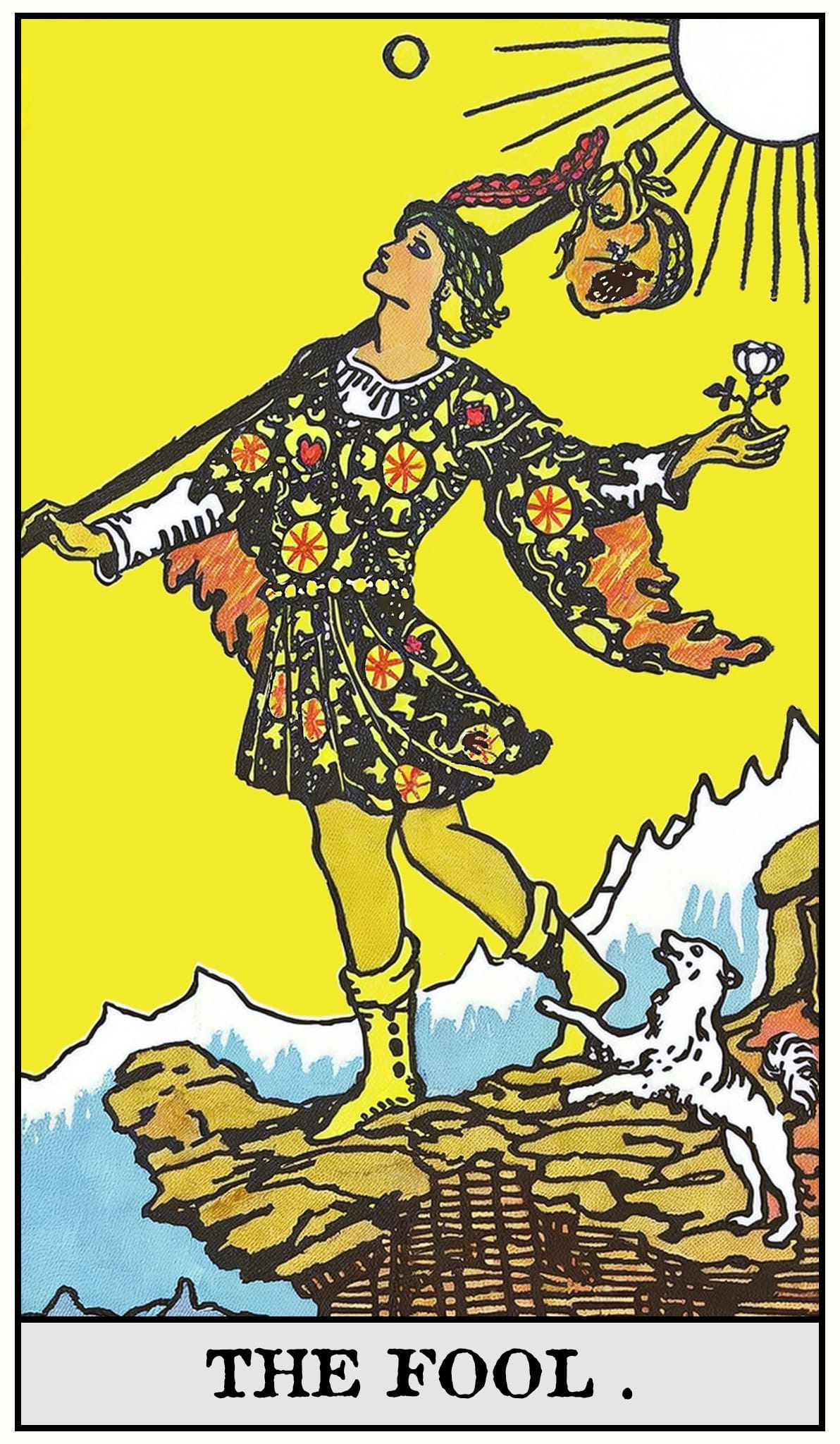
The Fool
He carries everything he owns in a single bag and calls it enough — then steps toward the edge, not because he cannot see it, but because the edge is the only place a journey has ever begun.
The Fool is card zero — the number before counting starts, the figure who holds all the others as pure potential. He is beginning itself: the willingness to move before the path has been proven.
Read psychologically, the Fool is not naïve so much as uncommitted — unmarked by the outcomes that will eventually shape every other figure in the deck. His power is precisely that he has not yet spent it. To draw him is to be asked whether you are standing at a genuine threshold, and whether you are prepared to cross it without first demanding a guarantee. The leap is the lesson; the certainty you want is the thing the card declines to give you.
The moment before a choice becomes a history
On the surface, the Fool describes the instant just prior to commitment — when every direction is still available and none has yet cost you the others. He is the held breath before the decision, the door still open on both sides. The card asks you to recognise that you are in that instant now, and that it will not last.
Why the leap works when the plan would not
Beneath the image is a psychological function: the Fool is the part of the psyche that can act before it fully understands, because some thresholds cannot be reasoned across — only crossed. The faith here is not belief in a good outcome. It is the willingness to begin without one, trusting that meaning is made in the walking and not located in advance on a map.
Where the same gift turns against you
Every card carries a shadow — not an opposite, but the cost of its own virtue overextended. The Fool's openness can curdle into a refusal to ever land. Held one way it is the trap; held another, the very thing the trap was protecting.
The Shadow Trap
Recklessness dressed as freedom. The eternal beginner who starts everything and finishes nothing, mistaking momentum for courage and motion for meaning — forever stepping off, never arriving.
The Shadow Gift
The capacity to stay unfinished. To resist premature closure, to refuse the false certainty that would end the journey early. Held consciously, the Fool's incompleteness is not a flaw but a door left deliberately open.
We do not read a reversal as an opposite. Following Pollack, a card turned is the same energy blocked, withheld, or channelled elsewhere — never inverted into its own negation. A reversed Fool is still the leap; it is simply the leap held back.
It can describe the threshold avoided — hesitation rebranded as prudence, the step you have been postponing while calling the delay wisdom. It can also describe the leap taken without looking at all: openness spilling into carelessness, beginning without attention. The question the reversal poses is not whether to move, but where the Fool's faith has gone — turned inward as fear, or outward as flight.
Reversals are read as blockage or redirection — not as opposite meaningsIn Relationship
A bond at its beginning, before either person has been priced. The invitation to meet someone without the armour of past endings — and the risk of mistaking infatuation for the readiness to truly begin.
In Work
The blank page, the unproven idea, the role you are not yet qualified for. Permission to start before you feel ready — paired with the caution that not every cliff is meant to be walked off today.
In Body
Restlessness, the nervous energy of the un-begun. The Fool in the body is the impulse toward movement — to be honoured as vitality, watched where it becomes flight from stillness.
Where in your life are you standing at an edge, calling your hesitation wisdom?
What would it cost you to take the step before you are certain?
Resist the urge to make the Fool tell you whether to leap. He will not, and the wish that he would is usually the thing worth examining. The card is not a verdict on your decision; it is a mirror held to your relationship with beginning — your appetite for it, your fear of it, the stories you tell to delay it.
Sit with the image before you reach for the meaning. Notice where your eye goes — to the edge, the rose, the dog, the drop. The Fool read well does not resolve your uncertainty. It returns you to it, more honestly, and lets you choose from there.