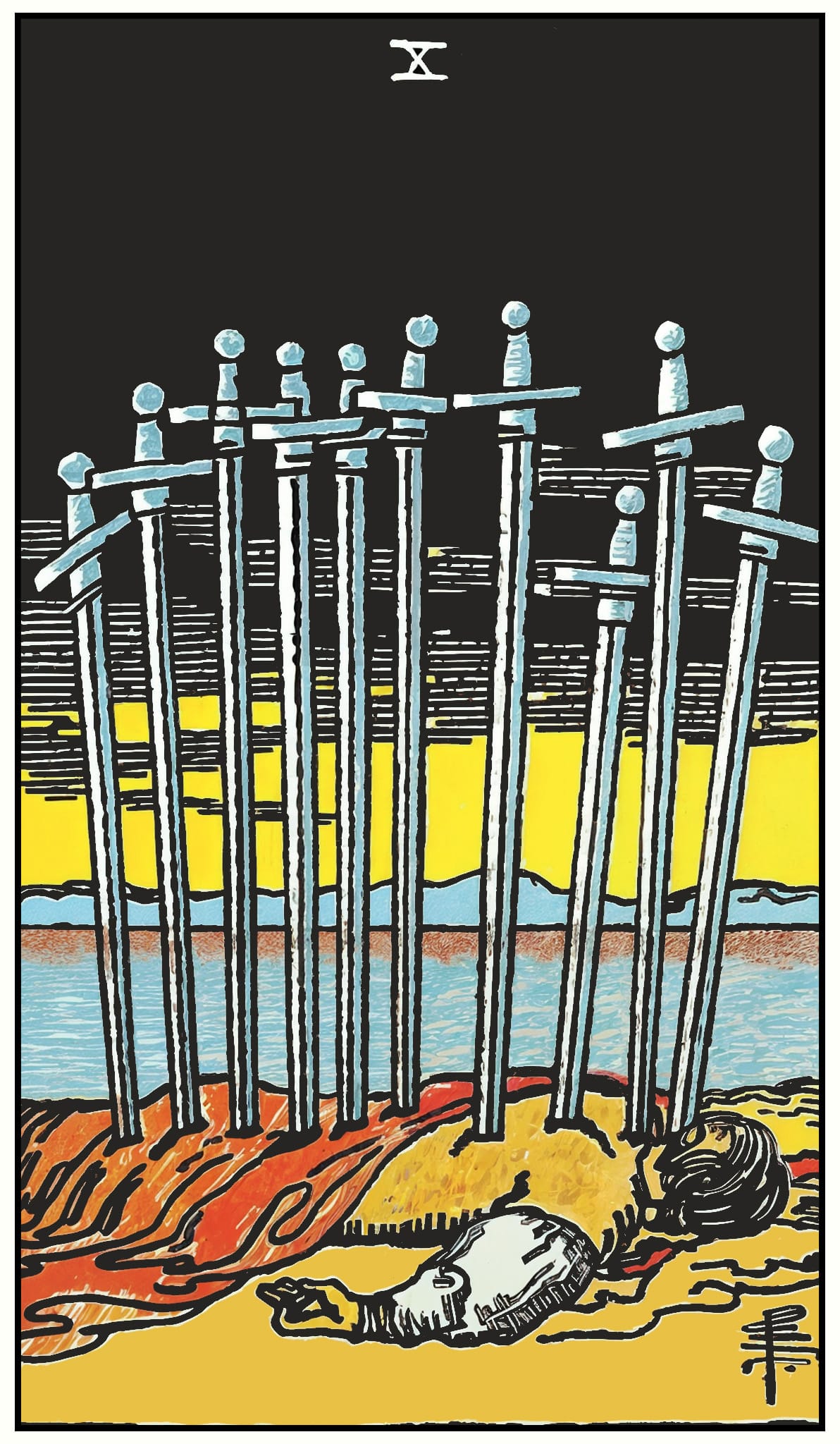
Ten of Swords
A figure lies face down on dark ground, ten swords planted in the back. In the distance, a still sea. Above it, a thin band of gold light at the horizon — the sky beginning, barely, to clear.
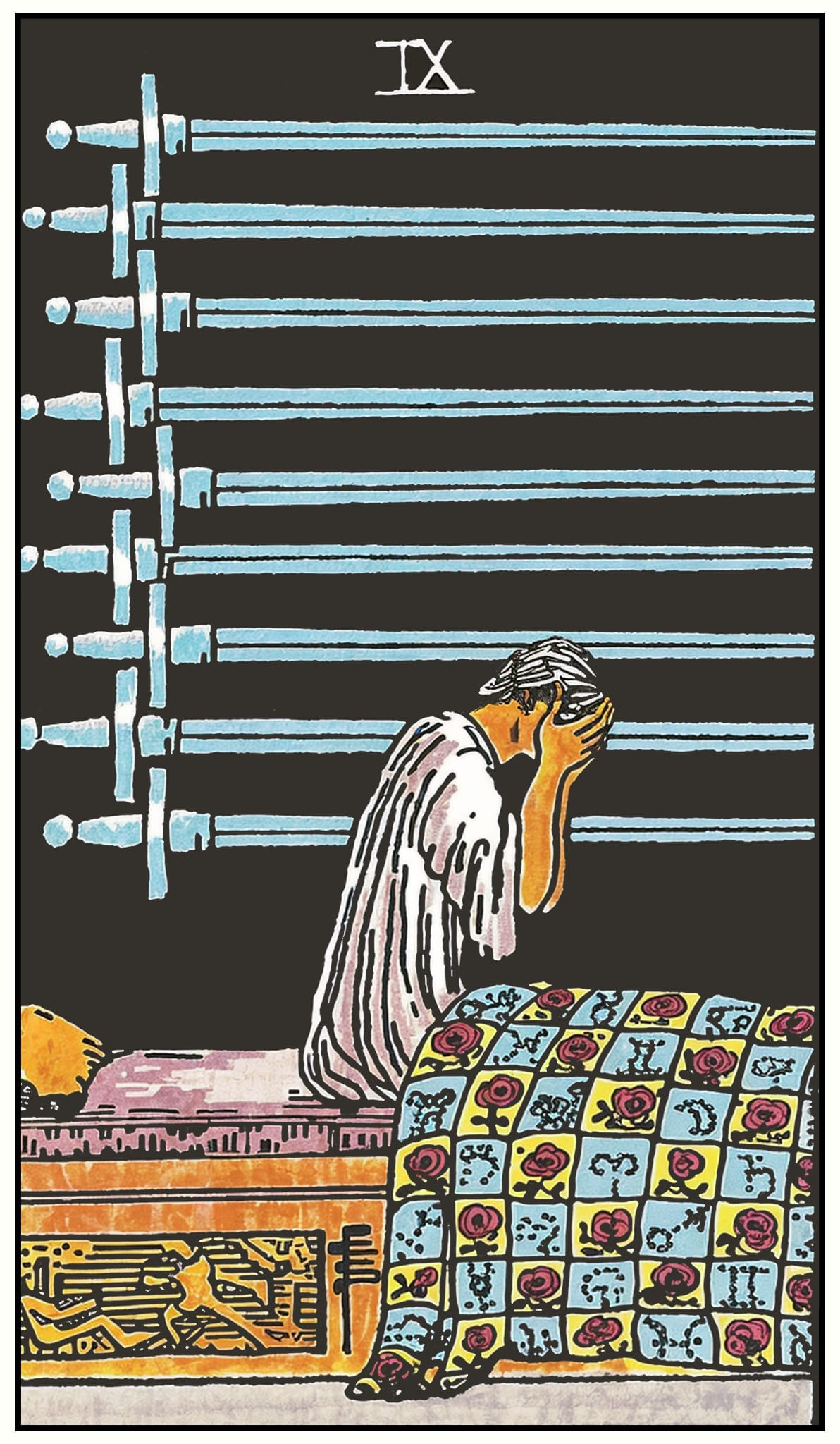
The Ten of Swords names the complete collapse — and it is worth staying with that image without immediately reaching for its redemption. Ten swords in a back. Every previous card was vertical. This one is horizontal. The mind that has been running the suit's proceedings has, at last, run out of proceedings to run. The gold on the horizon is not consolation. It is the structural consequence of having reached the bottom. Bottoms have floors. Floors hold.
The worst has happened. The worst is survivable. These are two separate pieces of information, and both are in the image.
The Ten of Swords is the full collapse: not the partial wound of the Three, not the self-constructed constraint of the Eight, not the curated terror of the Nine — but the complete stop. The suit has run its course. The exaggeration of ten swords in a back is intentional: this is what the end of a long mental defeat feels like from the inside — not metaphorically undone but grotesquely, absurdly, completely finished. There is a specific relief in this that the image initially obscures. Pollack names it: the worst has happened. The worst is not still coming. And the horizon, faint and gold, does not belong to the swords at all.
The final cost of mental life treated as infinite — and what the floor makes available that the middle never could
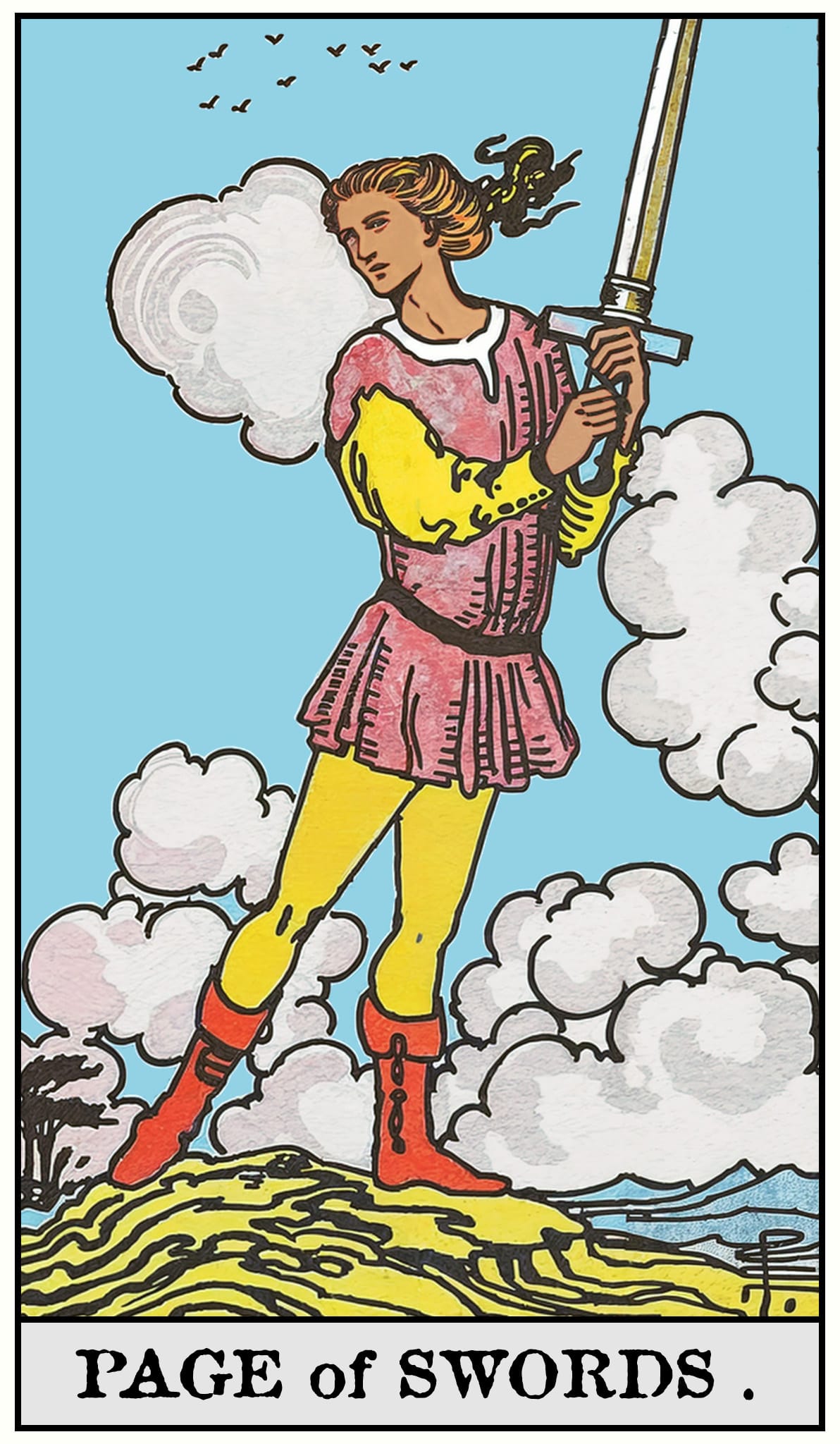
The Ten is the accumulation of what the suit produced when the mind refused the Three's grief, maintained the Two's stalemate, left the Seven's two swords in the ground, mistook the Eight's story for the territory. The swords were placed one at a time, over a long time, and each was accepted. The suit cannot continue past this card. The mind that was unwilling to stop — in the Two's impasse, the Seven's half-exit, the Nine's midnight dread — is finally, completely stopped. The floor is the floor. The only direction available from here is forward, which is what every direction becomes when the alternative has been exhausted.
The complete three-layer reading for all 78 cards — including the full psychological and archetypal layers — is in The Pocket Guide →
There are two ways to receive this card: as the worst, and as the floor.
Shadow TrapThe collapse entered and then prolonged — the person who has reached the floor and remains there not because the floor requires more time but because getting up would require acknowledging that the collapse is complete, and completion means facing what comes next.
Shadow GiftThe recognition that the floor is a structural fact rather than a punishment — that having fully reached the bottom is the only position from which the direction of up becomes unambiguous, and that the gold on the horizon is not ironic.
Shadow readings for each card, by suit, are gathered in The Pocket Guide →
We do not read a reversal as an opposite; following Pollack, a turned card is the same energy blocked, withheld, or redirected — not inverted into its negation. A reversed Ten of Swords often marks the collapse being held off — the person approaching the floor at high cost, the swords accumulating but the final horizontal not yet reached, the mind still running proceedings that it no longer has the resources to run.
Why Apocrypha Does Not Read Reversals as Opposites →Sixty-three symbols across the full deck — cross-referenced by card and meaning — are mapped in The Symbol Dictionary →
What are you still trying to prevent that has already happened — and what would change in your actual life if you allowed it to be over?
The Ten of Swords is most often either softened immediately — transformation is coming — or presented as dramatic warning. Both uses miss the card's structural precision. It is not a threat and it is not a comfort. It is an honest description of what the bottom looks like: the full stop, the complete horizontal, and the faint light that is not yet sunrise but is the evidence that the sky is not the same colour it was. The card asks only that both facts be received at the same time — the ten swords and the horizon — without one cancelling the other.