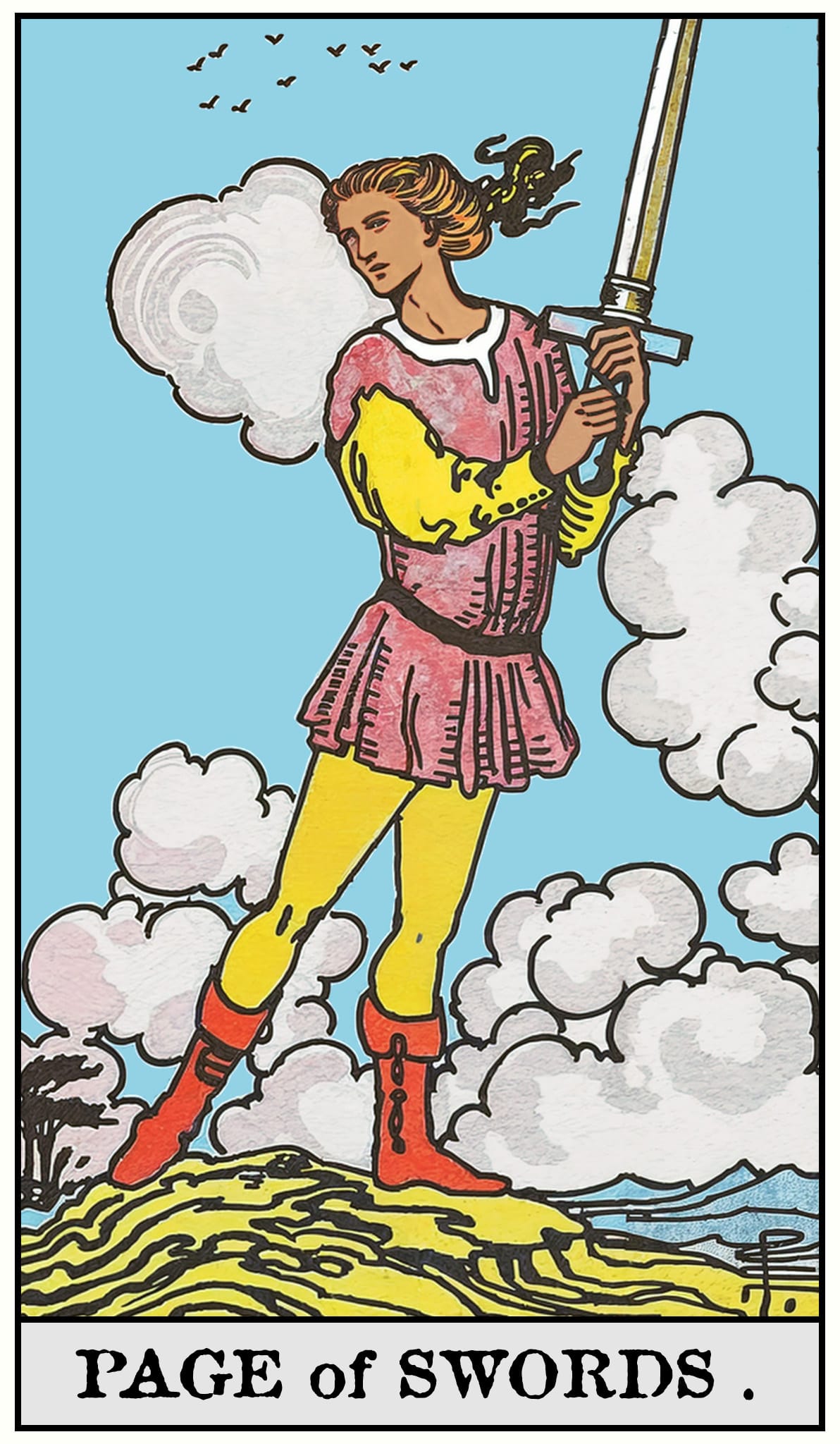
Page of Swords
A young figure stands on a hilltop, sword raised in readiness, wind moving everything — hair, clouds, trees in the distance. The ground is uneven. The posture is alert. The expression is that of someone who has just heard something and is not yet sure what it means.
The Page of Swords names the mind at its most alert and least seasoned: intelligence before it has learned the weight of what it can do, sharpness without the knowledge of what it will cut. The Page is watching everything. He misses nothing. He does not yet know that certain things, once said, cannot be unsaid — and that the sword in his hand can end a conversation permanently.
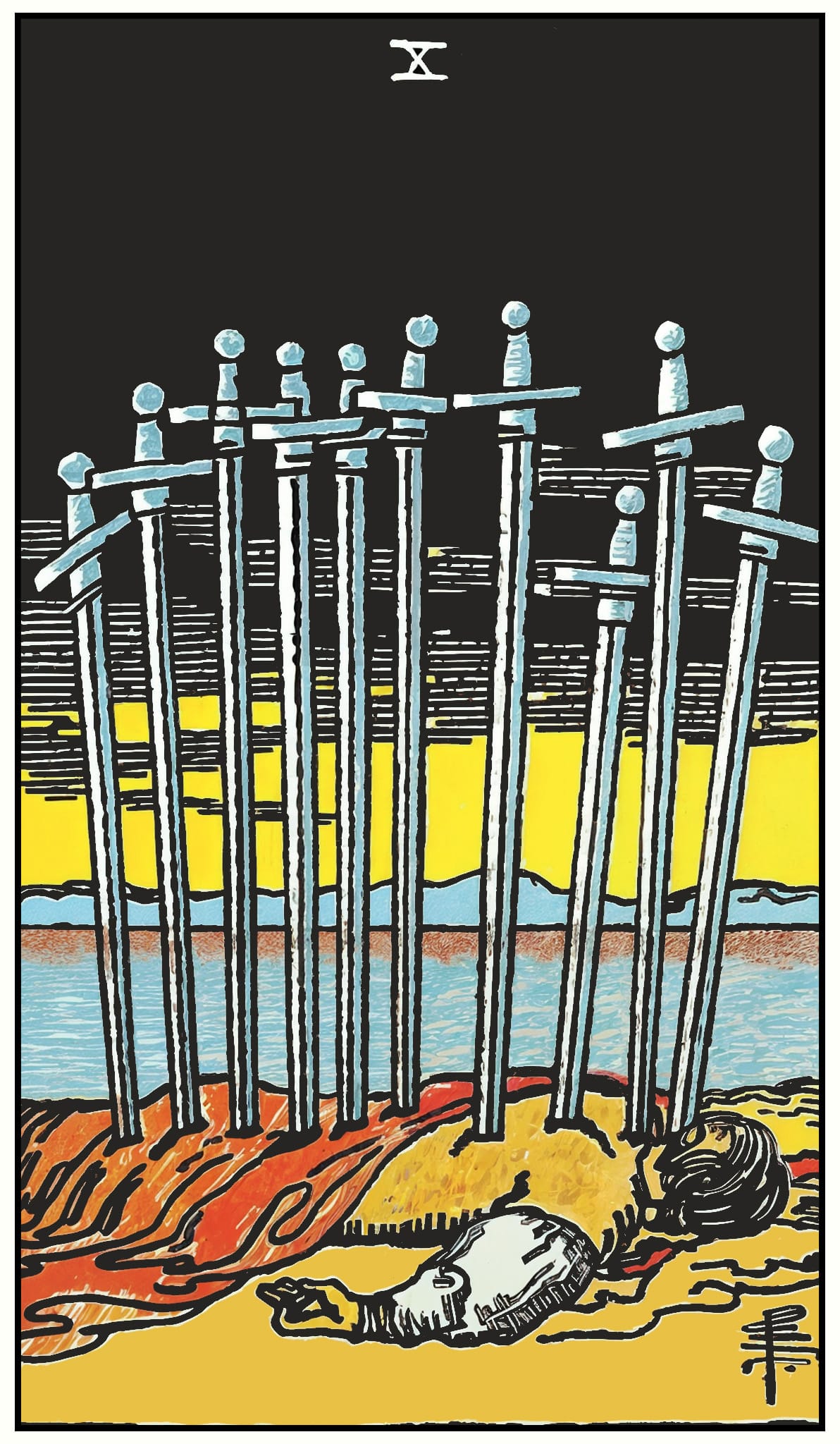
The briefest exhale after the Ten's full weight — and a new beginning that does not yet know what beginning will require
The Page of Swords arrives as the suit's restart: the intelligence returning to a state of alertness after the Ten's complete stop. He is young, wind-swept, sword raised not in triumph but in the posture of someone who has not yet been in a real confrontation and finds the whole situation interesting rather than alarming. He will ask the question that punctures something that needed to remain intact, and he will be genuinely surprised by the puncture. This is not malice. It is the mind unfinished — sharpness without the knowledge of proportion, alertness without the weight of consequence.
The Ace's energy without the Ace's clarity — air in its most undirected state
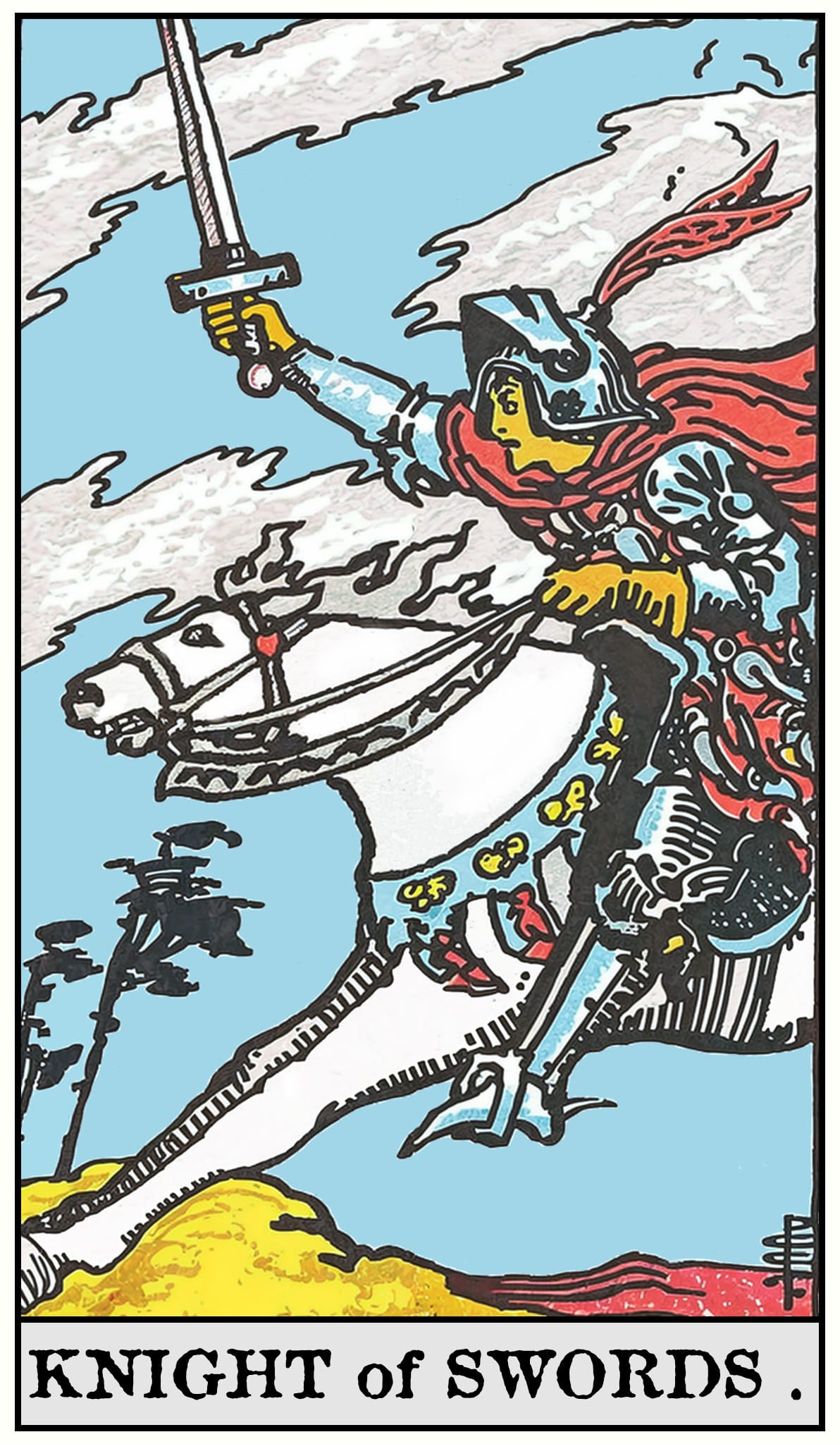
The Page does not return the suit to the Ace's uncontaminated precision. He returns it to the Ace's energy — the alertness, the readiness, the sword raised toward something — without the clarity that would direct it. The wind around him is the suit's element in its most unorganized form: moving, present, unchanneled. This is the Page's gift and the limit that defines it. The mind has been cleared by the Ten's full stop. What it has not yet acquired is the judgment about what the clearing is for, which is what the Knight — and eventually the Queen and King — will spend their arcs developing.
The complete three-layer reading for all 78 cards — including the full psychological and archetypal layers — is in The Pocket Guide →
The wind that clears the air is the same wind that topples what is not firmly rooted.
Shadow TrapThe alertness deployed without discrimination — the mind that notices everything and names everything and has not yet developed the judgment about which things are better left uncut, the truth-teller whose truths arrive without adequate reading of the room.
Shadow GiftThe capacity to hold the Page's genuine alertness — the freshness of beginning, the openness to everything — while beginning to develop the discipline about what the sword is actually for, which is the Page's only real work.
Shadow readings for each card, by suit, are gathered in The Pocket Guide →
We do not read a reversal as an opposite; following Pollack, a turned card is the same energy blocked, withheld, or redirected — not inverted into its negation. A reversed Page of Swords often marks the alertness turned inward as suspicion — the observant mind that has become watchful rather than curious, gathering information not for understanding but for defence, the readiness that has rotated from openness to vigilance.
Why Apocrypha Does Not Read Reversals as Opposites →Sixty-three symbols across the full deck — cross-referenced by card and meaning — are mapped in The Symbol Dictionary →
What truth are you circling without quite landing on — and is the circling from genuine uncertainty, or from the sense that landing would change something you are not yet ready to change?

The Page of Swords is most often read as sharp, curious energy — the observer, the questioner, the person who sees what others miss. The shadow embedded in the same description is less often addressed: the sharpness without proportion, the observation without judgment about what to do with what is observed. The card is not a warning about the Page. It is an accurate description of a developmental stage that every intelligence passes through and some never leave — the stage where the capacity to perceive is ahead of the capacity to know what perception is for.