Knight of Swords
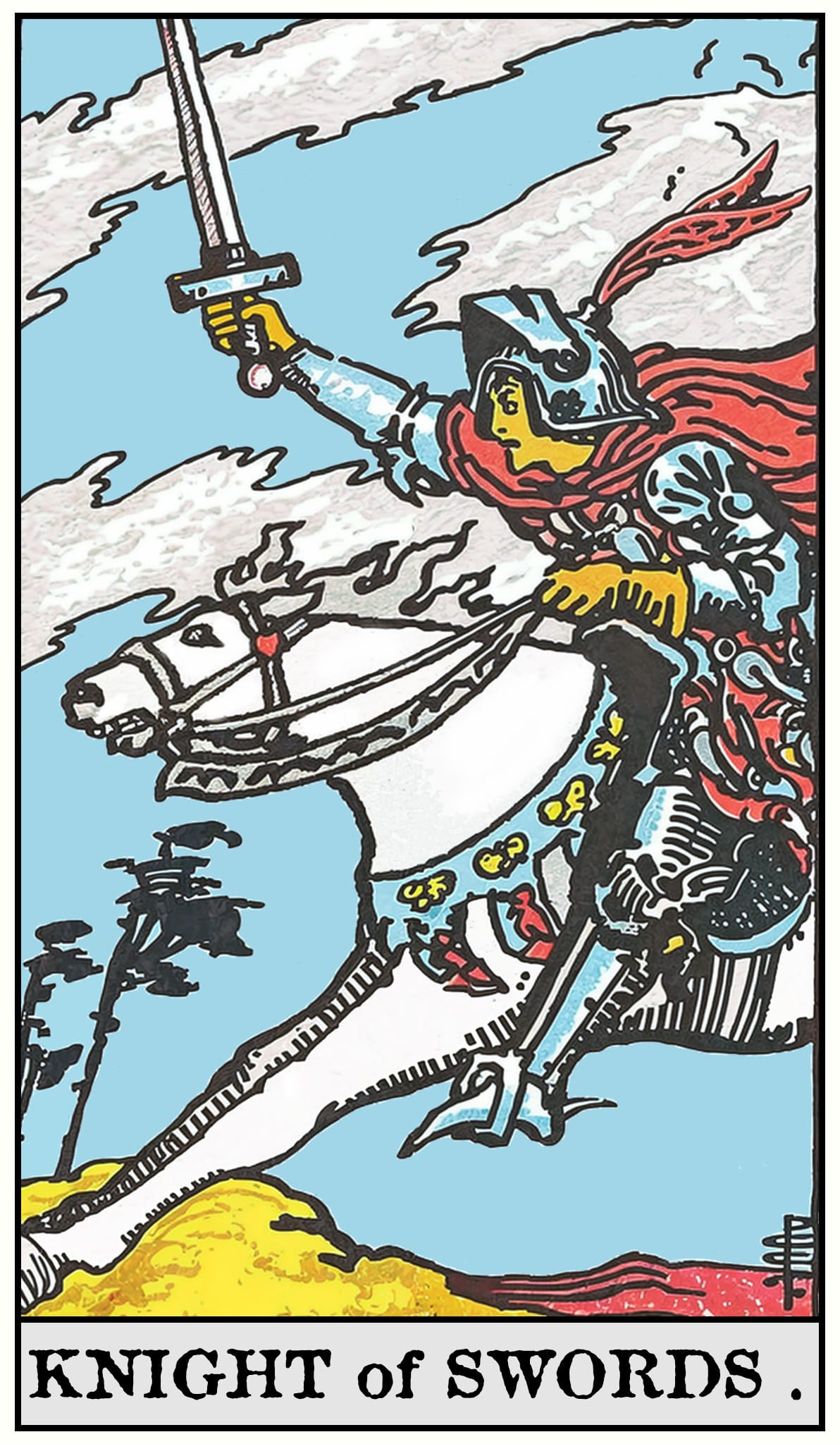
A knight charges at full gallop, sword extended forward — clouds tearing apart in the wake, trees bending, the horse's hooves barely touching the ground. He is not looking for a target. He has already decided what the target is.
The Knight of Swords names conviction at full speed: the mind that has identified the problem, determined the solution, and is currently in motion before the questions have been asked. The power is real — there are moments that require exactly this. The trouble is that the Knight cannot tell the difference between those moments and all the others. He charges because charging is the only speed he has.
He has already decided what the target is. The target may not have been consulted.
The Knight of Swords arrives with force. The decisive action, the fast clear move, the unambiguous cut — all of these have their right moment, and when the moment is right, the Knight provides them without hesitation or apology. The problem is structural: he cannot distinguish the right moment from every other moment, because certainty feels identical whether or not it is warranted. Every question has already been answered before it was asked. In shadow, the Knight is the third and most brittle of the suit's dangers — not the Wands' addicted-to-onset but the addicted-to-certainty, for whom the sensation of having the right answer has become more important than whether the answer is right.
Air's adolescence — and the specific wreckage that fixed categories leave behind
When fire is unfinished, things burn and can be rebuilt. When water is unfinished, relationships are hurt and can, slowly, be healed. When air is unfinished, categories get fixed — and fixed categories are the hardest damage to recover from, because the mind that fixed them uses the same categories to evaluate whether anything is wrong. The Knight charges past his blind spot at every pass. Jung's shadow enters here not as the night-fear of the Nine but as the intellectual's specific exclusion — the part of reality that certainty actively removes from view. The trees bending and the clouds tearing are not drama. They are the texture of what the Knight leaves behind.
The complete three-layer reading for all 78 cards — including the full psychological and archetypal layers — is in The Pocket Guide →
The genuine insight expanded until it becomes a system that explains everything — and therefore stops seeing anything.
Shadow TrapThe truth that was real in its original proportions, extended past those proportions until it has become the lens through which everything is interpreted, which means it has stopped being a tool and become a cage made of correct premises.
Shadow GiftThe recognition that the charge requires a target, and that the target should precede the conviction rather than being generated by it — the willingness to slow down long enough to find out whether what the sword is about to cut is what needs cutting.
Shadow readings for each card, by suit, are gathered in The Pocket Guide →
We do not read a reversal as an opposite; following Pollack, a turned card is the same energy blocked, withheld, or redirected — not inverted into its negation. A reversed Knight of Swords often marks the conviction frustrated — the decisive force that cannot find a direction, the certainty that has lost its momentum without losing its urgency, the charge energy that has turned inward and is now consuming the person who carries it.
Why Apocrypha Does Not Read Reversals as Opposites →Sixty-three symbols across the full deck — cross-referenced by card and meaning — are mapped in The Symbol Dictionary →
What position do you hold with such certainty that you have stopped noticing the evidence against it — and when did the genuine insight it began as become the system it has since turned into?
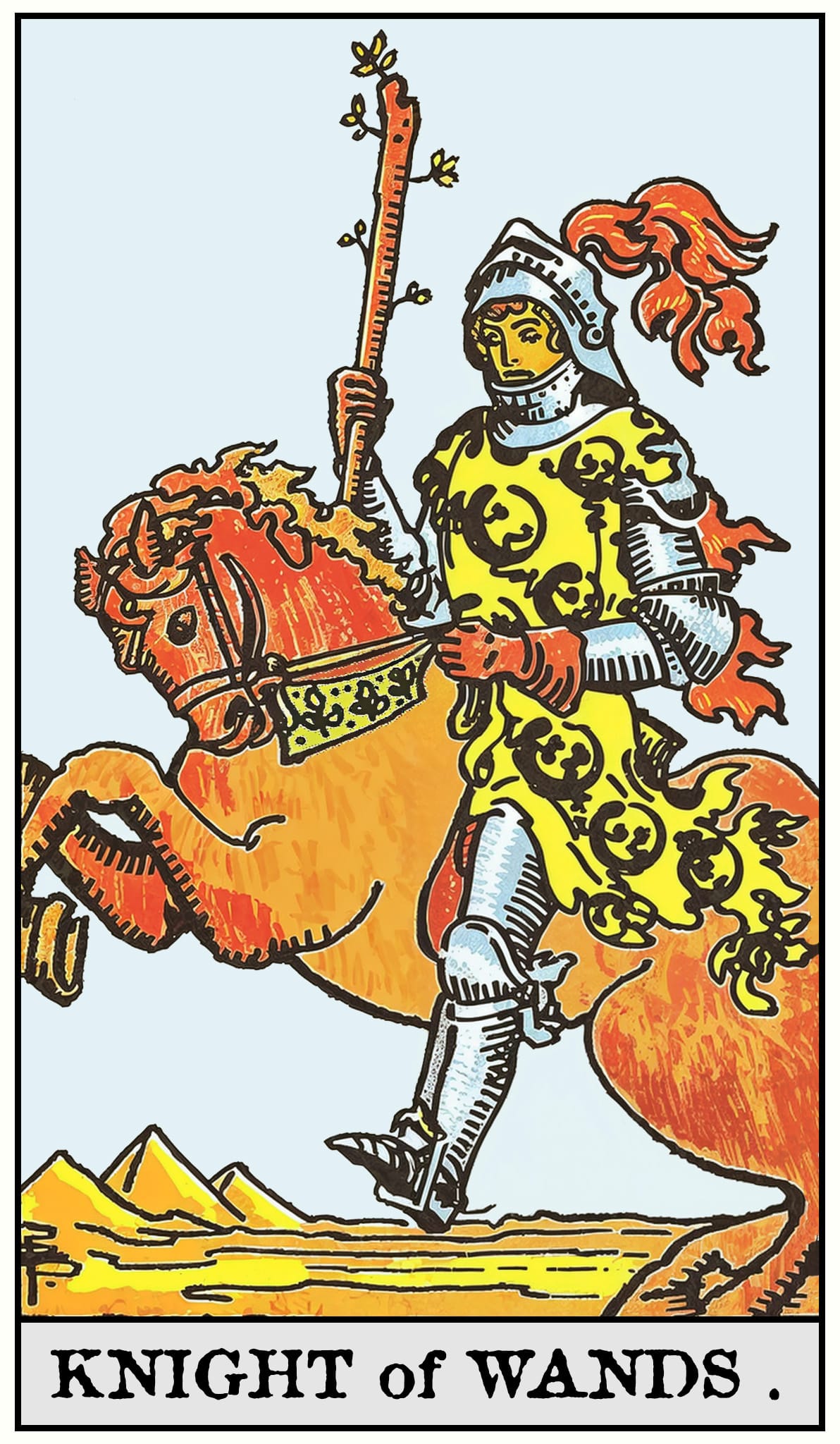
The Knight of Swords is most often read as either impressive energy — decisiveness, clarity, bold action — or as a warning about aggression. Both miss the card's precise diagnostic. The relevant question is not whether the Knight is wrong — sometimes the Knight is right. It is whether the certainty preceded the evidence or followed it. A mind that knows before it looks is not using the Ace's clarity. It is using the suit's most dangerous shadow, wearing the Ace's clothing. The distinction is available only to people willing to look at what the horse hooves barely touch on the way past.