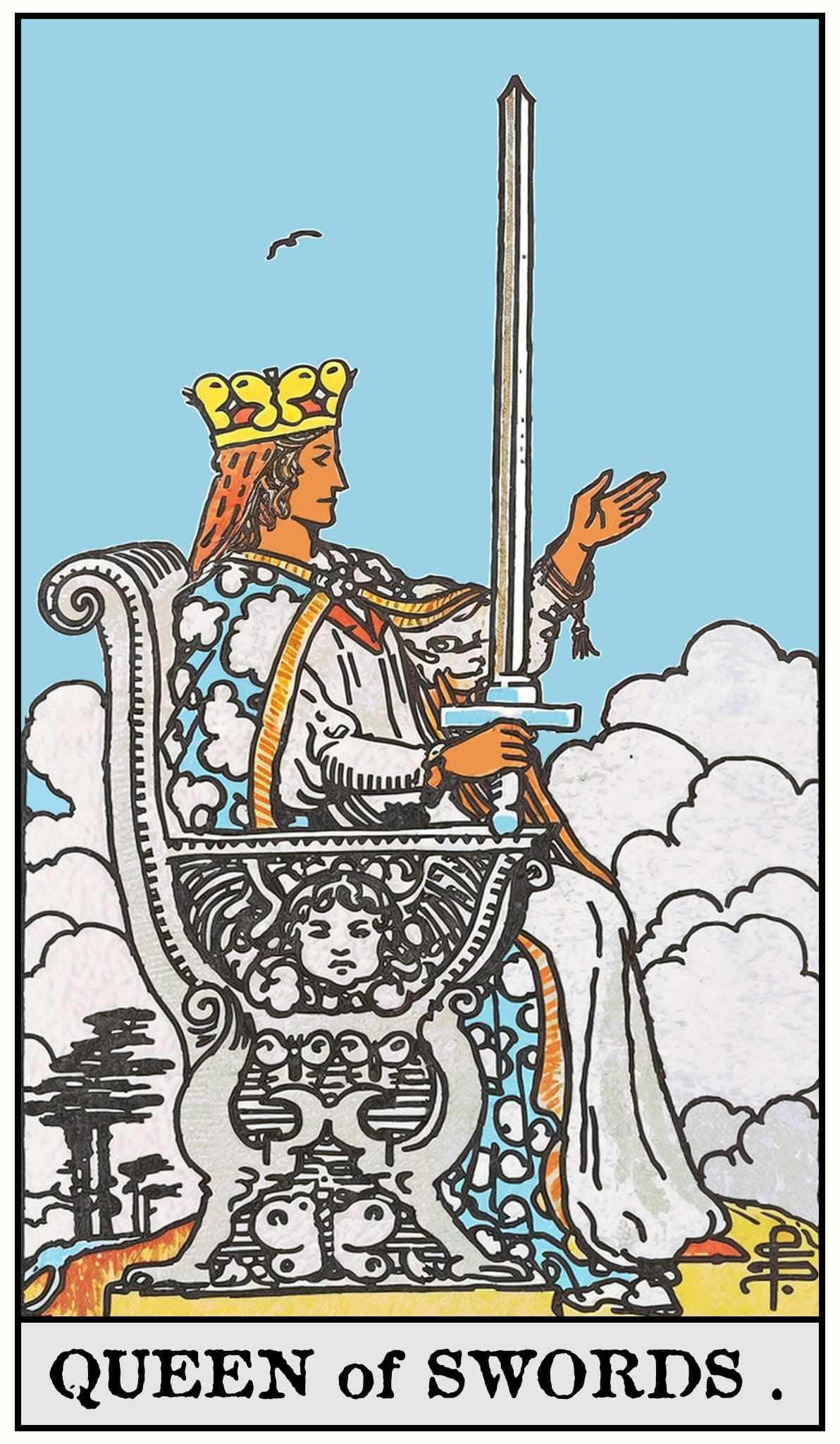
Queen of Swords
A woman sits above the clouds on a stone throne, sword raised vertically, left hand extended open — butterflies on her crown, one on her wrist, her face clear and turned slightly to the side as if listening to something just past the frame.
The Queen of Swords names clarity earned through loss: not the coldness she is often called but the precision of a mind that has been sharpened by what it survived. She has felt. She has felt considerably. What the card describes is what she did with the feeling — worked with it, rigorously, until the grief became comprehension and the comprehension became something she can now offer to others without falling back into the original wound every time she touches it.
She has been called cold by people who confused the absence of sentimentality with the absence of feeling
The Queen of Swords is the therapist who has done her own work, the lawyer who survived the injustice she now argues against, the teacher whose rigor is care that students sometimes recognize only in retrospect. She is not withholding. The extended hand is the card's key: she is offering what the sword has made possible to see. In shadow, the Queen's earned clarity becomes the mind that has made a principle of its own history — the wound so thoroughly processed that it has become a qualification for judgment, and the judgment has stopped being available to revision because revision would mean the history was wrong.
Soul-made clarity — the comprehension that could only have come from being inside what it comprehends
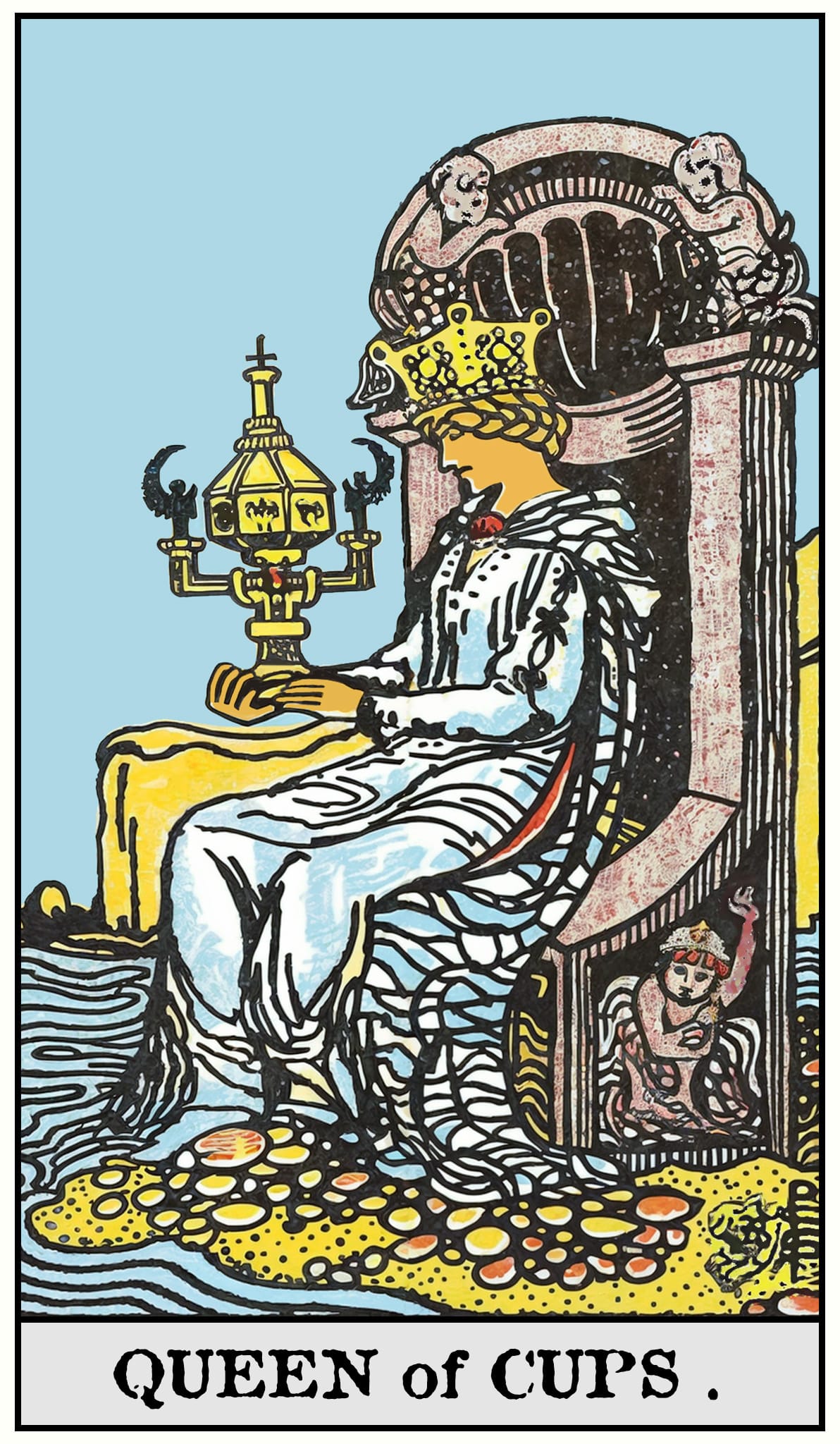
The contrast with the Queen of Cups names the card precisely: the Cups Queen sits at the water's edge, covered chalice in hand, receiving the depths and holding them inward. The Swords Queen sits above the clouds with her sword raised and her hand open — she has processed what she received and is now offering the distillate outward. One queen deepens inward; the other clarifies outward. Together they describe the full arc of an interior life that also speaks. The butterflies in her crown are not decorative: transformation that changes the form of the creature, not merely its surface. Something died to produce this clarity.
The complete three-layer reading for all 78 cards — including the full psychological and archetypal layers — is in The Pocket Guide →
Some knowledge is only available on the other side of its cost — and the cost can become the credential.
Shadow TrapThe grief become a qualification — the person who has processed what they suffered so well that the processing has become the source of authority, and the authority has stopped being available to correction, because correction would require admitting the foundation was incomplete.
Shadow GiftThe capacity to offer what the suffering taught without requiring the teaching to remain exclusively hers — to let the clarity be used by people who have not paid the same cost, because the point of the extended hand is that it is open.
Shadow readings for each card, by suit, are gathered in The Pocket Guide →
We do not read a reversal as an opposite; following Pollack, a turned card is the same energy blocked, withheld, or redirected — not inverted into its negation. A reversed Queen of Swords often marks the clarity turned inward as bitterness — the grief that has not fully completed its processing, the earned perspective that has curdled into the judgment that others have not earned the right to be spared the sharpness of what she learned.
Why Apocrypha Does Not Read Reversals as Opposites →Sixty-three symbols across the full deck — cross-referenced by card and meaning — are mapped in The Symbol Dictionary →
What has loss taught you — clearly, specifically, with the weight of having been inside it — that you have not yet trusted enough to offer? And what is the trust waiting for?
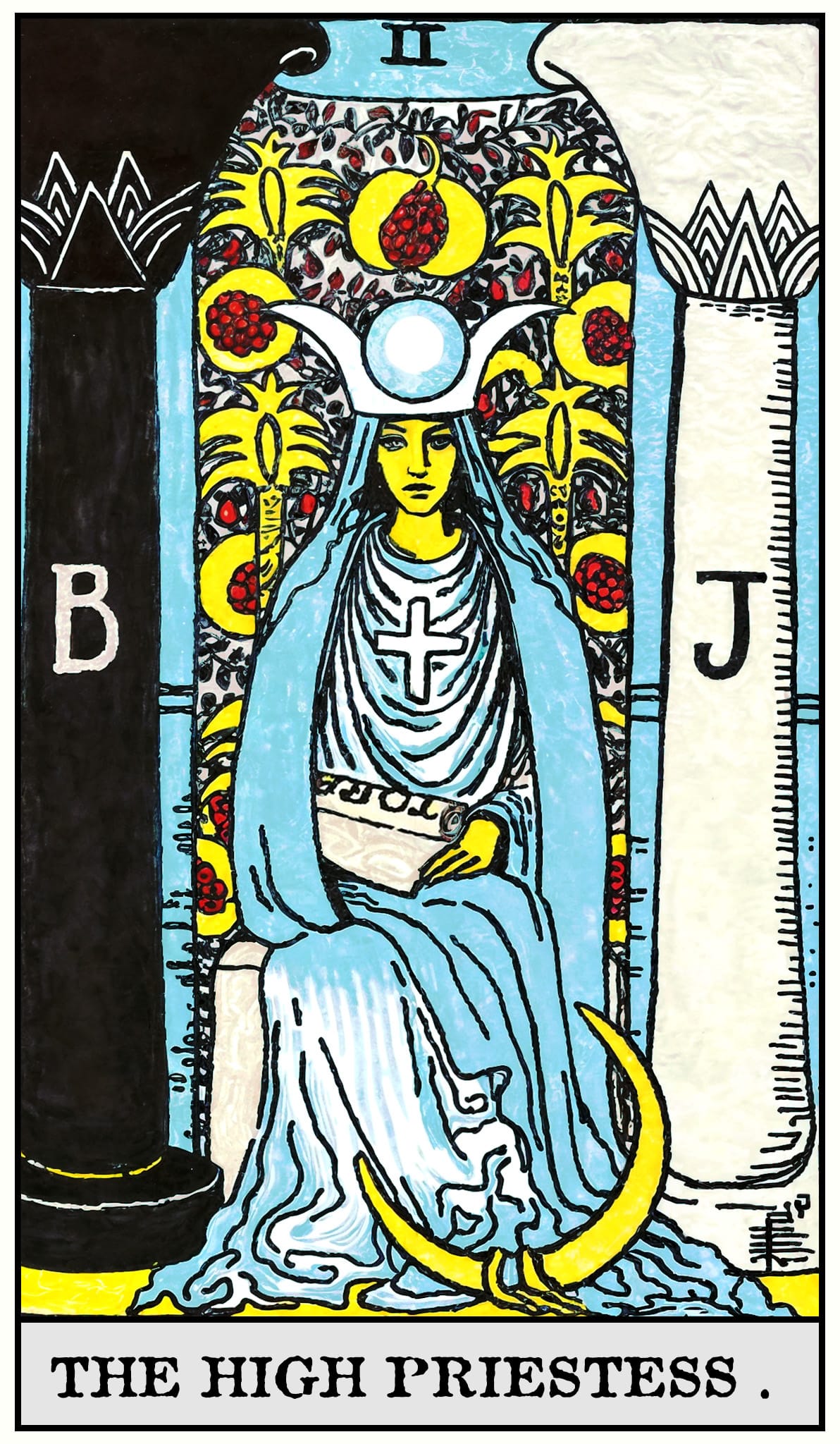
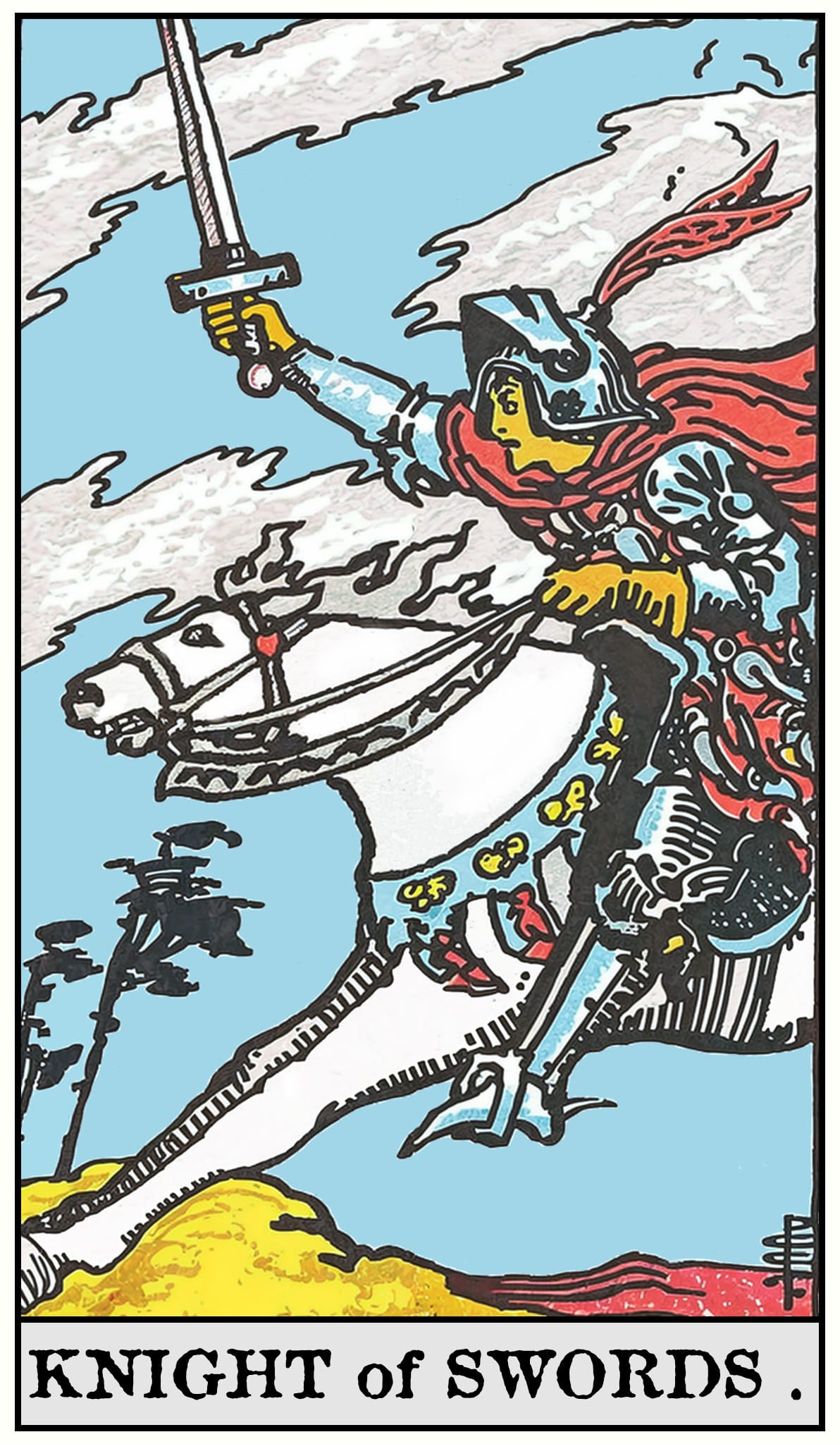
The Queen of Swords is most often either softened — she is warm really, just misunderstood — or maintained as the cold, precise figure her reputation suggests. Both miss the card's precise claim. She is not warm in the mode of the Queen of Cups, and she is not cold in the mode of someone who has not felt. She is exact in the mode of someone who has felt, processed, and converted the feeling into something usable. The question the card raises is not about her temperature. It is about what she is offering from the extended hand — and whether the person receiving the reading is willing to take it.