Queen of Cups
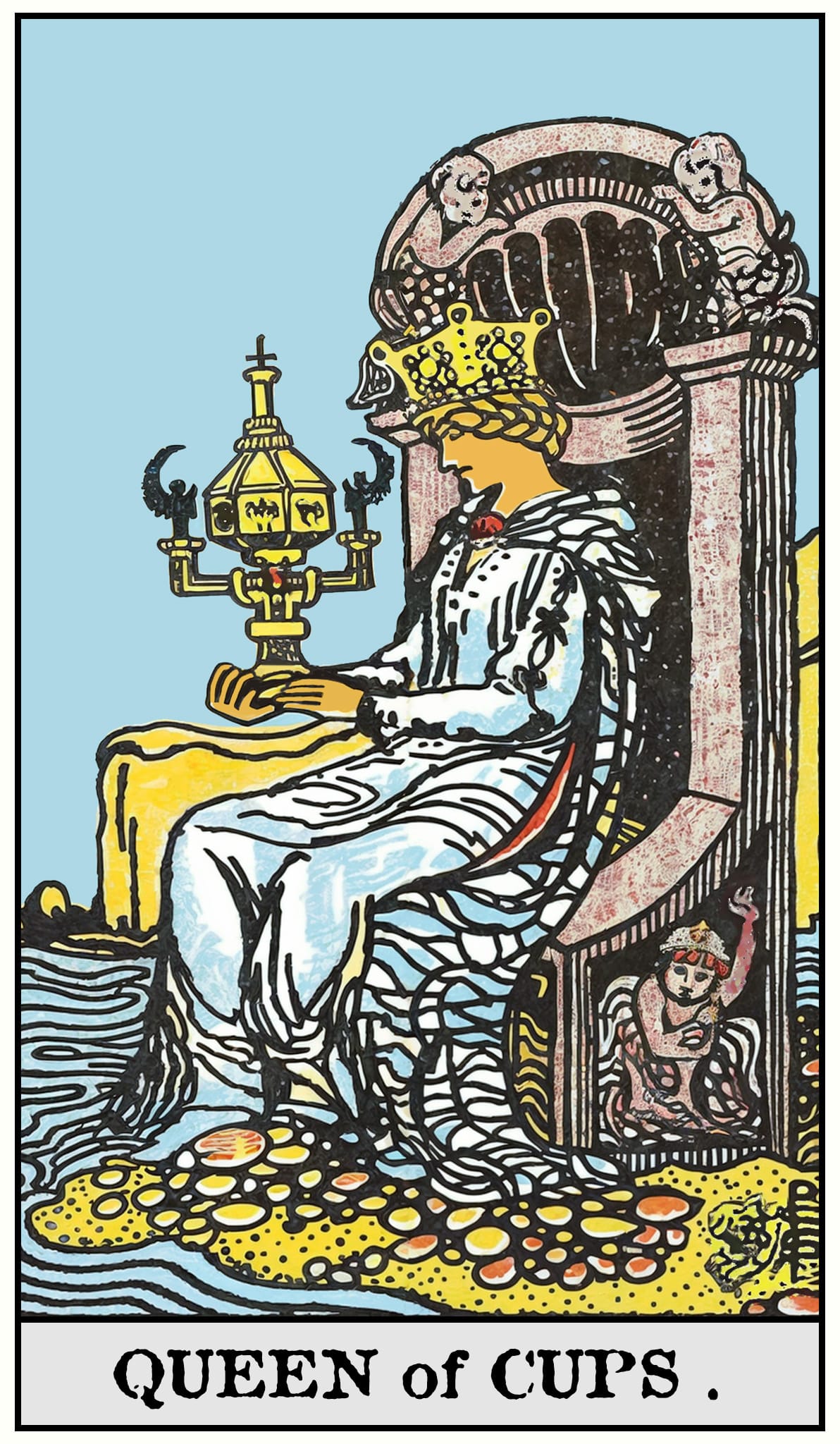
A woman on a throne at the water's edge holds a covered ornate chalice, gazing at it with focused attention — the sea moving around the base of her throne, the cup sealed, her eyes not on us.
The Queen of Cups names the interior that does not need to be witnessed to be real: the person in whose presence you feel unexpectedly understood — not because she has said anything but because her quality of attention made your own interior legible to you. The shadow is precise: the covered cup, in its darker form, becomes an emotional life so private it cannot be shared even when sharing is what would heal it.
Her quality of attention makes your interior legible to yourself — she has not said anything
The Queen of Cups is the therapist at her best, the particular parent, the friend whose presence somehow clarifies what was confused. She is not reflecting you back unchanged. She is holding a space large enough that what is in you can unfold without being managed. This is a specific and rare capacity, distinct from sympathy and from advice. In shadow, the Queen's depth becomes a closed system: the covered cup that the image explicitly shows can indicate the interior weaponized as mystery, the emotional life so protected from the outside world that it has become unreachable even to the person who lives inside it.
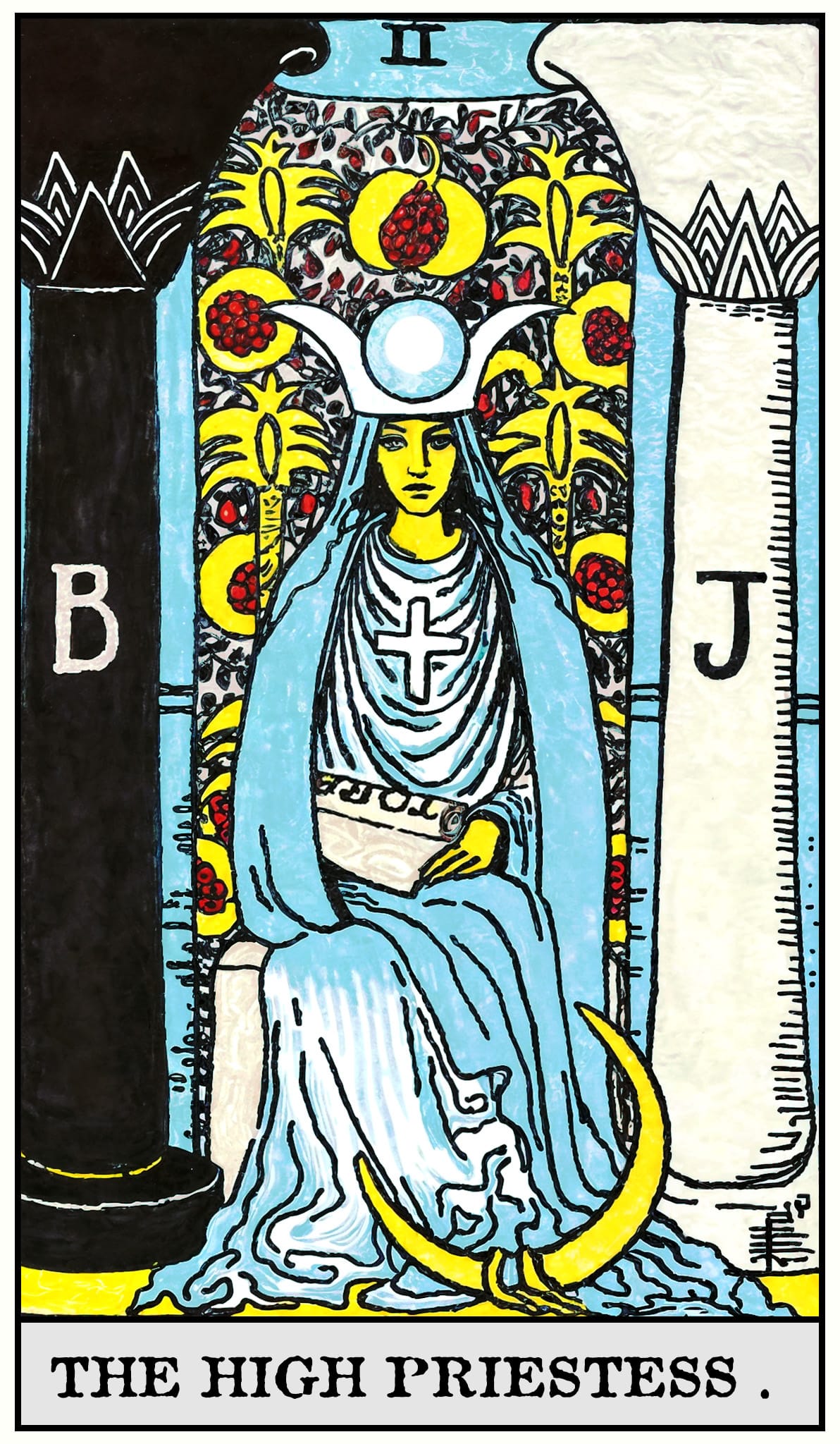
Where the High Priestess guards the threshold, the Queen lives inside what the threshold opens onto
The Queen's kinship with the High Priestess runs through deep water — both carry the interior life, both are associated with the unconscious, both hold rather than announce. The structural difference is location: the Priestess sits at the threshold between worlds, the veil behind her. The Queen sits at the actual water's edge, the sea surrounding her throne. She is not the guardian of the mystery. She is its inhabitant. This is the difference between the woman who keeps the secret and the woman who has made her peace with depth — and it is the difference Jung identified between the projected anima and the feeling function at its genuine maturation.
The complete three-layer reading for all 78 cards — including the full psychological and archetypal layers — is in The Pocket Guide →
The depth that will not surface, even when surfacing is what is needed, has become a form of withholding.
Shadow TrapThe emotional life so thoroughly protected from external witness that it has lost contact with the world that would give it proportion — the interior that has mistaken its own privacy for profundity.
Shadow GiftThe capacity to hold the depth without requiring it to remain unspoken — to know when the covered cup should be opened, and to whom, and to trust that the knowing does not diminish what is inside it.
Shadow readings for each card, by suit, are gathered in The Pocket Guide →
We do not read a reversal as an opposite; following Pollack, a turned card is the same energy blocked, withheld, or redirected — not inverted into its negation. A reversed Queen of Cups often marks the depth flooded — the interior that has lost its container, the emotional life that cannot be held still long enough to be useful either to the self or to anyone the self is in relation with.
Why Apocrypha Does Not Read Reversals as Opposites →Sixty-three symbols across the full deck — cross-referenced by card and meaning — are mapped in The Symbol Dictionary →
What do you know — have known for some time, perhaps longer than you have admitted — that you have been waiting for permission to say, or for a container safe enough to say it in?
The Queen of Cups is most often read as the empathic, intuitive presence — nurturing, receptive, emotionally intelligent. All of this is accurate. The less comfortable reading asks about the covered cup. The card's shadow is not unkindness — it is the depth that has become so well protected that it is now also inaccessible. The Queen who cannot open the cup, even when the situation specifically calls for it, is not demonstrating profundity. She is demonstrating the exact failure mode that this much-admired card contains.