Five of Swords
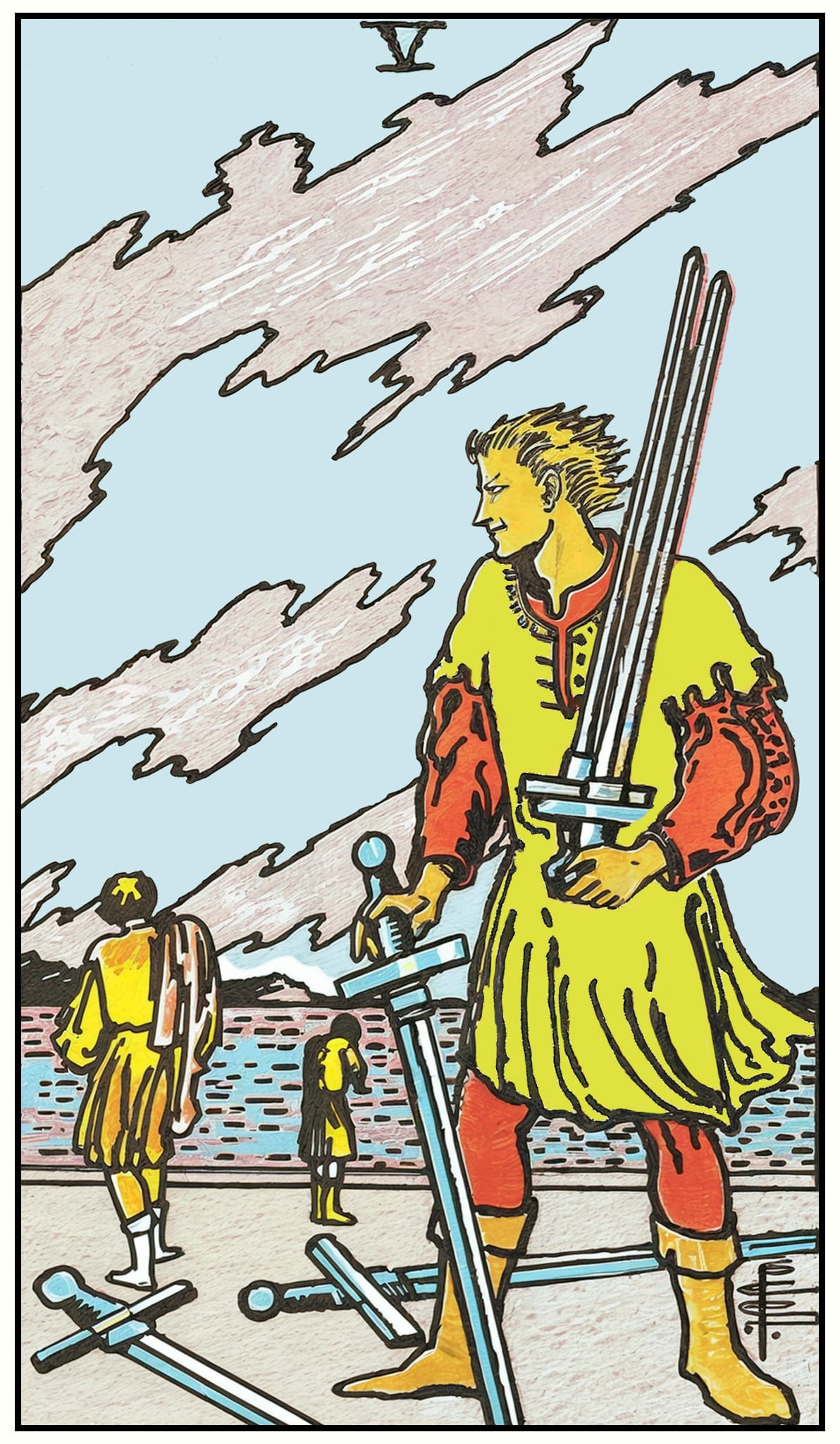
A figure bends to gather three swords from the ground, two already in hand — five total, heavy. He glances back at two retreating figures, their shoulders dropped. The sky is torn with turbulent clouds.
The Five of Swords names the victory that empties the room: the argument won at the cost of the relationship, the negotiation that secured the terms and lost the partner. The figure has the swords. The others are walking away. He is looking back with an expression that is part satisfaction and part something that is not yet named. The card is not about losing — it is about winning, and what winning required him to become.
He won. The field is his. He is alone in it.
The Five of Swords is not the card of defeat — the Tower handles collapse, the Ten handles the ending that arrives without being engineered. The Five is the card of the victory that reveals what it required. The argument won at the cost of the person it was about. The negotiation that produced the right terms and ended the collaboration. The competition completed first in, and the others walking away, and the sky overhead already breaking apart. The figure's backward glance is the card's essential detail: something in him already knows what the five swords in his arms cost, and has not yet decided what to do with knowing it.
The intellect's capacity for self-defeat through competence — the instrument confused for the end
Here the mind first reveals what it can do to itself through its own proficiency. The intelligence that produces the Ace's clarity is the same intelligence that wins every argument, outmanoeuvres every opponent, and eventually surveys a landscape of one. Hillman called this the pathology of achievement: the soul's signal that the means has displaced the end. The two figures walking away are the answer to the question the suit rarely asks — what does a mind that is better at winning than at knowing what winning is for eventually do with itself?
The complete three-layer reading for all 78 cards — including the full psychological and archetypal layers — is in The Pocket Guide →
The backward glance is the shadow trying to surface through the victory.
Shadow TrapThe continuation of the same strategy that produced the Five — the mind that has learned winning and cannot now stop applying the capacity to every available situation, regardless of whether winning is what the situation requires.
Shadow GiftThe capacity to hold the backward glance long enough for it to become a reckoning — to let the recognition that is already present in the expression become the beginning of the question about what the swords are actually for.
Shadow readings for each card, by suit, are gathered in The Pocket Guide →
We do not read a reversal as an opposite; following Pollack, a turned card is the same energy blocked, withheld, or redirected — not inverted into its negation. A reversed Five of Swords often marks the defeat absorbed rather than won — the figure on the other side of the card, shoulders dropped, walking away from a confrontation that was lost in ways that are still being processed.
Why Apocrypha Does Not Read Reversals as Opposites →Sixty-three symbols across the full deck — cross-referenced by card and meaning — are mapped in The Symbol Dictionary →
What have you won recently — in an argument, a negotiation, a competition, a confrontation — and what did you have to become to win it? And is what you became still who you want to be?
The Five of Swords is most often read as conflict incoming or conflict just concluded, with the focus on who won and who lost. The more demanding reading refuses that framing. The card is not about winning and losing in the ordinary sense — it is about what winning costs the winner, and specifically about the moment when the cost begins to register in the face of the person who paid it. The question is not whether the victory was deserved. The question is whether the person looking back over his shoulder is going to stand there until the recognition becomes something he acts on.