Page of Pentacles
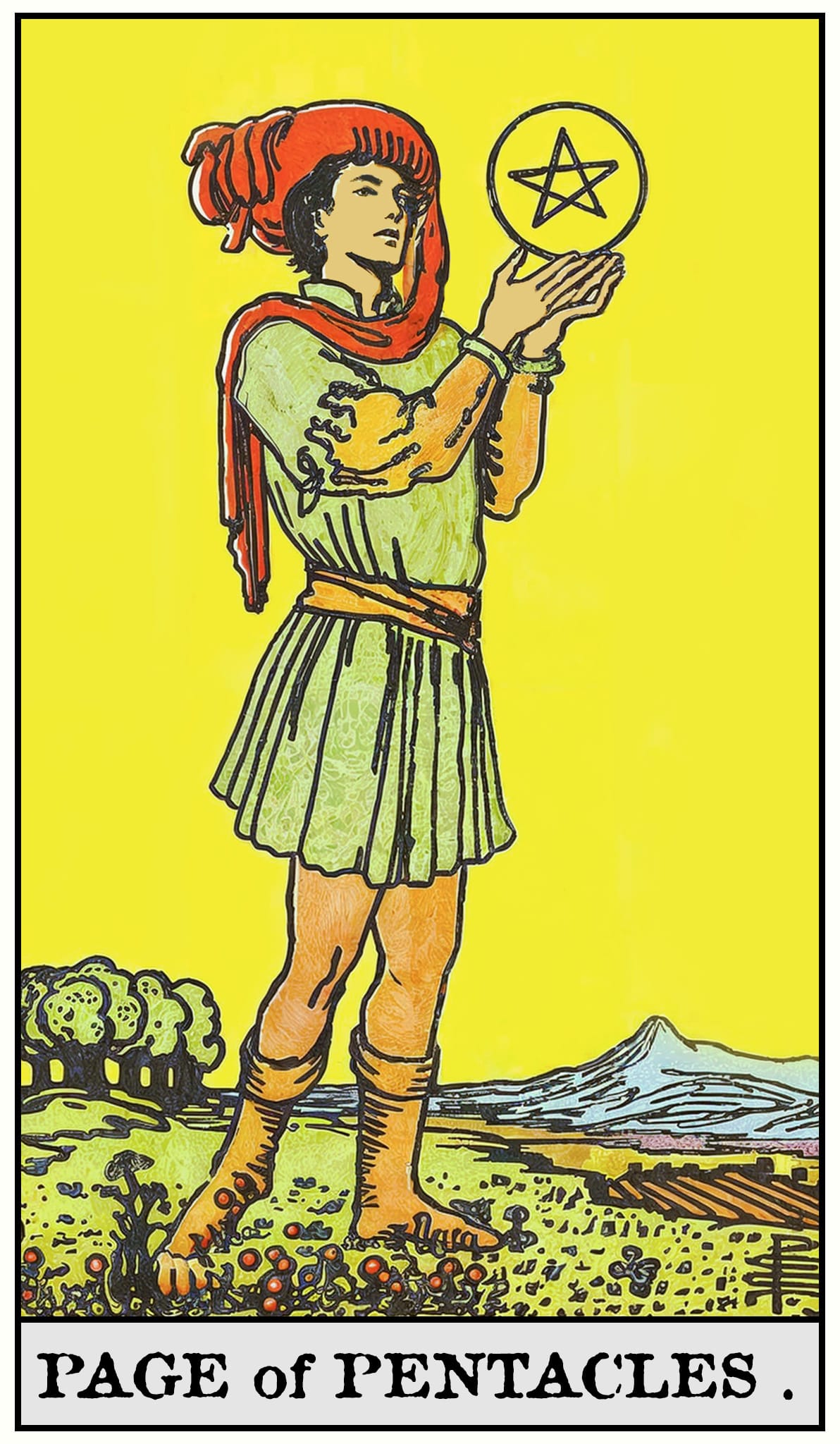
A young figure holds a pentacle up before him at eye level — not displaying it, not yet deciding what to do with it — the green field cultivated behind him, the mountains patient in the distance.
The Page of Pentacles names the mind in its most patient early form: the encounter with matter that begins not with action but with sustained looking. He has found something — or been offered something — and is studying it before he moves. This is not hesitation. This is the willingness to let a thing reveal itself rather than projecting a use onto it before its nature is understood.
The willingness to look at something until it yields its nature — before deciding what to do with it
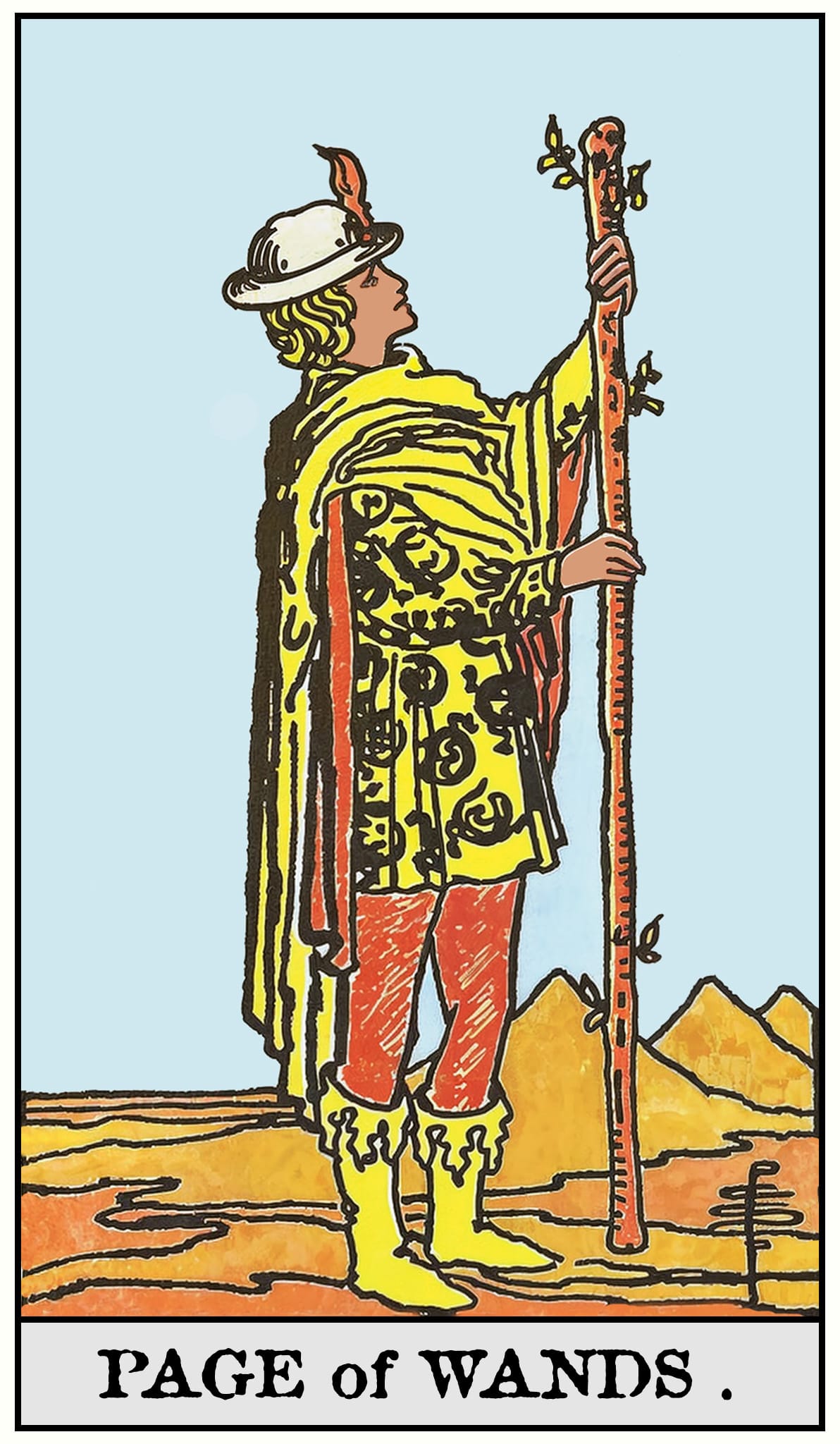
Where the Page of Wands met fire with immediate enthusiasm, this Page meets earth with study. He is not passive — the looking is its own form of work, and the most consequential acts in a life are often preceded by exactly this register: the long examination before the commitment. The field behind him has been cultivated by someone before him; he is learning what that work required. The shadow of this card is the looking that becomes permanent — the study that defers the act indefinitely, the page who accumulates knowledge of the pentacle without ever setting it in the ground.
Earth meeting its student — the element's first encounter in its most grounded form
Pollack reads the Pages as four forms of first encounter with their suits' elements. The Pentacles Page is the last of the four, and the most deliberate: where the others met their elements with fire, surprise, and sharpness, this Page meets his with slow inquiry. He positions the Page not as a deficiency but as a temperament — and notes that most durable things are made by people who began here, with more questions than answers and enough patience to wait for the field's reply.
The complete three-layer reading for all 78 cards — including the full psychological and archetypal layers — is in The Pocket Guide →
The long look is a virtue precisely until it becomes the reason that nothing is ever picked up and used.
Shadow TrapThe study that keeps expanding its scope — always more to understand before the work can begin, always another reason why the pentacle is not yet ready to be planted.
Shadow GiftThe capacity to arrive at action informed by genuine contact with the material rather than assumption — the practitioner who makes fewer mistakes not because they are more gifted but because they looked longer before they started.
Shadow readings for each card, by suit, are gathered in The Pocket Guide →
We do not read a reversal as an opposite; following Pollack, a turned card is the same energy blocked, withheld, or redirected — not inverted into its negation. A reversed Page of Pentacles often marks the attention that has been called away before it could complete its work — the study interrupted by impatience, anxiety, or the pressure of other people's timelines.
Why Apocrypha Does Not Read Reversals as Opposites →Sixty-three symbols across the full deck — cross-referenced by card and meaning — are mapped in The Symbol Dictionary →
What are you studying right now — genuinely studying, before you have decided what to make of it? And at what point does continued looking become a way of postponing the first move?
The Page of Pentacles is consistently underread, because what he is doing looks like doing nothing. The most common error is to rush past the card's central intelligence — that the looking is the work, and that decisions made without it tend to require correction later. The reading is not complete until the question of readiness has been distinguished from the question of delay.