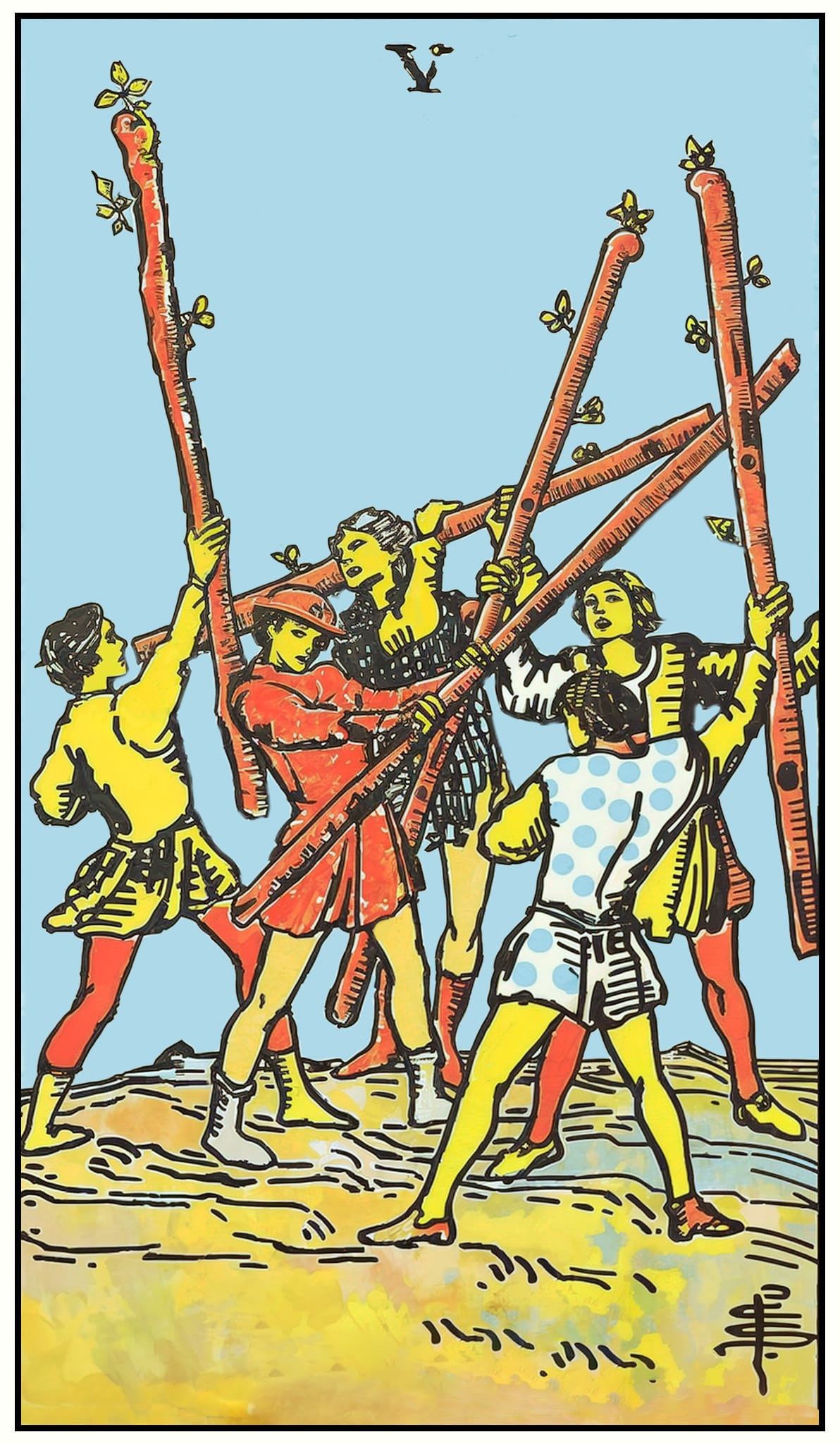
Five of Wands
Five figures clash in a tangle of raised wands — the choreography ambiguous between fight, game, and rehearsal; no one bleeding, no one winning, the wands crossing at angles that do not resolve.
The Five of Wands names the suit's first crisis: the concentrated energy of the Four scatters into competition, and the wands, equally matched, produce heat rather than movement. This is the card of the team that cannot agree, the project with too many strong opinions, the argument that has become the relationship. The question is whether the friction is producing sharpness or only smoke.
More energy, multiplied across competing wills, produces only friction — not forward motion
The Five arrives when the suit's accumulated energy has nowhere coherent to go. The team cannot align, the committee has too many strong wills, the debate circles without landing. The wands are equally matched — no dominant claim — and the energy dissipates in friction. The shadow is the seduction of the fight itself: the argument that becomes the relationship, the competitive dynamic that has stopped being a phase and become a way of life. Some configurations of the Five — the sparring workshop, the rival schools — are generative. The question is whether the friction is sharpening something or simply burning fuel.
The suit discovers that will cannot proceed by sheer intensity — it must be organized, not merely increased
Up to this card, Wands has assumed that more energy resolves most problems. The Five disproves this: more fire meeting more fire produces heat, not direction. The card marks the moment in the suit's arc when the question shifts from how much to toward what. Note the figures appear to be sparring rather than fighting to the death — the Five is not pure destruction. Hillman's concept of agon, the Greek contest that sharpens through opposition, lives in this card. The suit must learn whether this particular friction is producing clarity or only attrition.
The complete three-layer reading for all 78 cards — including the full psychological and archetypal layers — is in The Pocket Guide →
The conflict that was meant to be a phase becomes a permanent condition.
Shadow TrapThe person who has made the Five into a home — the chronic combatant, the professionally embattled, the one for whom struggle has become the only register in which they feel fully alive.
Shadow GiftThe capacity to move through the Five's friction and extract what it was sharpening, rather than remaining in the contest past the point where sharpening has become mere wear.
Shadow readings for each card, by suit, are gathered in The Pocket Guide →
We do not read a reversal as an opposite; following Pollack, a turned card is the same energy blocked, withheld, or redirected — not inverted into its negation. A reversed Five of Wands often marks the avoided conflict — the competing forces present but not being named, the friction that is happening beneath the surface of a situation everyone is agreeing to call harmonious.
Why Apocrypha Does Not Read Reversals as Opposites →Sixty-three symbols across the full deck — cross-referenced by card and meaning — are mapped in The Symbol Dictionary →
What argument in your life have you mistaken for a relationship — and what would the relationship look like if the argument were resolved rather than maintained?
The Five of Wands is most often read as simple conflict to be resolved, and the resolution is indeed what the suit requires. But the card is more specific than that: it asks whether the conflict is of the sharpening kind or the attrition kind. Some of the most productive periods in a creative or intellectual life sit inside the Five — the competing schools, the contested territory, the discipline that has not yet agreed on its own terms. The question is always whether the friction is making anything, or whether it is only wearing the figures down.