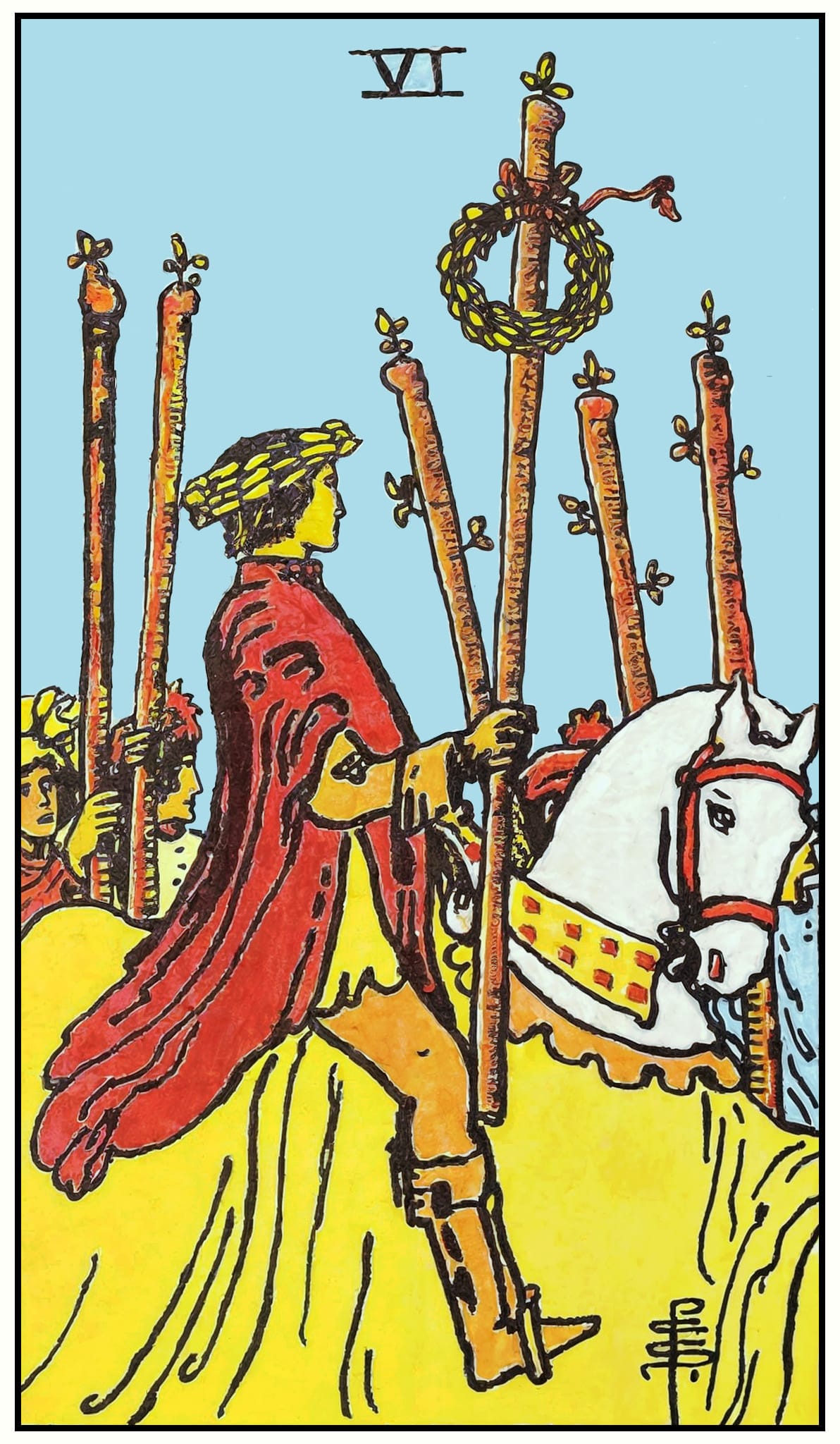
Six of Wands
A rider crowned with laurel passes through raised wands and upturned faces — the first public yes, received clean, already beginning to recede.
The Six of Wands names the moment of earned recognition: the work has been witnessed, the effort confirmed, and the external world has returned a verdict. The card does not ask whether the acknowledgement was deserved — it assumes it was. It asks what the recipient does next. To need the procession to keep moving is the failure this card is already preparing for.
The promotion announced — and the question the crowd cannot answer
The Six arrives after the Five's competition has resolved. A result has been declared and the world is responding: the commission awarded, the announcement made, the work seen by people whose seeing matters. The card is not sentimental about this. The rider does not look smug; he looks like someone who has been seen, perhaps for the first time, by those whose opinion he needed. In shadow, the Six becomes a dependency — the person who can only work when the work is praised, who begins managing the perception of effort rather than the effort itself.
Fire that returns to itself as confirmation — and learns what confirmation is worth
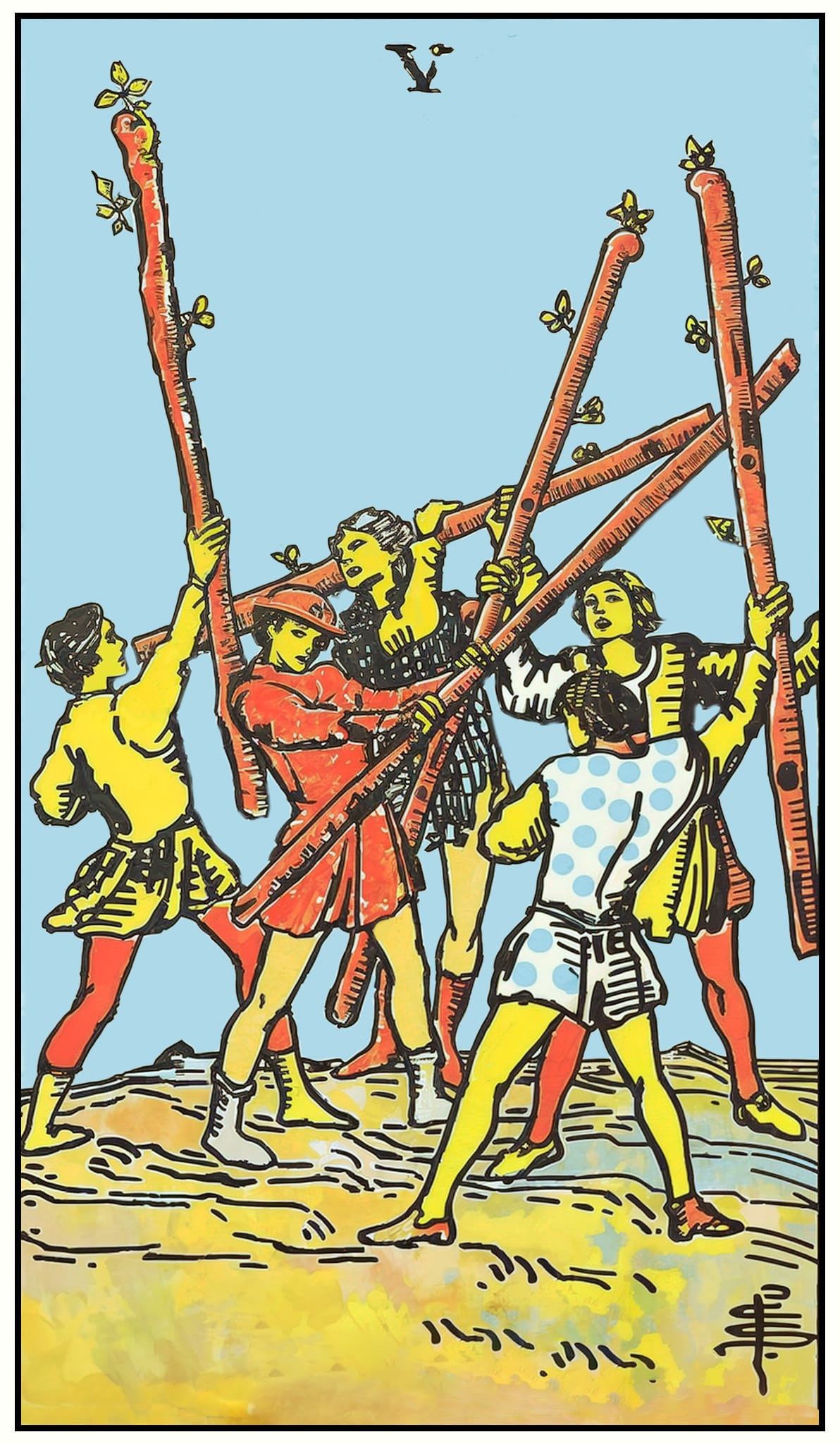
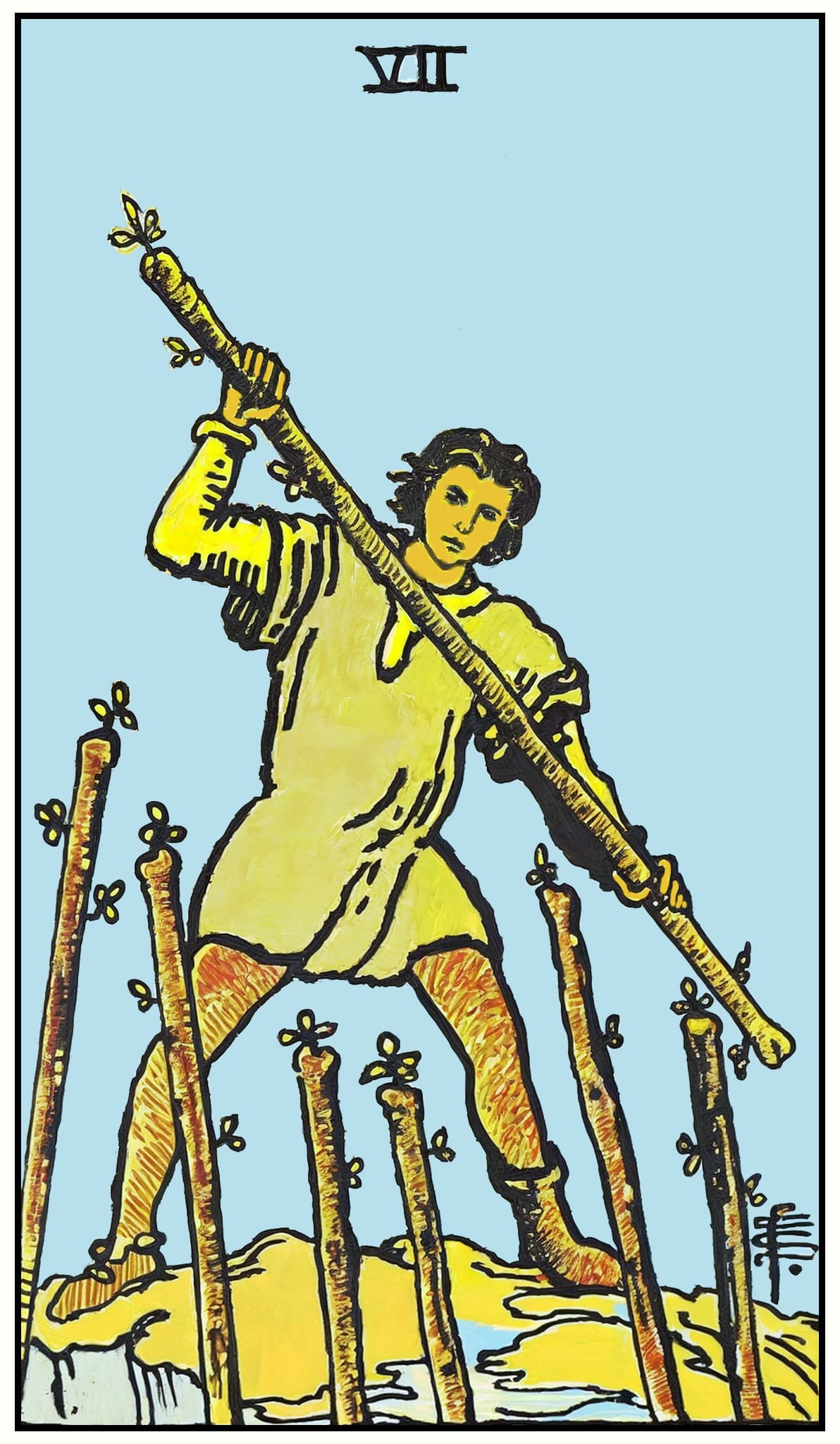
The Six is the first point in the suit where external reality mirrors the internal work. The fire went out, did something, and the world registered it. But Pollack names a quiet instruction embedded in the image: the procession is already moving past. Acknowledgement is a moment, not a station. The card belongs between the Seven's coming contest and the Five's preceding struggle — recognition lands precisely at the midpoint between one trial and the next.
The complete three-layer reading for all 78 cards — including the full psychological and archetypal layers — is in The Pocket Guide →
The procession is sweet. The shadow is building a permanent address there.
Shadow TrapThe person who has confused the acknowledgement with the destination — whose next project is already shaped, consciously or not, by the need to reproduce the public yes rather than the private work that earned it.
Shadow GiftThe capacity to receive the recognition fully, without deflecting it or clinging to it, and to return to the work with the same orientation that produced it — before the crowd finished turning away.
Shadow readings for each card, by suit, are gathered in The Pocket Guide →
We do not read a reversal as an opposite; following Pollack, a turned card is the same energy blocked, withheld, or redirected — not inverted into its negation. A reversed Six of Wands often marks either the delayed recognition — effort that has not yet been seen by the people positioned to see it — or the recognition that arrived and was not received, deflected by the person it was directed toward before it could land.
Why Apocrypha Does Not Read Reversals as Opposites →Sixty-three symbols across the full deck — cross-referenced by card and meaning — are mapped in The Symbol Dictionary →
Whose recognition have you been working toward without naming it clearly — and if that recognition arrived tomorrow, exactly as you have imagined it, what would you do the following morning?
The Six of Wands is most often read as straightforward good news, and within its limits, it is. The problem is that the limits are the card's whole subject. The common misreading stops at the victory. The more demanding reading asks what the recipient is about to do with the visibility — whether the laurel is being worn as evidence that the work is over or as confirmation that it continues. Most readers stop when the rider stops to receive the crown. The card doesn't.