Six of Pentacles
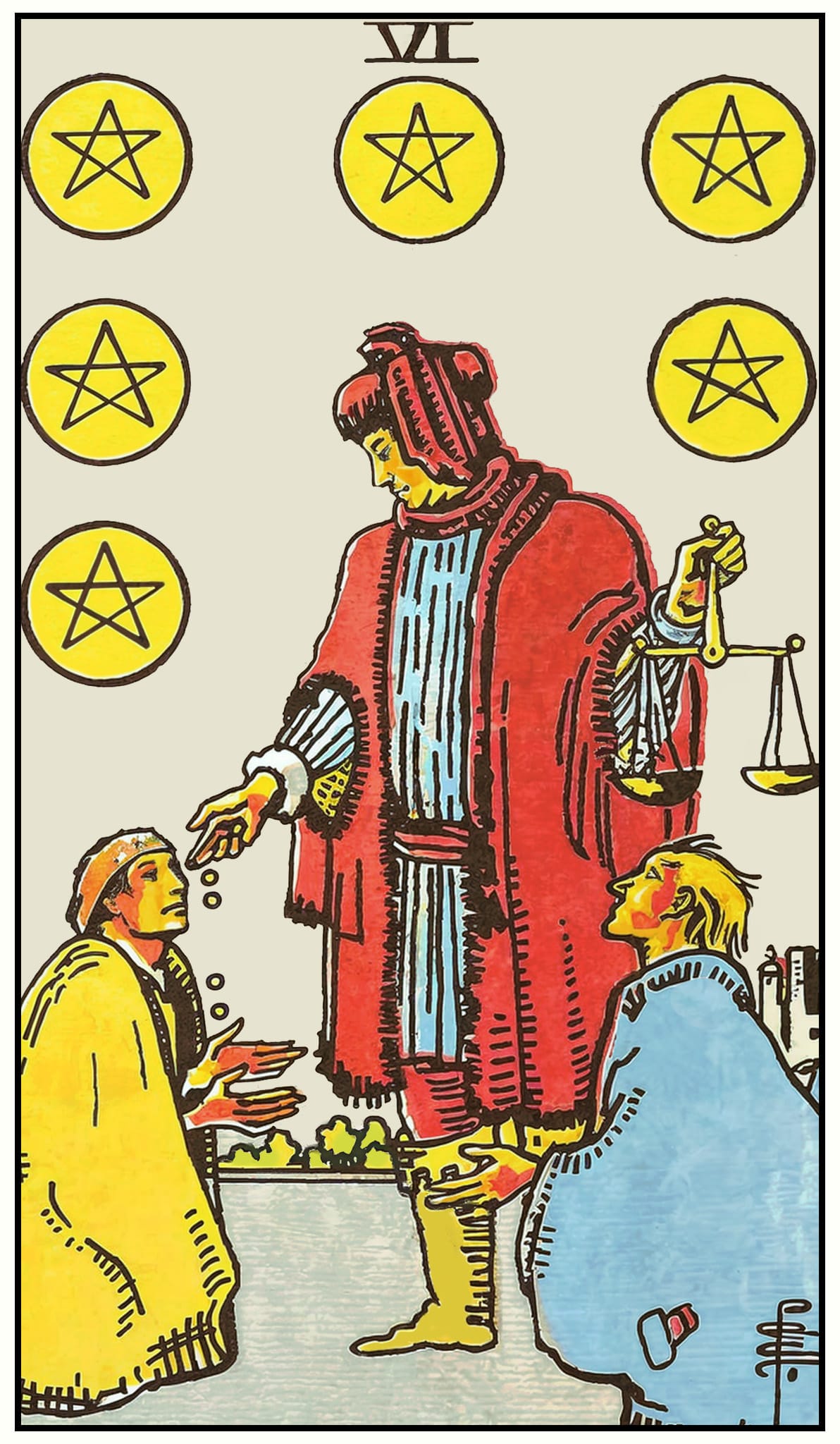
A wealthy merchant stands holding scales, distributing coins to two kneeling figures. The scales are balanced. The transaction is orderly. Whether this is generosity or the maintenance of a social order that requires the supplicants to remain supplicants is the card's deliberate ambiguity.
The Six of Pentacles names circulation restored after the Five's crisis — and asks, immediately, about the terms of the restoration. The merchant gives. The scales measure. The two figures receive from a kneeling position. This is not the Three of Pentacles' collaborative recognition. This is a transaction in which the power differential is structural. The giving is real. What the giving requires is worth examining.
The merchant gives. The scales measure. The question is what.
The Six of Pentacles is the card of material restoration after crisis — resources moving again, the frozen situation thawing. After the Five's cold, the circulation is real and necessary. But the manner of the restoration is the card's subject: the two figures receive from a kneeling position, the merchant stands above them with the measuring instrument, and the orderliness of the transaction conceals a structural question about what is being exchanged alongside the coins. The shadow is the charity that requires the recipient to remain a recipient — the giving organized to maintain the giver's position as giver.
Material resources between people are never neutral — giving and receiving carry the relationship between the giver and the given
Pentacles, more than any other suit, is honest that material exchange is never purely transactional. Money carries meaning. Food given to the hungry carries the relationship between the giver and the hungry. Pollack reads the Six as the card that demands the practitioner examine both sides of the scales simultaneously: not only whether generosity is present, but what the generosity requires of the person who receives it. The scales in the merchant's hand are measuring something. The question is what.
The complete three-layer reading for all 78 cards — including the full psychological and archetypal layers — is in The Pocket Guide →
Some configurations of giving are acts of love. Some are acts of status maintenance. The scales do not distinguish between them.
Shadow TrapThe giving that requires the recipient to remain in the posture of reception — the charity that sustains the need it addresses because solving the need would dissolve the relationship's structure, and the structure serves the giver.
Shadow GiftThe capacity to give in a way that moves toward the Three of Pentacles' collaborative recognition — that treats the recipient as someone whose position is temporary and whose capacity is real, rather than as someone whose permanent need is the condition of the exchange.
Shadow readings for each card, by suit, are gathered in The Pocket Guide →
We do not read a reversal as an opposite; following Pollack, a turned card is the same energy blocked, withheld, or redirected — not inverted into its negation. A reversed Six of Pentacles often marks the imbalanced scales — the exchange in which one party is giving what is not being received, or receiving what was not offered, or the transaction operating under terms that neither party has made explicit.
Why Apocrypha Does Not Read Reversals as Opposites →Sixty-three symbols across the full deck — cross-referenced by card and meaning — are mapped in The Symbol Dictionary →
When you give — materially, practically, with your time or your resources — what do you expect in return? And have you been honest with yourself about that expectation, including the forms of return that are not named as return?
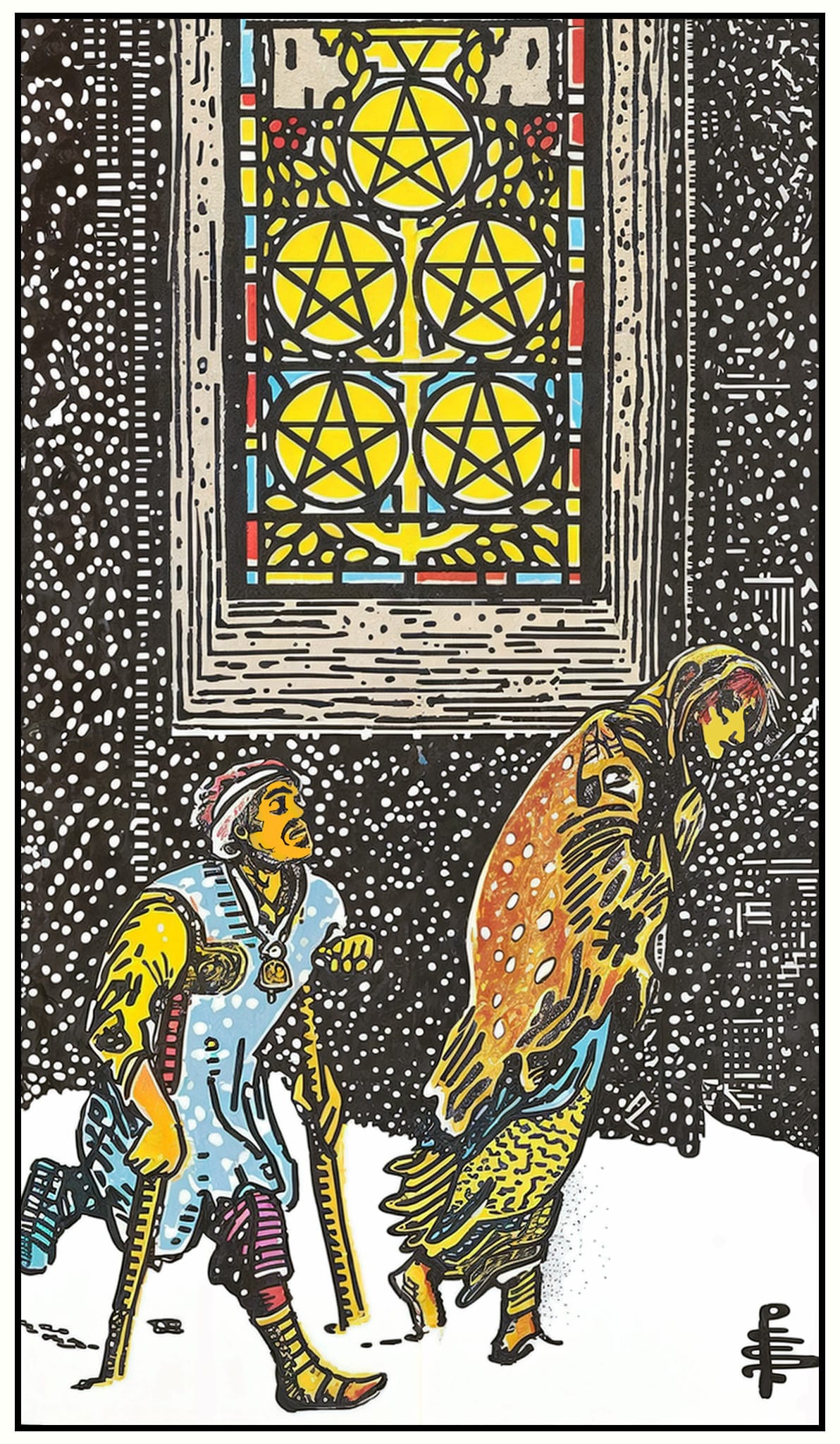
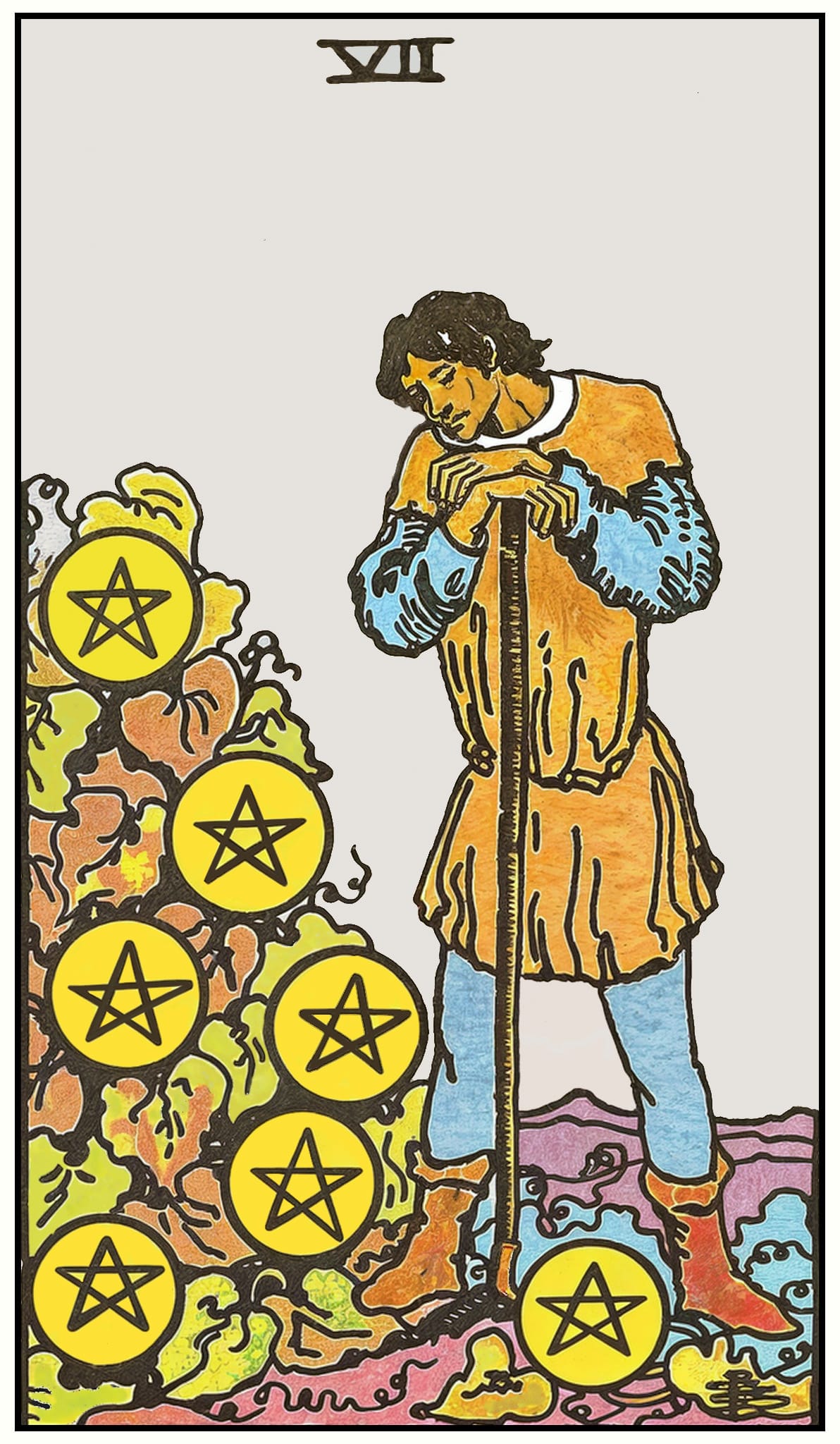
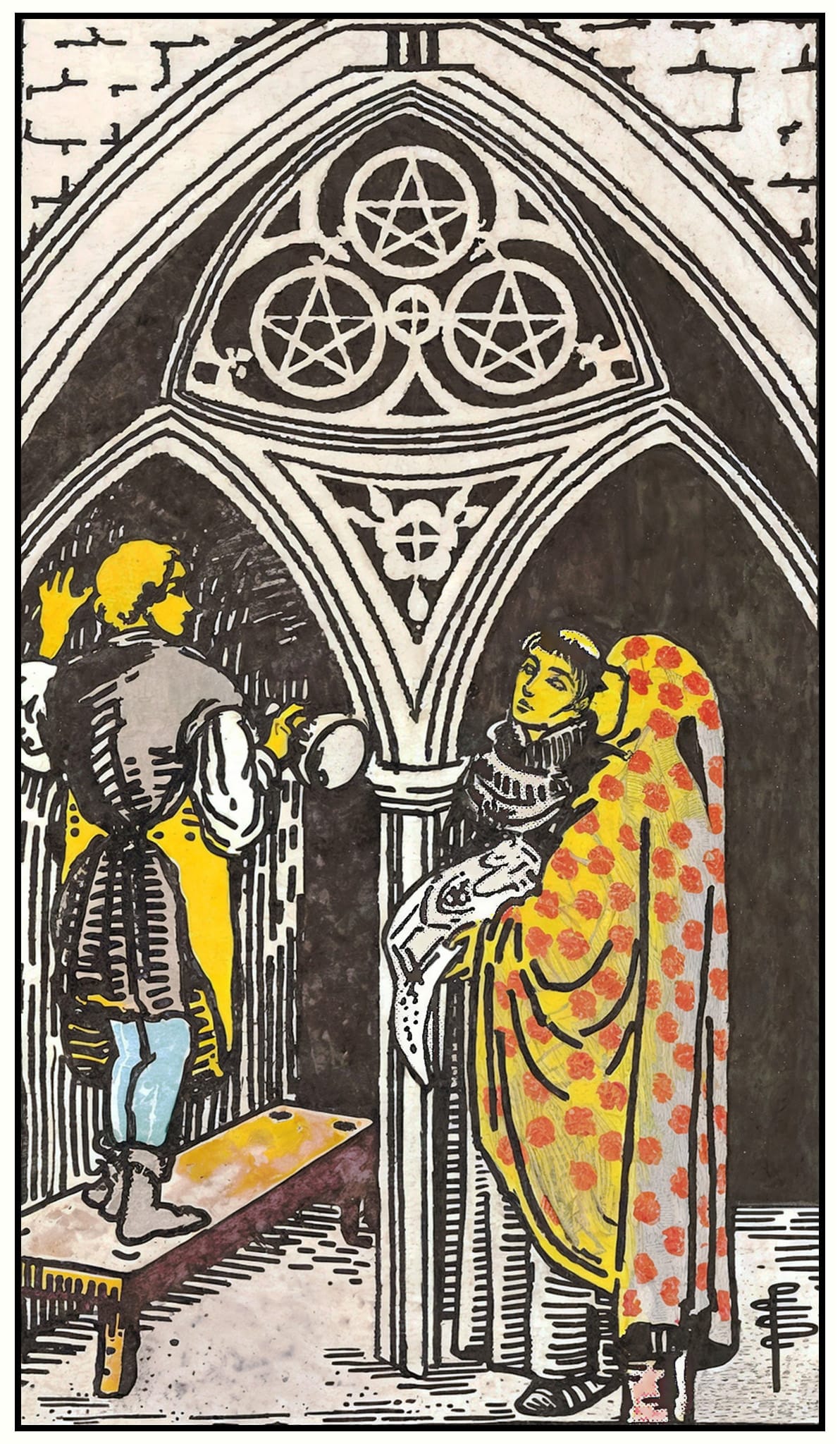
The Six of Pentacles is most often read as generosity incoming or as advice to give. The more demanding reading asks about the terms — not to condemn giving, which is the card's genuine content, but to examine what the giving is structured around. The card contains both genuine generosity and its shadow in the same image, and the distinction between them is not visible in the transaction itself. It is visible only in the answer to the question: does this giving move the recipient toward the Three's collaborative recognition, or does it require the kneeling position to continue indefinitely?