Seven of Cups
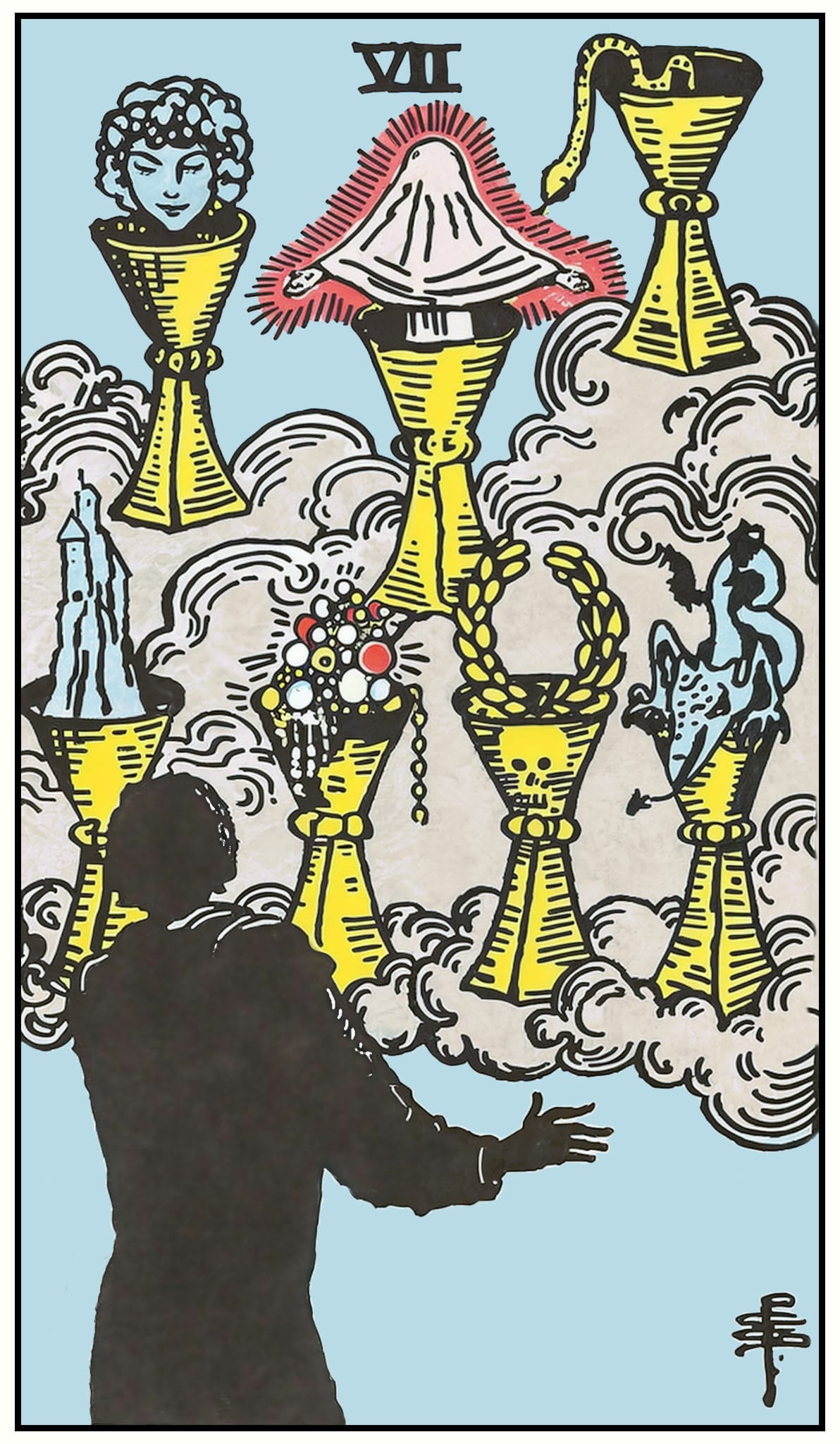
A dark silhouette stands before seven cups floating in cloud — each containing a different vision: a crowned head, a glowing shrouded figure, a snake, a castle, jewels, a wreath, a dragon.
The Seven of Cups names the enchantment of too many possibilities, each made more seductive by being unchosen. The figure is not lazy — he is suspended. The cups are beautiful and they are also clouds. The shadow is the life organized entirely around the moment before commitment: the elaborate inner cinema that never crosses into the rougher terrain where one path is taken and the others close.
The figure is not lazy — he is enchanted, which is a different and harder problem
The Seven of Cups is the proliferation of options without resolution: the career paths that multiply the longer they remain unchosen, the romantic interests, the cities, the spiritual practices — each rendered beautiful by the fact that it has not yet cost anything. In shadow, the card becomes an addiction to the moment before commitment — the person whose richest life exists in the planning, the dreaming, the elaborate interior cinema, and who finds the rougher terrain of actual commitment somehow beneath the visions. The wreath in one cup is real. So is the snake. The figure cannot determine which from where he is standing.
Water as imagination — and the discipline that separates active vision from passive consumption
Imagination is water's element as much as emotion, and ungoverned imagination produces not insight but proliferation. The Seven is the card at which the suit's deepest temptation surfaces: that the inner life can substitute for the outer one. Jung distinguished active imagination — the disciplined engagement with interior images, entering them, asking them to speak — from the passive version the Seven depicts: the figure who consumes his own visions like a viewer at a screen. Some of the cups contain real callings. The figure will not find out which without descending from the cloud.
The complete three-layer reading for all 78 cards — including the full psychological and archetypal layers — is in The Pocket Guide →
The vision that is never committed to remains perfect — and permanently unavailable.
Shadow TrapThe inner life used as a substitute for the outer one — the person who has cultivated a rich interior world of plans, possibilities, and imagined selves and has organized the actual life around not having to risk any of them in contact with reality.
Shadow GiftThe capacity to descend from the cloud into a single cup — not because the other visions were false, but because one path chosen and walked reveals more than seven paths admired from a distance.
Shadow readings for each card, by suit, are gathered in The Pocket Guide →
We do not read a reversal as an opposite; following Pollack, a turned card is the same energy blocked, withheld, or redirected — not inverted into its negation. A reversed Seven of Cups often marks the imagination that has shut down rather than proliferated — the person who has responded to the Seven's enchantment by eliminating all options rather than choosing among them, and now operates in a flattened field that mistakes its narrowness for clarity.
Why Apocrypha Does Not Read Reversals as Opposites →Sixty-three symbols across the full deck — cross-referenced by card and meaning — are mapped in The Symbol Dictionary →
Which of your cups have you been admiring at the level of vision rather than descending into — and what is the admiration protecting you from having to find out?

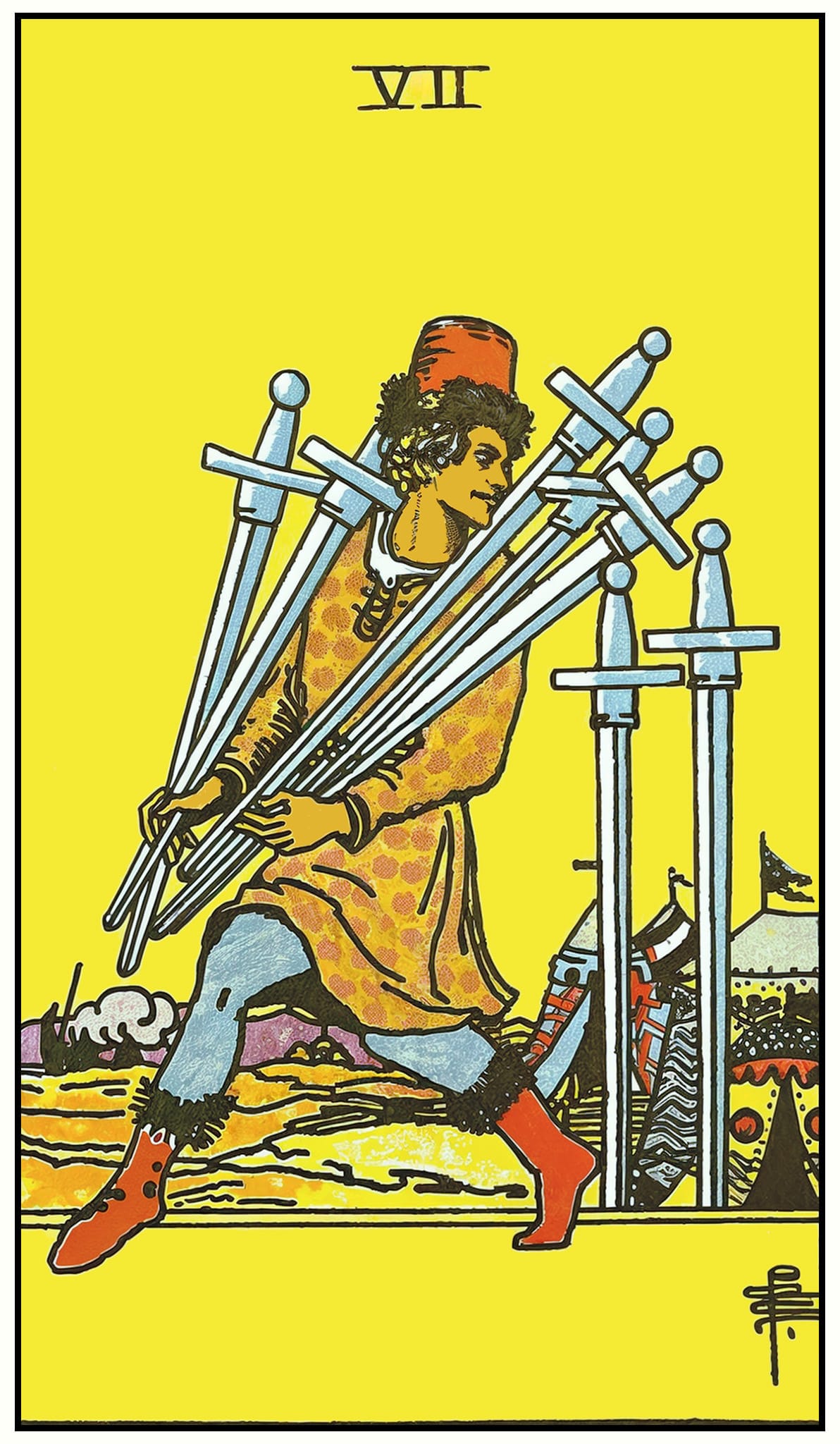
The Seven of Cups is most often read as a warning about illusion or confusion. The more precise problem the card names is not that the visions are false — some of them are real callings — but that the figure cannot determine which without committing to one. The misreading that stops at "watch out for illusion" leaves the reader with nowhere to go. The more useful question the card raises is specifically about the relationship between imagination and action: not whether the visions are trustworthy, but whether the person has confused having them with using them.