Six of Cups
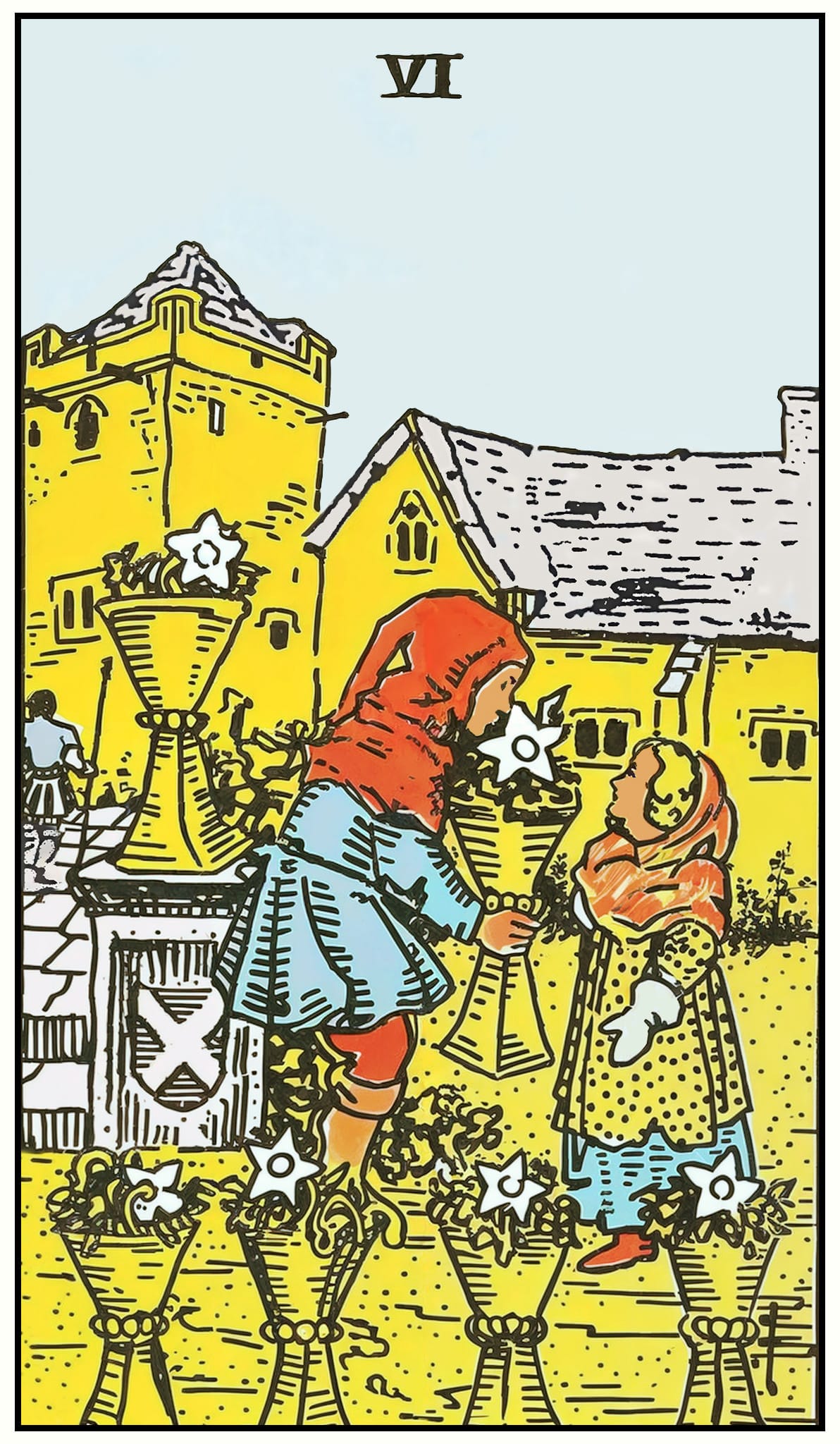
Two children in an old courtyard — the elder offering a cup of white flowers, five other flowered cups around the scene, a guard walking away in the background, golden light over all of it.
The Six of Cups names the gift that returns from an earlier self: not the lost thing itself, but a presence from before the wound that remembers who you were before it. The card has a tenderness the deck rarely permits. It also carries its shadow exactly — the past offered as a refuge from the present's demands, the memory weaponized as the standard everything since has failed to meet.
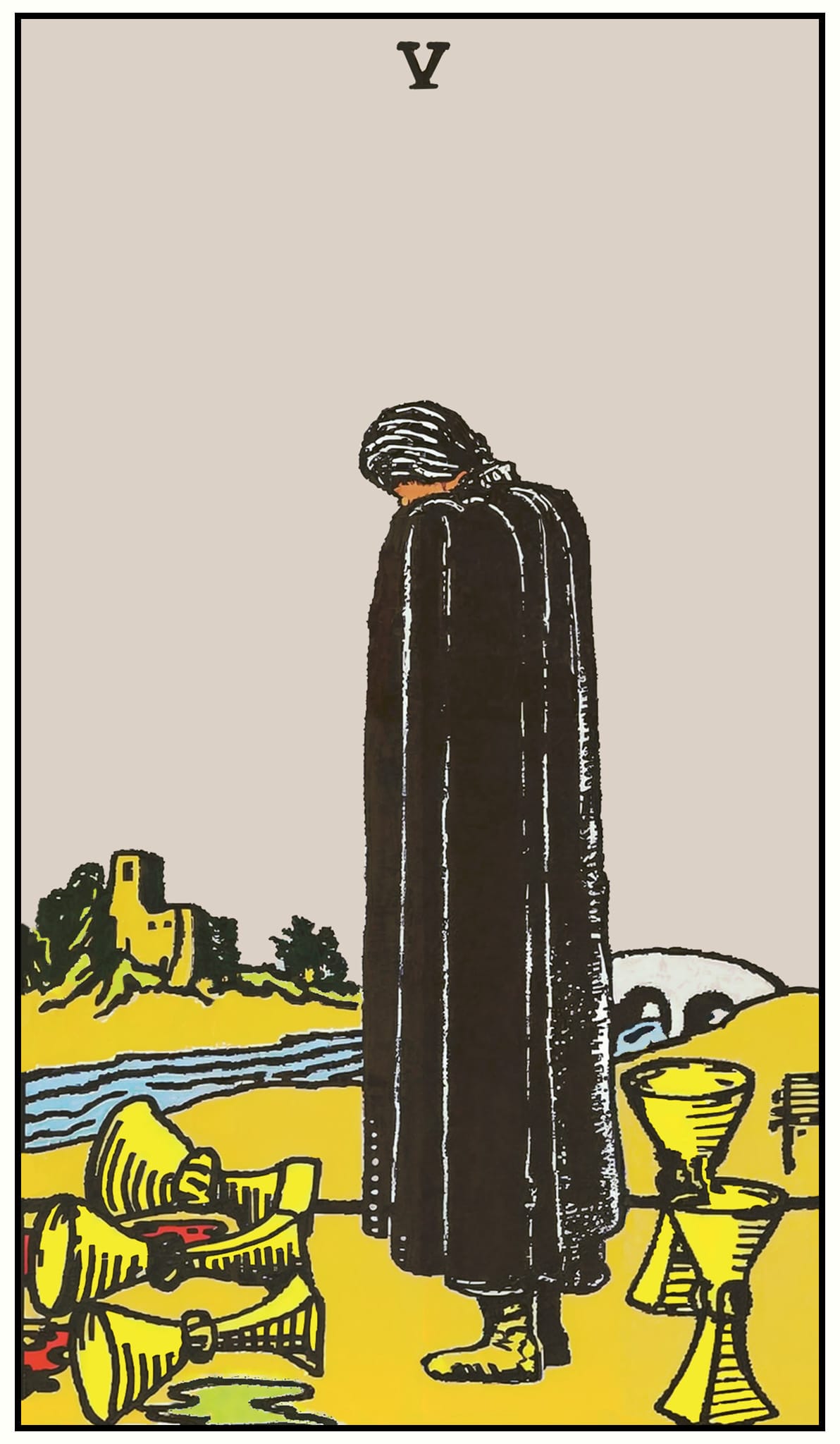
After the Five's loss, something returns — not the lost thing, but a presence that remembers who you were before it
The Six of Cups arrives as a particular kind of restoration: the old friend who reappears, the childhood capacity rediscovered, the tenderness toward an earlier version of oneself that had been left behind without a formal farewell. In shadow, the card becomes the retreat from the present into a mythologized past — the former relationship that becomes the standard against which every subsequent one fails, the version of oneself at twenty-two used as a cudgel against the version at forty. The flowers in the cups are real. The flowers from twenty years ago are not in any cup that currently exists.
The adult's relationship to childhood — reclaiming what was abandoned by honouring it forward, not by regressing into it
Pollack notes that the Six is frequently misread as childhood itself, when it is more precisely the adult's relationship to childhood: the older child in the image is the one making the offering, and the courtyard is being remembered, not inhabited. Jung identified a specific function of memory in individuation — the integrated self must recover what was abandoned in earlier life not by regressing but by bringing it forward into the present. The Six is that movement: the early loves and early curiosities placed back in a cup and offered into the life being currently lived.
The complete three-layer reading for all 78 cards — including the full psychological and archetypal layers — is in The Pocket Guide →
The past honoured forward and the past used as shelter from the present are not the same gesture.
Shadow TrapThe memory that has become a standard — the earlier version of the self, the earlier relationship, the earlier place — held not as something to reclaim but as evidence that everything since has been diminishment.
Shadow GiftThe capacity to receive what the earlier self was carrying — the curiosity, the tenderness, the willingness to be foolish — and to bring it forward into the present without requiring the present to resemble the past in which it was first held.
Shadow readings for each card, by suit, are gathered in The Pocket Guide →
We do not read a reversal as an opposite; following Pollack, a turned card is the same energy blocked, withheld, or redirected — not inverted into its negation. A reversed Six of Cups often marks the cut-off from the earlier self — the person who has moved so completely past a prior chapter that the gifts it contained have been left behind with it, and the present is running on a narrower emotional repertoire than the history would support.
Why Apocrypha Does Not Read Reversals as Opposites →Sixty-three symbols across the full deck — cross-referenced by card and meaning — are mapped in The Symbol Dictionary →
Which version of yourself have you left behind without a proper accounting — and what was that version holding that you have not replaced, or not yet tried to?

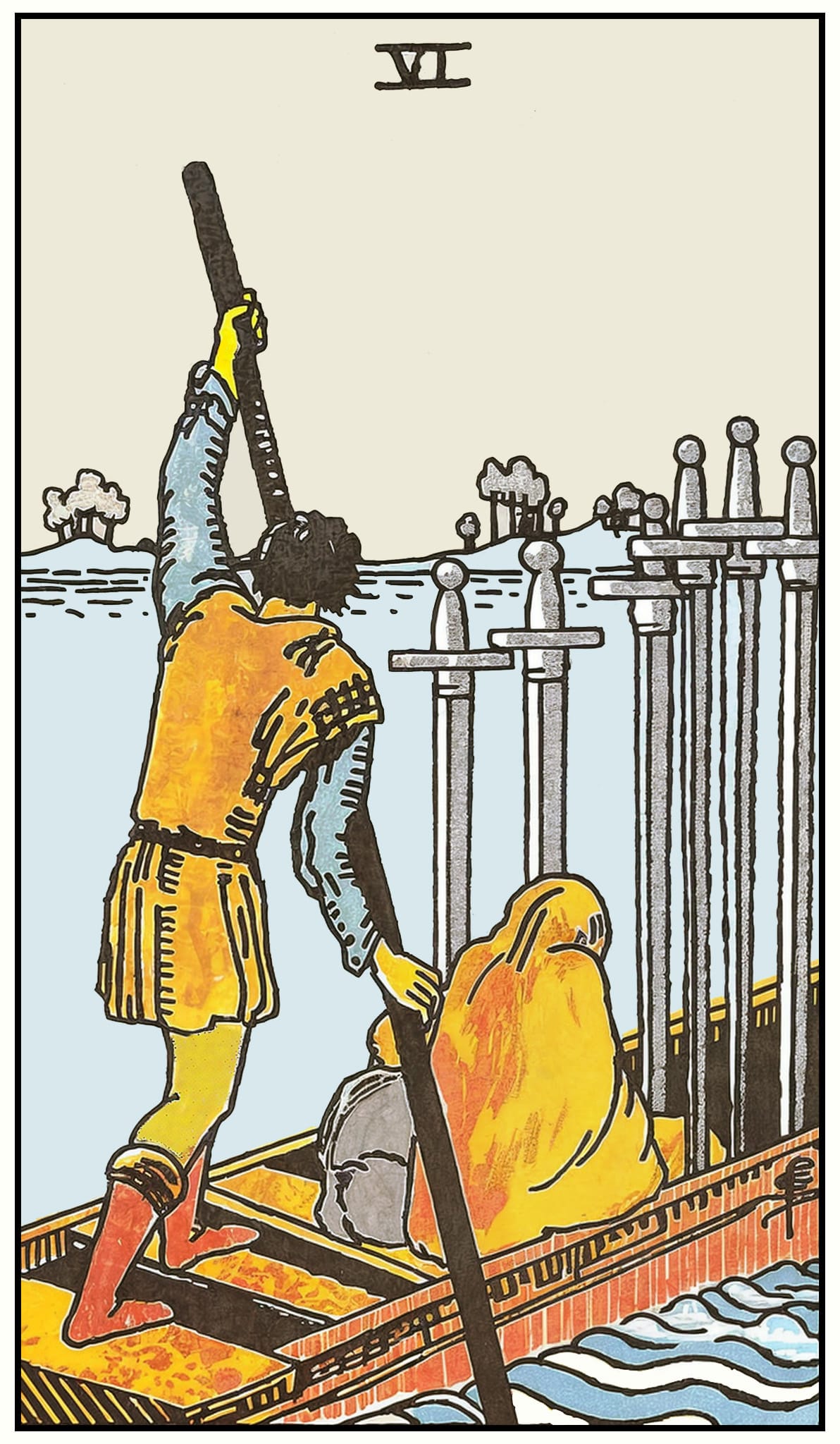
The Six of Cups is most often read as straightforward nostalgia — childhood, sweetness, simpler times. The more precise reading distinguishes between nostalgia and reclamation, which are related but opposite in their use. Nostalgia looks back as retreat. Reclamation reaches back in order to bring something forward. The card depicts the second movement, not the first. The older child is giving the younger one something into the present, not preserving it from it. That direction is everything.