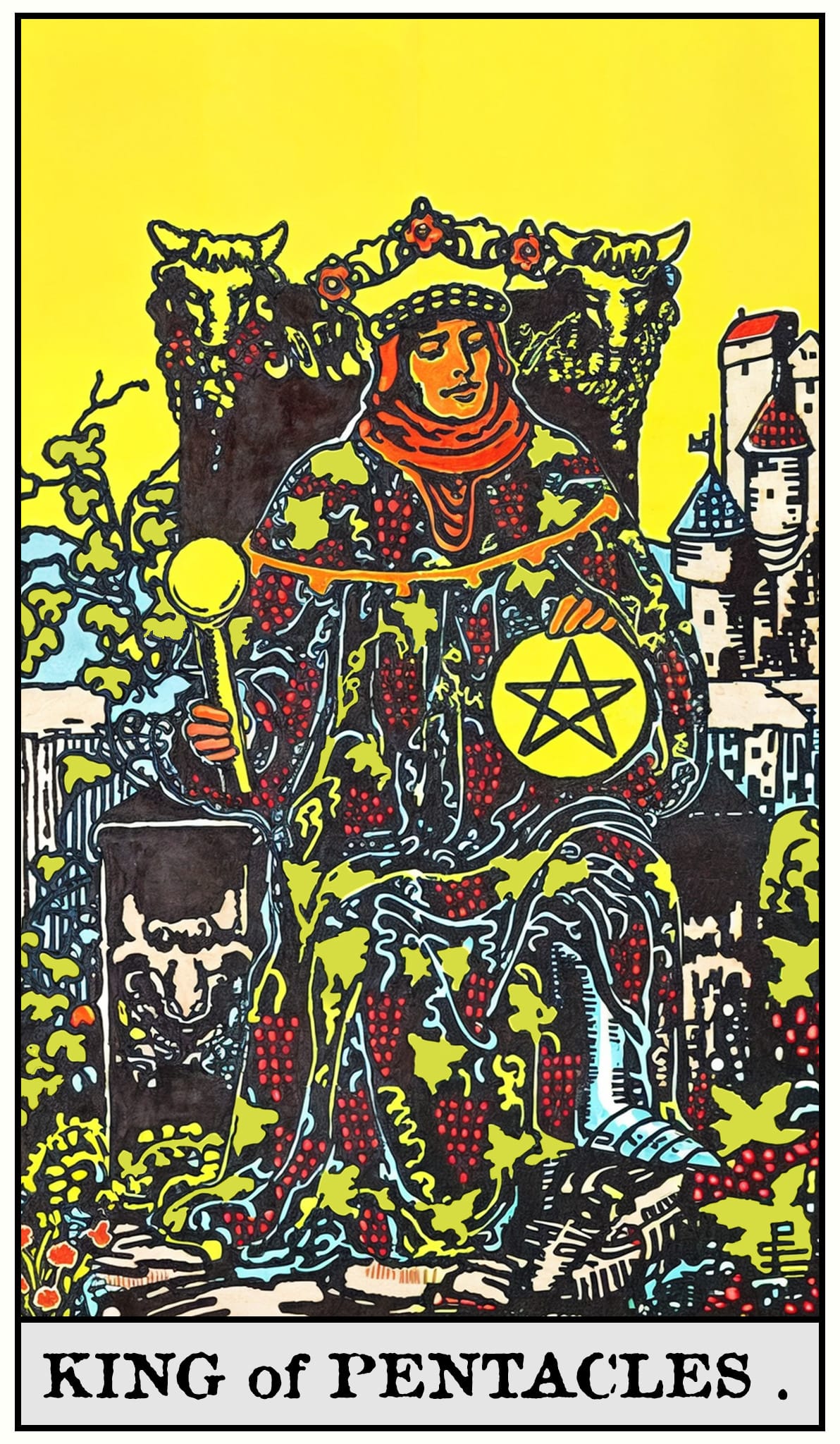
King of Pentacles
A king sits on a throne so overgrown with vines, grapes, and carved bulls that the throne itself is barely visible — robe embroidered with fruit and flowers, armour visible at the edges of the robe, golden pentacle in one hand, sceptre in the other, the castle behind him occupied and functioning.
The King of Pentacles names the mastery that has learned what mastery is actually for. He has accumulated enough — in knowledge, material stability, practical authority — to understand that accumulation was never the point. What he has built has taken on its own life. He is the last card of the Minor Arcana, and he is holding a door open.
The person who has accumulated enough to understand that accumulation was never the point
The vines growing over his throne are not ornament — they are evidence that what he built has exceeded him: the estate produces without constant intervention, the institution continues without constant correction, the investment compounds without daily attention. He holds the pentacle not as a trophy but the way a craftsman holds a familiar tool. The armour visible at his wrist and ankle is the card's most significant detail: he has not forgotten what this cost to build, and he does not confuse the castle's solidity for permanent safety. He knows, better than any other King, that everything material requires maintenance — and that maintenance is never entirely finished.
The Magician's question — what is your skill ultimately for? — answered across fifty-six cards and four elements
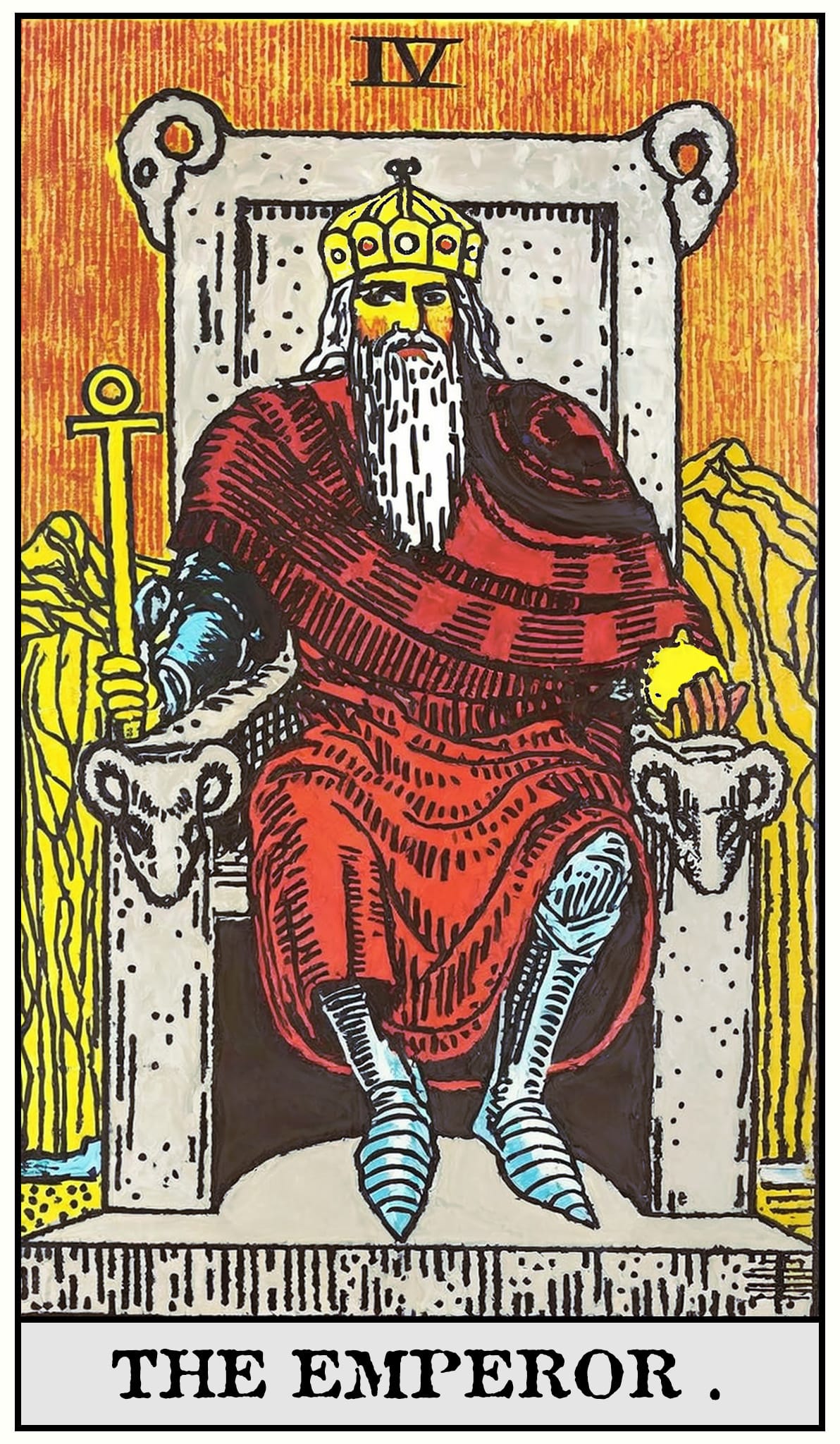
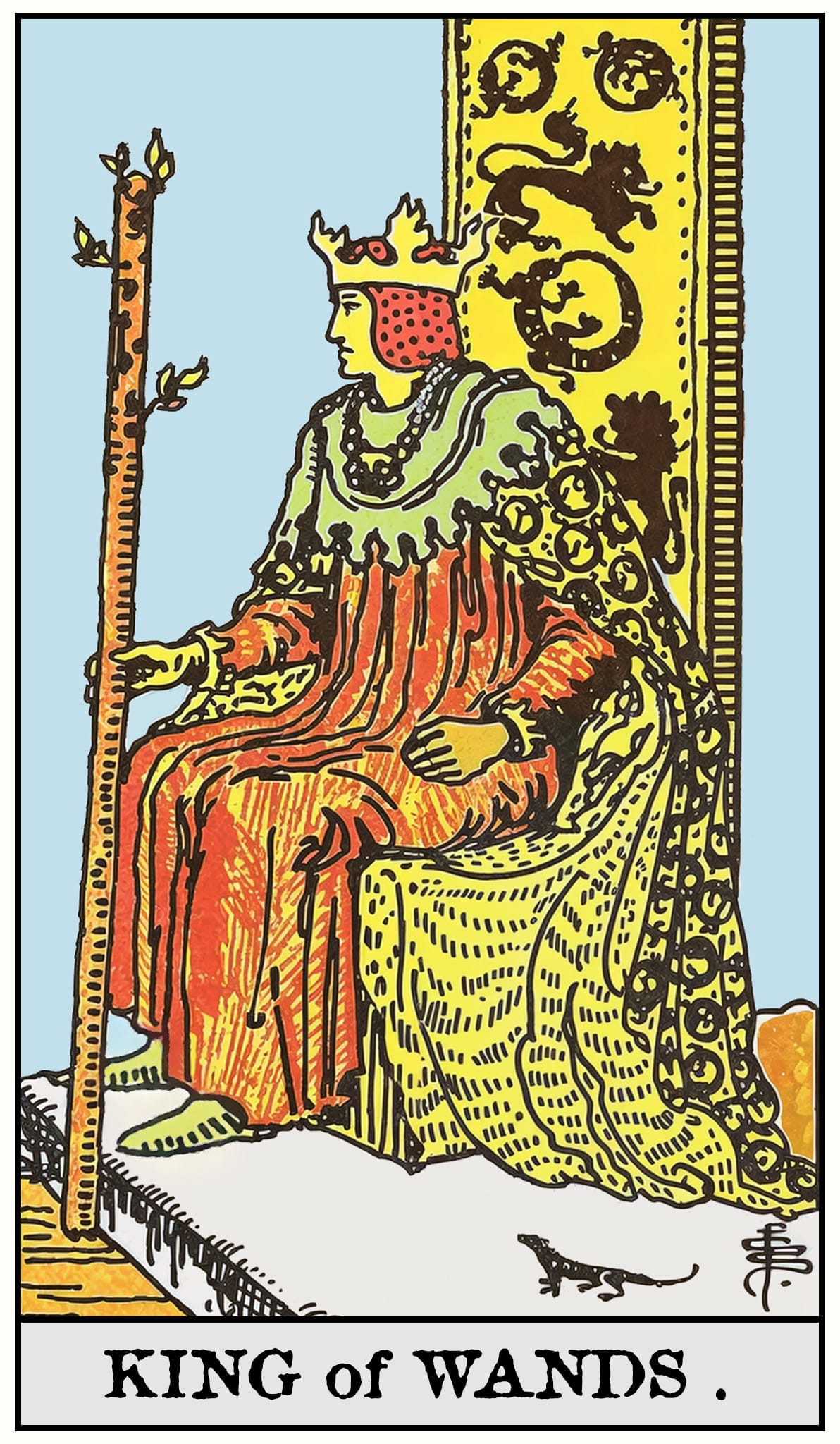
Pollack reads the four Kings as a system completing the Minor Arcana's full inquiry. Wands' King learned that fire's highest expression is tending other fires. Cups' King learned that water's highest expression is remaining stable enough to hold others' depth. Swords' King learned that air's highest expression is cutting through what obscures what is actually true. The Pentacles King learns that earth's highest expression is building what will outlast the builder. His distinction from the Emperor (IV) is the suit's last structural note: the Emperor governs through law — the universal rule that does not adjust to circumstance. The Pentacles King builds through accumulated knowledge of particular ground. His authority is not abstract. It is earned by contact.
The complete three-layer reading for all 78 cards — including the full psychological and archetypal layers — is in The Pocket Guide →
The King who knows what everything costs is also the one most at risk of calculating every relationship in the currency of the material.
Shadow TrapThe solidity that has become the measure of everything — the person who trusts what is stable, produces what lasts, and has quietly stopped knowing how to be in the presence of what is provisional, tender, or incomplete.
Shadow GiftThe capacity to build something that outlasts the builder — to give the gift that von Franz locates at the end of the fairy tale hero's journey: not the prize won, but the cleared ground left for whoever comes next.
Shadow readings for each card, by suit, are gathered in The Pocket Guide →
We do not read a reversal as an opposite; following Pollack, a turned card is the same energy blocked, withheld, or redirected — not inverted into its negation. A reversed King of Pentacles often marks the mastery that has become its own obstacle — the built stability now used to resist the very changes that would allow what was built to remain relevant. The castle that no longer opens its gate.
Why Apocrypha Does Not Read Reversals as Opposites →Sixty-three symbols across the full deck — cross-referenced by card and meaning — are mapped in The Symbol Dictionary →
What are you building that is meant to outlast you — and are you building it as though it will? And what have you already built that has begun to exceed your need to manage it — and can you let it?
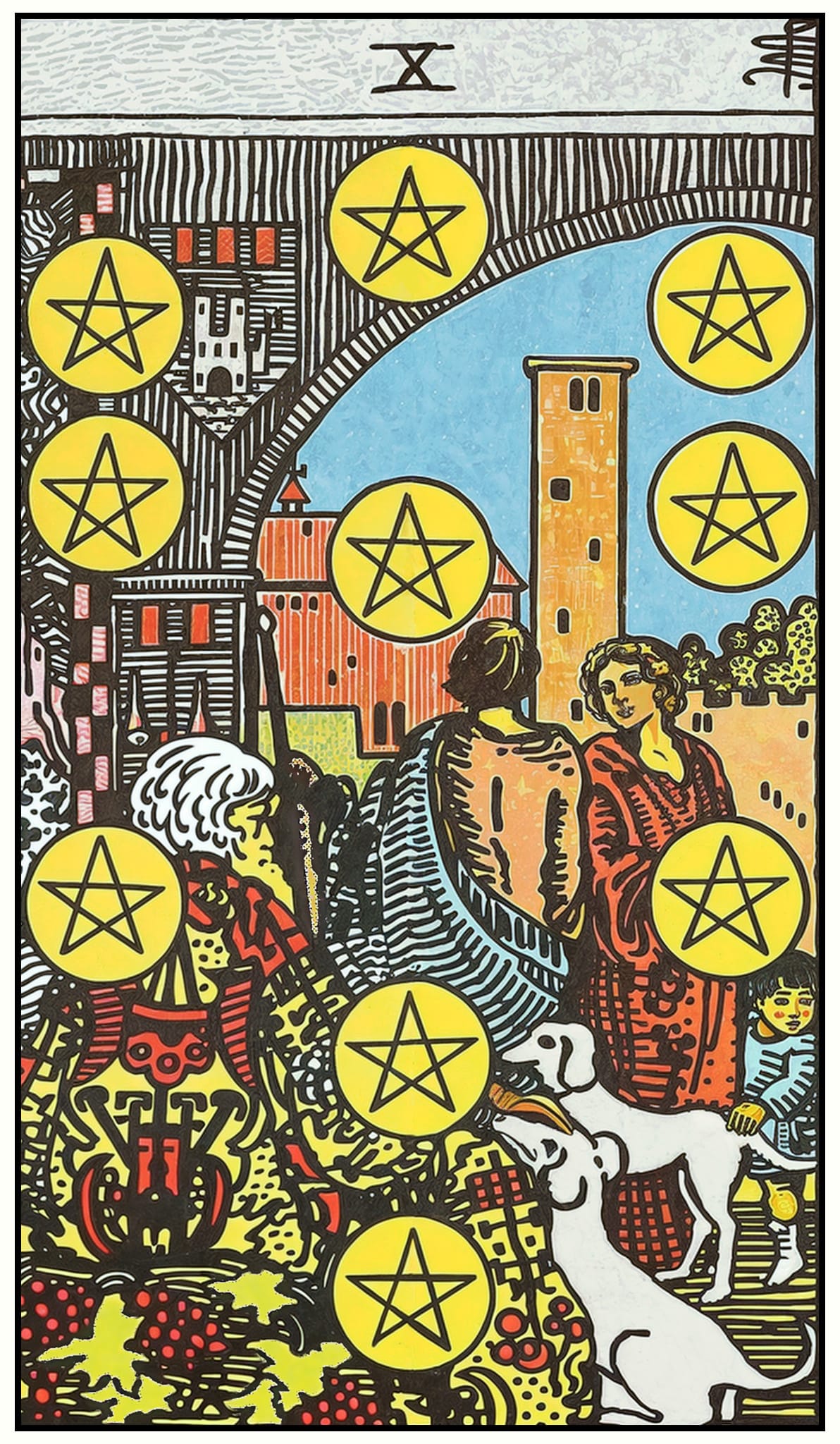
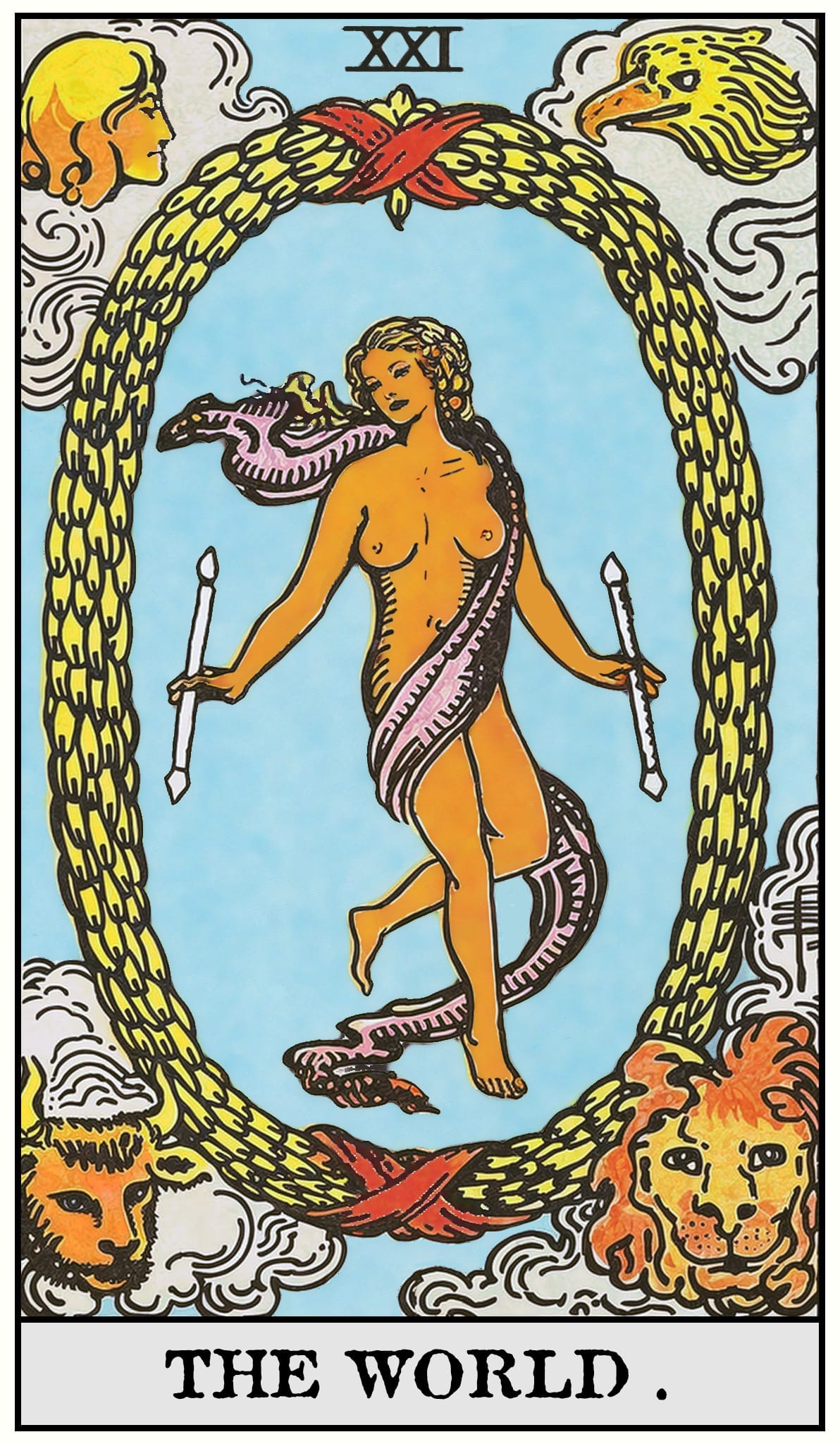
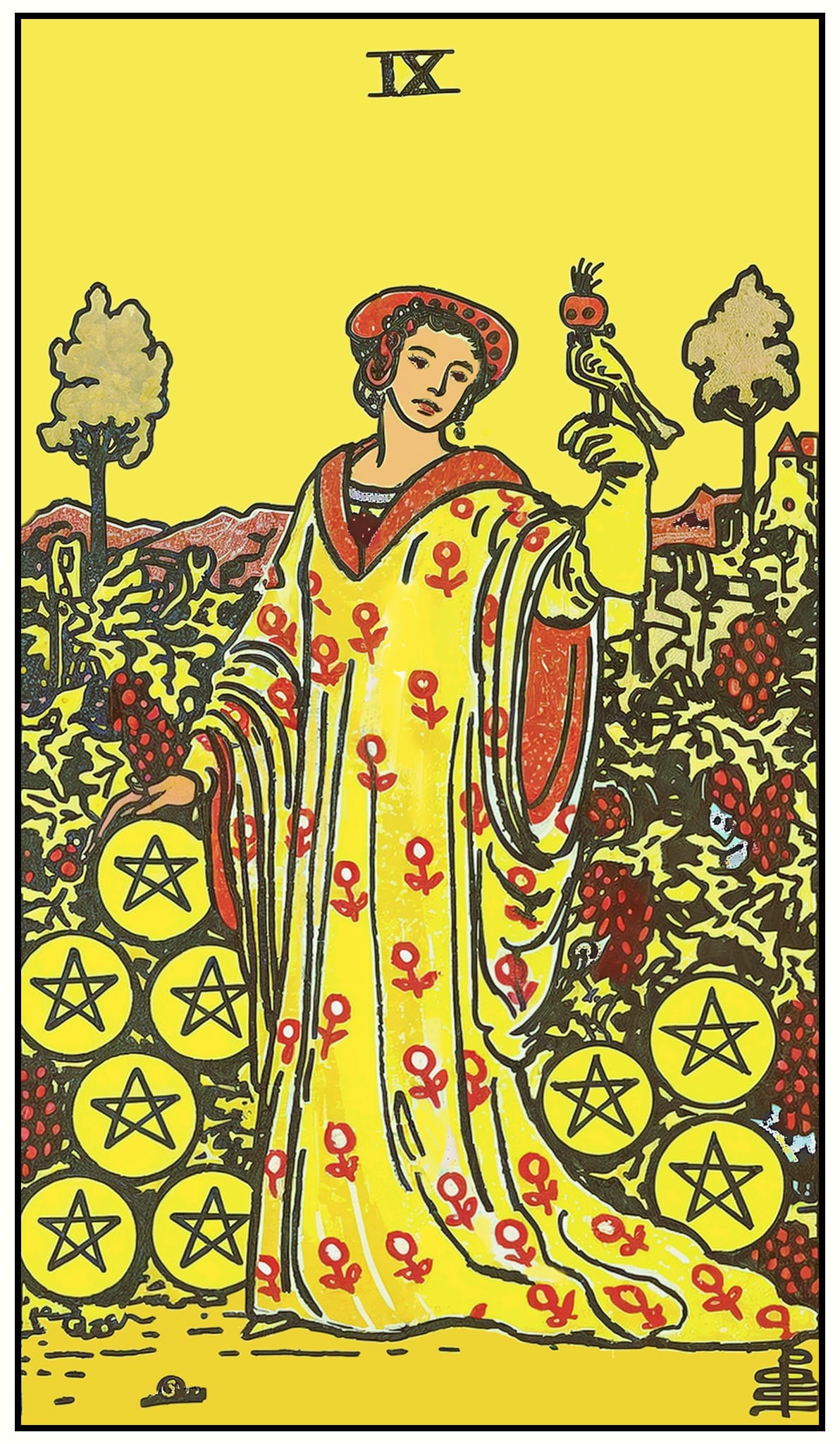
The King of Pentacles is most commonly read as a card of material success, and the material success is real. What tends to be missed is the card's structural position: this is the last card of the entire Minor Arcana, and it carries the weight of fifty-five cards before it. The reading is not complete until the question of what the built thing is for — beyond the builder's own security — has been asked. The door he is holding open is the card's final image. The question is who it is open for.