
Queen of Pentacles
A woman on a stone throne carved with fruit and goats holds a golden pentacle in her lap, gazing at it with the attention of someone tending something alive — the garden around her abundant, the rabbit at her feet unhurried, the land and the woman looking like versions of the same thing.
The Queen of Pentacles names the care so thoroughly enacted through practical attention that it can be mistaken for the absence of depth. She does not perform nurture — she practises it, continuously, in the material register that most people overlook because it produces no speeches. The depth is in the doing, and the doing never stops.
The tending that is indistinguishable from the tended — spirit expressed as maintenance, not declaration
She brings the soup; she notices the fever before anyone else has named it; she knows which task has been left undone and does it without announcement. Her shadow does not appear in neglect but in its opposite: care that has not been asked for and therefore controls. The Queen of Pentacles at her shadow extreme provides so thoroughly that the recipients never develop the capacity to provide for themselves. The garden that looks like love is also, at its shadow edge, a garden that does not permit things to grow in directions she has not planned.
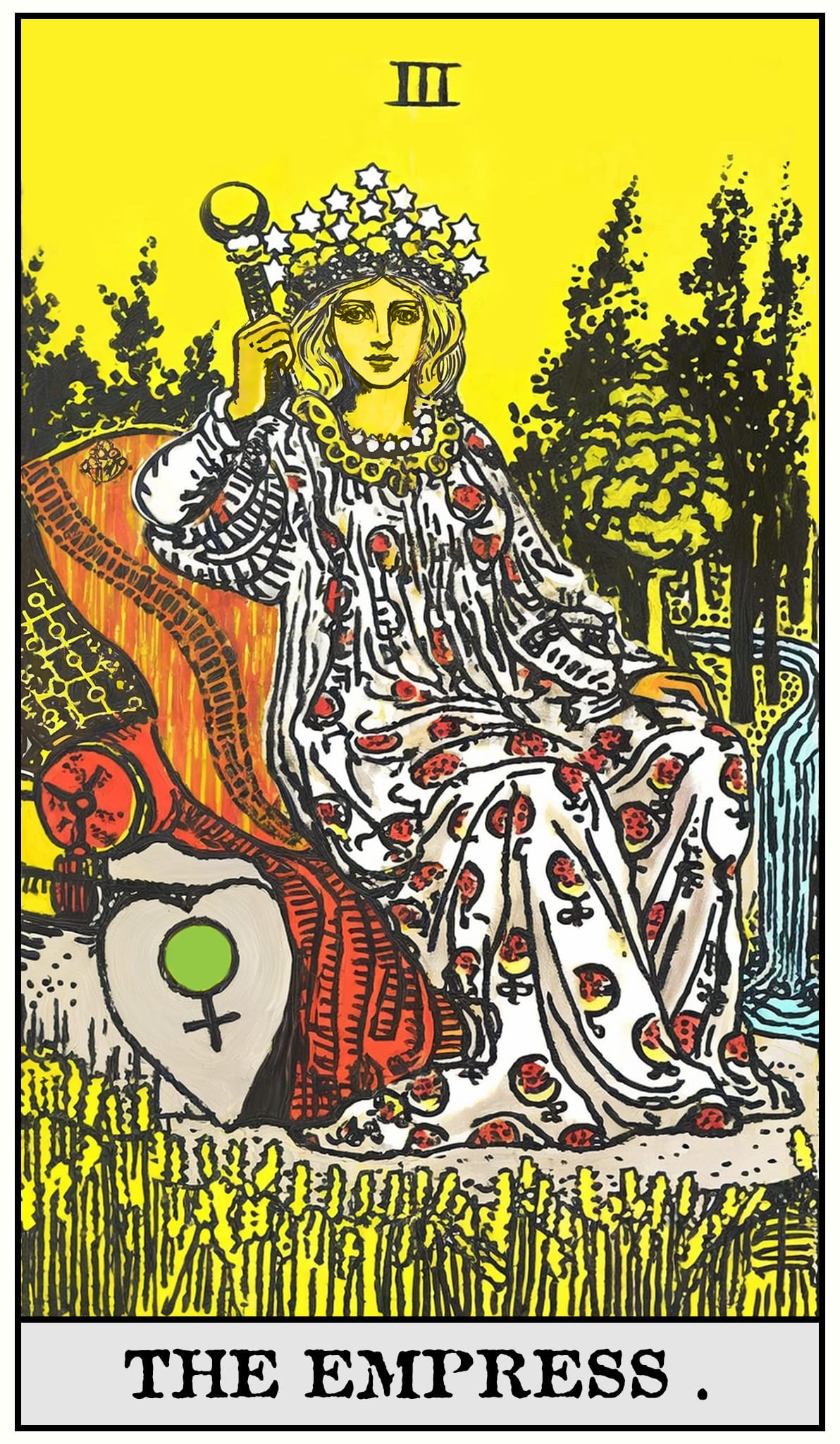
The Empress's generative principle made daily practice — divinity expressed through the consistent attention that keeps things alive
Pollack places this Queen in precise and distinguishable kinship with the Empress at III. The Empress is the archetype of generation — the life-force principle itself, the fertility of spring. The Empress does not tend; she generates. The Pentacles Queen has taken that principle and made it a daily practice across all seasons. She is the gardener in winter and autumn as much as spring. von Franz traced this figure across cultures and found her at the centre of what actually sustained communities — the sustained material tending that kept the ground from going cold while the named figures received the documentation.
The complete three-layer reading for all 78 cards — including the full psychological and archetypal layers — is in The Pocket Guide →
The care that sustains everything around it can also become the structure that prevents anything from growing outside its design.
Shadow TrapThe tending that has become indispensable by design — the person who provides so completely that dependence is the result, and whose care is partly a strategy for remaining necessary.
Shadow GiftThe capacity to make the material conditions of life genuinely good — to produce the abundance that makes depth, creativity, and clarity possible for everyone within range, without requiring acknowledgment that this is what has been happening.
Shadow readings for each card, by suit, are gathered in The Pocket Guide →
We do not read a reversal as an opposite; following Pollack, a turned card is the same energy blocked, withheld, or redirected — not inverted into its negation. A reversed Queen of Pentacles often marks the withdrawal of the tending — the care that has been given without recognition until it stops, or the practical attention that has been so thoroughly unacknowledged that the gardener has finally stopped showing up.
Why Apocrypha Does Not Read Reversals as Opposites →Sixty-three symbols across the full deck — cross-referenced by card and meaning — are mapped in The Symbol Dictionary →
Whose quiet, unremarked labour has been holding the conditions of your life together — and have you named it, even to yourself? And where in your own life are you tending something so consistently that its maintenance has become invisible, even to you?
The Queen of Pentacles is commonly read as pure nurturing warmth, and the warmth is real. What is consistently missed is the card's structural intelligence: the tending is a practice, and like all practices it has a shadow side that emerges when the practice runs past its appropriate scope. The reading is not complete until the question of whose growth the care actually serves has been honestly examined.