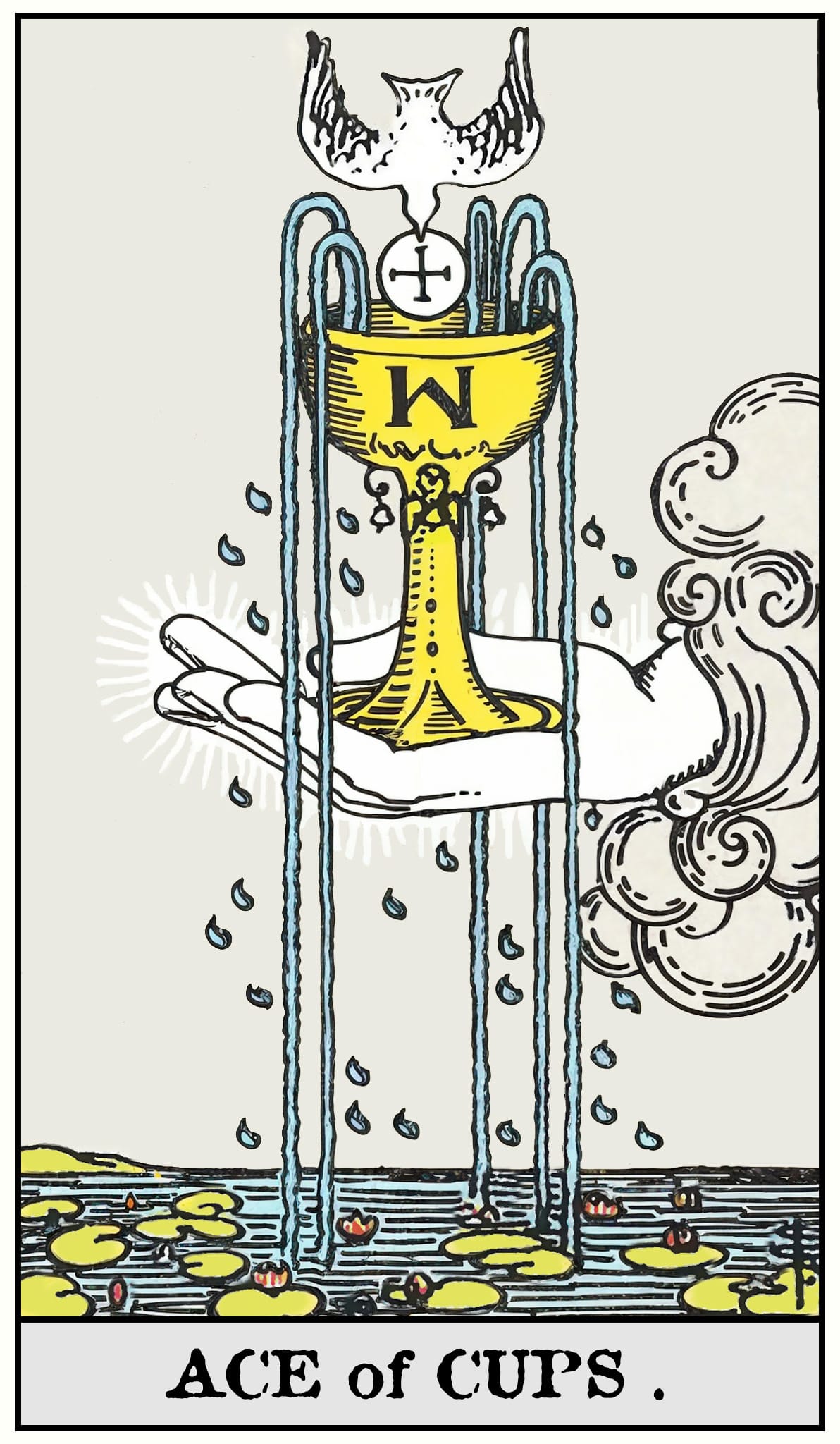
Ace of Cups
A hand emerges from a cloud, holding a chalice in full overflow — five streams descending, a dove arriving at the rim, a still pool below scattered with lotuses.
The Ace of Cups names the return of emotional permeability: not a specific feeling but the capacity for feeling, arriving in a life that had grown thin around its absence. Something opens. The defences that had been doing their job come down without warning. What the card asks — and this is its demand — is that the opening be received without being immediately sealed into a known shape.
The heart's sudden reopening — before it has chosen what to feel for
The Ace of Cups arrives as a specific kind of susceptibility: a face across a room, a piece of music that undoes you publicly, an unexpected tenderness toward a stranger — the defences of months coming down without warning. This is not yet any particular emotion. It is the capacity itself, returning. In shadow, the Ace is the cup spilled before it is drunk: the person who fears emotional openness as much as they crave it will translate this arrival into immediate action — a rushed commitment, a declaration made before the feeling has been given time to find its actual form.
The unconscious sending a courier — water that is simultaneously source and offering
The Ace of Cups draws from two Major Arcana: the High Priestess's still reflective pool and the Empress's generative river — interior knowing and outward nourishment held in the same vessel before they have differentiated. Jung would describe this as the unconscious sending an emissary before the conscious mind has agreed to receive one. The dove at the rim is the signal. The suit of Cups will spend ten cards asking one question: whether feeling can be allowed to move through a person without either drowning them or being sealed shut.
The complete three-layer reading for all 78 cards — including the full psychological and archetypal layers — is in The Pocket Guide →
The cup that cannot be received without immediately being translated into contract.
Shadow TrapThe openness that has been so rarely safe that the moment it arrives, the person converts it into an agreement — a relationship defined before it is understood, a commitment made before the feeling has been allowed to remain liquid.
Shadow GiftThe capacity to hold the Ace's opening without resolving it prematurely — to remain in the unformed availability long enough for what is arriving to declare its own shape.
Shadow readings for each card, by suit, are gathered in The Pocket Guide →
We do not read a reversal as an opposite; following Pollack, a turned card is the same energy blocked, withheld, or redirected — not inverted into its negation. A reversed Ace of Cups often marks the emotional permeability suppressed — the opening that has been recognized and immediately closed, the feeling that arrived and was reasoned away before it could make any demands.
Why Apocrypha Does Not Read Reversals as Opposites →Sixty-three symbols across the full deck — cross-referenced by card and meaning — are mapped in The Symbol Dictionary →
What in you has gone dry without your fully noticing — and what would it cost you to admit the thirst rather than continuing to manage the drought?



The Ace of Cups is most often read as good news about love or connection incoming, and in its outer register that reading is not wrong. The more interior reading asks about the capacity beneath the specific feeling — whether the person receiving this card has been emotionally available to their own life or has been managing that availability carefully from a distance. The card is not predicting a romantic arrival. It is describing the return of a permeability that has been absent, and asking what will be done with the reopening before it closes again.