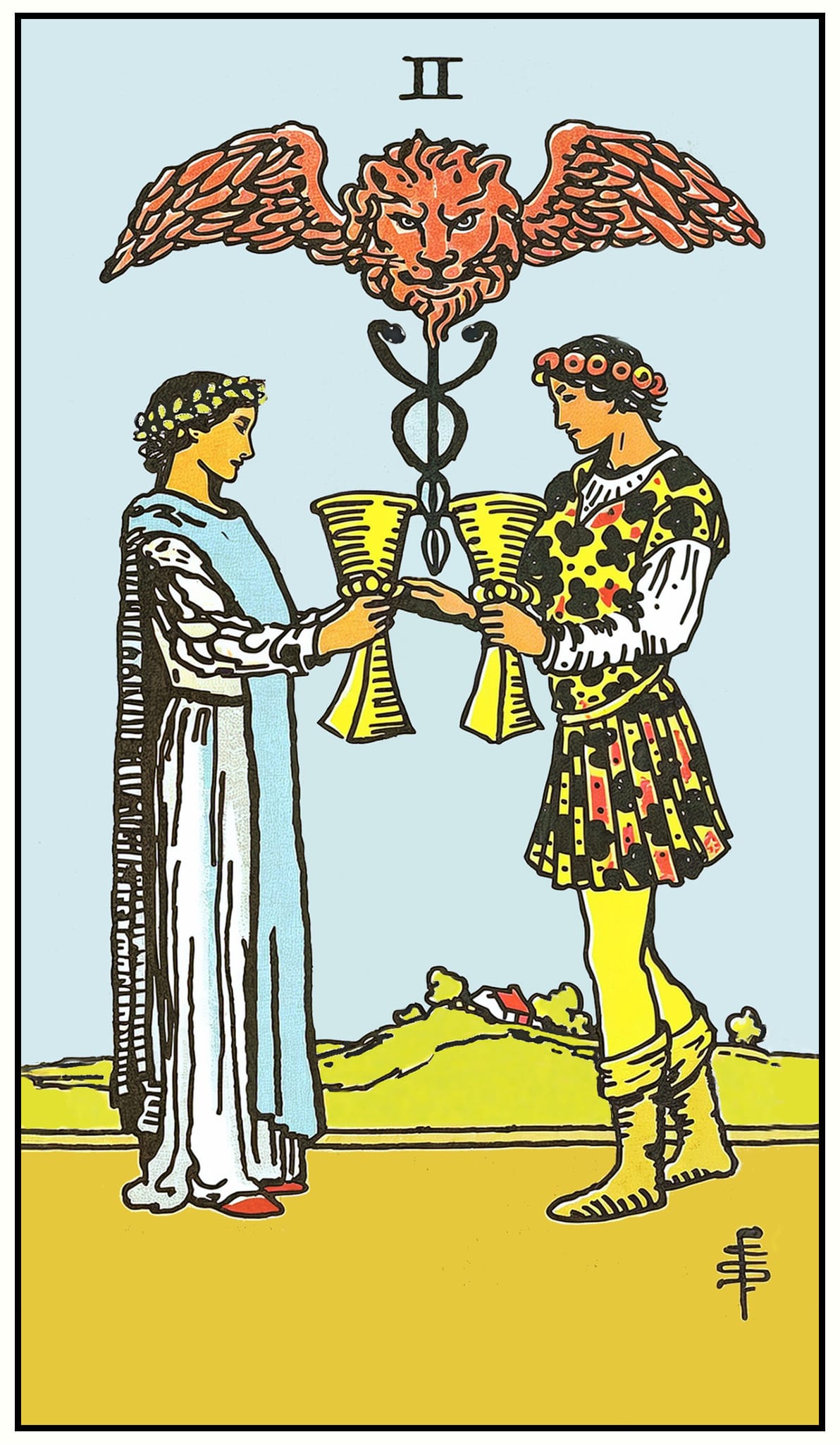
Two of Cups
A man and a woman face each other with cups raised in exchange, the caduceus of Hermes rising between them — the meeting poised at the exact moment before the cups change hands.
The Two of Cups names the encounter that matches: the meeting in which two separate interiors briefly recognize each other as capable of genuine reciprocity. This is not the projection that dresses a stranger as a saviour. It is the rarer event — mutual recognition between two people who remain two people, which is the only configuration from which a real third thing can grow.
The exchange that requires two complete interiors — not one extended across two bodies
The Two of Cups arrives as the appearance of the genuine meeting: a lover, a collaborator, a friend, a teacher — the figure who recognizes something in you that you had not clearly named in yourself. Both cups are held, both offered. The exchange is the point. In shadow, the Two becomes the doorway to fusion: the person terrified of separateness who uses this card's warmth to dissolve into another, substituting the other's interior for their own. The caduceus warns against this with precision — the serpents entwine but do not merge. Two complete interiors are the precondition of what this card promises.
The first relational gesture of the suit — and the first moment at which projection becomes possible and can also be withdrawn
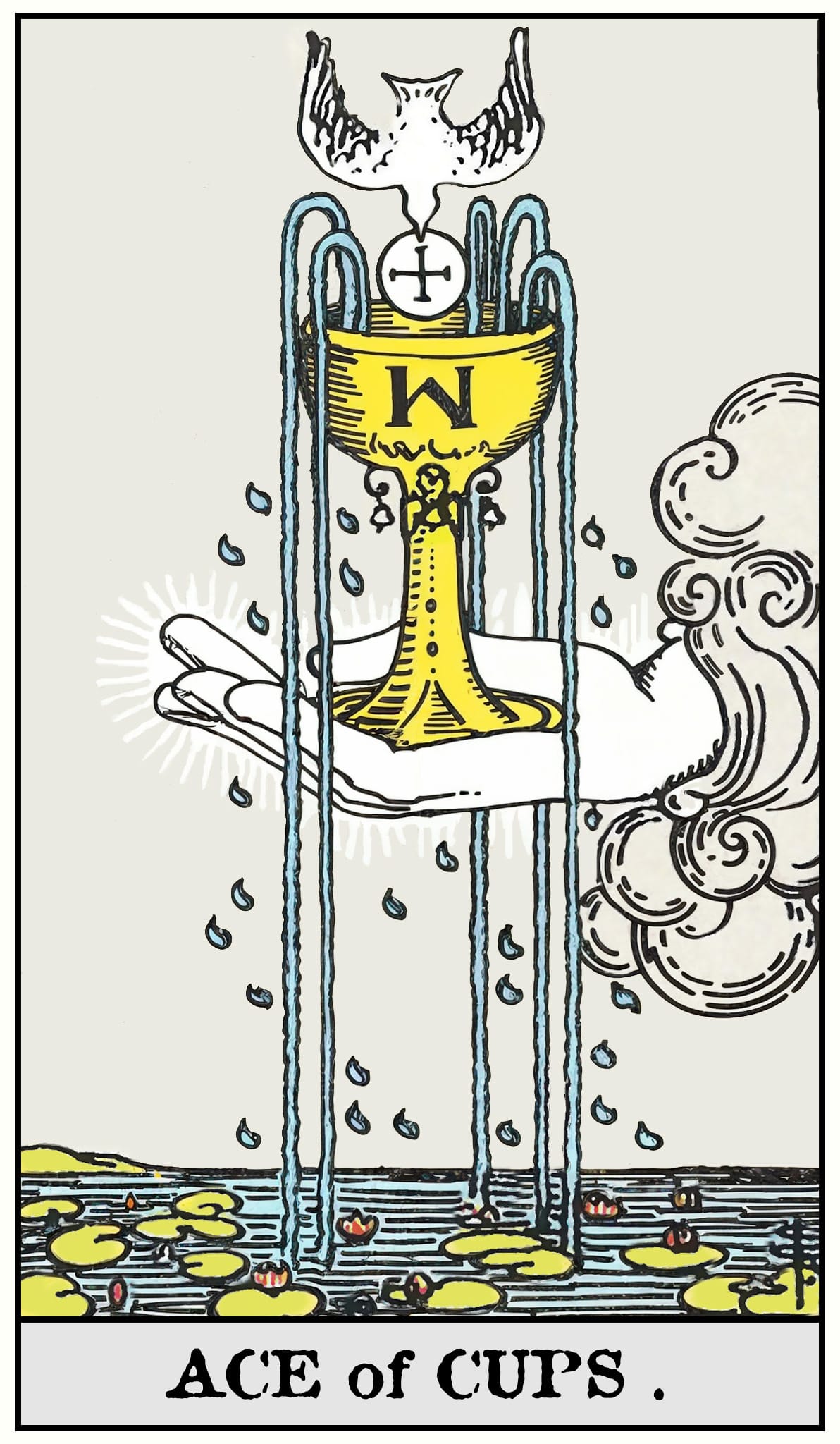
The Ace's solitary permeability has now encountered a second openness. The suit here makes its first true relational move. Pollack notes that the Two depicts a symmetry rarer in actual human encounter than the romantic tradition acknowledges — most meetings are asymmetric, one party more invested, less seen. The genuine Two is the card of the meeting between actual equals. Jung would describe it as the moment when the other becomes real enough to push back one's own projections, which is precisely what distinguishes a genuine meeting from an elaborate interior monologue with a cooperating body.
The complete three-layer reading for all 78 cards — including the full psychological and archetypal layers — is in The Pocket Guide →
The meeting that dissolves rather than connects does not become the Two — it replaces it.
Shadow TrapThe relationship used as escape from one's own interior — the two-cups configuration sought not for genuine meeting but for the relief of no longer having to be alone with oneself.
Shadow GiftThe capacity to remain two — to let the genuine meeting deepen without losing the separateness that makes the depth possible in the first place, and without which no real third thing can emerge from the exchange.
Shadow readings for each card, by suit, are gathered in The Pocket Guide →
We do not read a reversal as an opposite; following Pollack, a turned card is the same energy blocked, withheld, or redirected — not inverted into its negation. A reversed Two of Cups often marks the withheld recognition — the meeting that could occur and is being prevented, whether by one party's reluctance to offer the cup fully, or by the asymmetry that makes the exchange formal rather than genuine.
Why Apocrypha Does Not Read Reversals as Opposites →Sixty-three symbols across the full deck — cross-referenced by card and meaning — are mapped in The Symbol Dictionary →
Which of your relationships have you been using as a way to escape yourself rather than as a way to be genuinely met — and what would change if you required the meeting to go both ways?
The Two of Cups is most often read as confirmation of connection incoming or present. The more precise reading asks whether the configuration is genuinely mutual or whether it is being experienced as mutual because mutuality feels better than its alternative. The card describes a specific and demanding thing: two complete interiors in genuine exchange. That description can serve as a diagnostic as well as a prediction — not "is connection present?" but "is this the kind of connection this card describes?"