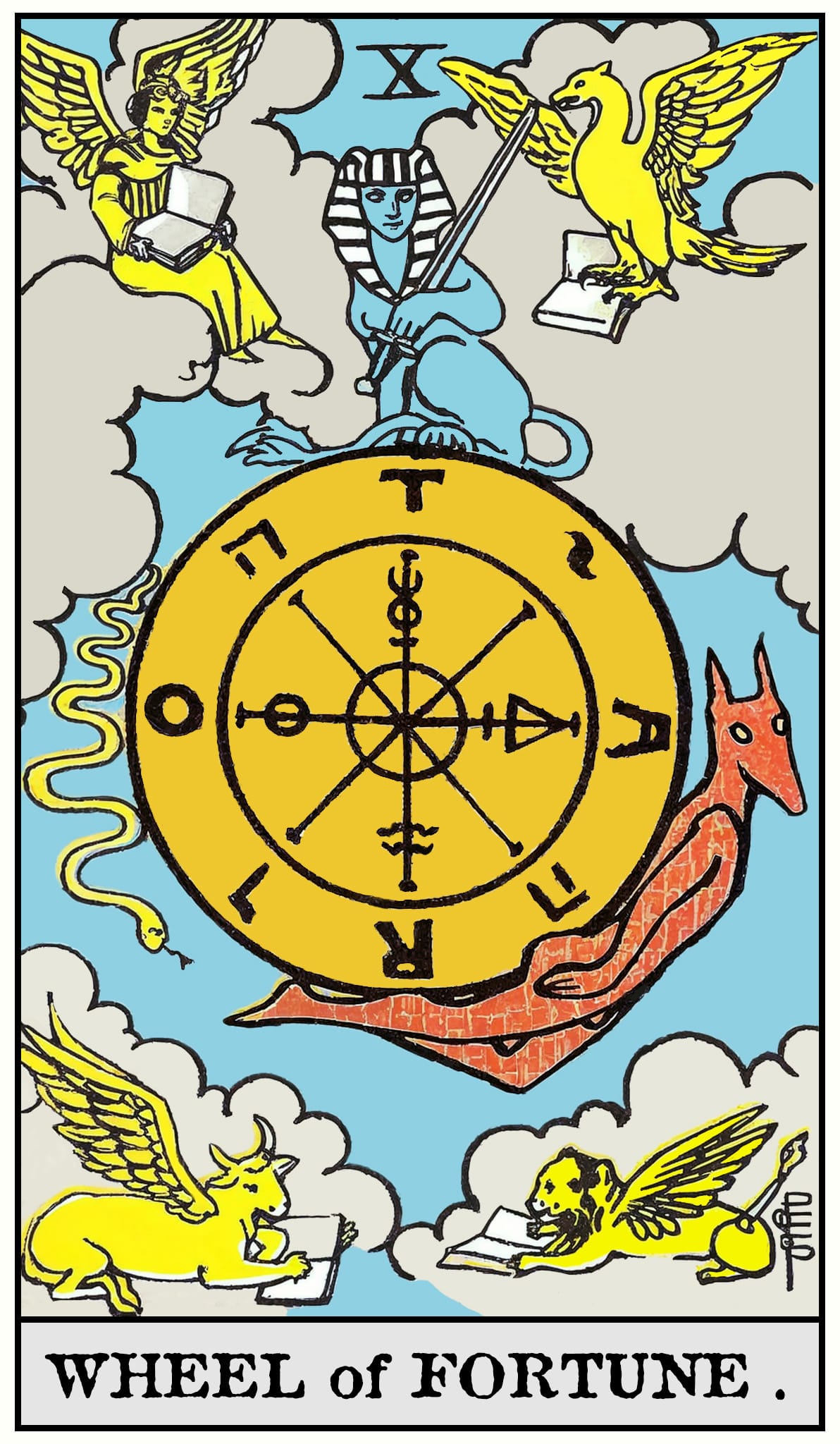
Wheel of Fortune
A great wheel turns at the centre of the image with figures rising and falling on its rim, four winged creatures reading in the corners of the sky — change as a structure, not an event.
The Wheel of Fortune names the turn of forces beyond the self's authorship or control. It is the deck's central card and it does not depict a person. What it depicts is the condition beneath every person: that the situations of a life are not entirely the product of what one has willed or deserved, that the wheel turns, and that the task is to find the standpoint from which the turning can be borne rather than explained away.
The turn that is already happening, regardless of whether it was requested
The Wheel appears when the situation is in motion: a door closing or opening, a phase ending or beginning. The card does not promise the change is welcome. It announces that change is the actual condition of things, and that a self operating as if change were optional is being corrected. The Wheel is morally neutral — the same turning that raises the rising figure sends the descending figure down. In its shadow, the Wheel becomes the alibi of passivity: the belief that everything is fortune, nothing is choice. The sphinx at the top holds a sword — the sword of conscious decision — precisely because at the top of the wheel there is, briefly, the capacity to act with awareness of where one stands.
The limit of the constructed self's assumption of authorship
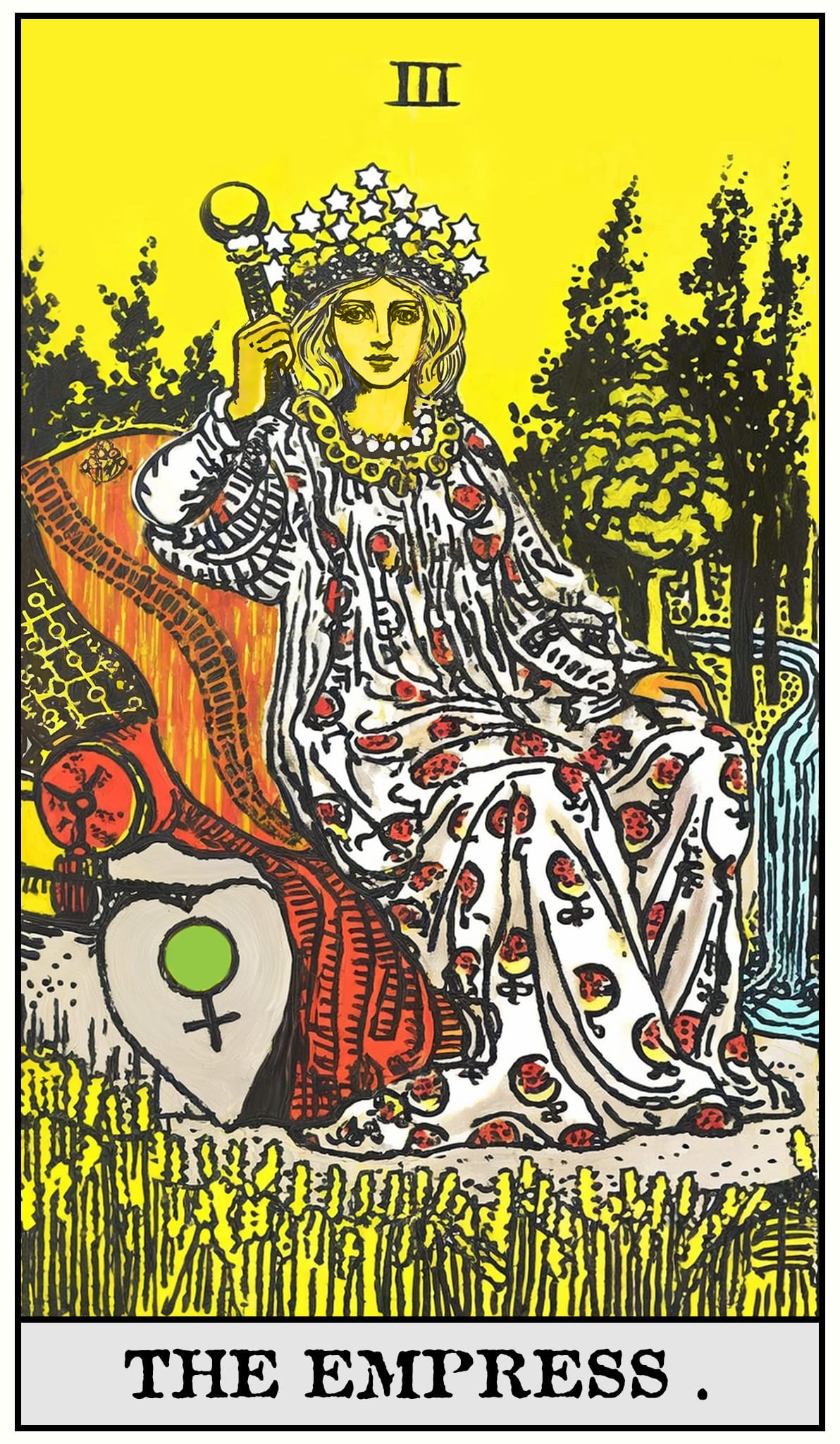
The Wheel is placed at the centre of the second row because it is the moment the constructed self encounters the boundary of its own control. The Magician thought the elements were tools to be directed. The Chariot thought the will could hold the sphinxes in formation indefinitely. The Wheel announces, without apology, that this was never entirely true. There are forces — biological, historical, accidental — that the self did not generate and cannot override. To recognize this is not defeat; it is a form of precision about what a self actually is and what it is not. The vertical line — Empress at III, Wheel at X, Star at XVII — makes the deck's deepest teaching about life: that it gives, that it turns, and that it gives again.
The complete three-layer reading for all 78 cards — including the full psychological and archetypal layers — is in The Pocket Guide →
The card of change misused is the card of permanent deferral.
Shadow TrapThe turning of the wheel taken as evidence that nothing one does matters — fortune as the cover story for the refusal to act with the awareness available at the top of the turn.
Shadow GiftThe capacity to consent to one's own contingency — to recognize that neither the rising nor the falling was personally deserved, and to act clearly within that recognition rather than despite it.
The complete shadow reading — trap, gift, and the practice of integration — for all 22 Major Arcana is in The Shadow Archetype Reference →
We do not read a reversal as an opposite; following Pollack, a turned card is the same energy blocked, withheld, or redirected — not inverted into its negation. A reversed Wheel often marks resistance to a change that is already happening — the attempt to hold a position stable past the point where the wheel has already moved it, the exhaustion of insisting on a version of the situation that the situation itself has departed.
Why Apocrypha Does Not Read Reversals as Opposites →Sixty-three symbols across the full deck — cross-referenced by card and meaning — are mapped in The Symbol Dictionary →
Where in your life are you at the top of the wheel right now — with the most clarity and the least time? And where are you at the bottom, or partway down, still trying to explain the fall as a personal failure rather than as the part of the turn that was always coming?
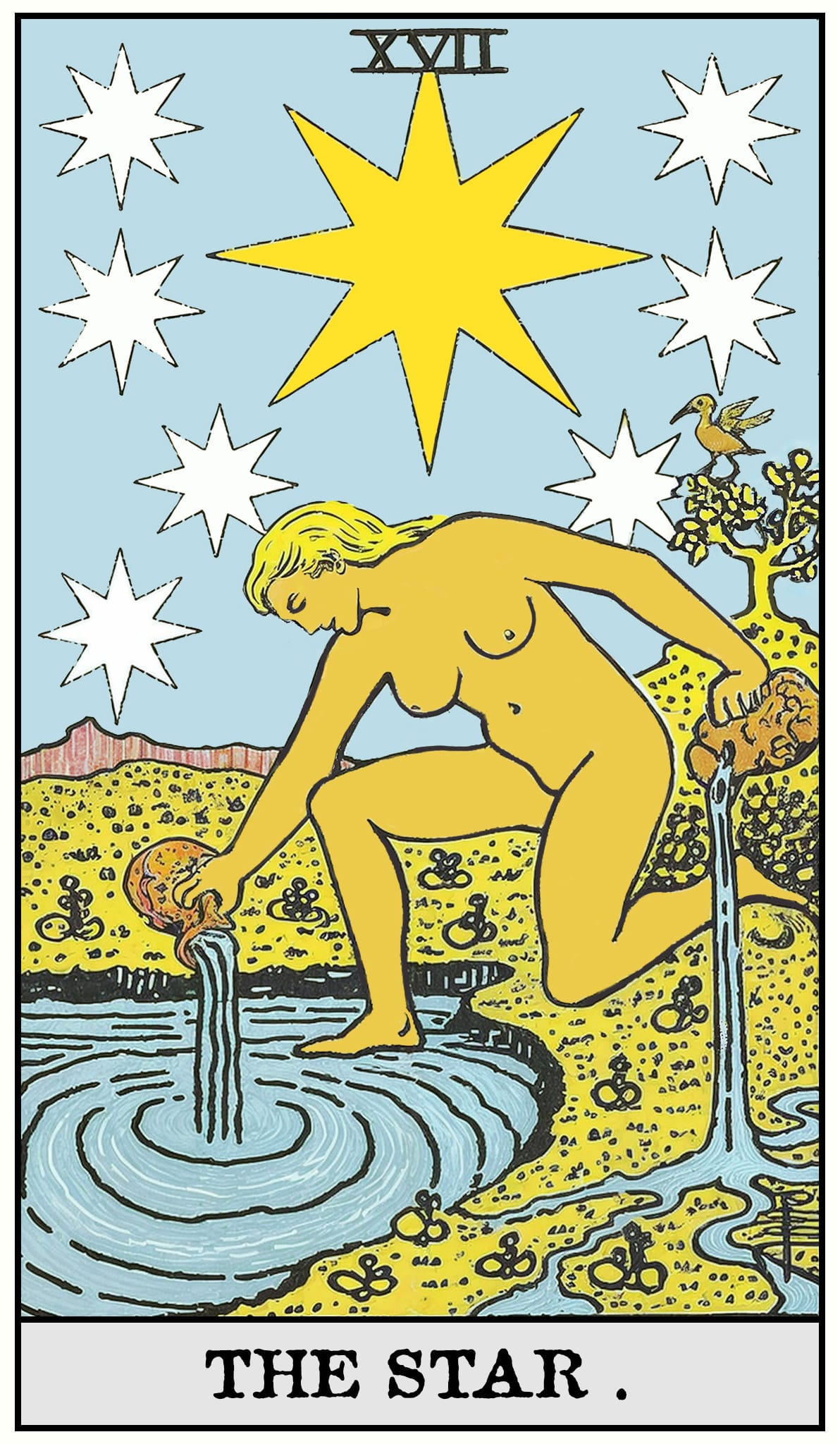
The Wheel is most often read as either good luck or bad luck incoming, depending on the surrounding cards. This reading is too thin. The card's real content is about the self's relationship to contingency — the degree to which one is operating under the assumption that the conditions of one's life are primarily the product of one's own deserving. The card challenges that assumption regardless of whether the turn in question is rising or falling.