Two of Swords
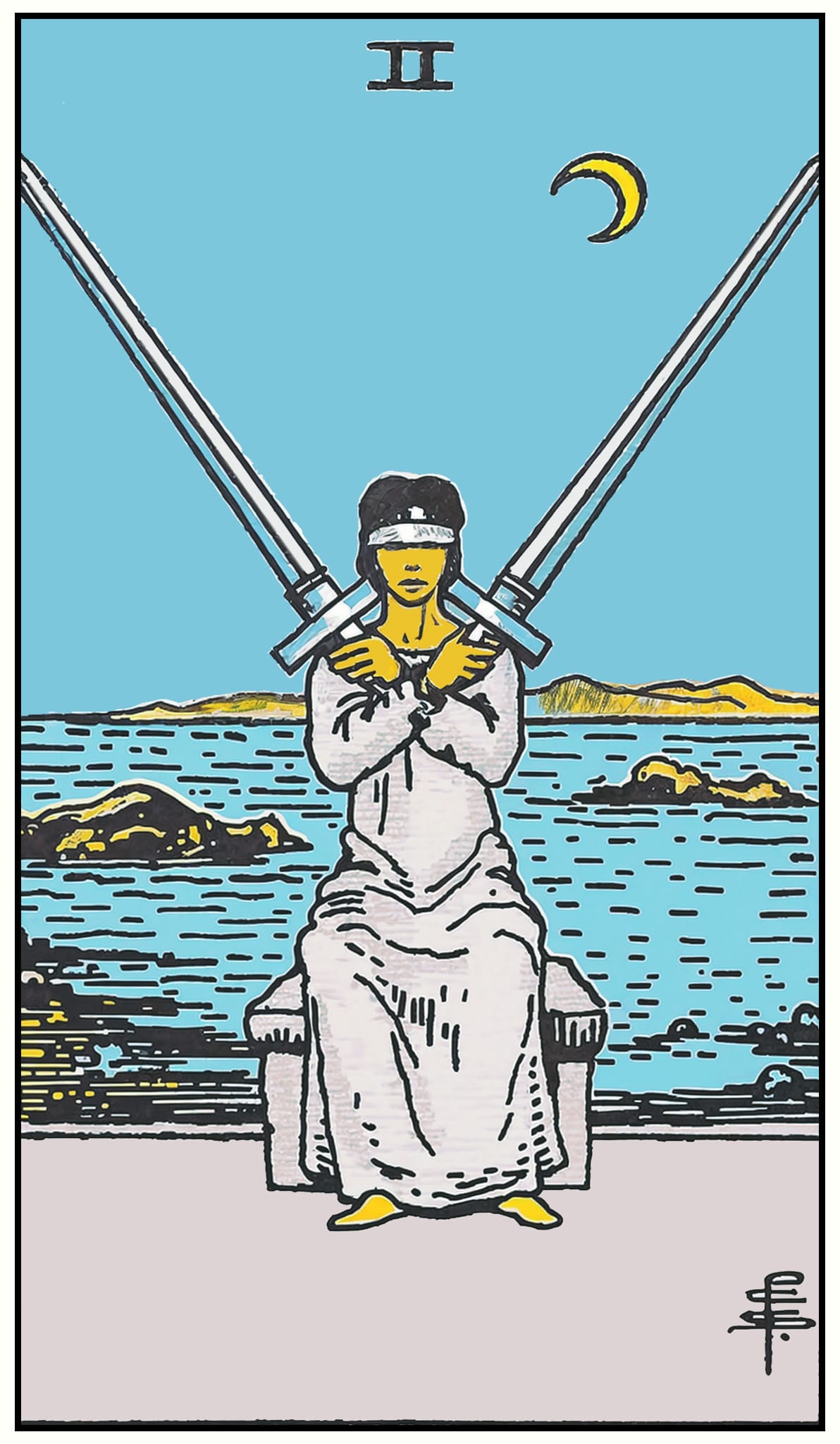
A blindfolded woman sits before a still sea with two swords crossed at her chest, arms holding both — the balance maintained but the blindfold required, the crescent moon behind her, rocky outcrops breaking the water's surface.
The Two of Swords names the decision not made — not because clarity is unavailable but because clarity would require removing the blindfold, and the blindfold is serving a purpose. The swords are held at great muscular cost. The balance is genuine. The card asks what is being managed by the balance, and what would have to be seen if the covering were removed.
The sea behind her is calm. The elements are present. She cannot see them.
The Two of Swords is the card of the person who has arranged a balance that prevents movement in either direction and is calling the arrangement wisdom. Both positions are held. Both are held at cost. The blindfold is not impartiality — impartiality does not require covering the eyes. In shadow, the Two becomes the comfort of impasse: the person who has mistaken the experience of holding two irreconcilable positions for the virtue of seeing both sides, and has organized their life around never having to choose either — because choosing requires removing the blindfold, and what is behind the blindfold is why the balance was constructed in the first place.
The mind's first capacity for self-obstruction — the gap between what is known and what will be admitted
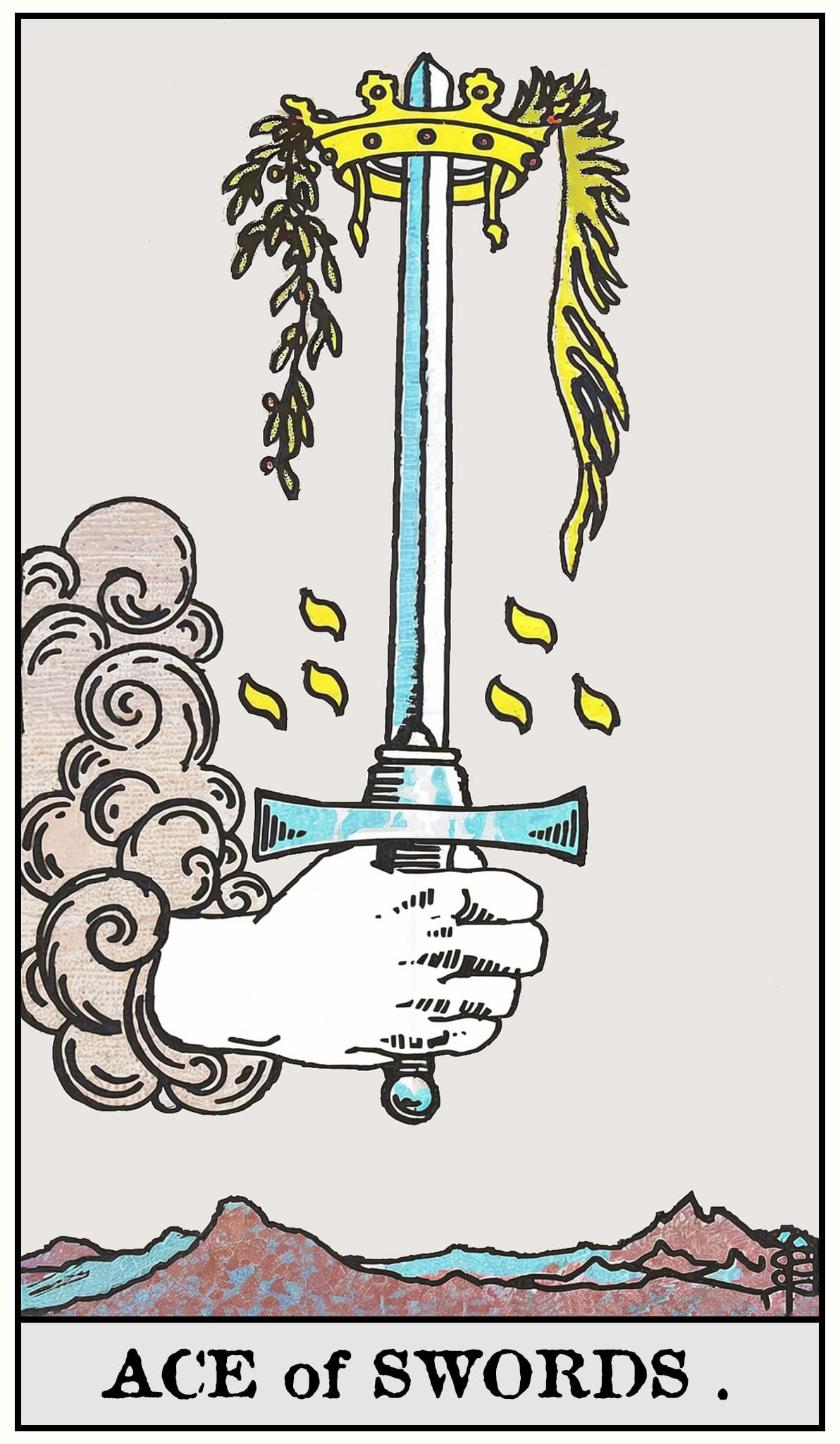
The Ace's clarity is already gone — blocked not by external opposition but by an internal arrangement that prevents movement. The crescent moon behind the figure is the unconscious operating in darkness: the part of the person that knows exactly which sword to lower and has decided not to communicate this to the part holding both. Pollack identifies the Two as the suit's first map of the gap between what we know and what we will acknowledge knowing — and that gap is the entire terrain of the suit's remaining arc.
The complete three-layer reading for all 78 cards — including the full psychological and archetypal layers — is in The Pocket Guide →
The decision that has already been made and is being managed into the shape of a question.
Shadow TrapThe stalemate maintained because choosing would require seeing — and what would be seen, if the blindfold came off, is a clarity the person is not yet prepared to act on and is therefore not yet prepared to have.
Shadow GiftThe recognition that the balance is being maintained at genuine cost — that the muscular effort of holding two swords crossed at the chest is ongoing and finite — and that the decision not to decide is itself a decision whose consequences are accumulating.
Shadow readings for each card, by suit, are gathered in The Pocket Guide →
We do not read a reversal as an opposite; following Pollack, a turned card is the same energy blocked, withheld, or redirected — not inverted into its negation. A reversed Two of Swords often marks the forced removal of the blindfold — the impasse broken not by the figure's own decision to look but by external circumstance making the maintained balance impossible to continue, the stalemate resolved by the situation rather than by the person inside it.
Why Apocrypha Does Not Read Reversals as Opposites →Sixty-three symbols across the full deck — cross-referenced by card and meaning — are mapped in The Symbol Dictionary →
What decision have you been calling difficult when you already know what it requires — and what is the blindfold protecting you from having to do, or to lose, or to become?
The Two of Swords is most often either read as genuine uncertainty — the situation is unclear, more information is needed — or as a warning about self-deception. The precise reading asks about the distinction between these, which the person receiving the card is usually better positioned to make than the reader. The relevant question is not whether the uncertainty is real but whether it is the same uncertainty it was three months ago, and whether it has been tended or maintained. Genuine uncertainty moves. The Two of Swords does not move.